










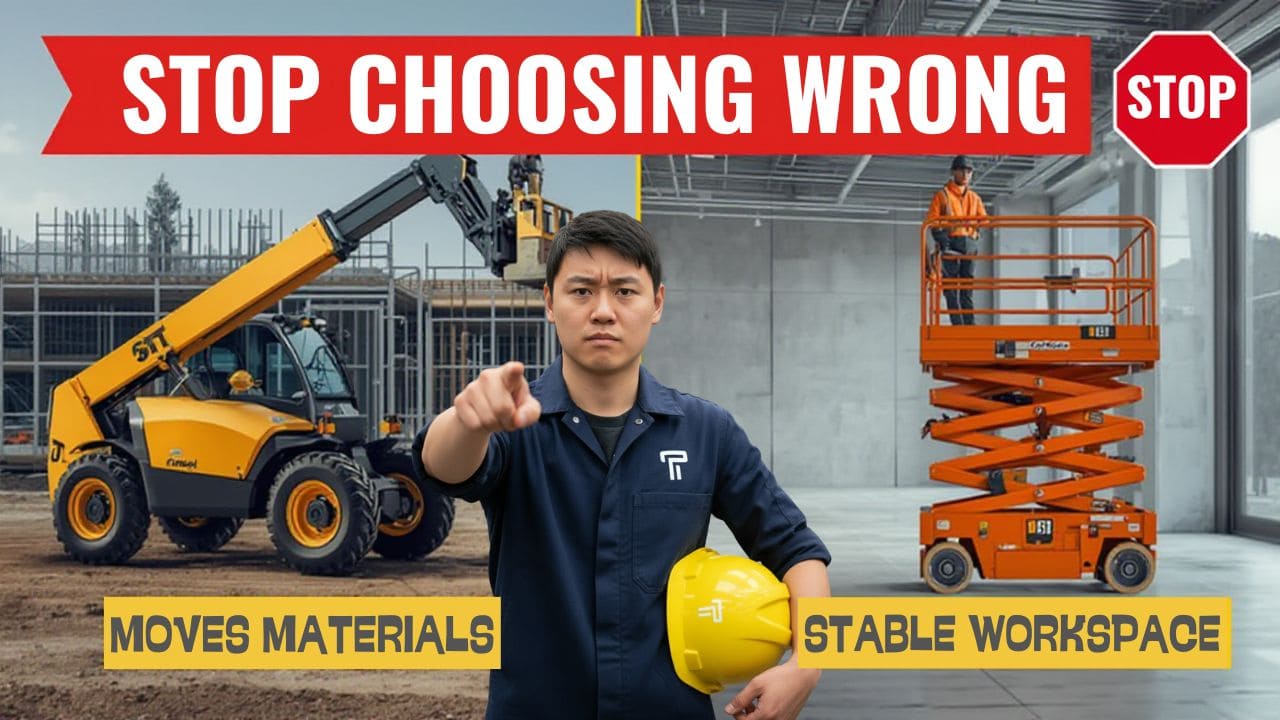
Telehandler vs. Scissor Lift: How to Choose the Right Tool for Your Height Work
When you need to get something done at height, the question isn’t simply “How high do we need to go?”—it’s “What exactly are we doing up there?” If you’re like most contractors or rental managers, you’ve probably faced that moment where both a telehandler and a scissor lift seem like they could work. But once you look closely, the differences start to matter.
Think of this as a conversation across the jobsite planning table—practical, straightforward, and focused on helping you pick the machine that will actually make your day easier.
1. What Each Machine Is Really Designed to Do
If you peel back the technical details, the simplest distinction is this:
A telehandler is designed to lift, carry, and position heavy materials. That’s its DNA. The telescopic boom gives you both vertical and horizontal reach, allowing you to put loads where other machines simply can’t. It can carry people with the right platform, but that’s not its main job.
role1
A scissor lift, on the other hand, exists to give you a stable place to work at height. Straight up, straight down. No outreach. No complexity. If your priority is keeping several workers steady and comfortable while they handle tools and light materials, this is the machine you feel at home on.
vertical2
Keeping this difference in mind will help you make clearer decisions as you plan your work.
2. Telehandler Overview: For When You Need Strength and Reach
Capacity and height
If you often need to lift full pallets or structural materials, you already know why telehandlers matter. Most operate comfortably in the 5,000–12,000 lb class and reach around 40–55 ft, depending on the model.
capacity3
If you’ve ever tried to feed materials into a second-floor opening or across a slab that’s still too soft for other lifts, a telehandler’s boom feels like the perfect problem-solver.
Reach and placement
One thing you’ll notice on site is how often work happens not directly above where a machine can park. Telehandlers solve this. Their booms push forward, not just up, giving you reach across trenches, barriers, or rebar grids.
reach4
So if you often find yourself thinking, “I just need this load another two meters in,” you’re already describing a telehandler application.
Terrain and flexibility
Telehandlers thrive where the ground isn’t finished—mud, gravel, or partly graded surfaces. The large tires and high clearance keep them moving even when nothing else can.
terrain5
And because you can swap forks, buckets, jibs, or platforms, you get a machine that can jump between tasks without calling something else in.
3. Scissor Lift Overview: For Stable, Efficient Work at Height
Vertical access only
A scissor lift won’t reach out or over anything. That simplicity is intentional. When you want workers to have a broad, steady workspace at a precise height, nothing beats a scissor lift.
mechanism6
Capacity and height
Most scissor lifts carry under 1,000 lb, which is plenty for workers, tools, and modest materials. Platform heights commonly fall between 30–50 ft, making them ideal for facility maintenance, interior construction, and façade work on level surfaces.
platform7
If you often have two or three people working together at height, the platform space alone makes a scissor lift the comfortable choice.
Environment and power
Electric models shine indoors—quiet, clean, and maneuverable. Rough-terrain versions handle outdoor slabs and compacted surfaces but still require level ground.
power8
4. Side-by-Side Comparison
Here’s a quick way to picture the differences when you are choosing equipment:
| Feature / Requirement | Telehandler | Scissor Lift |
|---|---|---|
| Primary role | Lifting and placing heavy materials | Supporting workers and tools at height |
| Movement | Vertical and horizontal reach | Vertical only |
| Typical capacity | ~5,000–12,000 lb | Under ~1,000 lb |
| Typical height | ~40–55 ft on common models | ~30–50 ft |
| Platform experience | Narrower, more dynamic movement | Wide and stable workspace |
| Terrain capability | Excellent on soft or uneven ground | Best on level, prepared surfaces |
| Versatility | High—attachments add multiple functions | Focused on vertical access |
| Indoor suitability | Limited | Excellent (electric models) |
| Operator complexity | Higher (load charts, reach limits) | Lower (simple up/down operation) |
5. When Each Machine Fits Your Work Better
When a scissor lift is the right call
Choose a scissor lift when your real need is workspace, not reach. It works best when:
- Workers need a stable platform for extended periods
- The ground is level
- The job is indoors or on finished surfaces
- You’re installing, maintaining, or finishing at height
If you’ve ever felt cramped or unstable in a suspended platform, you’ll appreciate how much easier a scissor lift makes your day.
use-case9
When a telehandler delivers more value
Pick a telehandler when you’re moving heavy materials and height is only part of the challenge. It excels when:
- Loads need to be placed onto decks, roofs, or upper floors
- The ground isn’t ready for other lifts
- Access is blocked by obstacles
- One machine needs to do multiple tasks
If you often think, “We need to get materials up there before crews start,” that’s a telehandler moment.
task10
6. A Practical Way to Decide
The simplest formula tends to hold true across most projects:
- If you need a place for people to work, choose a scissor lift.
- If you need to move and place heavy materials, choose a telehandler.
Once you match the machine to the real task—not just the height—you’ll start seeing smoother workflows, fewer delays, and better use of your equipment budget.
References
-
Overview of functional differences between telehandlers and personnel lifts. ↩
-
Explanation of scissor lifts as vertical-only access equipment. ↩
-
Summary of common telehandler capacity ranges. ↩
-
Notes on telehandler boom reach and placement characteristics. ↩
-
Description of rough-terrain suitability of telescopic handlers. ↩
-
Overview of scissor-lift platform design and stability. ↩
-
Typical platform height and load specifications for scissor lifts. ↩
-
Discussion of electric scissor lift characteristics and environments. ↩
-
Examples of vertical-access applications suited to scissor lifts. ↩
-
Considerations for material handling and reach in elevated work. ↩