










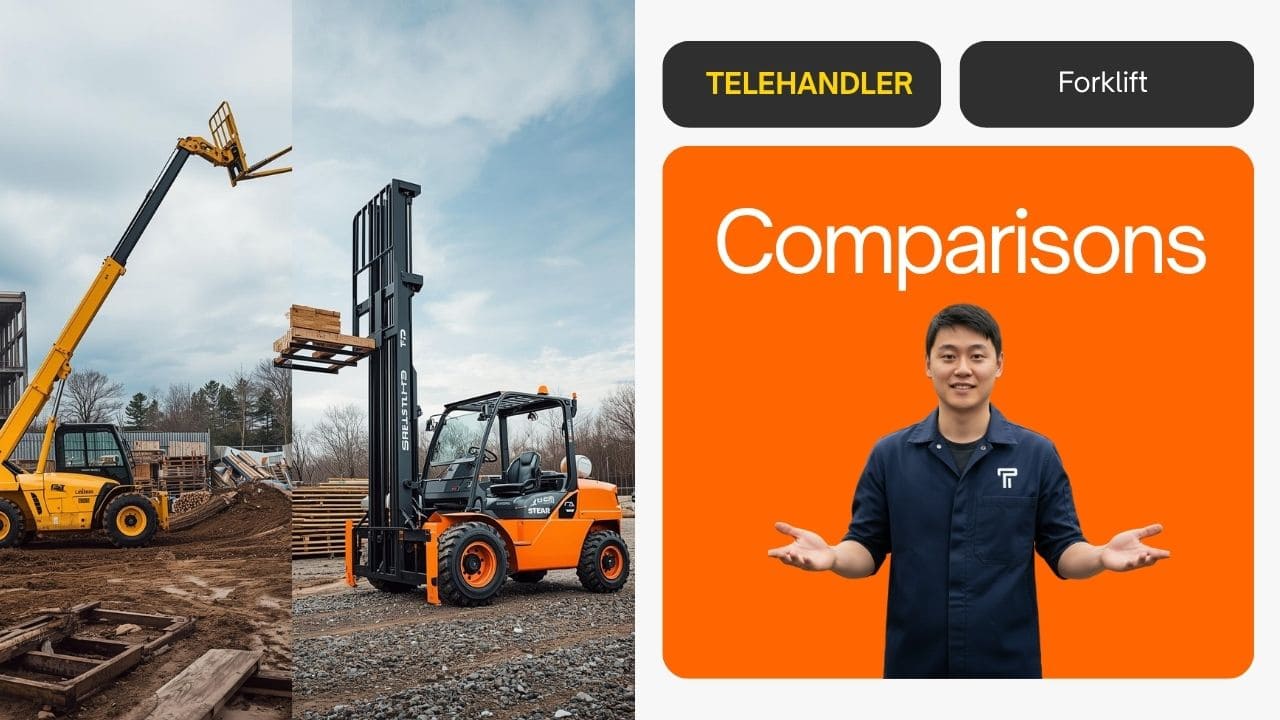
Telehandler vs. Rough Terrain Forklift: Key Differences Explained
Telehandlers and rough-terrain forklifts often work in the same harsh outdoor environments—construction sites, industrial yards, farms, and material-handling depots where the ground is uneven and tasks change quickly. Both machines move heavy loads, both run on large off-road tires, and both operate where standard forklifts simply can’t.
But despite those similarities, they are built for fundamentally different purposes, and choosing the right one has a major impact on safety and productivity.
Below is a clear, practical comparison that reflects how these machines perform in real-world field conditions.
1. Lifting Mechanism & Reach
Telehandler
A telehandler relies on a telescopic boom1 that lifts both vertically and forward. This allows operators to place loads on elevated structures, reach across trenches, or set materials behind barriers. Typical lift heights for mainstream models often exceed 40 feet, giving you placement capability far beyond what a mast-type forklift can reach.
Rough Terrain Forklift
A rough-terrain forklift uses a vertical mast2, designed for clean up-and-down movement. Depending on the mast design, typical lift heights fall in the 10–20 ft range—ideal for truck loading and ground-level stacking, but not for high-reach placement.
Why it matters:
If your job requires placing loads at height—or reaching out, over, or into structures—the telehandler is the only tool that can do it.
If you primarily lift, move, and stack on rough ground, the mast-type forklift is simpler and more efficient.
2. Attachments & Versatility
Telehandler
Telehandlers accept a wide variety of multi-purpose attachments3—forks, buckets, truss booms, winches, jibs, and personnel platforms—turning the machine into a versatile tool that adapts quickly as job demands change.
Rough Terrain Forklift
A rough-terrain forklift focuses on pallet handling. While some units can accept basic fork variations, their overall attachment options4 are far more limited than telehandlers.
In practice:
If your work changes hour-to-hour—unloading trucks in the morning, placing loads in the afternoon—the telehandler’s flexibility is a major advantage.
If your tasks are repetitive and predictable, the forklift’s simplicity is all you need.
3. Terrain Adaptability & Maneuverability
Telehandler
Telehandlers handle uneven ground well, but their longer chassis and higher center of gravity mean you must manage stability at long reach5 carefully—especially with the boom extended. Some models use stabilizers, while others rely exclusively on frame design.
Rough Terrain Forklift
Rough-terrain forklifts offer excellent terrain capability6 thanks to their shorter mast, compact frame, and off-road tires. They are often more maneuverable in tight yards and outdoor material depots.
What this means for you:
A telehandler excels where reach is important;
A rough-terrain forklift excels where constant travel and tight turning matter.
4. Typical Use Cases & Operational Efficiency
Telehandler
Telehandlers shine when tasks involve high-reach placement7—feeding upper floors, placing roofing materials, or working behind obstacles. They are common on construction sites where height and reach are essential.
Rough Terrain Forklift
Rough-terrain forklifts perform best in ground-level material handling8, such as lumber yards and outdoor warehouses, where they move heavy loads repeatedly over uneven surfaces.
Rule of thumb:
Telehandler = placement
Rough terrain forklift = transport
5. Cost & Maintenance
Telehandler
Because of its complex hydraulics and boom structure, a telehandler generally carries higher ownership cost9.
These advanced systems also result in more demanding maintenance requirements10, and operators need more training to safely manage load charts and boom extension.
Rough Terrain Forklift
A rough-terrain forklift uses a simpler mechanical layout with fewer high-pressure hydraulic components, leading to lower maintenance requirements11 and a more economical ownership profile—especially when most work involves repetitive pallet movement.
Comparison Table
| Feature | Telehandler | Rough Terrain Forklift |
|---|---|---|
| Lift mechanism | Telescopic boom | Vertical mast |
| Reach capability | Vertical + forward reach | Vertical only |
| Typical lift height | 40+ ft | 10–20 ft |
| Attachments | Extensive options | Limited options |
| Versatility | High | Low to moderate |
| Terrain handling | Strong; caution required at long reach | Excellent on uneven ground |
| Maneuverability | Lower in tight spaces | Very good in compact outdoor areas |
| Best use | Material placement at height | Ground-level lifting & transport |
| Cost & maintenance | Higher | Lower |
Professional Guidance
Choose a Telehandler if you need:
- To place loads at height or across obstacles
- Versatility through multiple attachments
- Access into upper floors or recessed structures
- One machine that adapts as tasks change
Choose a Rough Terrain Forklift if you need:
- Reliable pallet movement over rough ground
- High stability during travel
- Tight maneuverability in outdoor yards
- Lower long-term operating cost
On many large jobsites, both machines complement each other rather than compete.
Reference
-
Overview of telescopic boom design and reach characteristics. ↩
-
Description of vertical-mast lifting principles and typical height range. ↩
-
Summary of telehandler attachment variety and versatility. ↩
-
Explanation of limited attachment compatibility on mast forklifts. ↩
-
Stability considerations for telehandlers working on uneven ground. ↩
-
Maneuverability and terrain adaptability of rough-terrain forklifts. ↩
-
Common telehandler applications involving reach and upper-level placement. ↩
-
Typical ground-level handling tasks for rough-terrain forklifts. ↩
-
Cost factors associated with owning and operating telehandlers. ↩
-
Maintenance considerations linked to telehandler system complexity. ↩
-
Simpler maintenance profile of rough-terrain mast forklifts. ↩