










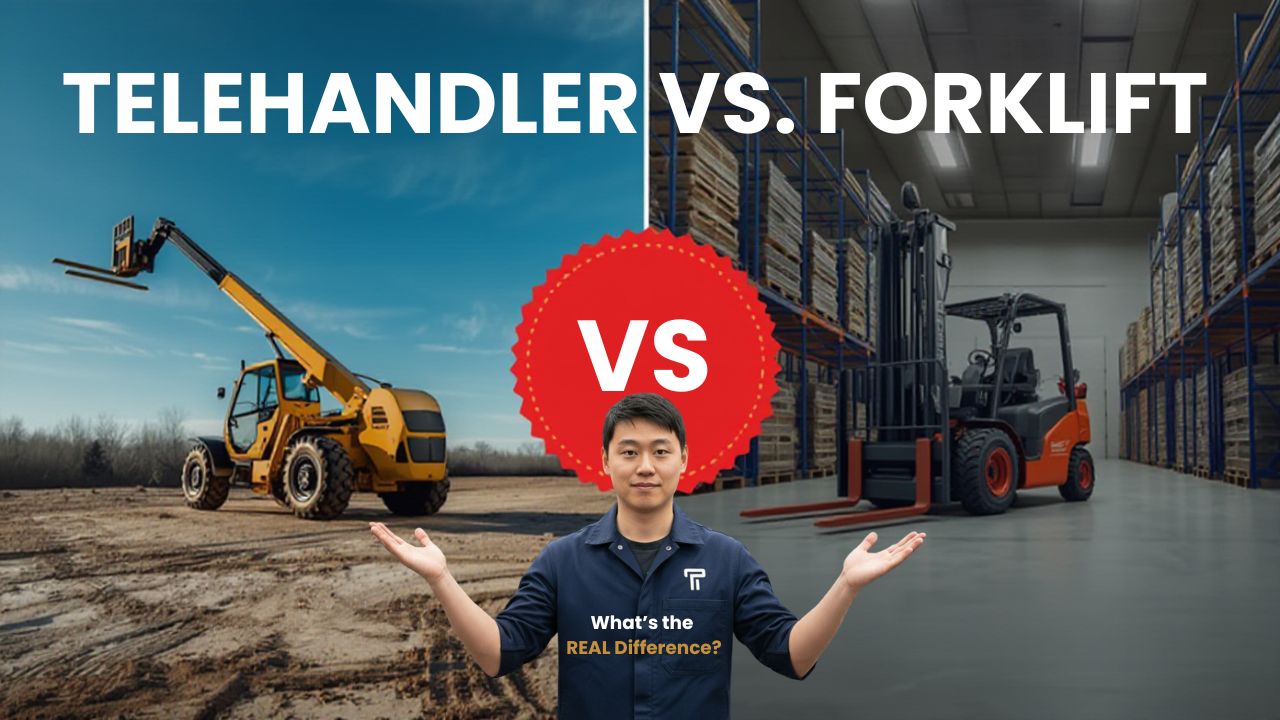
How Does a Telehandler Differ from a Forklift?
A telehandler and a forklift are both material-handling machines, but they serve different roles on the job site.
The key difference lies in how they lift: a telehandler uses a telescopic boom for extended reach and versatility telehandlers1, while a forklift relies on a vertical mast for straightforward, up-and-down movement mast forklifts2.
This design difference defines their capabilities, working environments, and the kind of work each machine does best.
Reach and Lifting Capabilities
The telescopic boom on a telehandler can extend both upward and forward telescopic boom3, allowing operators to lift materials over obstacles or place them at height — for example, on rooftops, upper floors, or scaffolding.
Most telehandlers can reach between 6 and 20 meters (20–65 ft) depending on model and configuration reach capacity4.
Forklifts, on the other hand, use a vertical mast that lifts loads straight up. Their reach is limited to about 3–7 meters (10–23 ft), ideal for stacking pallets or loading trucks inside warehouses forklift height5.
Maneuverability and Working Environment
Telehandlers are built for outdoor work. Their heavy-duty chassis, large tires, and four-wheel drive allow them to operate safely on rough or uneven terrain rough terrain6.
They also feature multiple steering modes — front-wheel, four-wheel, and crab — which give them the flexibility to navigate open sites and tight corners.
Forklifts, in contrast, are designed for smooth indoor surfaces.
Their compact frame and tight turning radius make them perfect for working in narrow aisles, loading docks, and production areas warehouse operation7.
While they lack off-road capability, they excel in efficiency and maneuverability indoors.
Attachment Versatility
One of the telehandler’s greatest strengths is its ability to use different attachments8.
A quick-coupler system allows operators to switch between forks, buckets, jibs, work platforms, and bale grabs in minutes, transforming the same machine for multiple tasks such as lifting, loading, or personnel access.
Forklifts, however, are more limited. They mainly use forks for pallet handling, with optional side-shifters or clamps for special loads forklift accessories9.
Load Placement and Stability
Telehandlers can lift and place loads at a distance, which is useful for reaching over obstacles or accessing upper structures load placement10.
Because the boom extends forward, stability changes with reach and angle. To maintain safety, telehandlers are equipped with load charts, stabilizers, and load-moment indicators (LMI) that monitor lifting conditions and warn the operator if the load approaches unsafe limits.
Forklifts, by contrast, keep their load close to the chassis. Their stability remains consistent, thanks to a low center of gravity and a fixed rear counterweight.
This makes forklifts simpler to operate but less flexible in variable terrain or high-reach tasks.
Summary Table
| Feature | Telehandler | Forklift |
|---|---|---|
| Lifting Mechanism | Telescopic boom 3 | Vertical mast 2 |
| Working Environment | Outdoor, rough terrain 6 | Indoor, smooth floors 7 |
| Attachment Options | Wide range, quick-change system 8 | Limited, mainly forks 9 |
| Reach / Height | Up to 20 m (65 ft) 4 | Up to 7 m (23 ft) 5 |
| Load Placement | Forward reach and high placement 10 | Vertical stacking only |
| Typical Use | Construction, agriculture, outdoor logistics | Warehousing, manufacturing |
Final Thoughts
Both telehandlers and forklifts move materials, but they’re built for different worlds.
A forklift is the right choice for efficient, repetitive pallet handling in tight indoor spaces.
A telehandler, with its telescopic reach, off-road design, and wide attachment range, is ideal for outdoor lifting, placement, and multi-purpose site work.
Simply put:
- A forklift lifts up and down.
- A telehandler lifts up, out, and beyond — delivering reach, versatility, and stability across the toughest environments.