










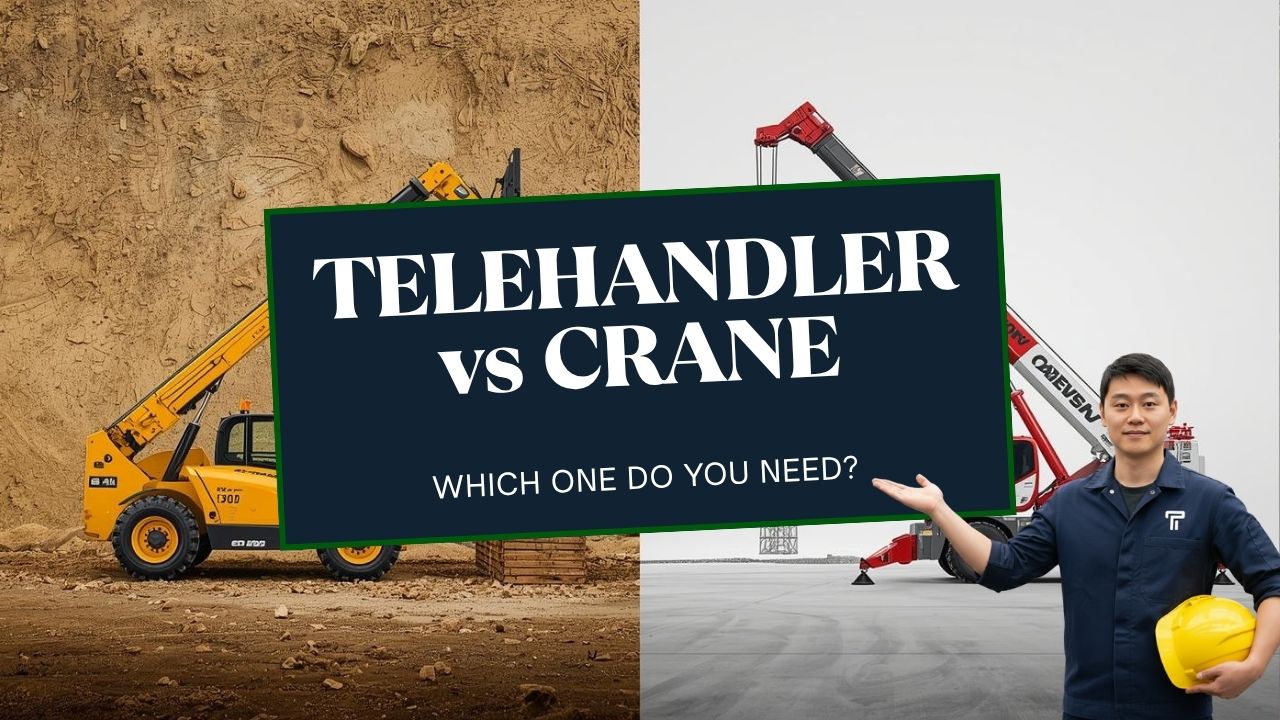
Telehandler vs Crane: What’s the Difference?
A telehandler and a crane are both essential lifting machines, but they differ significantly in design, lifting principles, applications, and capacity.
While both feature extendable booms capable of vertical and horizontal reach, they belong to distinct categories of equipment.
Understanding these differences ensures you choose the right machine for safety, efficiency, and performance on your job site telehandler vs crane1.
Design and Function
Telehandler: Versatile Material Handler
A telehandler (telescopic handler) combines the characteristics of a forklift and a small crane.
It uses a telescopic boom that extends upward and outward, allowing operators to lift, move, and place materials precisely where needed.
Its true strength lies in versatility — telehandlers can be fitted with multiple attachments, including forks, buckets, jibs, grabs, and work platforms telehandler versatility2.
This flexibility allows one machine to perform a wide range of roles on construction, agriculture, and industrial sites.
However, as the boom extends, lifting capacity decreases due to leverage and stability limits. Telehandlers follow a load-distance curve, meaning the farther the boom reaches, the less weight it can safely lift safe handling3.
Crane: Precision Heavy Lifter
A crane is designed specifically for heavy, vertical, and precise lifting.
It uses cables, pulleys, and counterweights to hoist and position loads with accuracy.
Depending on type—mobile, crawler, or tower—cranes may include a rotating upper structure (slewing mechanism) and specialized hooks or lifting attachments crane operation4.
Cranes are not multi-purpose tools; they are specialized lifting systems engineered for load stability, control, and height.
While a telehandler can act as a light-duty crane for short lifts, it cannot match a crane’s precision or rated load capacity crane comparison5.
Capacity and Lifting Performance
| Feature | Telehandler | Crane |
|---|---|---|
| Typical Capacity | 5,000–12,000 lbs (2.5–6 tonnes) | 20,000+ lbs (10–1,200 tonnes) |
| Max Height / Reach | Up to 60 ft (18 m) | Several hundred feet possible |
| Reach Type | Telescopic boom, forward and upward reach | Wire rope hoist with full 360° slewing |
| Load Behavior | Capacity decreases with extension | Stable across large working radii |
| Attachments | Forks, buckets, grabs, platforms | Hooks, lifting beams, spreader bars |
| Precision | Moderate – for placement and handling | High – for structural and heavy lifts |
Telehandlers are excellent for medium-height, light-to-moderate loads.
Cranes dominate when weight, height, or precision is the defining requirement.
Mobility and Site Adaptability
Telehandlers excel in mobility. They can drive with a load, handle rough terrain, and reposition quickly without setup time.
Four-wheel drive, crab steering, and compact frames make them ideal for congested or uneven sites terrain adaptability2.
Cranes, by contrast, require setup and stabilization before lifting.
Mobile cranes can travel on roads and between sites, but tower and crawler cranes are largely stationary during operation.
Cranes need flat, stable ground and more working space to safely manage heavy or high loads crane site requirements4.
Safety and Compliance
Safety standards reflect each machine’s purpose.
Telehandlers operate under EN 1459 / ISO 10896 standards for rough-terrain handlers.
They are equipped with:
- Load Moment Indicators (LMI)
- Boom angle sensors and stabilizers
- Load charts showing safe lifting ranges safety guidance5.
Cranes follow EN 13000 (Mobile Cranes) and related international standards, requiring:
- Load Moment Limiter (LML) and Rated Capacity Indicators (RCI)
- Anti-two-block protection
- Automatic overload prevention and slewing control
Operator requirements also differ:
- Telehandler operators are usually certified under forklift or rough-terrain handler training.
- Crane operators require dedicated crane certification and lifting signal coordination training standards6.
Important: A telehandler should never be used for sustained or precise suspended lifting unless equipped with manufacturer-approved lifting attachments and operated under strict load limits use limitation7.
Applications and Job Suitability
| Application Type | Recommended Equipment | Reason |
|---|---|---|
| Loading, unloading, and moving pallets | Telehandler | Mobility and quick operation |
| Lifting materials to moderate height (≤60 ft) | Telehandler | Fast setup, versatile attachments |
| Structural or heavy lifts (>20,000 lbs) | Crane | Load capacity and safety precision |
| High-rise or industrial installation | Crane | Height and reach advantage |
| Rough terrain site logistics | Telehandler | 4WD and compact design |
| Precise component placement | Crane | Fine control and stability |
In many large-scale projects, both machines work together:
the telehandler handles day-to-day material movement, while the crane manages critical high or heavy lifts equipment coordination8.
Professional Guidance
- Choose a telehandler for projects requiring multi-function material handling, rough terrain performance, and frequent mobility across the site.
- Choose a crane for heavy lifting, precise load placement, or high elevation where safety and regulatory compliance are critical selection advice4.
- Assess your load weight, height, site conditions, and setup space before selecting the right equipment.
In complex projects, telehandlers and cranes often complement each other — one for logistics, the other for lifting.
References
-
An industry article explaining the main design and purpose differences between telehandlers and cranes. ↩
-
A comparison outlining where telehandlers or cranes perform best on job sites. ↩ ↩
-
A professional guide describing telehandler operation, attachments, and safety controls. ↩
-
A detailed overview comparing crane and telehandler applications in construction. ↩ ↩ ↩
-
A technical note discussing whether telehandlers can replace cranes and related safety concerns. ↩ ↩
-
A resource explaining telehandler and crane operator training and certification differences. ↩
-
An article advising safe material hoisting practices when using telehandlers. ↩
-
A field-based discussion comparing mini crawler cranes and telehandlers in job site coordination. ↩