










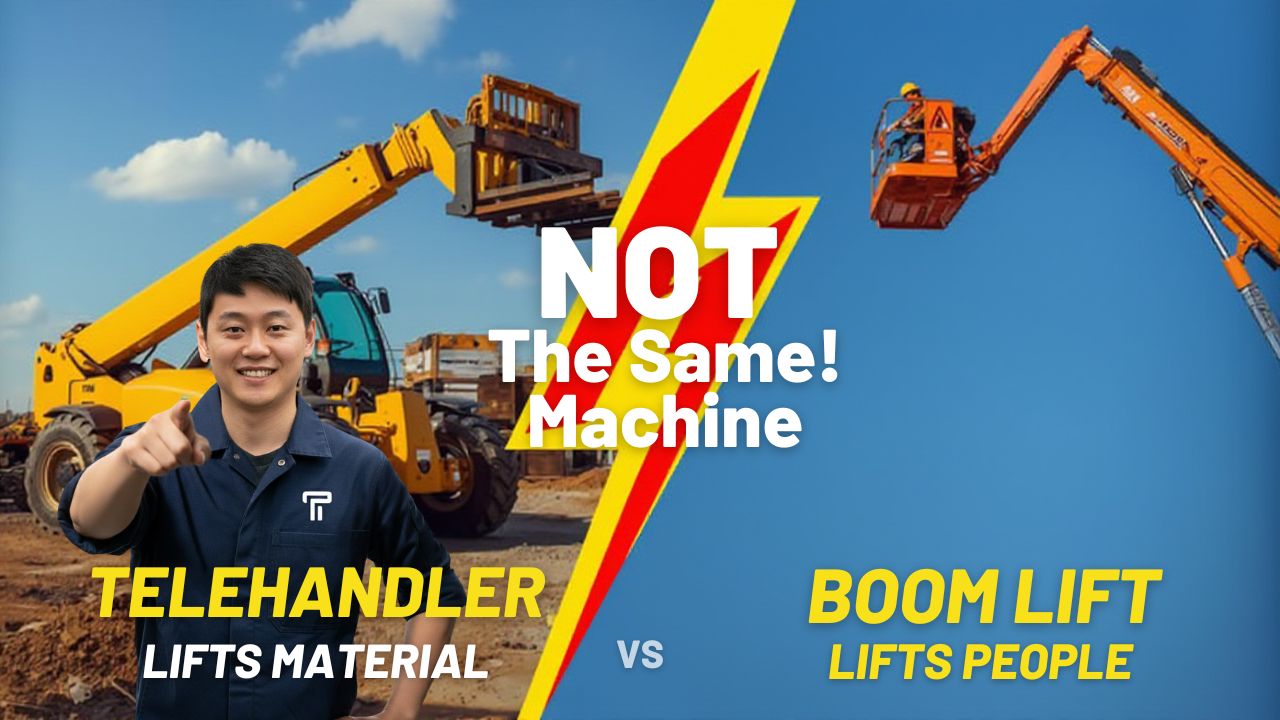
Telehandler vs Boom Lift: What’s the Difference?
A telehandler and a boom lift may look similar at first glance — both have extendable booms and work at height on construction sites.
However, they’re built for different purposes. The key distinction lies in what they lift: telehandlers handle materials, while boom lifts lift people equipment comparison1.
This fundamental difference defines their design, capabilities, and ideal working environments.
Telehandler: Overview and Function
A telehandler, also known as a telescopic handler or reach forklift, uses a telescopic boom that extends forward and upward telehandler overview2.
It combines the roles of a forklift and a small crane, giving it the ability to lift, move, and place materials in challenging site conditions.
Telehandlers can be fitted with a variety of attachments, including forks, buckets, jibs, and work platforms attachments3.
This flexibility allows one machine to perform several jobs, from loading trucks to lifting roof trusses.
They are designed for rough terrain, featuring large tires, four-wheel drive, and oscillating axles that provide traction and stability on uneven surfaces rough terrain4.
Modern models often include load management systems and load-moment indicators (LMI) to prevent overloading and enhance operator safety safety systems5.
Boom Lift: Overview and Function
A boom lift, often called a cherry picker or man lift, is designed to elevate personnel and tools to high or hard-to-reach areas boom lift definition6.
Instead of carrying materials, its focus is safe aerial access for tasks like maintenance, painting, or electrical installation.
Boom lifts are available in two main designs:
- Telescopic (straight boom) – for maximum height and horizontal outreach.
- Articulating (knuckle boom) – for maneuvering around obstacles boom types7.
The operator stands inside a safety platform or basket equipped with guardrails and emergency systems.
All boom lifts are governed by strict aerial work platform (AWP) safety standards and require specific operator training AWP safety8.
Engineering and Performance Differences
The telehandler’s boom is mounted at the front of the chassis and is controlled from an enclosed cab. Its advantage lies in lifting capacity and forward reach, but stability decreases as the boom extends load behavior9.
To maintain safety, telehandlers rely on stabilizers and detailed load charts to guide operators.
In contrast, a boom lift carries its operator directly on the boom. Its design prioritizes precise positioning and platform stability.
Proportional control systems and hydraulic sensors help keep movement smooth and secure, even at full height platform stability10.
Practical Applications
Telehandlers excel at:
- Moving and stacking heavy pallets
- Loading and unloading materials on-site
- Placing loads on rooftops or scaffolds
- Handling bulk materials like sand or gravel
Boom lifts are ideal for:
- Electrical or HVAC installation
- Window cleaning and façade maintenance
- Painting, finishing, and overhead repairs
- Reaching confined or elevated areas on even ground
Though they may appear on the same job site, each serves a distinct function — one moves materials, the other provides safe access for people construction applications11.
Comparison Table
| Feature | Telehandler | Boom Lift |
|---|---|---|
| Primary Function | Material handling and placement | Lifting personnel and tools |
| Lifting Mechanism | Telescopic boom | Telescopic or articulating arm |
| Load Capacity | 2,500 – 10,000+ kg | 200 – 1,000 kg (personnel + tools) |
| Maximum Height | Up to 18 m (60 ft) | Up to 64 m (210 ft) |
| Terrain Capability | Excellent on rough, outdoor terrain | Best on smooth or stabilized ground |
| Operator Position | Inside cab | In basket/platform on boom |
| Typical Use | Construction, agriculture, logistics | Maintenance, installation, façade work |
Training and Regulations
Telehandler operators typically require a forklift or telehandler license, focusing on load charts, terrain handling, and machine stability.
Boom lift operators must obtain AWP or MEWP certification, with training centered on fall protection and platform control operator training12.
These differing certifications reflect the machines’ distinct safety priorities — telehandlers manage heavy loads, while boom lifts ensure worker safety at height.
Final Thoughts
While both telehandlers and boom lifts feature extendable booms, their purposes differ completely.
A telehandler is a material mover — powerful, versatile, and ideal for outdoor logistics.
A boom lift is a personnel platform — precise, stable, and designed for safe work at height.
Simply put:
- A telehandler lifts materials.
- A boom lift lifts people.
Choosing the right one depends on whether the job calls for reach and power, or height and precision.
References
-
An article explaining the main differences between telehandlers and boom lifts. ↩
-
A guide describing the functions and structure of telehandlers. ↩
-
An overview of common telehandler attachments and their uses. ↩
-
An explanation of telehandler types and rough-terrain capabilities. ↩
-
A technical guide detailing telehandler load management and safety systems. ↩
-
A general introduction to what a boom lift is and how it operates. ↩
-
An outline of different boom lift types, including articulating and telescopic models. ↩
-
A discussion of aerial work platform safety standards and certification requirements. ↩
-
A training resource covering telehandler operations and load handling. ↩
-
An engineering explanation of boom lift design and platform stability. ↩
-
A comparison of various construction lift types and their field applications. ↩
-
A practical overview of operator training and licensing for boom lifts. ↩