










What Is a Telehandler Used for in Agriculture?
If you visit almost any modern farm today, you’ll see a telehandler hard at work. Whether it’s stacking bales, loading feed, or cleaning barns, the telehandler — short for telescopic handler — has become one of the most valuable and versatile machines in agriculture.
It combines the strengths of several different pieces of equipment: the lifting power of a loader, the reach of a crane, and the maneuverability of a tractor. With its extendable boom and a quick-change attachment system, a telehandler can lift, transport, and place almost any kind of material around the farm. One machine can take on dozens of different jobs throughout the year.
The Role of a Telehandler on a Farm
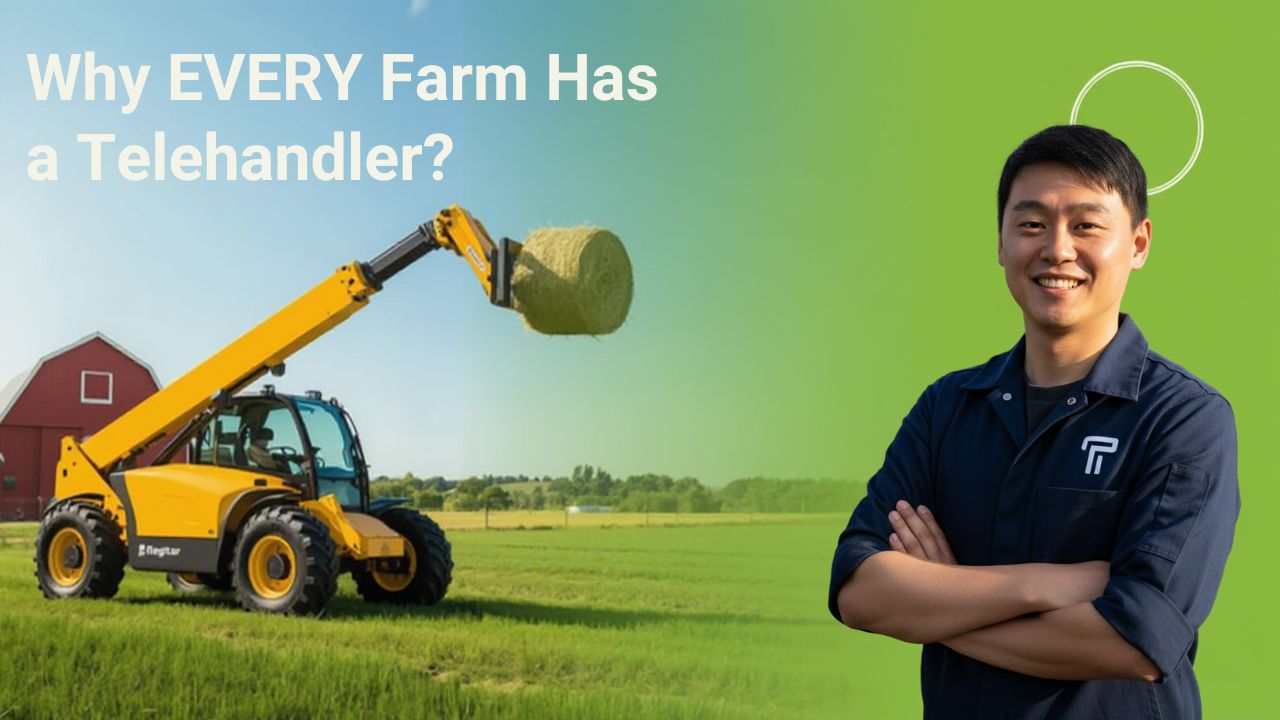
In daily farm work, the telehandler often acts as the main handling and loading machine. It moves feed, hay, straw, fertilizer, and grain between barns, silos, and trailers. Its telescopic boom gives it far greater reach than a tractor loader — which means it can stack bales several layers high, load silage into feed mixers, or tip grain into tall trailers with ease.
Because of its rough-terrain design, large off-road tires, and four-wheel drive, the telehandler can operate comfortably on uneven ground, muddy yards, or tight indoor spaces. It’s built to work hard in real farm conditions — all day, every day.
Common Uses in Agriculture
Telehandlers take on a huge variety of jobs across different types of farms. Some of the most common include:
| Application | How It’s Used | Typical Attachment |
|---|---|---|
| Bale handling | Lifting, transporting, and stacking round or square hay and straw bales in storage sheds or fields. | Bale spike / Bale grab |
| Feed and silage handling | Loading feed mixers or moving silage from clamps to troughs. | Bucket / Silage grab |
| Manure and waste cleaning | Clearing barns, livestock yards, or poultry houses and loading manure into spreaders or trucks. | Grab bucket / Muck fork |
| Material loading | Loading bulk materials such as grain, compost, fertilizer, or soil. | General-purpose bucket |
| Farm logistics | Moving pallets of seed, feed, chemicals, or spare parts between different storage areas. | Pallet forks |
| Maintenance at height | Helping with tasks like roof repairs, gutter cleaning, or lighting maintenance on farm buildings. | Work platform / Lifting jib |
With a simple change of attachment, the same telehandler can go from stacking bales to loading grain in minutes — a key reason why it’s so widely used across both small family farms and large commercial operations.
Why Farmers Choose Telehandlers
Farmers and agricultural contractors choose telehandlers for a few clear reasons.
First, versatility. A single telehandler can replace several machines, handling materials across livestock barns, storage sheds, and fields. This flexibility keeps operations efficient and reduces downtime.
Second, lifting power and reach. Agricultural telehandlers can typically lift between 3 and 4 tons and reach up to 9 meters high, allowing operators to work faster and make better use of vertical storage space.
Third, mobility and control. Four-wheel steering and a compact turning radius make the machine easy to maneuver around tight farmyards or inside sheds. It’s built to stay stable even when lifting on rough or sloped ground.
Finally, safety and comfort. Enclosed cabs protect operators from dust and weather, while features like load management systems, stabilizers, and precision hydraulics help maintain balance and prevent overloading. These details make a big difference when the machine is used for long hours each day.
Common Model Types
Telehandlers for agriculture come in several sizes, depending on the size of the farm and the kind of work being done.
| Model Type | Lift Height | Capacity | Typical Use |
|---|---|---|---|
| Compact | 5–6 m | 2.5–3.0 t | Small farms, dairy or poultry houses |
| Mid-range | 6–9 m | 3–4 t | Mixed farming, livestock and arable operations |
| Heavy-duty | 9–10 m+ | 4–5 t or more | Large-scale farms, silage and bulk material handling |
Choosing the right machine depends on your main materials, the lift height required, and the available working space on the farm.
Safety and Best Practices
Even though telehandlers can handle many tasks, they’re not meant to replace tractors for fieldwork like plowing or harvesting. Their true value is in lifting and moving materials efficiently.
Operators should always follow the machine’s load chart, use certified attachments, and be properly trained. Stability changes with boom angle, load size, and ground conditions — so attention to safety is essential for reliable, long-term operation.
The Bottom Line
On a modern farm, the telehandler is no longer a luxury — it’s a necessity.
It keeps daily work moving smoothly, reduces manual labor, and saves time during busy seasons. Whether it’s feeding cattle in the winter or stacking hay in summer, a telehandler provides the reach, strength, and versatility that make farm operations more efficient year-round.
In short, the telehandler has become the multi-purpose workhorse of agriculture — a single, dependable machine that helps farmers do more, faster, and with greater safety and precision.