










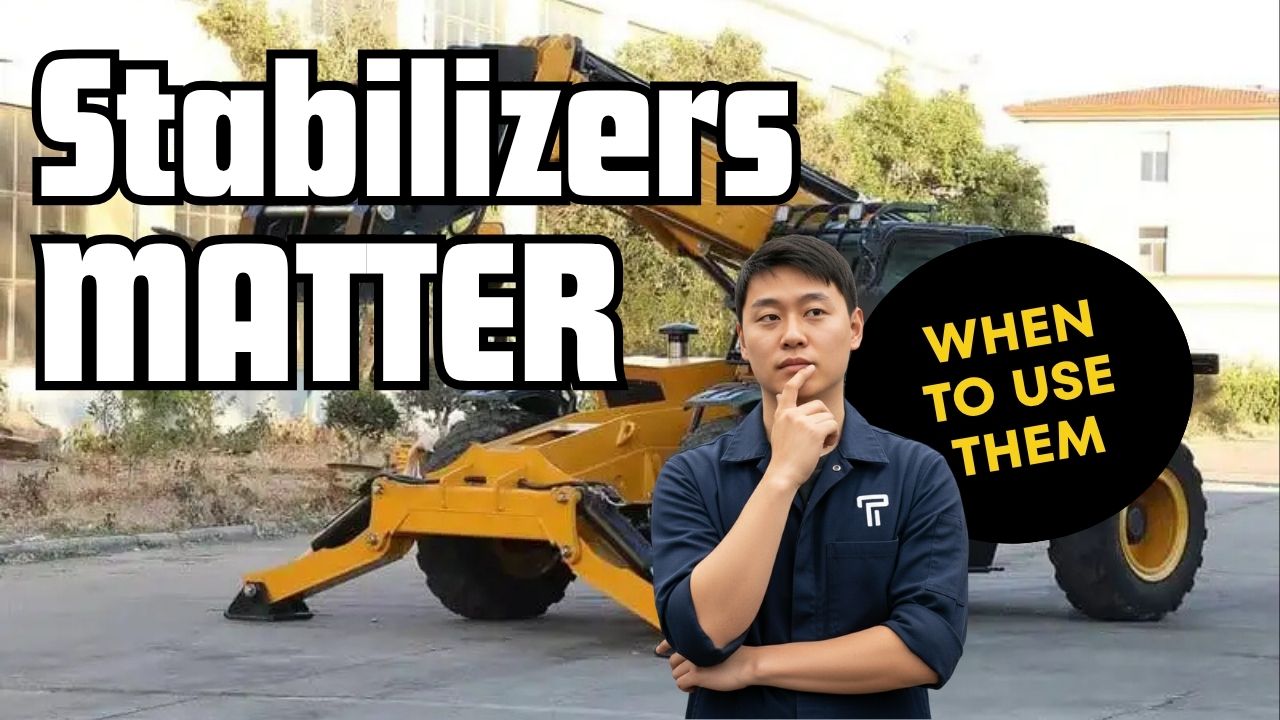
What Is the Role of Stabilizers on a Telehandler?
When you’re working with a telehandler, stabilizers are the components that help the machine stay balanced and secure. They’re hydraulic or mechanical outriggers that widen the telehandler’s footprint and transfer weight directly into the ground—giving you the extra stability you need for high lifts or long outreach, based on essential telehandler stability principles1.
In short, stabilizers let you operate in places and positions that would be unsafe if the machine were supported only by its tires.
Why Stabilizers Matter
Any time you extend a telehandler boom, the machine is dealing with forward and upward leverage from the load. The farther you reach, the stronger that tipping force becomes. When you deploy stabilizers, you’re countering that leverage—they take weight off the suspension, widen the support base, and turn the telehandler into a solid lifting platform instead of a vehicle balancing on four wheels.
If you’ve ever worked on uneven ground or needed precise placement at height, you already know how valuable that extra stability can be.
What Stabilizers Actually Do
1. Help You Lift Heavier Loads at Long Reach
When stabilizers are down, the telehandler can handle more weight safely. The pads push directly into the ground, creating a broader and stiffer base. This is what gives you access to the stabilizers-down load chart, which almost always offers higher capacity than lifting on tires—something supported by modern capacity specifications2.
In simple terms:
If you need more lifting capacity at reach, you need stabilizers.
2. Reduce Your Risk of Tip-Over
Tip-over is the number-one hazard when operating telehandlers. As you extend the boom, especially with a heavy load, the machine’s center of gravity shifts forward. Stabilizers widen the base of support so the machine stays balanced, even with the boom fully extended.
Where you’ll notice the difference most is when you’re:
- Placing loads at height
- Reaching across trenches or barriers
- Handling long, awkward, or uneven materials
Stabilizers don’t make the telehandler impossible to tip, but they give you a much larger—and safer—operating envelope, which is emphasized in industry safety guidance3.
3. Let You Use the Machine’s Full Height and Outreach
A lot of operators don’t realize this until they check the load chart: many telehandlers can’t reach their maximum published height or forward reach unless stabilizers are deployed.
If you’re running a rotating telehandler, stabilizers become non-negotiable. The machine relies on them to create a secure base for full 360° lifting4.
4. Help You Level the Machine on Slightly Uneven Ground
Some stabilizer systems include a frame-leveling function. If you’re on a minor slope, you can adjust the chassis before lifting, giving you better fork angle control and smoother placement. This feature shows up on specific telehandler types5, and it’s extremely useful when you’re working on rough terrain.
Just remember: stabilizers can fix small variations in level, but they won’t overcome soft ground, steep grades, or poor preparation.
When You Need Stabilizers—And When You Don’t
You’ll typically need stabilizers when you’re:
- Using maximum lift height
- Reaching far forward
- Placing heavier loads on upper floors
- Working in tight areas with little room to reposition
- Operating rotating telehandlers
- Doing precise placement at height
You may not need stabilizers when you’re:
- Using a compact telehandler for ground-level work
- Loading trucks at short reach
- Moving palletized loads over short distances
- Staying fully within the on-tires load chart
You won’t have them down all day—but when the lift gets demanding, you’ll feel the difference immediately.
Practical Comparison: With vs. Without Stabilizers
| Factor | On Tires Only | On Stabilizers |
|---|---|---|
| Lifting Capacity | Lower, especially at long reach | Higher at most boom positions |
| Maximum Forward Reach | Restricted | Full outreach available |
| Maximum Lift Height | Limited by stability | Full height typically usable |
| Precision Placement | More sway due to suspension | Much steadier and more accurate |
| Ground Requirements | Needs firm, level conditions | Can correct small variations |
| Safety Margin | Lower | Significantly higher |
If you think about it, stabilizers don’t change the boom—they change the foundation you’re lifting from. And on a telehandler, that foundation matters just as much as the hydraulics.
Summary
Stabilizers give you the confidence to work at height, reach farther, and handle loads that would otherwise push the machine beyond its limits. They widen the base, reduce the risk of tipping, and let you use the full capabilities shown in the load chart. Whether you’re placing materials on an upper floor or lifting at maximum outreach, stabilizers make your work safer, smoother, and far more predictable.
References
-
Overview of telehandler functions and stability principles. ↩
-
Load-stability systems and capacity indicators on modern telehandlers. ↩
-
Safety recommendations for telehandler stability and ground conditions. ↩
-
High-reach and rotating telehandler operational requirements. ↩
-
Overview of telehandler types and functional differences. ↩