










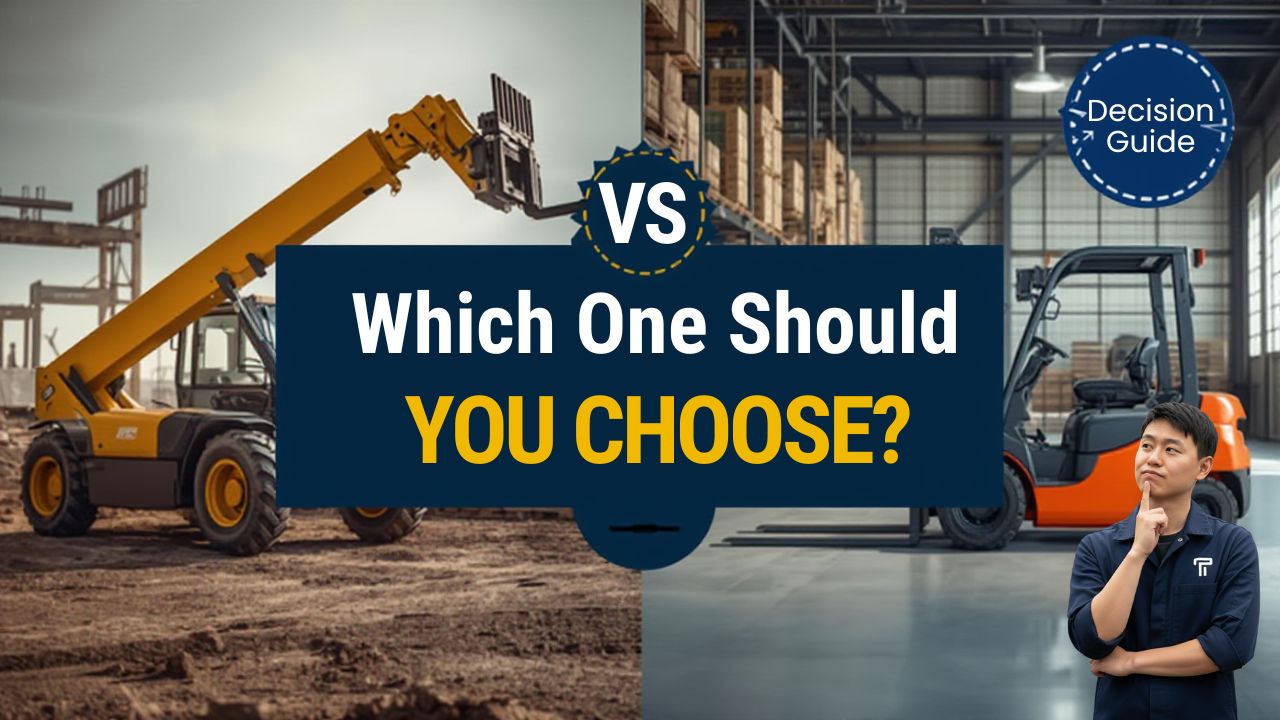
Telehandler vs. Forklift: Which One Should You Choose?
Choosing between a telehandler and a forklift depends on your specific job requirements, site environment, and the types of materials you handle.
Both are material-handling machines, but they excel in very different situations.
A telehandler offers reach, versatility, and off-road power comparison guide1, while a forklift delivers speed, efficiency, and precision indoors warehouse lifting2.
Selecting the right one can greatly improve your productivity, safety, and operating costs.
Decision Factors
1. Application and Reach
A telehandler is ideal when extended reach is needed.
Its telescopic boom can lift loads upward and forward, allowing materials to be placed on rooftops, elevated decks, or over obstacles.
Thanks to a quick-coupler system, operators can easily switch attachments for tasks such as scooping, grabbing, or personnel lifting telescopic handler3.
A forklift, in contrast, is designed for repetitive vertical lifting.
It’s the best choice for stacking pallets, loading trucks, or moving goods within confined indoor spaces industrial forklifts4.
2. Terrain and Site Conditions
Telehandlers thrive in outdoor and rough-terrain environments.
Large tires, high ground clearance, and four-wheel drive provide strong traction and stability.
They also feature three steering modes—front-wheel, four-wheel, and crab—for maneuvering on uneven ground terrain capability5.
Forklifts, on the other hand, are optimized for smooth, flat surfaces.
They perform best in warehouses, factories, and loading bays, where tight steering and compact frames matter most site efficiency6.
3. Versatility and Attachments
A telehandler supports a broad range of attachments—forks, buckets, jibs, clamps, and work platforms—that can be changed within minutes tool options7.
This allows one machine to handle lifting, loading, and material placement tasks across different applications.
Forklifts are more limited.
They usually operate with standard forks or simple accessories such as side-shifters and clamps, ideal for palletized goods but less flexible for varied materials.
4. Lifting Capacity, Height, and Stability
Telehandlers can lift up to 24,000 lbs (≈11 tonnes) and reach heights of around 56 ft (≈17 m), depending on model size load performance8.
Because the boom extends forward, lifting capacity decreases with reach.
To manage this safely, telehandlers include Load Moment Indicators (LMI), stabilizers, and load charts that monitor real-time balance and prevent overloads.
Forklifts generally lift up to 10,000 lbs (≈4.5 tonnes), though heavy-duty units can exceed that.
Their stability comes from a low center of gravity and fixed counterweight, offering consistent capacity within design limits.
5. Maneuverability, Training, and Cost
Forklifts are compact, fast, and easy to control in tight areas.
They cost less to buy and maintain, and electric models offer quieter, cleaner operation for indoor use machine cost9.
Telehandlers, while larger and more expensive, provide unmatched flexibility.
Because of their variable load dynamics, they require certified operator training.
Forklift operation is simpler but still regulated under most safety standards.
Selection Guidelines Table
| Criteria | Choose Telehandler | Choose Forklift |
|---|---|---|
| Application | Extended reach and multi-purpose work | Repetitive pallet handling |
| Terrain | Rough, uneven, outdoor | Smooth, level, indoor |
| Attachment range | Wide (multi-function tools) | Limited (forks, clamps) |
| Max height | Up to 56 ft / 17 m | Up to 25 ft / 7.5 m |
| Max load | Up to 24,000 lbs / 11 t | Up to 10,000 lbs / 4.5 t |
| Steering & stability | Three steering modes, LMIs | Compact, fixed balance |
| Operator training | Certified telehandler operator | Basic forklift license |
| Cost/maintenance | Higher | Lower |
Professional Recommendation
If your work involves high reach, outdoor environments, or variable materials, a telehandler is the better investment.
Its reach, power, and attachment versatility make it a key machine for construction, agriculture, and site logistics.
If your operation is indoor, repetitive, and pallet-based, a forklift will deliver greater efficiency and lower costs.
It’s compact, reliable, and perfect for warehouses, factories, and distribution centers.
In short:
- A telehandler lifts up, out, and over obstacles.
- A forklift lifts up and down—fast and efficiently.
References
-
Forklift vs Telehandler comparative guide. ↩
-
Forklift vs Telehandler operations and efficiency. ↩
-
When to use a telescopic handler. ↩
-
Forklift vs Telehandler application comparison. ↩
-
Understanding terrain and steering differences. ↩
-
Key workplace differences between telehandlers and forklifts. ↩
-
Telehandler versatility and attachment range. ↩
-
Forklift vs Telehandler lifting height and load capacities. ↩
-
Differences between forklifts and telehandlers, including cost and efficiency. ↩