










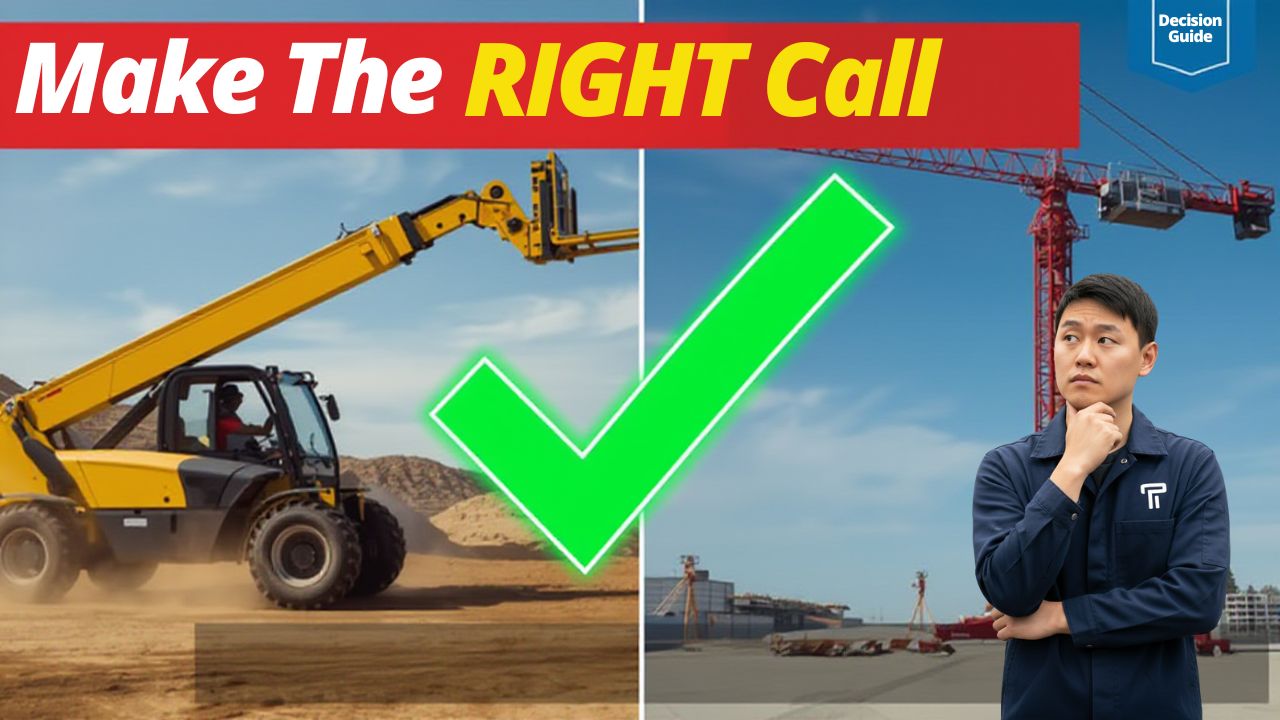
Telehandler vs Crane: Which One to Use?
A telehandler and a crane are both used for lifting and moving materials, but they differ significantly in design, maximum capacity, maneuverability, attachments, and ideal applications.
Understanding these distinctions ensures that each machine is used safely, efficiently, and according to its intended role on the job site equipment overview1.
Core Function and Design
Telehandlers: Versatile Material Handlers
A telehandler (telescopic handler) is a multi-purpose machine that combines the functionality of a forklift and a small crane.
It features a telescopic boom that extends upward and forward and can be fitted with multiple attachments such as forks, buckets, lifting hooks, and man baskets machine versatility2.
Telehandlers are prized for their maneuverability on rough terrain and their ability to perform diverse on-site material handling tasks — from loading pallets to placing loads onto scaffolding.
They are ideal for construction, agriculture, and industrial sites that require flexible handling and quick movement between tasks. However, their lifting capacity decreases as the boom extends, following a defined load-distance curve for safe operation safe operation3.
Cranes: Precision Heavy Lifters
A crane is a purpose-built lifting system engineered for vertical and horizontal movement of heavy or awkward loads.
Most cranes use fixed or rotating booms with wire ropes, pulleys, and counterweights to achieve extremely high lifting capacity and precise control crane design4.
They are designed for critical lifting applications such as steel erection, bridge work, and equipment placement, where stability, reach, and accuracy are paramount.
Capacity and Reach
-
Telehandlers typically lift between 5,000–12,000 lbs (2.5–6 tonnes), with maximum lift heights up to 60 ft (18 m).
Their lifting capacity decreases as the boom extends, which requires operators to reference load charts and maintain awareness of stability limits load limits5. -
Cranes can lift anywhere from 20,000 lbs (10 tonnes) to 500+ tons, depending on type and configuration.
Tower and mobile cranes can reach heights exceeding 100 m (328 ft) and maintain rated load capacities through counterweights and outriggers lifting performance6.
Attachments and Versatility
- Telehandlers accept a wide range of attachments — forks, buckets, jibs, winches, or man baskets — giving them unmatched task flexibility. This allows one machine to function as a forklift, loader, or light crane on demand attachment flexibility2.
- Cranes, by contrast, are more specialized. They use hooks, slings, concrete buckets, or spreader beams, focusing purely on heavy and precise lifting rather than multipurpose material handling crane specialization7.
Maneuverability, Setup, and Cost
Telehandlers offer superior maneuverability and ground mobility.
Their four-wheel drive and steering systems allow movement with a load over uneven terrain or in tight work areas.
They require minimal setup time and are more cost-effective to purchase, rent, and maintain site efficiency2.
Cranes, however, often require setup and stabilization before operation.
Mobile cranes can travel between job sites but must deploy outriggers to ensure stability.
Crawler and tower cranes, while powerful, are slower to mobilize and more expensive to operate setup complexity4.
From a rental standpoint, telehandlers are generally more economical for daily logistics, while cranes justify higher costs for specific heavy-lift operations.
Safety and Regulatory Compliance
The two machines fall under different safety and certification standards:
-
Telehandlers are regulated under EN 1459 / ISO 10896 for rough-terrain handlers.
They are equipped with Load Moment Indicators (LMI), stabilizers, and load charts to guide safe lifting limits safety systems3.
Telehandlers must not be used as cranes for continuous or precision lifting unless fitted with manufacturer-approved lifting attachments. -
Cranes are governed by EN 13000 (Mobile Cranes) and ISO 9927 (Inspection and Maintenance).
They feature Rated Capacity Indicators (RCI), anti-two-block systems, boom angle limiters, and automatic overload prevention mechanisms lifting safety7.
Crane operators require specialized licensing and signal coordination certification, while telehandler operators are typically trained under forklift or rough-terrain handler programs.
Summary Table
| Feature | Telehandler | Crane |
|---|---|---|
| Core Function | Versatile material handling | Heavy, precise lifting |
| Max Capacity | 5,000–12,000 lbs (2.5–6 t) | 20,000 lbs to 500+ tons |
| Max Reach / Height | Up to 60 ft (18 m) | Up to 100+ m (328+ ft) |
| Attachments | Forks, buckets, jibs, baskets | Hooks, slings, spreaders |
| Maneuverability | High (4WD, compact, rough terrain) | Limited, setup required |
| Setup & Cost | Low setup, cost-effective | High setup, costly |
| Operator Training | Telehandler / forklift license | Crane operator certification |
| Typical Use Cases | Construction, agriculture, site logistics | High-rise, infrastructure, heavy construction |
Professional Recommendation
- Choose a telehandler when your project involves material handling, frequent mobility, and moderate lifting heights or weights.
- Choose a crane for heavy loads, precision lifts, and high or extended reach requirements.
- For large-scale projects, telehandlers and cranes often work together — telehandlers manage daily logistics, while cranes handle structural lifting and assembly equipment coordination8.
In summary:
A telehandler delivers mobility and versatility, while a crane provides capacity and precision.
References
-
An article outlining the major design and performance differences between telehandlers and cranes. ↩
-
A professional comparison describing the versatility and site adaptability of telehandlers versus cranes. ↩ ↩ ↩
-
A technical overview explaining telehandler safety limitations and regulatory compliance. ↩ ↩
-
A guide discussing setup requirements and operational differences between mobile cranes and telehandlers. ↩ ↩
-
A resource on safe load handling and boom operation practices for telehandlers. ↩
-
A discussion of lifting capacities and reach performance between telehandlers and cranes. ↩
-
A construction equipment analysis detailing crane features, safety systems, and operational standards. ↩ ↩
-
A field-based article comparing mini crawler cranes and telehandlers in coordinated job site use. ↩