










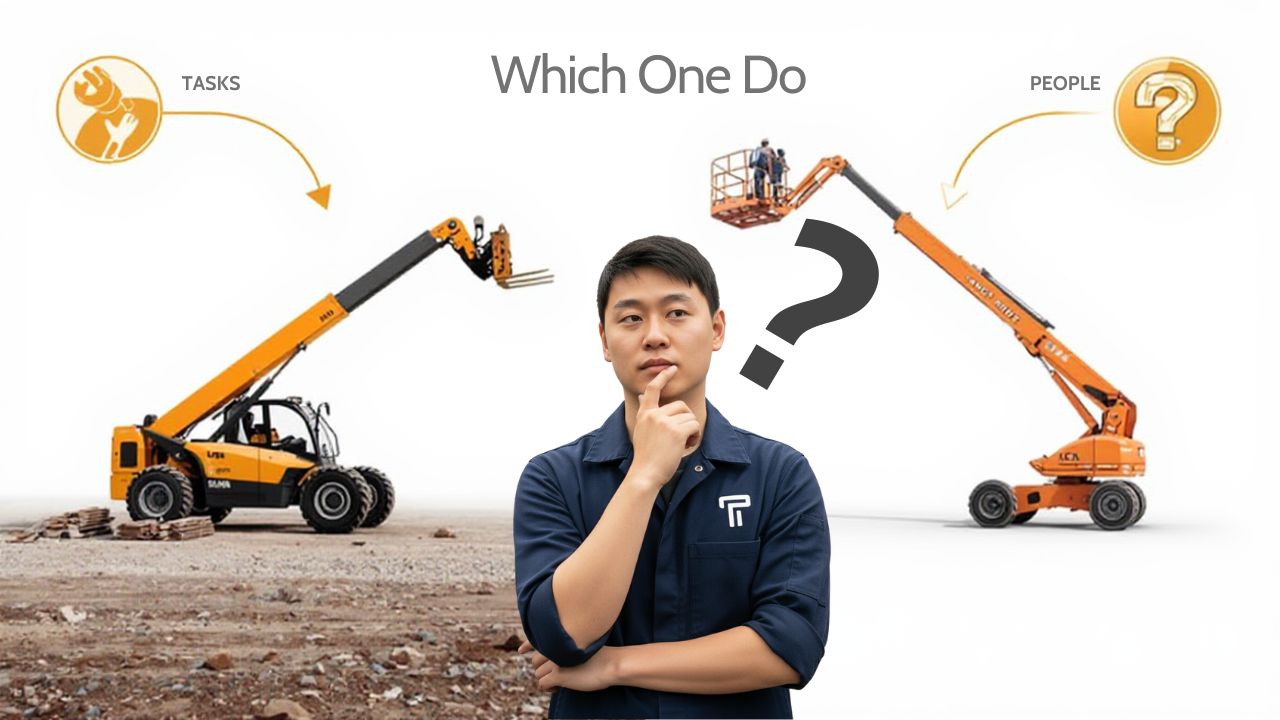
Telehandler vs Boom Lift: Which One to Use?
Choosing between a telehandler and a boom lift depends entirely on what you need to lift and where you’re working.
While both machines feature extendable booms and can reach impressive heights, they serve fundamentally different purposes. Selecting the correct machine is essential for safety, efficiency, and productivity on any job site equipment differences1.
When to Use a Telehandler
A telehandler, short for telescopic handler, is designed primarily for material handling. It combines the reach of a small crane with the lifting stability of a forklift telehandler basics2.
Material Handling Power
Telehandlers can lift, carry, and place heavy loads such as pallets, steel, bricks, or bulk goods.
Their telescopic boom extends both upward and forward, allowing materials to be positioned at height or over obstacles — something a standard forklift cannot achieve telehandler operation3.
Versatility Through Attachments
A major advantage is interchangeable attachments. With forks, buckets, lifting jibs, or work platforms, a telehandler can function as a forklift, light crane, or loader depending on the day’s task attachments4.
Terrain and Stability
Telehandlers are built for outdoor and rough-terrain environments — large pneumatic tires, four-wheel drive, and oscillating axles ensure mobility across mud, gravel, or unpaved sites rough terrain capability5.
Modern models use load-moment indicators (LMI) and stabilizers to prevent tipping and maintain balance as the boom extends safety systems6.
In short: use a telehandler when your job involves lifting, moving, and precisely placing heavy materials, especially in challenging site conditions.
When to Use a Boom Lift
A boom lift (also called a cherry picker or man lift) is built to elevate personnel and tools safely to height boom lift overview7.
Personnel Elevation and Access
Boom lifts are ideal for tasks at height — painting, electrical installation, maintenance, or façade cleaning.
They provide a secure work platform with guardrails, harness points, and operator controls located directly in the basket work platform safety8.
Precision and Reach
There are two main types of boom lifts:
- Telescopic (straight boom) – maximum vertical and horizontal reach.
- Articulating (knuckle boom) – maneuverable design for working up and over obstacles boom configurations9.
Surface Requirements
Most boom lifts are designed for flat, stable surfaces, such as paved construction areas, warehouses, or industrial plants.
Rough-terrain boom lifts do exist, but they are generally heavier and less mobile than telehandlers site suitability10.
In short: choose a boom lift when your priority is lifting people safely to perform elevated work, rather than moving materials.
Professional Comparison Table
| Application Type | Telehandler | Boom Lift |
|---|---|---|
| Primary Purpose | Material handling, loading, placement | Personnel elevation and work access |
| Lifting Capacity | 2.5 – 10 tonnes (up to 12 t heavy-duty) | 200 – 450 kg (1–2 workers + tools) |
| Maximum Height | Up to ~18 m (60 ft) typical | Up to ~64 m (210 ft) possible |
| Horizontal Outreach | Good, forward reach for load placement | Excellent, especially with articulating arm |
| Attachments Supported | Multiple (forks, buckets, jibs, platforms) | Limited (personnel basket only) |
| Terrain Suitability | Excellent on rough or uneven ground | Best on smooth, level surfaces |
| Personnel Safety Systems | LMI, stabilizers, load charts | Guardrails, sensors, platform interlocks |
| Operator Position | In cab (ground level) | In basket (on boom) |
| Typical Worksite | Construction, agriculture, logistics yards | Maintenance, utilities, indoor/outdoor access |
Key Recommendations
- Use a telehandler when your project involves lifting and placing materials, working on rough or unpaved terrain, or requiring multi-purpose flexibility with attachments.
- Use a boom lift when you need to safely elevate personnel to perform inspection, installation, or maintenance at height.
- Never use a telehandler for routine personnel lifting unless fitted with a certified work platform attachment and all relevant safety standards are followed work-at-height safety11.
Professional Insight
In practice, telehandlers and boom lifts often complement each other on complex projects.
A telehandler moves materials to upper levels or staging areas, while a boom lift provides safe worker access for installation or finishing work.
From a rental or ownership standpoint:
- Telehandlers offer higher versatility and utilization rates across multiple site functions.
- Boom lifts provide cost-effective, specialized access for short-term aerial work.
Ultimately, the right choice depends on the nature of the task:
A telehandler delivers reach and load capacity.
A boom lift provides access and precision.
References
-
An article comparing the functions and job suitability of telehandlers and boom lifts. ↩
-
A general explanation of how telehandlers operate and where they are used. ↩
-
A professional guide outlining telehandler structure and safety controls. ↩
-
A resource describing common telehandler attachments and versatility. ↩
-
An overview of telehandler performance on rough or uneven ground. ↩
-
A discussion of load-moment indicators and safe lifting systems. ↩
-
A guide explaining what a boom lift is and how it functions. ↩
-
A practical article describing safe operation and types of boom lifts. ↩
-
A technical discussion of boom configurations and articulation. ↩
-
A reference outlining site conditions suitable for different boom lifts. ↩
-
A safety-focused comparison explaining correct personnel lifting practices. ↩