










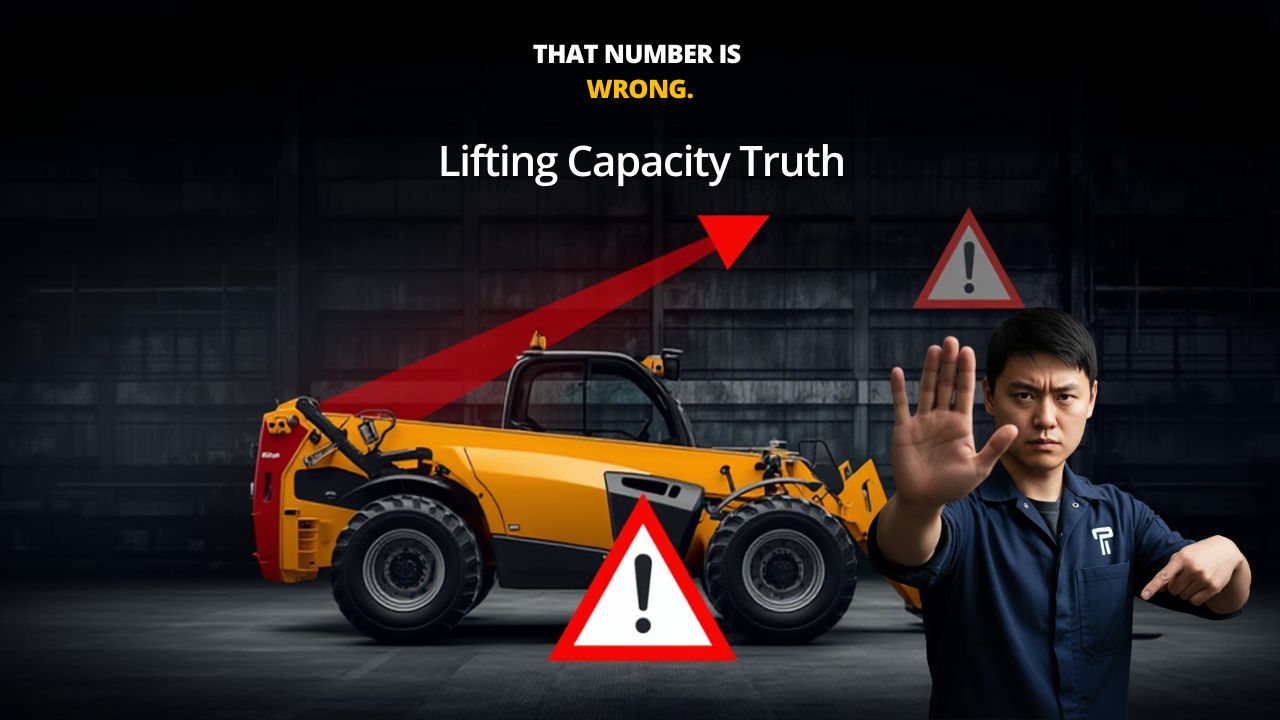
What “Lifting Capacity” Means for a Telehandler
Lifting capacity on a telehandler refers to the maximum weight the machine can safely lift, hold, and position at a specific boom height and reach—based on its structural design, hydraulics, and stability limits.
It is not a single fixed number, but a value that changes with boom extension, boom angle, and the attachment you’re using telehandler lifting ratings1.
How Lifting Capacity Is Defined
Rated Lifting Capacity
This is the maximum weight the telehandler can handle under its most stable configuration—typically with the boom fully retracted, the load close to the machine, and using standard forks.
Manufacturers publish this value in their technical data and on the machine’s identification plate lad chart basics2.
Capacity at Different Boom Positions
Once the boom extends outward or lowers to a flatter angle, the lifting capacity decreases. This is due to increased leverage on the chassis and the machine’s changing center of gravity.
These limits are illustrated in the telehandler’s load chart, which specifies the safe weight at every combination of height and reach capacity change with reach3.
In practice:
The number printed on a brochure is only valid at the shortest reach.
The “real” working capacity depends entirely on the boom position.
What Affects Lifting Capacity
1. Boom Extension & Angle
As the boom reaches farther forward, the load moves away from the machine’s center of gravity.
For example, a machine that lifts 5,500 kg at ground level with the boom retracted may safely handle only 1,000 kg at maximum outreach specification example4.
2. Attachments
Every attachment—buckets, platforms, jibs—has its own weight and geometry. This reduces the net load the boom can handle and sometimes changes the load center.
Telehandlers come with dedicated load charts for each attachment, because the rated capacity is never the same across all tools attachment effects5.
3. Stability & Ground Conditions
Soft ground, side slopes, and uneven terrain all reduce stability.
Load charts assume firm, level ground, so operators must adjust expectations when conditions are less than ideal good practice guide6.
4. Load Center
Telehandler ratings are based on a standard load center (commonly 500 mm or 24 inches depending on region).
If the load is longer, wider, or unevenly distributed, the effective load center increases—and the safe lifting limit decreases.
Why the Load Chart Matters
The load chart is the real “truth” behind lifting capacity.
It shows:
- Maximum weight at specific boom angles
- Allowed load at each extension stage
- Height–reach working envelope
- Zones where lifting is prohibited
Modern telehandlers support this chart with Load Moment Indicators (LMI) that warn or stop operations if the machine approaches unsafe conditions telehandler stability systems[^10].
Ignoring the load chart is one of the most common causes of instability and tip-over incidents.
Example Make for You
A telehandler with a rated capacity of 4,000 kg may have safe lifting limits such as:
- 4,000 kg at full retraction
- 1,800–2,000 kg at mid-extension
- 500–800 kg at maximum forward reach
This pattern is universal:
the farther you reach, the less you can lift.
Professional Guidance
If you want to use a telehandler safely and efficiently:
- Know the difference between “rated capacity” and “capacity at working reach.”
- Always check the correct load chart for the attachment installed.
- Maintain stable ground conditions whenever possible.
- Watch your boom angle and be aware of how far the load sits from the chassis.
Mastering lifting capacity isn’t just about understanding numbers—it’s about understanding how a telehandler behaves as the boom moves.
References
-
Overview of telehandler lifting capacity ratings and how they are established. ↩
-
Explanation of rated capacity, lift height, and the relationship between boom geometry and capacity. ↩
-
Description of how telehandler weight limits change with height and outreach. ↩
-
Example specification sheet illustrating capacity changes at different boom extensions. ↩
-
Guide to understanding load charts and the effect of attachments on capacity. ↩
-
Industry good-practice guide emphasizing ground conditions and stability considerations. ↩