










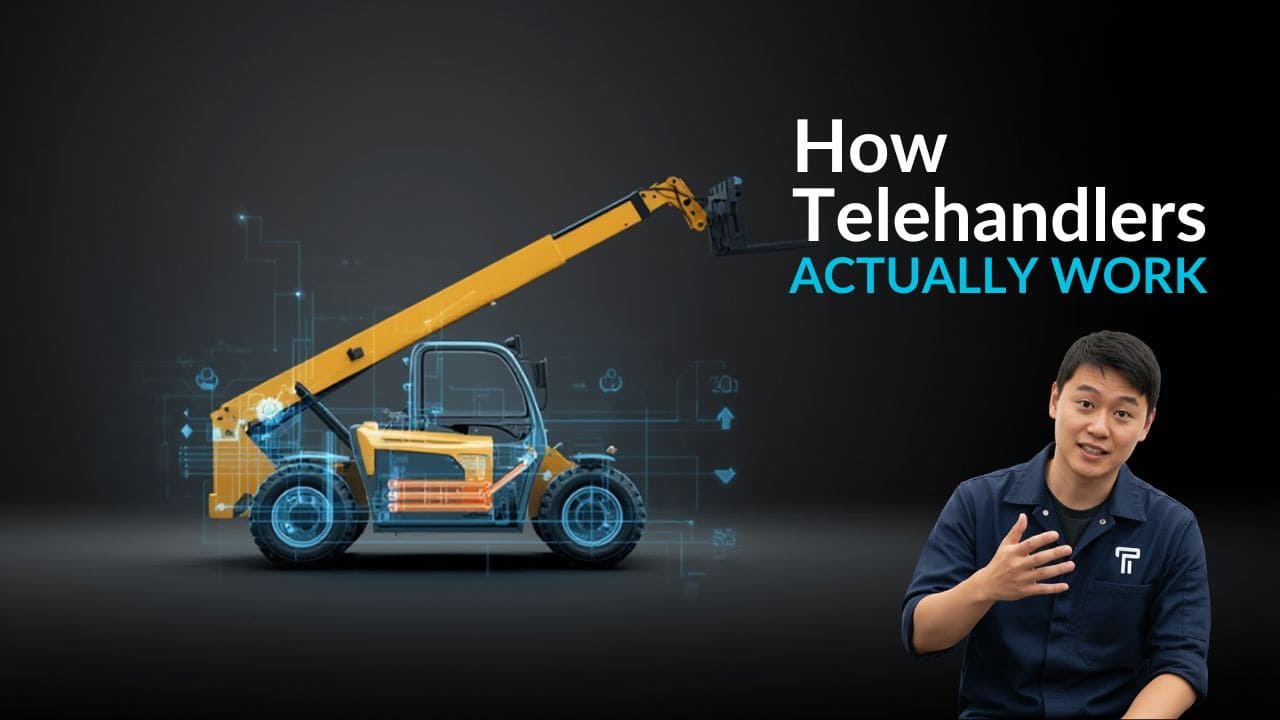
How Does a Telehandler Work?
At first glance, a telehandler might look like a cross between a forklift and a small crane — and that’s exactly what it is. It combines lifting power, reach, and mobility into one versatile machine.
But how does it actually work? Let’s break down the systems that make this possible and see how they come together to perform precise, heavy-duty lifting on any terrain.
The Basic Working Principle
Every telehandler works on the same simple idea:
use hydraulic power to raise, extend, and control a telescopic boom that carries a load at its tip.
The engine drives a hydraulic pump, which sends oil under high pressure through a network of valves and cylinders.
When the operator moves the joystick inside the cab, that oil pressure becomes motion — lifting the boom, extending it forward, or tilting the attachment for accurate placement.
This system gives the operator full control of heavy materials, allowing loads to be lifted several meters high or placed several meters away — safely and smoothly.
Power and Movement
A telehandler is powered by a diesel engine that does two jobs at once:
it moves the machine and drives the hydraulic system.
Power flows through a transmission and drive axles, giving the machine traction and control.
Depending on the model, the transmission might be hydrostatic, powershift, or torque converter — each tuned for a balance of speed and pushing power.
To handle uneven or tight job sites, telehandlers feature four-wheel drive and three steering modes:
- Front-wheel steering for road travel
- Four-wheel steering for tight spaces
- Crab steering for sideways movement along walls or storage rows
These steering options make it surprisingly maneuverable, even when working in narrow or cluttered areas.
The Telescopic Boom in Action
The boom is the signature component of a telehandler — a multi-section arm that extends outward like a telescope.
Inside, one hydraulic cylinder raises the boom, and another extends it. As the boom extends, the load moves farther from the center of gravity, so balance becomes critical.
To manage this safely, telehandlers rely on a rear counterweight, stabilizers (on some models), and a Load Moment Indicator (LMI) system.
The LMI constantly monitors boom angle, extension, and load weight, warning the operator if stability limits are being approached.
This system ensures that even at full reach, the telehandler remains stable and safe.
Hydraulics – The Power Behind Every Movement
Hydraulics are what give the telehandler its strength and precision.
The hydraulic pump, driven by the engine, generates the pressure that powers every movement — lifting, tilting, extending, or steering.
Inside the system:
- Control valves direct oil to the right cylinder.
- Cylinders convert that pressure into linear motion.
- Hydraulic lines carry oil to the boom and attachments.
Some models include auxiliary hydraulic lines at the boom head to power tools like buckets, clamps, or rotating forks.
The result is smooth, proportional movement that lets the operator position loads exactly where they’re needed — even several stories high.
Attachments and Versatility
At the front of the boom is the quick coupler, the part that connects the telehandler to its tools.
This system allows operators to switch attachments in minutes — from forks to buckets, jibs, bale spikes, or work platforms.
Each attachment can be tilted or rotated to suit the task, and hydraulic couplings power more advanced tools.
This adaptability is what makes a telehandler such a valuable machine — one unit can take on dozens of roles, from lifting pallets and stacking hay bales to cleaning yards or placing materials at height.
Stability and Safety
Lifting heavy loads high or far forward requires precise control. That’s why telehandlers are designed with multiple stability systems:
- Rear counterweights balance the boom’s leverage.
- Wide axles and large tires distribute weight evenly.
- Frame levelling systems allow minor tilt adjustments on slopes.
- Stabilizers (outriggers), when fitted, provide extra support for high-reach work.
Safety systems such as the Load Moment Indicator, overload cut-off, and ride control (boom suspension) work together to keep the machine stable, the load secure, and the operator protected.
The Operator’s Role
Even with all its automation, a telehandler still depends on a skilled operator.
The operator reads the load chart, chooses the correct attachment, and monitors the LMI during each lift.
Good technique — such as keeping loads low when traveling and extending the boom only when stable — ensures both efficiency and safety.
Inside the cab, everything is designed to help: clear visibility, responsive controls, and ROPS/FOPS-certified protection for peace of mind during long working days.
Bringing It All Together
So, how does a telehandler work?
It’s the coordination of engine power, hydraulics, and mechanical balance — all controlled through a highly responsive operating system.
| System | What It Does |
|---|---|
| Engine & Powertrain | Generates power and movement |
| Hydraulic System | Converts pressure into lifting and extension motion |
| Telescopic Boom | Provides vertical and forward reach |
| Chassis & Counterweight | Keeps the machine stable under load |
| Attachments | Adapt the machine for specific tasks |
| Safety Systems | Monitor load, stability, and operator safety |
Every time you lift a pallet, place a beam, or load a trailer, these systems work in sync to deliver controlled, precise motion.
That’s what makes the telehandler one of the most capable and adaptable lifting machines in the world — combining power, precision, and practicality in a single design.