










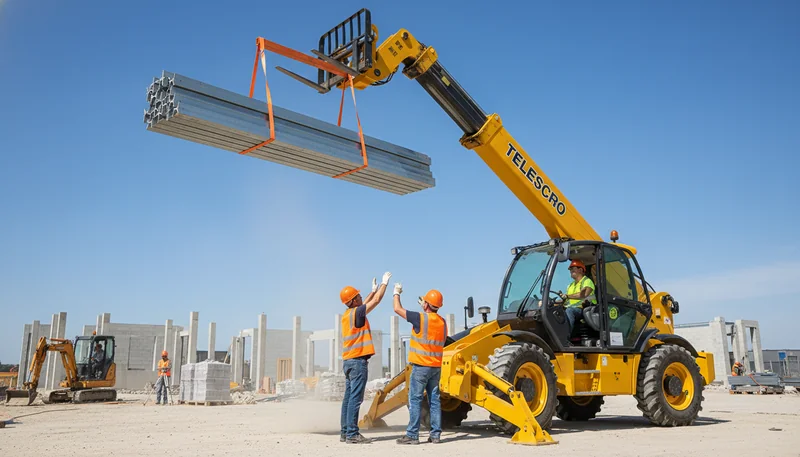
Is a Telehandler Dangerous to Operate? Field Engineer’s Safety Guide
One thing that’s really stuck with me: the day I saw a seasoned operator in southern Brazil tip a fully loaded telehandler after creeping just a foot too far on soft ground. He’d managed tractors his whole life, but didn’t expect the machine to flip so quickly—no warning, just gone.
Telehandlers are widely treated as high-risk plant on farms and construction sites because their extendable booms can place heavy loads far from the chassis, rapidly reducing stability compared with standard forklifts or loaders—especially as reach increases. Tipping/overturn, crush/run-over, and electrocution risks are repeatedly highlighted in guidance from farm and construction safety authorities. Instability can increase quickly with boom extension, soft or uneven ground, slopes, or improper operating practices. Using the manufacturer’s load chart for the specific task and attachment, maintaining clear exclusion zones, and ensuring task-specific operator training are critical controls.
How Dangerous Is Operating a Telehandler?
Telehandlers are classified as high-risk lifting equipment due to their crane-style boom, which extends loads far from the machine’s centre of gravity, reducing stability. Accidents, including overturns, crushing, and electrocution, are serious risks. Safety standards require rigorous operator training1, strict procedures, and reliance on the manufacturer’s load chart2 for every operation.

Most people don’t realize just how unforgiving a telehandler can be. It’s not just a forklift with extra reach—extending the boom moves your load further away from the machine’s center of gravity, and that’s exactly where stability can vanish fast. I remember a job in Dubai where a crew tried to position a 1,200 kg bundle at close to full reach on a 4-ton model. The telehandler started to tip even though the load was under half the rated capacity3—because at 14 meters out, the load chart showed their real safe limit was under 1,000 kg. That moment sticks with me. The consequences if they hadn’t stopped? Overturning happens in seconds.
Operator error is the most common factor when I review accident reports—there’s no substitute for proper training. In Kenya, I consulted for a farm that replaced tractor loaders with compact telehandlers. Within two months, a new operator tried lifting wrapped silage bales on a slope, ignoring the load chart and boom angle. The telehandler rolled over, trapping the operator. He survived, but it’s a clear example of why you should never trust “experience-based shortcuts.” Every situation—ground, boom position, stabilizer use—changes what the telehandler can handle.
To be honest, I always insist that teams keep the load chart in the cab and make every decision by it. Relying on memory or old habits is dangerous. If you’re unsure, check the moment indicator or onboard limiter if your machine has one, but always back it up with the manufacturer’s load chart. That’s the only way to control the real risks with telehandlers.
A telehandler can become unstable and tip over even when lifting loads well below its maximum rated capacity if the boom is extended far out horizontally.True
As the boom extends, the load moves further from the telehandler's center of gravity, which reduces stability and lifting capacity, as reflected in the machine’s load chart. Capacity decreases rapidly at longer reaches, making safe operation dependent on both weight and reach, not just weight alone.
Operating a telehandler is just as safe as operating a standard forklift since both machines have similar stability characteristics regardless of boom position.False
Unlike forklifts, telehandlers have extendable booms that dramatically affect their center of gravity and stability. This makes them much more susceptible to tipping, especially at long reaches or high lifts, which standard forklifts do not experience in the same way.
Key takeaway: A telehandler’s stability risks make it one of the most dangerous machines on farm or construction sites. Only treat telehandlers as high-risk equipment, require specialized operator training, and make safety decisions by consulting the manufacturer’s load chart—never using shortcuts, personal experience, or generic rules.
Why Do Telehandlers Tip Over Easily?
Telehandlers are prone to tipping because stability decreases dramatically as the boom is raised or extended, moving the load further from the chassis. Overloading, working on side slopes exceeding 3–5°, driving with a raised boom, or operating on soft or uneven ground are leading causes of tip-over incidents.
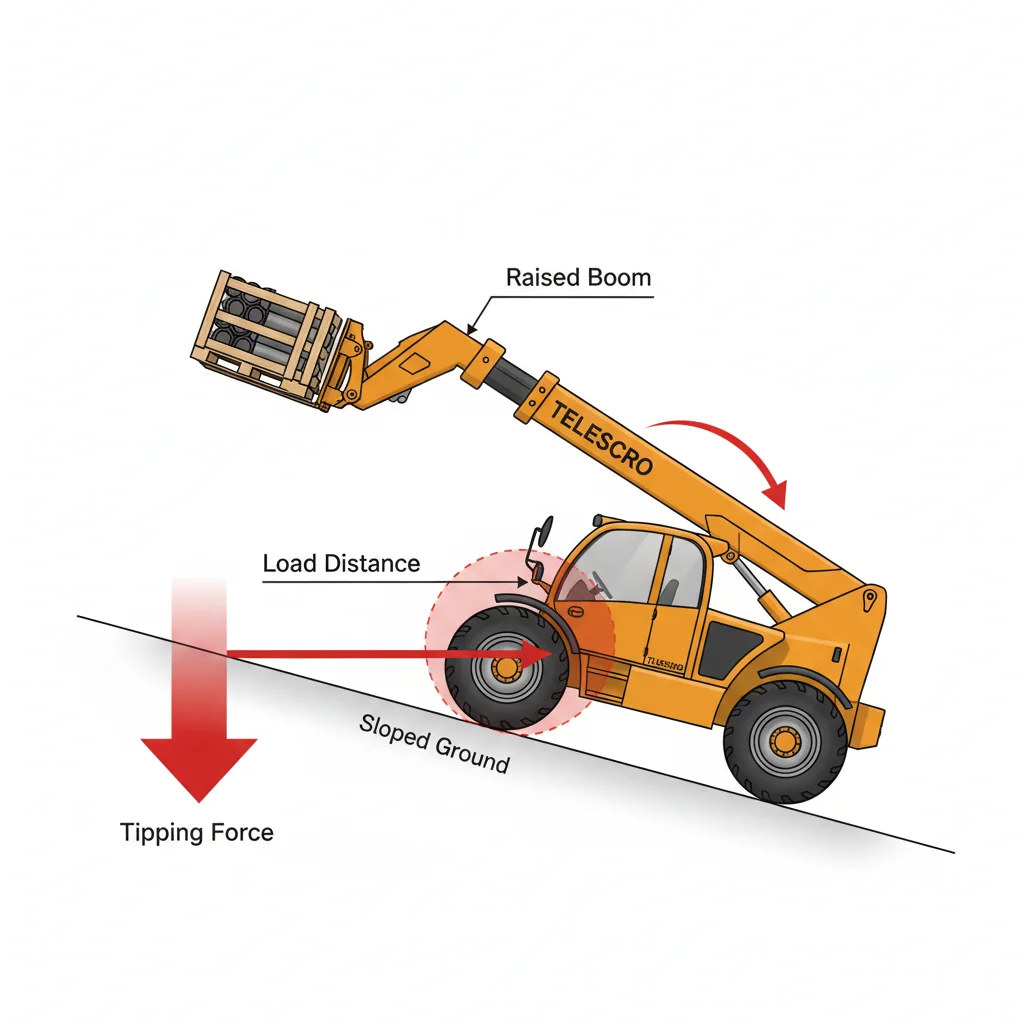
Let me share something important about telehandler stability4—how fast things can go wrong when the basics are ignored. Most people think the rated capacity is always there, but that’s only true when your machine is sitting absolutely level—within about 3°. If you’re on even a small side slope, the safe margin falls off sharply. Last year, I supported a contractor in Kazakhstan whose operator felt “just a little tilt” wouldn’t matter. They were lifting steel beams at 10 meters up, only to see the rear wheels lose contact—a near tip-over that stopped their whole site for hours.
From my experience, the most common tipping triggers are simple mistakes—booming out an extra meter for convenience, or carrying a raised load across rough ground. On one wind project in coastal China, I watched an 18-meter telehandler with a 2.5‑ton load work perfectly on firm soil. Later, a rainstorm softened the ground. The same operator tried to drive with the boom halfway up. The wheels started sinking, the load lurched, and only quick lowering of the boom prevented a full rollover. The operator admitted he thought “it felt stable” until that moment.
Here’s the thing: every meter you raise or extend the boom moves the load’s center of gravity farther from the chassis. That means rated capacity drops and your tipping margin shrinks—often by 50% or more at max reach. I always recommend treating any side slope over 3–5° as a major hazard, traveling with the boom low and retracted, and never trusting just your instincts. If the ground looks soft or uneven, take a minute to reassess—one pause can prevent a disaster.
A telehandler’s rated lifting capacity only applies when the machine is on a level surface, typically within 3 degrees of horizontal; even a slight side slope can drastically reduce safe lifting limits.True
Telehandlers use stability charts calculated for level ground. When on a slope, the center of gravity shifts toward tipping, and the rated capacity no longer keeps the operator within a safe boundary, increasing the risk of rollover.
Using the machine’s outriggers will always prevent a telehandler from tipping over, regardless of load or slope.False
While outriggers provide extra stability, they cannot overcome the dangers of lifting on a significant side slope or exceeding rated load limits—the fundamental stability principles still apply, and outriggers do not guarantee immunity from tip-overs.
Key takeaway: Telehandler stability is highly sensitive to boom extension, load placement, and ground level. Always travel with the boom low, reassess if working on soft or uneven ground, and treat side slopes over 3–5° as hazardous—never assume stability just by feel.
How Do Telehandler Load Charts Prevent Accidents?
Telehandler load charts detail the rated capacity at specific boom heights and reaches, which can be much lower than the machine’s headline figure. Overloading commonly occurs when operators rely on brochure numbers rather than the chart. Load charts are the primary safety tool against tip-over and must be referenced for every lift.
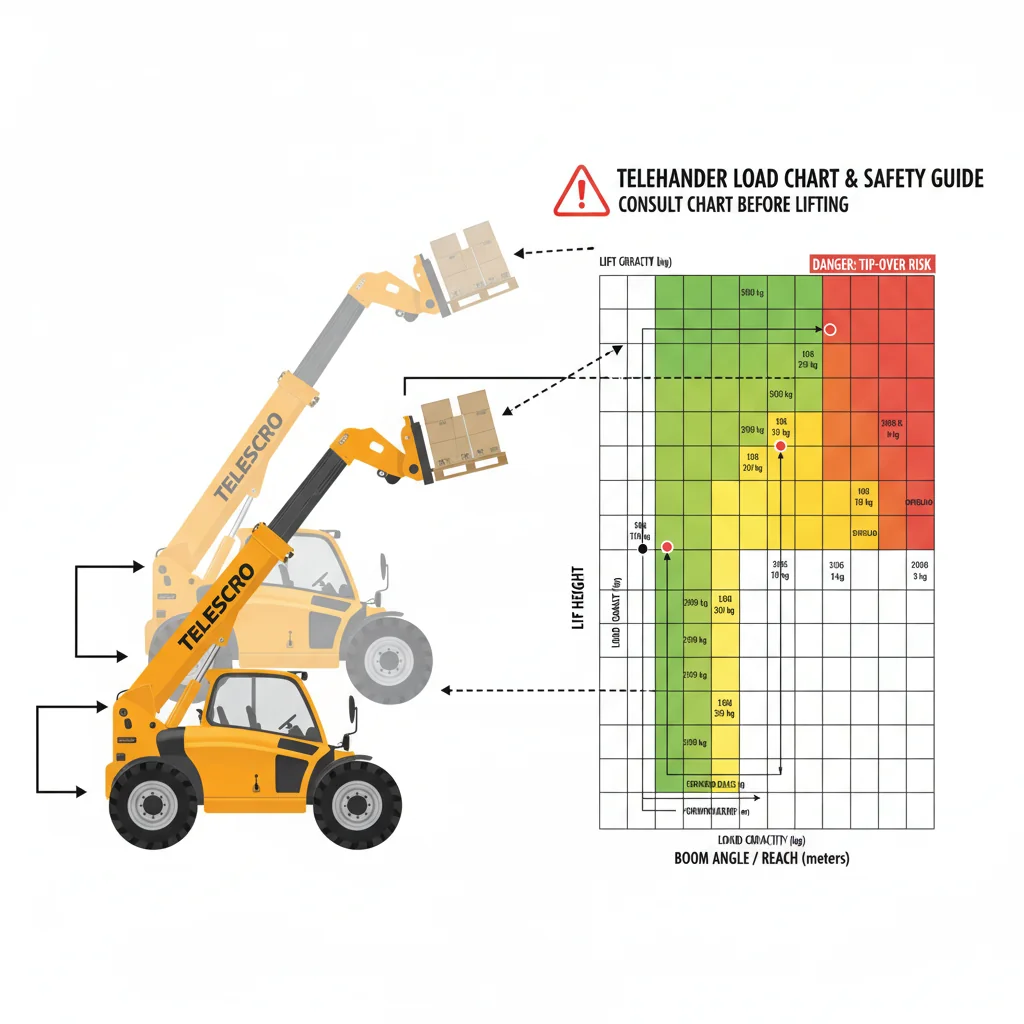
The biggest mistake I see is operators trusting the headline figure—like “4 tons”—without checking the actual load chart for their real job conditions. It catches out even experienced teams. Several years ago, I worked with a project in Dubai where crews had to lift heavy HVAC units to a rooftop, about 14 meters up. They thought their 3.5-ton telehandler could handle every lift. Turns out, at that boom height and reach, the load chart limited them to just under 1,100 kg. The crew only realized the risk when the rear end felt light, and their manager called me after a near tip-over.
Here’s what happens: the load chart in the cab isn’t just a sticker—it’s your main safety barrier. Rated capacity drops sharply as you extend or elevate the boom, especially with long forks or a bucket. Many charts for 18-meter models show a safe load of only 900–1,500 kg at maximum reach, even if the brochure says “4,000 kg.” If you miss this, the machine feels rock-solid until the last meter—then suddenly it starts to nose down. I’ve seen this scenario play out in Kazakhstan, Vietnam, and right here in China.
To be honest, the spec that actually matters is whether operators can read and explain the load chart for every attachment and situation. The chart is there to stop overloading and tip-over before it happens—not after. I always recommend making load chart training part of operator sign-off. And if you’re acquiring new machines or attachments, double-check that the correct, legible chart is present in the cab every time. That’s your real insurance on the jobsite.
Telehandler load charts account for changing lifting capacity based on boom angle and extension, not just overall machine limits.True
Load charts provide operators with critical information on how much weight can be safely lifted at specific boom heights and outreach, which is essential because the further a load is from the telehandler, the lower the lifting capacity due to leverage and stability factors.
Once a telehandler's maximum lifting capacity is known, operators do not need to consult the load chart for each individual lift as long as the load does not exceed that value.False
The maximum lifting capacity only applies at the closest boom position. As the boom is raised or extended, the safe lifting capacity decreases significantly, so operators must always refer to the load chart for every lift scenario to avoid dangerous overload conditions.
Key takeaway: Relying on a telehandler’s load chart rather than headline capacity is crucial for safe operation. The rated capacity decreases as boom height and reach increase. Operators must be trained to read and interpret load charts for each attachment and task to prevent accidents.
How Serious Is Electrocution Risk for Telehandlers?
Electrocution is a severe but often underestimated telehandler hazard, particularly when the boom operates near overhead powerlines. Serious and fatal incidents have been repeatedly reported by safety authorities, driven by risks such as electrical arcing and inadvertent contact during lifting or travel. Effective controls include route planning, clearly defined exclusion zones, visible signage, the use of trained spotters, and task-specific operator training when working near electrical infrastructure.
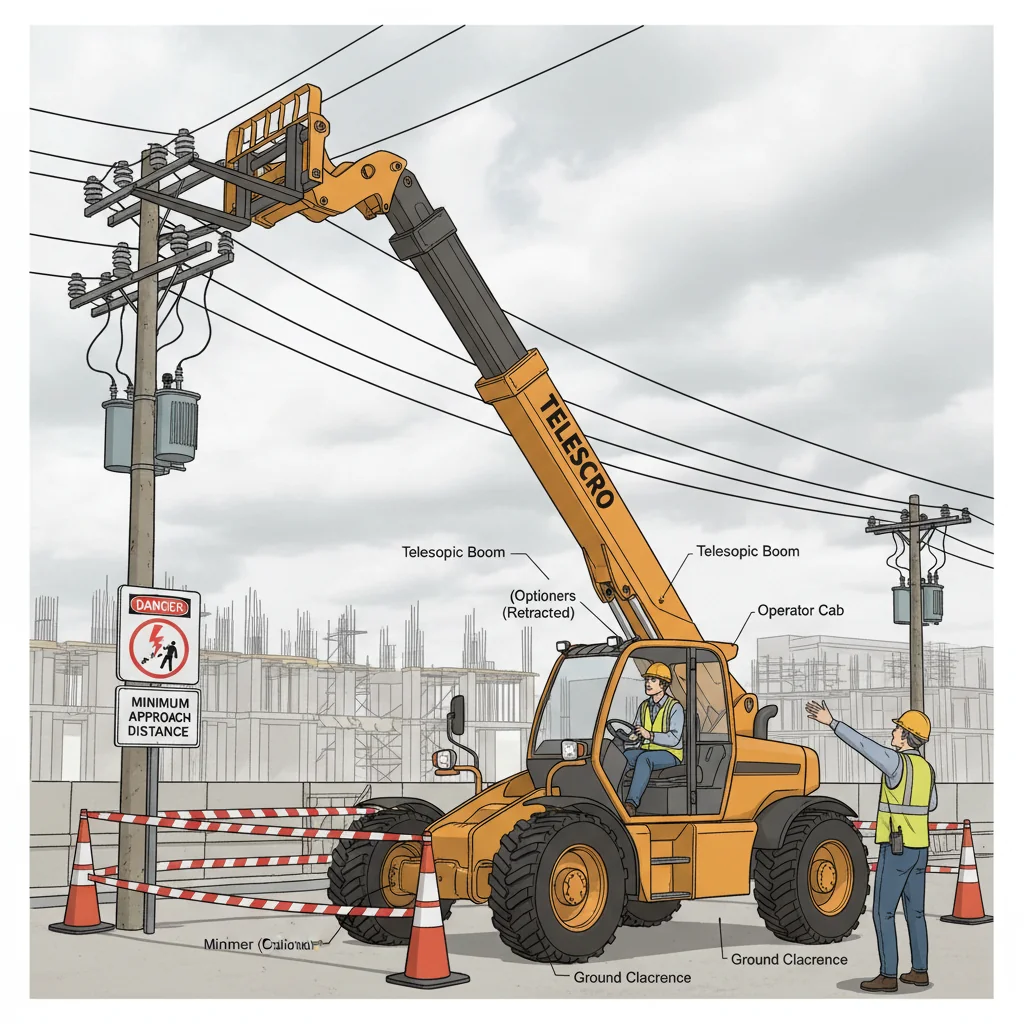
Here’s what matters most when working with telehandlers near powerlines: electrocution isn’t just a remote risk—it’s a serious, immediate threat. I’ve seen jobsites in Canada and Malaysia almost grind to a halt after a near-miss with live wires. The telehandler’s boom doesn’t need to physically touch the line for a shock; high-voltage current can arc over surprising distances, especially in wet or humid conditions. This isn’t only about the operator—if anyone grabs the load or touches any part of the machine while it’s electrified, they’re exposed too. I can’t count how many times I’ve had to remind teams to check local voltage clearances5—with 11kV lines, the safe distance is not the same as for standard power.
Last year, at a big distribution site in Dubai, a local client was moving steel trusses using a 4-ton telehandler with a 14-meter boom. The spotter lost sight of the boom’s tip and nearly swung it within 2 meters of a 33kV overhead line. If they’d made contact, the result could have been fatal for anyone touching the machine or even just standing on nearby ground—electricity travels unpredictably in these situations. We reviewed the work zone and established clear exclusion barriers. Now, each move near utilities starts with a 5-minute safety talk and route check. That single routine has already prevented at least one serious incident. I always recommend marking approach limits on the ground using high-visibility cones or tape—physical cues work better than signs alone.
A telehandler can cause electrocution even if its boom comes within close proximity to a high-voltage power line, due to the phenomenon of electrical arcing.True
High-voltage electricity can sometimes arc through the air to nearby objects, especially in humid or wet conditions. This means the operator does not have to actually touch the power line to be at risk—just getting close can be hazardous.
Only the telehandler operator is at risk of electrical shock when a telehandler is near powerlines, as passengers and ground crew are protected by the machine's insulation.False
Anyone touching any part of the telehandler or its load can be part of the electrical path if there is contact or arcing with a live powerline. The entire machine and anything it’s lifting can become energized, putting ground crew and others at risk.
Key takeaway: Electrocution risk with telehandlers is severe and extends beyond the operator to anyone in contact with the machine or ground near powerlines. Proactive planning, exclusion zones, competent spotters, and operator training on emergency procedures are essential to prevent fatal incidents involving overhead electrical hazards.
How Do Telehandler Crush Accidents Happen?
Crush and run-over incidents with telehandlers mostly involve people on the ground rather than operators. Large blind spots, restricted views from the boom or loads, and unpredictable pedestrian movement on busy sites are key factors. Fatalities often occur during reversing, tight manoeuvres, or when pedestrians approach the telehandler’s path.
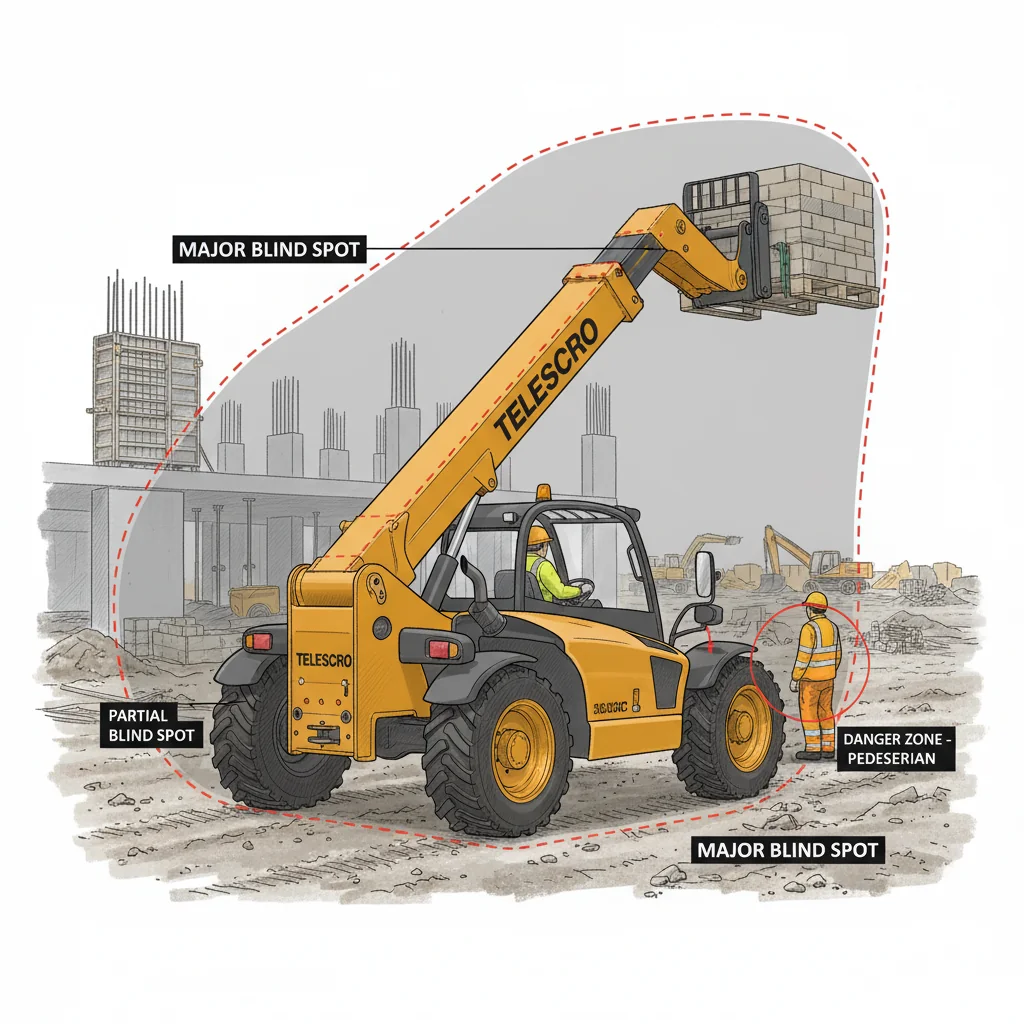
I’ve worked with customers in Dubai and Brazil who were shocked at just how easy it is for someone on the ground to end up in a telehandler’s blind spot. Even experienced operators can’t see everything around them—especially with the boom raised or a bulky load blocking their view. One project in Dubai last year had a worker step behind a 4-ton telehandler reversing near a stacked pallet zone. The operator had checked his mirrors but missed the guy because the rear blind spot stretched over three meters—a gap nobody had planned for. The result? A close call that could have been fatal.
On busy sites, it’s not just reversing that’s risky. Pedestrians often take shortcuts across loading areas or between parked trucks and operating machines. I’ve seen this in Kazakhstan when a forklift driver ducked under a raised boom to cut a few steps. At that moment, any movement or hydraulic drift could have been deadly. The truth is, operator vigilance alone can’t prevent these situations. Too many sites rely on “be careful” as the main safety plan.
From my experience, real prevention starts with traffic management6—clear routes, fencing, and enforced pedestrian exclusion zones. Simple additions like reversing alarms, wide-angle mirrors, and if possible, 360° cameras, make a huge difference. When visibility drops—like in muddy weather or tight warehouses—I always recommend using a trained spotter. Most fatal accidents I’ve heard of happened when nobody was there to guide the operator in low-visibility situations. Set strict “no go” rules around moving or lifted loads, and back them up with barriers or cones. That’s where the real protection comes from.
A telehandler’s rear blind spot can be large enough to fully hide an adult worker even if the operator checks the mirrors.True
Telehandlers have significant blind spots due to their size, design, and elevating boom, especially to the rear. Mirrors do not always cover the entire area behind the machine, and raised booms or loads can further obstruct visibility, making it possible for a person to be completely hidden from the operator’s view.
Telehandlers are designed so that the operator always has a clear, unobstructed view of the ground around the machine during operation.False
While telehandlers are equipped with mirrors and sometimes cameras, their design—especially with a raised boom or large load—often creates blind spots. Operators can lose sight of ground workers, particularly behind the machine or along the sides, making unobstructed visibility impossible in many real-world scenarios.
Key takeaway: Most telehandler crush accidents result from blind spots, poor traffic management, and lack of pedestrian controls on site. Effective prevention requires separating pedestrians from operating zones, clear traffic routing, and implementing safety features like reversing alarms, spotters, and cameras—not relying solely on operator vigilance.
Why Do Loads Fall from Telehandlers?
Loads fall from telehandlers mainly when loads are not properly secured, centered, or exceed the machine’s rated capacity for the boom position. Common causes include incorrectly spaced forks, damaged attachments, and carrying materials with the boom raised. Using only approved attachments and daily fork inspections are effective preventive controls.

Last month, a contractor in Brazil sent me photos of a pallet of tiles tipped off their telehandler forks—luckily, no one was hurt, but the tiles shattered and shut down the upper floor for the morning. The cause? Forks were set too far apart, so the narrow pallet bounced and slid as they crossed uneven ground. This kind of thing happens more than you’d expect, even to trained teams. Loads shift or fall whenever forks aren’t spaced right, or the load isn’t centered. If you use homemade hooks or non-approved attachments, the risk jumps fast—I’ve seen bent brackets snap clean off under just half the rated load.
A lot of customers think a machine rated for 4,000 kg can carry anything up to that number, no matter the boom angle or position. The reality is very different. For example, on most 4-ton, 13-meter telehandlers, you might only get 1,300–1,600 kg safely at max extension, according to the load chart. Lift more than that—or keep the boom raised while driving—and things get unstable quickly. I always recommend checking that machine’s load chart before every job, since boom position changes everything.
Traveling with the boom high is another common trigger. Best practice? Keep the load around 20–30 cm (8–12 inches) off the ground, move slowly, and use straps for tall or odd-shaped items. I tell teams in Kenya and Vietnam the same thing: inspect forks and quick couplers daily, and keep extra people clear from the travel path. These small habits prevent dropped loads—and the headaches that follow.
A telehandler can lose its load if the forks are set too far apart for a narrow pallet, causing the load to wobble and slide, especially on uneven surfaces.True
When forks are spread wider than the load’s base, there’s less contact and lateral support, increasing the risk of the load shifting or falling as the machine moves, particularly over rough or sloped ground.
Telehandlers are designed so that fork spacing has no effect on load stability as long as the load does not exceed rated capacity.False
Even within rated capacity, improper fork spacing can make loads unstable by reducing lateral support. The load needs to be centered and fully supported across its base to prevent movement or tipping.
Key takeaway: The most frequent cause of dropped loads from telehandlers is improper load handling—such as poor fork spacing, unapproved attachments, or oversized loads at height. Always secure and restrain difficult loads, use only manufacturer-approved gear, and inspect load-handling components daily to minimize risk.
What Training Makes Telehandler Operation Safer?
Telehandler safety depends on task-specific training rather than general plant experience alone. Effective programs cover interpreting load charts, boom dynamics, stabiliser use, ground condition assessment, and working near site-specific hazards. Training and authorization requirements vary by jurisdiction and by how the telehandler is used, with additional certification required in some regions or configurations. Clear site-specific procedures and regular operator assessments are essential for minimizing risk.

I’ve worked with customers who made the mistake of sending “all-rounder” plant operators to run telehandlers, thinking that loader or forklift experience was enough. That’s usually where accidents start. In Kazakhstan last winter, one project halted for three days after a telehandler nearly tipped—operator missed a key detail on the load chart and forgot to factor in slope on icy ground. Luckily, no one was hurt, but poor training and no refresher cost them time and credibility on a major contract.
The reality is, telehandler training isn’t just a matter of ticking a box. Operators need to know how boom angle, reach, and stabilizer position affect lifting—capacity can drop by half at full extension. I always remind clients: the manufacturer’s load chart is your “bible” for safe operation, not a guideline. For jobs above 3,000 kg or where people use work platforms, most sites require specific certification, and many insurers demand annual proof of competency. That means hands-on training with each attachment type, not just the forks.
Formal programs should include practical modules—checking ground conditions, using the load moment indicator7, and practicing emergency lowering. Written procedures matter just as much. On a site in Kenya, a simple checklist—“stabilizers out, check slope, read load chart, verify attachment pin”—reduced near misses by half in six months.
So, don’t gamble on generic plant training. I suggest treating telehandlers as high-risk machines that demand rigorous record-keeping, regular skills audits, and clear site rules. Investing in proper training and process saves more than it costs—one accident can set your project back weeks.
Formal telehandler training focuses on reading and interpreting load charts, which is crucial for safe lifting on uneven or slippery ground.True
Telehandler operators must understand how load charts change with boom extension, angle, and environmental factors like slope or ice. This knowledge goes beyond basic forklift or loader training, directly reducing the risk of accidents in challenging site conditions.
Operating a telehandler is safe as long as the operator has experience with other equipment, even if they haven’t received specific telehandler training.False
Telehandlers have unique stability, reach, and load handling characteristics that differ from forklifts or loaders. Without dedicated training, operators may overlook critical factors—such as boom position or terrain effects—leading to a higher risk of accidents.
Key takeaway: Specialized telehandler operator training, combined with rigorous site procedures and documented competency checks, is essential for safe operation. Relying on generic equipment experience is inadequate; adherence to manufacturer load charts and regulatory certification requirements is crucial to mitigate risk and satisfy insurers or clients.
Which Telehandler Features Improve Operator Safety?
Selecting the correct telehandler model and safety features directly reduces operator risk. Key options include ROPS/FOPS-certified cabs8, load moment indicators, boom sensors, stabiliser interlocks, and high-visibility cabs. Proper sizing, matching rated capacity and reach to task requirements, and using manufacturer-approved man-platforms for personnel further minimizes danger.
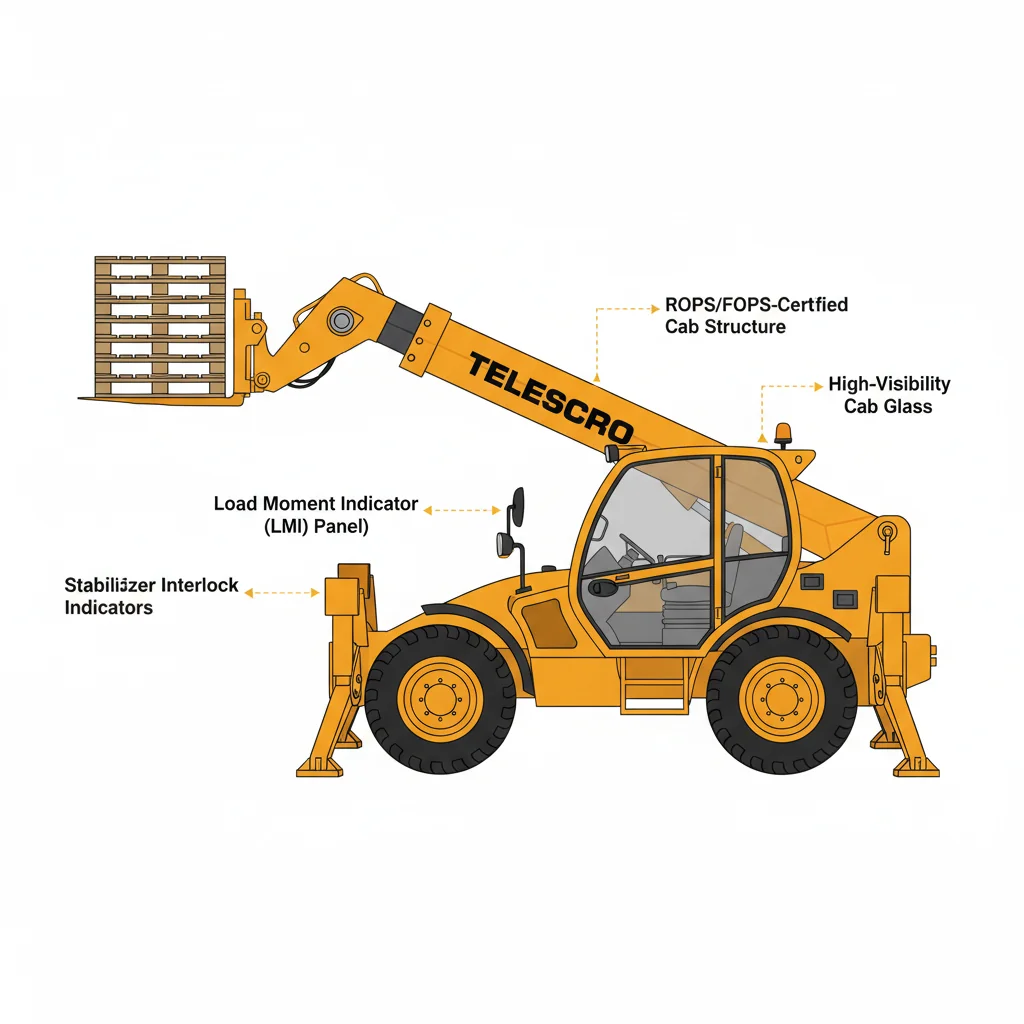
From my experience, buyers often get distracted by maximum specs and ignore key safety features that actually keep operators out of trouble. Take a small site I worked with in Kazakhstan—the owner wanted a heavy 4-ton telehandler, even though the majority of lifts averaged just 1,200 kg. That oversized machine ended up awkward to maneuver in tight spaces, and the operator struggled with blind spots. In reality, a compact 2.5-ton unit with a high-visibility cab and solid safety gear would have reduced the risk of accidental contact and tip-overs.
When comparing telehandler safety options, it helps to see how different features stack up:
| Safety Feature | What It Does | Why It Matters | Typical Models |
|---|---|---|---|
| ROPS/FOPS Cab | Protects operator from rollovers & falling debris | Required on every modern jobsite | All types |
| Load Moment Indicator (LMI) | Warns/limits overloads by sensing tip risk | Stops operation before instability | Mid/high-range, rotating |
| Boom Angle/Extension Sensors | Monitors safe boom position | Prevents out-of-chart lifts | Most mid/high-range |
| Stabiliser Interlocks | Only allows lifting when stabilisers are set | Critical for full capacity, especially rotos | High-reach, rotating |
| High-Visibility Cab & Cameras | Reduces blind spots | Prevents site collisions | Premium, new-generation |
| Telematics/Event Logging | Records misuse, overloads | Enables early intervention | High-spec, fleet models |
Telehandlers equipped with high-visibility cabs and surround-view cameras can significantly reduce accidents caused by blind spots during operation.True
Blind spots are a known hazard with telehandlers, especially when maneuvering in confined areas. High-visibility cabs and camera systems enhance the operator's field of view, reducing the likelihood of collisions or incidents with nearby personnel or obstacles.
Selecting a larger telehandler with a higher maximum lift capacity always results in safer operation on any jobsite.False
Oversized machines can actually increase risk in tight or crowded jobsites due to reduced maneuverability and larger blind spots, making the machine harder to control and more difficult for operators to maintain awareness of their surroundings.
Key takeaway: Telehandler safety depends on matching the machine’s rated capacity, lift height, and features to site and task requirements. Prioritizing proven safety systems and correct model selection over sheer size reduces risks of instability and misuse, supporting safe operation in line with manufacturer and regulatory guidance.
How Do Slopes and Wind Affect Telehandler Safety?
Telehandlers are rated for stability on firm, level ground under the operating conditions defined by the manufacturer. Working on side slopes, soft or uneven ground, or with the boom extended can rapidly reduce stability and increase tip-over risk. Wind also plays a significant role—particularly when handling large or elevated loads or approved work platforms—so operators must follow manufacturer guidance and attachment-specific limits, as illustrated by industry discussions on wind effects such as those outlined for elevated equipment operations (wind considerations9).

To be honest, ground conditions and weather are often underestimated—until something goes wrong. Telehandlers are tested on flat, stable surfaces, usually with less than 3° tilt and firm support under each wheel. But real jobsites aren’t so perfect. In western China, I once visited a solar project where the team tried to lift panels with the machine parked half-on packed earth, half on gravel. Just a slight side slope—maybe 6°—combined with some rain-softened ground, nearly caused the telehandler to tip when the boom went out past 12 meters. The operator stopped just in time, but it could have been a serious accident.
What makes slopes and wind so risky is how fast stability drops off. A side slope above 5° does not seem much, but with a load at height or boom extended, you’re approaching the limits within seconds. And wind? I worked with a crew in Kazakhstan lifting glass wall panels for a hotel project. Wind hit 14 m/s (about 31 mph) during a platform lift, and the machine’s moment indicator alarmed—the safe rated capacity was instantly reduced, and the lift had to be cancelled. Most manufacturers set a hard stop for platform use above 12–15 m/s. Ignore that, and you’re playing with disaster.
I always suggest planning safe routes ahead of time. Mark “no-go” areas by trench edges, backfilled sections, or steep slopes. Probe questionable ground—don’t trust appearances. If the wind picks up or conditions feel off, empower your operator to pause the job. A safe delay is far better than a tipped machine.
Operating a telehandler on a modest side slope can increase the risk of tipping, even when the machine is within rated load limits.True
A telehandler's center of gravity can shift dangerously on uneven ground, meaning that loads considered safe on flat surfaces become unstable on slopes, increasing tip-over risks despite following load charts.
Weather conditions like wind are only a concern when lifting loads at maximum boom extension.False
Wind can cause instability at various boom positions, not just at full extension. Even partially raised booms with large or lightweight loads, such as panels or trusses, can be affected by wind, making it a constant safety consideration.
Key takeaway: Telehandlers must not be operated at rated capacity on slopes or in high winds. Even a 5° slope or soft ground can exceed safe stability limits. Pre-plan routes, mark hazardous zones, and empower operators to refuse lifts if ground or weather conditions are unsafe.
How Does Maintenance Impact Telehandler Safety?
Maintenance directly affects telehandler safety. Mechanically sound units behave predictably, while neglected machines present severe hazards: weak brakes can lead to runaways, worn boom components create erratic loads, and hydraulic leaks10 cause unsafe boom movement. Strict daily checks and scheduled inspections are essential for minimizing operational risk.

Here’s the thing—telehandler safety isn’t about luck or operator skill alone. If a machine’s brakes or hydraulics aren’t maintained, it simply will not behave the way you expect. For example, I worked with a project manager in Kazakhstan who skipped daily checks on their 3.5-ton unit. Three months in, his crew experienced a sudden boom drop due to a leaking hydraulic hose. No injuries, but it shook everyone up. The cause? A small leak that went unnoticed during rushed pre-shift walkarounds.
Every critical component has a direct link to operator safety. Weak service brakes or a failed parking brake can let a fully loaded machine roll down a slight slope—just a 2% grade can be enough if you’re carrying 2,000 kg. Structural issues are just as dangerous. I’ve seen cracked boom welds on older units in Kenya after years of rough loading. Ignoring cracks or worn boom slide pads can result in unpredictable movements—like shocks, sudden jerks, or drift while the boom is extended. That’s not something you want when lifting fragile materials 13 meters up.
I always suggest a strict daily routine: check tyre condition and pressure (keep it within about 0.2 bar of spec), make sure the forks have no cracks or over 10% wear, and confirm every safety device works—horn, lights, alarms. Schedule thorough periodic inspections too, including non-destructive testing for older machines. And if you’re considering a used telehandler, get an independent structural inspection and look closely at service records for any sign of overload or past mishaps. A little maintenance discipline reduces risk more than any safety sticker ever could.
Undetected hydraulic fluid leaks in a telehandler can lead to unpredictable boom movement, increasing the risk of dropped loads or sudden machine instability.True
Hydraulic systems are responsible for controlled movement of the telehandler's boom. If leaks go unchecked, hydraulic pressure may drop unexpectedly, making the boom react slower or more erratically, which can compromise both load handling and operator safety.
If the telehandler’s engine is running smoothly and without strange noises, there is little risk of safety incidents related to mechanical failure.False
A smooth-running engine does not indicate that critical safety systems like brakes, steering, or hydraulics are in good condition. Many mechanical issues that cause safety hazards do not affect engine performance and may not present obvious warning signs at first.
Key takeaway: Comprehensive maintenance, including daily safety checks and periodic thorough inspections, is critical to telehandler safety. Failing to address wear, hydraulic leaks, or structural issues can turn an inherently safe machine into a serious workplace hazard. Prioritize both routine and in-depth examination to manage risk.
What Is the True Cost of Telehandler Accidents?
Telehandler accidents can rapidly incur costs beyond initial repairs and downtime, often reaching tens or hundreds of thousands of dollars when medical expenses, regulatory fines, legal claims, lost contracts, and reputation damage are included. In contrast, structured operator training and essential safety features require only a modest investment compared to potential accident-related liabilities.

The biggest mistake I see is managers focusing only on the repair bill after a telehandler accident. That’s just the tip of the iceberg. I’ve helped a client in Kazakhstan who thought a minor tip-over would cost a few thousand dollars. Instead, they ended up with not just boom and bodywork repairs, but over two months of machine downtime, an injured operator needing medical care, and a lost contract on a high-rise project, all together costing well over $85,000. When an accident leads to injuries—or worse—costs can skyrocket fast. There’s compensation payouts, insurance premiums that jump for years, investigations, and in places like the EU or US, regulators might issue fines that dwarf any initial repair cost.
But the real long-term price is often reputation. In Brazil, I saw a contractor lose their biggest logistics customer after a load dropped due to operator error. The equipment was fixed in three weeks. Their image with local developers? Broken for much longer. Clients pay attention to safety records, especially on large sites. Word gets around quickly if your team is seen as careless with complex machines like telehandlers.
Let me share something important about managing this risk. Training one operator thoroughly might cost $300–$400. Modern safety features—like load moment indicators or extra cameras—rarely add more than 2–3% to the price of a standard 3.5-ton, 14-meter telehandler. Compare that to six-figure legal claims, and the calculation is simple. I always suggest budgeting for training, regular inspections, and proven safety add-ons from the very start. That’s real asset protection—and long-term business insurance.
The indirect costs of a telehandler accident, such as project delays and lost contracts, can frequently surpass the direct repair expenses.True
Beyond fixing the machine, accidents can halt workflow, incur penalties, and undermine business relationships, often resulting in total losses much greater than the repair costs alone.
Telehandlers are rarely dangerous to operate because their stability systems prevent nearly all tip-overs under real-world conditions.False
While telehandlers include safety features, improper use, overloading, and operator error still contribute to tip-overs and accidents, making them potentially dangerous if not operated correctly.
Key takeaway: Investing in telehandler safety—through operator training, robust inspections, and proven safety technologies—significantly reduces accident risk and financial exposure. For fleet managers and contractors, safety measures are not optional expenses but vital components of responsible asset protection and long-term business sustainability.
Conclusion
We’ve looked at why telehandlers are considered high-risk and how following the load chart—not gut feeling—keeps jobsites safer. From what I’ve seen, operators who stick to the right safety routines avoid nearly all the scary moments you sometimes hear about. Don’t let the machine’s size or impressive reach distract from checking actual stability; that’s the #1 cause of preventable accidents.
If you have questions about interpreting load charts, safe setup, or specific attachments, I’m happy to share what’s worked for real crews across different countries. Feel free to reach out any time. Every jobsite is different, so real-world advice matters most.
References
-
Detailed guidance on operator training reduces accidents by improving handling skills and adherence to safety protocols on telehandlers. ↩
-
Expert insights on interpreting load charts ensure safe lifting practices and prevent overturns by understanding load capacity limits. ↩
-
Understand how rated capacity varies with boom height and reach, critical to preventing overloads and enhancing jobsite safety. ↩
-
Detailed insights into how boom position affects telehandler balance, crucial for preventing tip-over accidents on construction sites. ↩
-
Explains the importance of maintaining proper voltage clearances to avoid electrical arcs and ensure safety around high-voltage overhead lines. ↩
-
Learn practical traffic management strategies for busy construction sites to reduce telehandler-related accidents and protect pedestrians effectively. ↩
-
In-depth look at LMI technology, how it senses load and alerts operators to tipping risk, improving site safety and equipment longevity. ↩
-
Detailed explanation of ROPS/FOPS cab standards, their role in protecting operators from rollovers and falling debris, with expert insights. ↩
-
Details how high winds reduce telehandler stability and prompt manufacturers to limit platform use, preventing accidents during lifts. ↩
-
Detailed explanation of how hydraulic leaks create unsafe boom movement risks and best practices for inspection and repair. ↩