










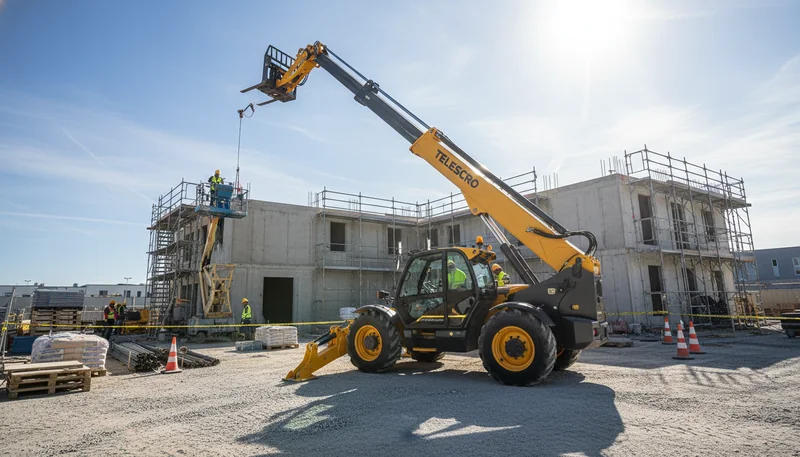
How to Select the Right Telehandler Jib Boom (Avoid Common Pitfalls)
Last month, an Australian project manager sent me a photo of a snapped lifting chain—his team had picked a jib based only on “max lift” and ignored the load chart entirely. Trust me, I’ve watched that mistake turn deadlines and budgets upside down on more than one jobsite.
Selecting an appropriate telehandler jib boom hinges on understanding both machine-specific and attachment-specific load charts, as these determine true safe operating ranges under varying reach and angle. Rated capacity typically decreases by 30–50% when a jib attachment is in use, with the jib’s own weight and load center1 extension further limiting maximum safe loads. The configuration—whether adjustable, truss, or heavy-duty—should correspond directly with key recurring applications, since misalignment can lead to operational
How Do Load Charts Guide Jib Selection?
Telehandler load charts2 determine safe jib boom selection by specifying allowable capacities at various heights, reaches, and boom angles for each machine and attachment combination. Selecting a jib based solely on the base capacity plate is unsafe. Attachment-specific charts3 reveal that jib booms typically reduce rated capacities by 30–50%, so reviewing these charts is essential for every planned lift.

The biggest mistake I see is operators relying only on the base telehandler’s capacity plate when sizing a jib. That plate might say 4,000 kg, but the moment you fit a jib boom, your numbers change—often by 30–50%. I’ve worked with a team in Kazakhstan who discovered this the hard way. They planned to lift 2,500 kg pipe sections out to 12 meters using a long jib, assuming their 5,000 kg telehandler could manage it without any trouble. When we double-checked the attachment-specific load chart, capacity at that reach dropped to just over 3,000 kg. It worked, but only just. If their pipes weighed even 500 kg more, they’d have needed to change their plan on the fly.
Most people don’t realize that every jib attachment comes with its own chart, showing how safe capacity varies by height, outreach, and boom angle. The chart is built around your exact telehandler model, not just some average spec. For example, a compact 3-ton machine rated for 8 meters on forks may handle only 1,700 to 2,000 kg at full reach with a 2-meter jib. Also, keep in mind—added jib weight4 reduces what you can actually lift at working distance.
Let me share something important about planning lifts. I suggest defining three numbers before you even choose a jib: your maximum load weight, your highest working point, and the horizontal distance needed. Always verify those against the manufacturer’s chart for your machine with that exact jib. This single check prevents site delays, last-minute rigging changes, or, worse, a dangerous overload.
When a jib boom is attached, the telehandler’s maximum lifting height and stability arms must also be considered, as the added leverage can reduce the rated capacity by up to 50% at extended reachesTrue
The jib boom changes the load moment by extending the load further from the telehandler’s center of gravity, thus significantly decreasing rated capacity and often requiring outriggers or stabilizers to counterbalance the increased tipping risk. Load charts specific to the attachment provide these adjusted ratings.
Load charts for jib booms typically show the same lift capacities regardless of the jib length because modern telehandlers compensate electronically for all attachmentsFalse
Telehandlers do not electronically compensate for the mechanical disadvantage introduced by longer jib lengths; instead, load charts explicitly reduce capacity ratings to reflect increased leverage and stability concerns, making it unsafe to assume identical capacities across different jib lengths.
Key takeaway: Always rely on manufacturer’s attachment-specific load charts—never just the base machine rating—when selecting a telehandler jib boom. Failing to confirm capacities at needed heights and reaches risks unsafe lifts and operational setbacks, as jib attachments substantially alter maximum safe loads compared to forks.
How Do Load Center and Jib Weight Affect?
Load center and jib weight directly impact a telehandler’s lifting capacity. Extending the load with a jib boom increases the load center distance, significantly reducing safe maximum loads. Additionally, the jib’s own weight—often several hundred pounds—must be subtracted from rated chart capacities to avoid overloading and ensure safe operation. Always consult the specific load chart for the attachment.

Let me share something important about how load center and jib weight actually affect what your telehandler can lift. Most people think only about the max capacity—let’s say 4,000 kg—but that number means very little the moment you use a jib boom. What matters is how far out the load sits from the front wheels (the load center). Every centimeter further means less real capacity. In Dubai, I worked with a contractor who tried to place a 2,000 kg generator onto a rooftop using a 6-meter jib. On the chart, their telehandler could lift 2,300 kg at that outreach, but after including the jib’s own weight (almost 400 kg), he was dangerously close to overload. I explained that the safe lifting weight is always the chart’s capacity minus the weight of the attachment—so in this case, only about 1,900 kg at that position.
From my experience across projects in Kazakhstan and South Africa, ignoring jib weight causes more load chart mistakes than almost anything else. The numbers may seem small—a typical jib can weigh 180 to 400 kg—but that’s a huge percentage when you’re near the machine’s limits. Also, loads hanging further out multiply the tipping risk, not just due to weight but due to the hydraulic circuit pressure and leverage on the chassis.
For safety and stability, I always suggest three things:
(1) check the telehandler’s load chart specific to your attachment;
(2) subtract the exact jib or boom dead weight from the capacity;
(3) keep loads as close to the front axle as the job allows.
This detail can mean the difference between a safe lift and a disaster on site.
Extending a jib boom by 1 meter can reduce a telehandler’s lifting capacity by approximately 10-15% due to increased leverage and load center distanceTrue
The load center distance directly affects lifting capacity because the farther the load is from the front axle, the greater the moment arm. Extending the jib increases this distance, leading to a significant capacity reduction often quantified around 10-15% per meter extension depending on machine design.
Using a jib boom does not affect the telehandler’s rated capacity as long as the load itself remains under the maximum weight limitFalse
Rated capacity is based on load center and machine stability, not just load weight. Adding a jib boom shifts the load further from the lift point, increasing leverage and reducing capacity. Ignoring this results in unsafe operations and potential equipment damage.
Key takeaway: Accurate telehandler capacity assessment depends on both load center and jib weight. Relying on headline numbers risks serious overloads; always use the jib-specific load chart, subtract the jib’s weight from rated capacity, and keep loads as close as possible to the machine for safety and stability.
Which Telehandler Jib Boom Type is Best?
Selecting the correct telehandler jib boom depends on core applications. Adjustable or telescopic jibs5 excel in variable-height work like HVAC installation or general construction. Truss jibs6 are ideal for framing, roof trusses, and fine placement at elevated positions. Heavy-duty industrial jibs accommodate high-capacity manufacturing, plant, or material yard environments, typically handling loads from 2,000 to 20,000 lb depending on the model.

Most people don’t realize that picking the right telehandler jib boom is less about specs and more about your daily jobsite routine. If you’re mainly lifting air-conditioning units to different floors, an adjustable or telescopic jib (typically in the 4–12 ft or 1.2–3.6 m range) gives you that flexibility. I’ve worked with contractors in Dubai who needed to swap between short- and mid-reach multiple times per shift—these adjustable industrial jibs made their life easier, especially in tight rooftop spaces. You get multiple pin positions, so you can fine-tune your reach and lift angle without wasting time. For framing and roof installs, truss jibs are a different animal. These are popular in North America, where builders use telehandlers to set wood trusses or steel beams at heights up to 10 meters.
One client in Texas was setting steel beams on a warehouse project: with a 3.6-meter truss jib, they hit the sweet spot for reach and precise placement. Compared to an all-purpose jib, truss jibs keep control steady and reduce risk when placing long materials overhead. Heavy-duty industrial jibs are all about raw capacity. If you’re working in a steel plant, pipe yard, or manufacturing yard, lifting 5,000–20,000 lb loads, these models stand out. I saw a team in Kazakhstan use a 9-ton heavy-duty jib to handle machine parts—they couldn’t risk overloading or awkward angles, so they checked the load moment indicator (that’s the warning gauge for safe lift limits) every lift.
Adjustable telescopic jib booms ranging from 4 to 12 feet provide greater operational flexibility on tight jobsite spaces by allowing multiple reach configurations without swapping attachmentsTrue
Adjustable telescopic jibs enable quick length changes between roughly 1.2 to 3.6 meters, so operators can adapt reach length to confined areas or variable lifts without stopping work to change booms, increasing productivity and safety.
Fixed-length jib booms below 6 feet generally provide better load capacity and stability than adjustable telescopic jibs of the same lengthFalse
Load capacity and stability depend more on the telehandler's design and boom engineering rather than jib boom type; adjustable telescopic jibs do not inherently reduce load capacity compared to fixed-length jibs of similar size.
Key takeaway: Map out the top 2–3 recurring jobsite tasks before selecting a telehandler jib boom. Align application needs—such as HVAC, trusses, or heavy lifting—to the jib family engineered for those demands, minimizing unnecessary costs or performance issues from using the wrong attachment.
What Telehandler Jib Length Suits My Job?
Jib length determines telehandler utility. Longer jibs (4–5 m) provide greater reach but reduce tip capacity7, while shorter jibs (2–3 m) offer better stability and lifting power. Fixed jibs excel in repetitive, predictable environments, while adjustable/telescopic jibs provide versatility for jobs with changing reach and load needs. Site measurement and load chart review are essential.

Last month, a contractor in Dubai asked me why his telehandler couldn’t lift roof trusses as smoothly as expected. He was using a 5-meter jib to reach over a wall, but the load chart showed his 4-ton machine could only handle about 1,100 kg at full extension—not enough for his job. That’s a classic case. Longer jibs offer more reach, but you lose a lot of tip capacity—sometimes over 35% depending on your telehandler’s size and geometry. It’s tempting to go with the longest jib available, but I’ve seen people waste hours repositioning or even rent a second machine when a shorter, sturdier jib would do the job in one shot.
From my experience, for most yard work or repetitive lifting, a fixed jib8 in the 2 to 3-meter range is a smart fit. I worked on a steel yard project in Kazakhstan where the operator lifted heavy beams—around 1,800 kg each—on a tight, flat site. They used a fixed 2.5-meter jib and finished a full day’s work without stability alarms or slow cycles. Fixed jibs excel when your pick-and-place points barely change.
But what if your jobsite is unpredictable? On building maintenance sites in South Africa, I’ve watched crews switch extension length several times per hour. Adjustable telescopic jibs—usually adjustable between 1.5 meters and 4 meters—let you match the lift precisely to the task. Here’s what matters most: always measure the furthest placement distance and hook height, then check your actual load chart at that specific extension. I suggest taking ten minutes on-site to verify these before ordering your attachment—it saves headaches later.
Extending a telehandler jib boom from 3 meters to 5 meters can reduce the tip load capacity by over 35%, depending on the machine's geometry and base capacityTrue
The longer the jib, the greater the leverage applied to the telehandler's lifting point, significantly reducing the maximum safe load capacity at the jib tip, often by more than a third when extending from 3m to 5m on mid-sized machines. Load charts reflect these reductions precisely based on the boom geometry and stability.
Using a longer jib boom on a telehandler always increases its overall lifting capacity because leverage improves mechanical advantageFalse
Longer jibs increase leverage on the telehandler, which actually decreases the maximum allowable load at the jib tip due to stability and structural limits, meaning lifting capacity typically drops rather than increases with longer boom extensions.
Key takeaway: Matching jib length and adjustability to job requirements optimizes safety and efficiency. Fixed jibs are robust for repetitive lifts, while adjustable jibs suit varied sites. Always measure distances and check load charts at target extension to ensure the selected jib boom meets lifting capacity for each application.
How Do Mount Style and Compatibility Affect Jib?
Mounting style and compatibility are crucial for selecting a telehandler jib boom. Quick-attach jibs9 connect directly to a machine’s coupler for fast swaps but may only fit specific brands, while fork-mounted jibs10 offer broader compatibility and lower cost. Choosing the wrong type limits efficiency, increases downtime, or may render the attachment unusable.

To be honest, mount style and compatibility are two specs that cause the most trouble on the jobsite—especially when crews work with mixed fleets. I’ve seen this firsthand on sites in Kazakhstan and Mexico, where a fleet had half compact 2.5-ton telehandlers and half high-reach 4-ton units. The project manager picked a quick-attach jib boom, thinking it’d fit all machines. But when it arrived, the coupler plates were only compatible with the larger units. The result? Two telehandlers sat idle every time they switched to jib work, costing a full day each week just in swaps and lost time.
If your team changes attachments five or more times a week, a quick-attach jib is more efficient—even if it comes at a higher upfront cost (usually above $4,000 for well-built models). These jibs connect directly to the machine’s quick-coupler and lock into place. Changeover time drops to under 5 minutes, with no tools required. The catch is compatibility: a coupler for one 18-meter unit often won’t fit a 13-meter model, even from the same manufacturer. Always check interface specs—hydraulic and electrical connections, not just the mounting plate.
Fork-mounted jibs are popular on sites in Kenya and Brazil, especially for teams with older or diverse machines. They simply slide over the forks and secure with locking pins behind the fork heels. The process takes longer—typically 10 to 15 minutes—and rated capacity can be 10–20% lower than the quick-attach equivalent, since the load sits further from the mast. For mixed fleets or limited jib use, I suggest testing one fork-mount on your oldest and newest machine first. That way, you’ll spot any fit issues before committing.
Quick-attach jib booms often have specific coupler plate dimensions tailored to telehandler models, so a jib designed for a 4-ton high-reach unit may not fit compact 2.5-ton machines despite identical quick-attach mechanismsTrue
Mount style variations include plate thickness, hole pattern, and hydraulic connection compatibility, meaning quick-attach jibs are not universally interchangeable across different telehandler sizes and capacities without adapter kits.
All jib booms, regardless of mount style, can be universally fitted to any telehandler as long as the machine’s load capacity exceeds the jib's maximum rated loadFalse
Compatibility depends on more than load capacity; physical mount dimensions, coupler styles, and hydraulic connections must all match precisely, so just meeting load capacity does not ensure the jib boom will fit or operate properly.
Key takeaway: Matching jib boom mounting style and compatibility to the telehandler’s quick-coupler or fork system ensures safe, efficient operation. Quick-attach jibs deliver speed but often require brand-matched interfaces, while fork-mount jibs fit more universally. The right choice depends on job frequency and fleet diversity.
What Safety Standards Must Telehandler Jibs Meet?
Telehandler jib booms must comply with recognized safety standards, such as ASME/ANSI B56.611 for rough-terrain forklifts or the CE/ISO regulations for lifting attachments. Certified jibs display permanent capacity plates12 with model, load ratings, and operating instructions. Missing or illegible certification or documentation renders the jib non-compliant and increases liability on job sites.

Here’s what matters most when looking at telehandler jib safety: compliance isn’t just paperwork—it’s what keeps jobsites open and operators safe. I’ve seen this firsthand on projects in South Africa and the Middle East, where strict inspections mean even minor issues with documentation can stop all lifting work for days. For example, a client in Dubai once rented a jib without a visible capacity plate. Their site was shut down for almost three days while the crew scrambled to track down paperwork and replace the plate—delaying the entire pour schedule.
Certified jibs must meet standards like ASME/ANSI B56.6 for rough-terrain forklifts or, in Europe, CE and ISO 23815 for lifting attachments. That means a permanent metal plate, not a sticker, displaying the model, safe working load at each boom angle, and clear instructions. Missing or illegible markings? That jib shouldn’t go near a machine. Load charts are just as important. They show safe lift limits at various extensions and angles—critical for avoiding overloads. For most 5-ton telehandlers, you’ll typically see jibs rated around 2,000 kg near full retraction, dropping to 700–1,000 kg at max reach.
I always suggest requesting official certificates and checking the jib is specifically approved for your make and model. Some reputable suppliers add extras—anti-drop hook latches or hydraulic lockout valves—to pass international tests. This protects your operators and keeps insurers satisfied. Before buying or renting, make sure all documentation is present and readable. It saves you costly site shutdowns and failed safety audits. In my experience, verified documentation and clear capacity plates are non-negotiable.
Telehandler jibs must have a clearly visible capacity plate indicating maximum load limits and boom angle restrictions to comply with international lifting safety standardsTrue
Capacity plates provide essential information for safe operation, ensuring operators do not exceed rated loads or improper boom angles, which is a common requirement in standards like ISO 16368 and European Machinery Directive regulations. Missing or illegible plates can cause immediate work stoppage due to safety concerns.
Telehandler jib safety compliance primarily depends on operator training records rather than physical documentation like capacity plates or inspection reportsFalse
While operator training is critical, compliance is legally and practically enforced through physical documents such as capacity plates and inspection certificates. Without these, regulators typically halt lifting operations regardless of training status, because physical proof of equipment safety is mandatory.
Key takeaway: Always verify that any telehandler jib boom meets current ASME/ANSI, CE, or ISO standards and features a clear, permanent capacity plate. Certified documentation from reputable manufacturers protects operators, ensures regulatory compliance, and minimizes job site risk, inspection failures, and insurance complications.
How Do Telehandler Specs Affect Jib Choice?
Telehandler power and capacity directly limit jib boom selection. Engine horsepower, hydraulic output13, and stability define safe and efficient use, especially near load chart limits or on uneven terrain. Jib rated capacity must never exceed the telehandler’s own limits at any radius. Always verify OEM approval, tire suitability, and site conditions before integrating a jib attachment.

From my experience, buyers often focus on the jib’s rated capacity, not realizing the machine itself sets the real limits. In Kazakhstan last year, a client tried pairing a 12-meter telehandler—rated for 3,800 kg—with a heavy-duty jib meant for 5,000 kg loads. On paper, the jib could handle more, but the telehandler struggled with stability above 2,200 kg at full extension. When I reviewed their load chart, it was clear—at a 10-meter radius, the max safe load dropped by almost half. Hydraulic pump output also matters. If your machine’s main circuit only delivers around 90 liters per minute, larger jibs may move sluggishly, slowing cycles and frustrating operators. I’ve seen this happen on renovation sites with limited access.
Another issue is tire load and ground conditions. In Dubai, I visited a site where workers ignored soft soil warnings. The telehandler shifted dangerously when lifting with a longer jib, even though the total weight stayed under max capacity. Outriggers and tires are often overlooked but play a huge role in keeping things safe—especially when you work near your machine’s limit.
Here’s what matters most: always cross-check the jib’s rated load against your telehandler’s chart at every radius you’ll use, not just the max. Get attachment approval from the telehandler OEM or a qualified engineer. It’s tempting to over-spec the jib for “extra” capacity, but that just adds cost and strain without real benefit. I suggest reviewing the site’s main lifting task, radius, and ground stability before selecting any jib. That’s how you keep lifts productive and safe.
The maximum safe load of a telehandler with a jib decreases significantly as the boom extends, sometimes halving capacity at a 10-meter radius compared to its rated maximumTrue
Telehandler load charts account for leverage effects; as the jib extends further, the moment arm increases, reducing stability and thus requiring lower loads to maintain safe operation. This is why rated capacities on paper often don't reflect actual safe lifting limits at full reach.
Choosing a jib rated for a higher capacity than the telehandler's rated load will always increase the overall lifting capability of the machineFalse
Telehandler capacity is limited by the machine's stability and hydraulic system, not just the jib rating. A higher capacity jib cannot override the telehandler's load chart limits, and mismatching these ratings can lead to instability or equipment failure.
Key takeaway: Always match jib boom capacity and configuration to the telehandler’s rated power, hydraulic performance, and stability characteristics. Over-specifying the jib can lead to operational inefficiencies and safety risks. Proper alignment of attachment and machine prevents premature wear, unsafe handling, and cycle slowdowns, ensuring productive and compliant lifting operations.
How Do Telehandler Jib Costs Compare?
Telehandler jib booms vary from $1,000 for generic fork-mounted models to over $5,000 for branded high-capacity or quick-attach types. Sticker price can be misleading, as unbranded jibs may increase insurance, downtime, and compliance costs. Calculating lifetime value requires evaluating purchase price, utilization, labor savings, avoided crane rentals, and risk reduction.
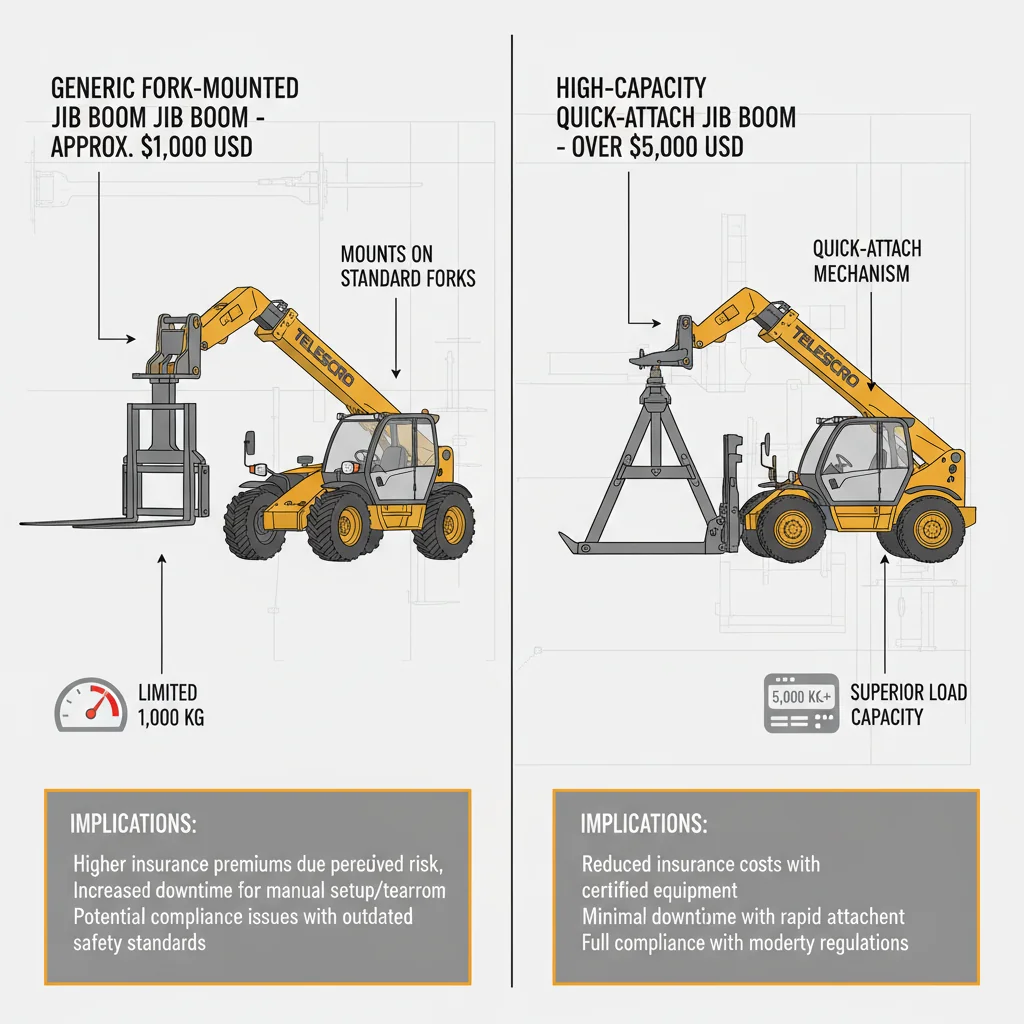
I’ve worked with rental fleet owners in Germany and South Africa who often ask, “Is a fork-mounted jib14 really enough, or should we invest in the high-capacity quick-attach jibs?” Looking at just the sticker price, it’s tempting to grab the basic fork-mounted type for around $1,000. But, in practice, the picture is more complicated. I’ve seen operators lose hours every week swapping cheap jibs between machines—especially when the design doesn’t line up with their quick-attach couplers.
Let’s break it down with a simple comparison:
| Jib Type | Upfront Cost | Typical Capacity | Attachment Method | Key Risk/Benefit | Lifetime Value Factors |
|---|---|---|---|---|---|
| Fork-Mounted (Generic) | ~$1,000 | 1–3 tons | Fork pocket | Lowest price; may lack certification | Higher insurance, slow swaps, downtime |
| Quick-Attach (Unbranded) | ~$2,500 | 2–4 tons | Manual coupler | Faster changes; sometimes sketchy paperwork | Medium labor savings; compliance risk |
| Quick-Attach (Certified) | ~$5,000+ | 3–6 tons | Hydraulic/auto | Fastest swaps; proper load certificate | Labor savings, insurance benefits |
In Kazakhstan this March, a fleet manager told me their uncertified jib caused two days’ downtime while they sorted load charts and paperwork for a public project. That lost time wiped out the savings from buying cheap. Oversized jibs can tie up funds, while undersized ones force extra crane rentals—a single lift can cost over $700 per day. To be honest, total cost of ownership matters much more than initial price.
High-capacity quick-attach jibs typically reduce equipment downtime by up to 20% compared to basic fork-mounted jibs due to faster interchangeability and better compatibility with telehandler couplersTrue
Quick-attach jibs are designed for precise fitment with telehandler couplers, eliminating the frequent manual adjustments required by fork-mounted jibs, which can waste several hours each week in swapping and alignment. This efficiency gain directly translates to reduced operational downtime.
Fork-mounted jibs generally provide higher lifting capacity than quick-attach jibs because they are lighter and cause less stress on the telehandler frameFalse
Fork-mounted jibs are often more limited in lifting capacity due to load distribution constraints and lower structural robustness, whereas quick-attach jibs are engineered to handle higher loads safely by distributing weight more effectively over the telehandler chassis.
Key takeaway: Prioritize total lifetime value over initial cost when selecting telehandler jib booms. Factoring in certification, labor savings, and reduced compliance risk yields a more accurate ROI, especially for rental fleets or multi-machine operations seeking reliable, efficient, and compliant equipment solutions.
How Often Should Jib Booms Be Inspected?
Jib booms require a visual inspection15 before each use and a comprehensive inspection at least every six months, per industry best practices. After any overload or impact, an immediate check is crucial. Key areas include welds16, pins, hooks, and labels. Documentation is important for rental fleets and compliance.

One thing I see often is teams only glancing at a jib boom before using it—especially on busy sites in Asia or the Middle East. A quick look isn’t enough. I remember working with a client in Qatar last year; their 2.5-ton telehandler’s jib boom had a barely visible crack in a main weld. They’d been using it for months without noticing. The risk? Total structural failure during a lift—not worth it for any job or budget. A visual inspection before every shift should be standard, but it has to be more than checking the paint or stickers. For example, look closely for cracked or broken welds, bent plates, and any deformation in the hook or boom tip.
I’ve seen pin holes stretch out over time, especially on older models or when operators handle heavy prefab panels every day. If the holes are elongated or pins look worn, you’re one bad lift away from a serious accident. After any overload or a hard bump—say, someone drags the boom against rebar cages or concrete slabs—do a full check right away. On an industrial site in Kenya, a customer ignored a small dent, only to discover six weeks later the boom was losing strength and showing more flex under load. We had to pull that unit from service. That cost them a week of delays, plus over $1,500 in repairs. For rental fleets and larger contractors, documenting every inspection is a must.
Jib booms should be inspected visually before every shift, with a detailed non-destructive test like dye penetrant or ultrasonic inspection recommended every 6 months to detect hidden weld cracksTrue
Visual inspections before each shift help catch obvious damage, but small weld cracks or internal flaws can develop unnoticed. Non-destructive testing methods applied biannually provide an early warning to prevent structural failure.
Jib boom inspections only need to be performed annually unless there is visible damage because minor cracks rarely propagate into safety issuesFalse
Weld cracks can grow quickly under load cycles, making infrequent inspections risky. Waiting for visible damage overlooks early-stage defects that could lead to catastrophic failure, so annual-only inspections are insufficient.
Key takeaway: Consistent inspections—both visual and thorough, at recommended intervals—are vital for jib boom safety and longevity. Addressing structural fatigue or wear before failure minimizes costly downtime and risks. Proper documentation of inspections helps maintain compliance and ensures accountability for fleets or contractors.
When Are Swivel Hooks Worthwhile on Jib Booms?
Special hooks and swivel features on telehandler jib booms enable precise load positioning, including 360° rotation and improved handling of awkward or irregular loads. While these options add cost and weight, they significantly reduce installation time and labor when aligning beams, pipe spools, or HVAC units—especially valuable in steel erection and industrial maintenance applications.

One question I often get from contractors is whether investing in swivel hooks or adjustable heads on jib booms is really justified. Let me give you a concrete example: I worked with a steel erection crew in Kazakhstan last year. Their main job involved lifting 6-meter beams—to about 10 meters high—right inside a partially finished plant. Space was tight on site, with rebar, ductwork, and existing columns everywhere. Before adding swivel hooks, two riggers would always fight the load with tag lines, costing them at least an extra hour per install. Once they upgraded to a 360° swivel hook on their 4-ton telehandler’s jib, they cut that time by almost half. The operator could rotate and align each beam from the cab, instead of repositioning the entire machine.
Swivel hooks shine when you’re handling HVAC units, pipe spools, or fabricated steel—anything awkward or with off-center gravity. I’ve seen the same payoff on shutdown jobs in Brazil, where clients needed to place pumps through overhead openings less than 2 meters wide. With an articulating head17 and multiple pick points, precise placement became a one-person job. Sure, these attachments add a bit of weight—often 30 to 50 kg—and can increase upfront cost by several hundred dollars. But for complex lifts, the reduction in labor, rigging, and rework is significant.
I suggest thinking about your most common lifts. If you’re often dealing with difficult alignments or swinging loads, a swivel hook or adjustable head is one of those smart upgrades that pays for itself surprisingly fast.
Swivel hooks on jib booms are especially worthwhile when lifting loads in confined spaces where frequent load rotation is required, as they reduce the need for tag lines and minimize the risk of swinging that can cause collisionsTrue
Swivel hooks allow the load to rotate freely without twisting the hoist line or boom, which is critical in tight environments like plant interiors where space constraints and obstacles increase the risk of load control issues and site accidents. This feature improves efficiency by reducing the number of riggers needed to manage load orientation.
Swivel hooks primarily increase the maximum lifting capacity of telehandler jib booms by up to 20%, allowing operators to handle heavier loads safely without upgraded machineryFalse
Swivel hooks do not affect the lifting capacity of the jib boom; the capacity is determined by the boom design, hydraulic system, and telehandler chassis strength. Swivel hooks improve load control and handling flexibility but do not enhance the mechanical lifting limits of the equipment.
Key takeaway: Special swivel hooks and adjustable heads are a smart investment for contractors who routinely handle challenging or awkward loads. These upgrades can pay for themselves through faster installations, reduced need for extra riggers, and lower risk of load swings, leading to improved efficiency and on-site safety.
Conclusion
We covered why manufacturer-specific load charts—not just base machine specs—are the key to choosing a safe, effective telehandler jib boom. From my experience, the crews who avoid trouble always double-check their lifting needs at actual working heights and boom extensions before ordering. I’ve seen too many teams get caught by the “showroom hero, jobsite zero” problem—impressed by the numbers on paper, but stuck with a lift that can’t safely perform on-site. Have questions about load charts or want advice on attachments that fit your job? I’m happy to share what’s worked for real-world jobsites—just reach out. Every site has its own demands; pick the attachment that truly fits your workflow.
References
-
Detailed explanation on how load center distance impacts telehandler capacity and safe lifting limits for operators and contractors. ↩
-
Explore how telehandler load charts specify safe jib capacities at various heights and angles with real-world lifting scenarios. ↩
-
Understand why reviewing attachment-specific charts is crucial to avoid unsafe lifts and capacity overestimations with jib booms. ↩
-
Insights on subtracting jib weight from load charts to prevent overload and ensure safe telehandler operation at different outreach lengths. ↩
-
Detailed insights on how adjustable and telescopic jibs improve flexibility for HVAC and variable-height construction tasks. ↩
-
Explains the benefits of truss jibs in precise placement and elevated work in construction, supported by real project examples. ↩
-
Detailed insights on how tip capacity limits lifting ability at reach, with impact on telehandler safety and job efficiency. ↩
-
Explains benefits of fixed jibs for stability and repetitive lifts, with real-world examples improving workflow efficiency. ↩
-
Detailed explanation of quick-attach jib booms, highlighting faster attachment swaps and efficiency gains for telehandler operations. ↩
-
Insight into fork-mounted jibs offering broader compatibility and cost benefits, helping reduce downtime on mixed fleet jobsites. ↩
-
Detailed insights into ASME/ANSI B56.6 standards ensuring telehandler jib compliance for safe lifting operations and legal adherence. ↩
-
Explains the importance of certified capacity plates displaying load ratings and instructions to prevent accidents and job site delays. ↩
-
Detailed insights on how hydraulic flow rates influence lifting speed and efficiency in telehandlers under various load conditions. ↩
-
Detailed comparison of fork-mounted jibs including cost, capacity, and operational risks helps decide the best fit for telehandler use. ↩
-
Detailed guidance on scheduling visual inspections to prevent structural failures and ensure safety on construction sites. ↩
-
Expert explanation on the importance of detecting weld cracks to avoid catastrophic failures during lifts in industrial operations. ↩
-
Learn how articulating heads with multiple pick points enhance precise placement of awkward loads in confined spaces and complex installations. ↩