








How to Choose Telehandler Forks: Field Guide to Avoid Costly Mistakes
Not long ago, I watched a crew in Turkey lose half a day swapping out bent forks on a high-reach telehandler—all because the originals weren’t rated for the load at full extension. Mistakes like these cost more than money; they can stall an entire pour or risk safety on site.
Selecting telehandler forks requires careful consideration of load chart data, fork capacity, and attachment compatibility. The load chart establishes maximum safe capacities at various boom positions, factoring in the fork assembly’s own weight. Forks must be rated above the heaviest anticipated load at the greatest reach, not just the headline machine capacity. Dimensions—including fork length, thickness, and mounting class—must suit both the machine’s carriage and the types of loads handled.
How Do Load Charts Affect Fork Selection?
Telehandler load charts1 indicate maximum safe lifting capacities at different boom angles and extensions, already accounting for attachment weight. Forks must be rated for at least the highest anticipated load at maximum reach, not just headline capacity. Undersized or incorrect mounting class forks risk structural failure, machine instability, and voided warranties.
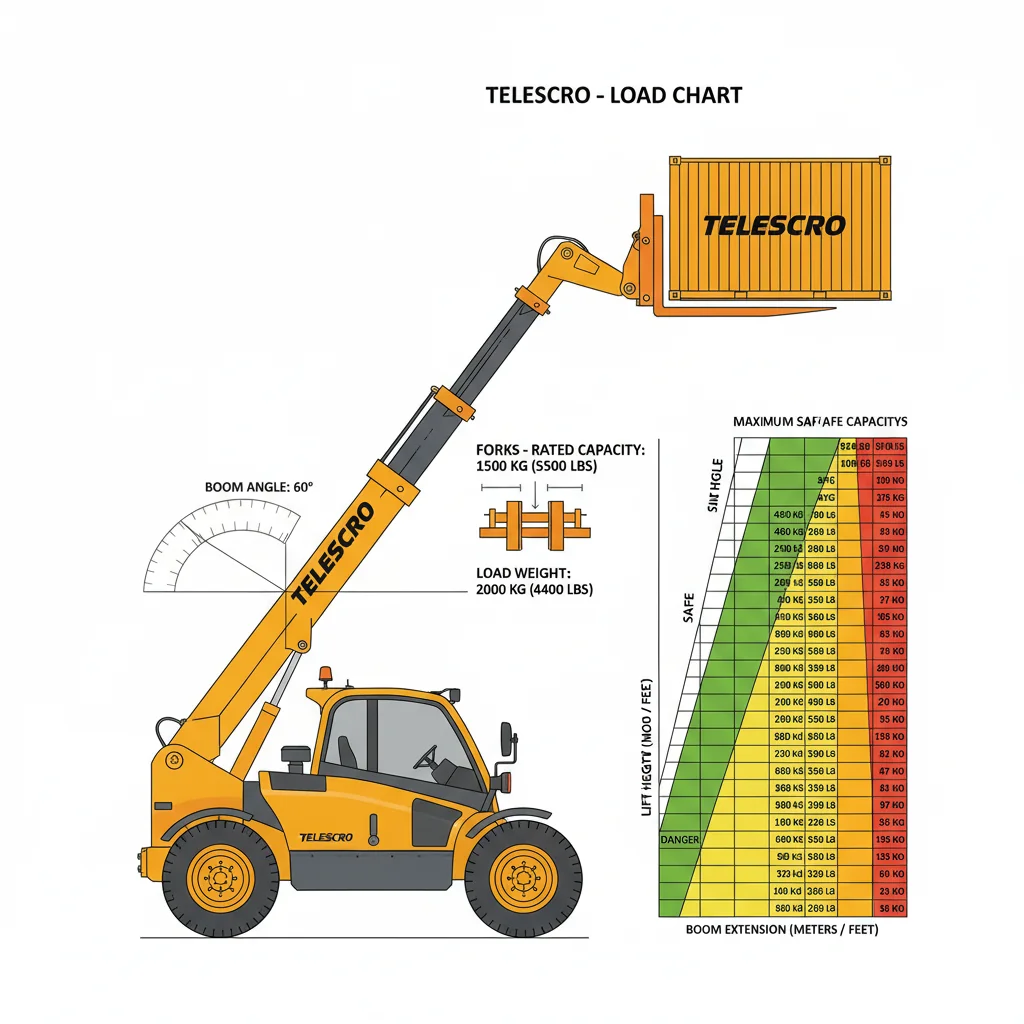
Most people don’t realize that a telehandler’s load chart isn’t just about headline numbers—it tells you exactly how much weight you can lift at every boom angle and extension, factoring in the attachment weight too. I’ve seen buyers in South Africa overlook this and choose forks rated just for "max capacity." The trouble came when they reached out to 14 meters with a 10-meter-high reach model—suddenly, their forks were overloaded by at least 700 kg compared to what the load chart specified for that position. It’s all about matching your fork capacity to the actual task. Here’s what matters most: always reference the toughest load scenario shown on the chart, not just what you do 80% of the time.
For instance, if your telehandler needs to handle 2.5 tons at maximum reach, your forks should be rated for at least 3 tons. That extra margin gives room for dynamic forces, uneven loads, or minor operator mistakes. I suggest checking the rating plate stamped on each fork—make sure it matches or exceeds your application’s real demands. Let me share something important. A few months ago, a team in Dubai used lower-class forks (ITA class II) on a 4-ton machine with a class III carriage. They thought it would save money, but it led to bent forks and risked tipping the machine. Their warranty didn’t cover the damage. I always recommend verifying the mounting class, not just the weight—it’s as vital as the fork’s capacity.
A telehandler's load chart includes the weight of the attachment, such as forks, and reduces the maximum allowable load accordingly at different boom angles and extensionsTrue
Load charts provide safe lifting capacities by accounting for the added weight of attachments, meaning operators must subtract fork or other attachment weight from the rated lift capacity specific to boom position to avoid overloading.
Forks rated for the telehandler's maximum lifting capacity at the lowest boom angle are always suitable without considering boom extension or heightFalse
Fork suitability must consider variable load limits from the load chart, which change significantly with boom extension and elevation; max capacity at minimal extension does not guarantee safety at maximum reach due to load chart derating.
Key takeaway: Always specify telehandler forks based on the most demanding load and reach scenario shown in the machine’s load chart, plus a safety margin. Check that fork capacity, rating plate, and mounting class align with application requirements to avoid damage, safety hazards, and warranty issues.
Which Telehandler Fork Size Fits My Loads?
Selecting correct telehandler fork dimensions2 depends on load type, carriage compatibility, and capacity needs. Standard fork lengths range from 900–1800 mm (36–72 in). Industry practice specifies forks should cover at least two-thirds of the load length; heavier, longer, or palletized items demand thicker, longer forks with matching hook profiles and section sizes for safety and performance.
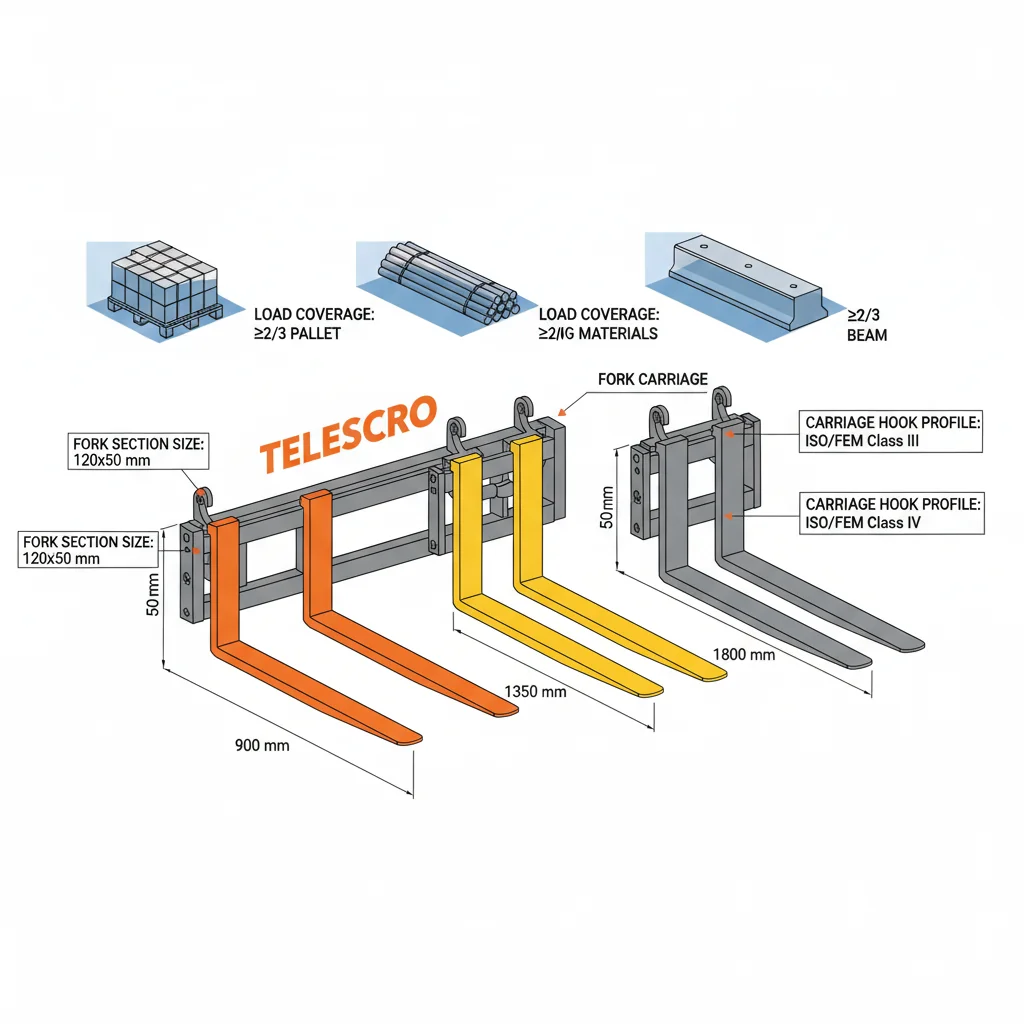
Let me share something important about matching telehandler fork size to your real jobsite needs. Too many buyers only look at what’s in the catalog. But if you’re lifting 2-meter pallets of block every day in a place like Dubai, a 900 mm fork just isn’t enough—I’ve seen operators there try, and it led to cracked pallets and bent tips within weeks. The right fork size comes down to three things: your typical load length, load weight, and making sure the fork’s hook and section match the carriage.
Here’s a quick comparison you can use:
| Fork Size (mm) | Typical Use Case | Max Capacity* | Common Load Types | Comments |
|---|---|---|---|---|
| 900 x 100 x 40 | Small pallets, tight spaces | Up to 1,500 kg | Tiles, light materials | Good for short, lightweight loads |
| 1200 x 125 x 50 | General construction, bricks | Up to 2,500 kg | Block, masonry, timber | Most jobsites use these |
| 1500 x 150 x 50 | Oversized or long objects | Up to 3,000 kg | Lumber packs, wide pallets | Heavy-duty, requires wide turning |
| 1800 x 150 x 60 | Extra-long loads, timber yards | Up to 3,500 kg | Scaffolding, trusses | Use only if needed—adds weight |
*Actual capacity depends on load center and telehandler rating. I always suggest covering at least two-thirds of your load.
Using forks shorter than half the length of your typical pallet load increases the risk of load instability and potential damage to both the load and forksTrue
Forks that are too short cannot support the full length of the pallet evenly, causing stress concentrations at the tips and uneven load distribution, which can lead to pallet cracking and bent fork tips over time. For a 2-meter pallet, forks should be at least 1 meter long to maintain proper stability and safety.
All telehandler forks of the same length can be used interchangeably on any telehandler model regardless of the hook and section dimensionsFalse
Fork compatibility depends not just on length but also on the fork’s hook type and cross-sectional profile to match the telehandler’s carriage. Using forks without matching these dimensions can result in insecure mounting and unsafe operation.
Key takeaway: Fork length, width, and thickness must suit the typical load size and weight, as well as match the telehandler’s carriage specifications. Oversized forks reduce lift capacity, while undersized forks can bend or break. Always align fork specs with actual, recurring material handling tasks for safe operation.
How to Match Forks and Carriage to Jobs?
Selecting the correct fork style and carriage configuration depends on the application. Masonry jobs benefit from narrow carriages and forks for better visibility. Framing and general construction favor wider setups for stability with long loads. Agriculture often requires wider, longer forks. Fixed forks suit level, predictable sites, while floating forks3 handle uneven ground. Side-tilt carriages4 enhance safety on slopes.
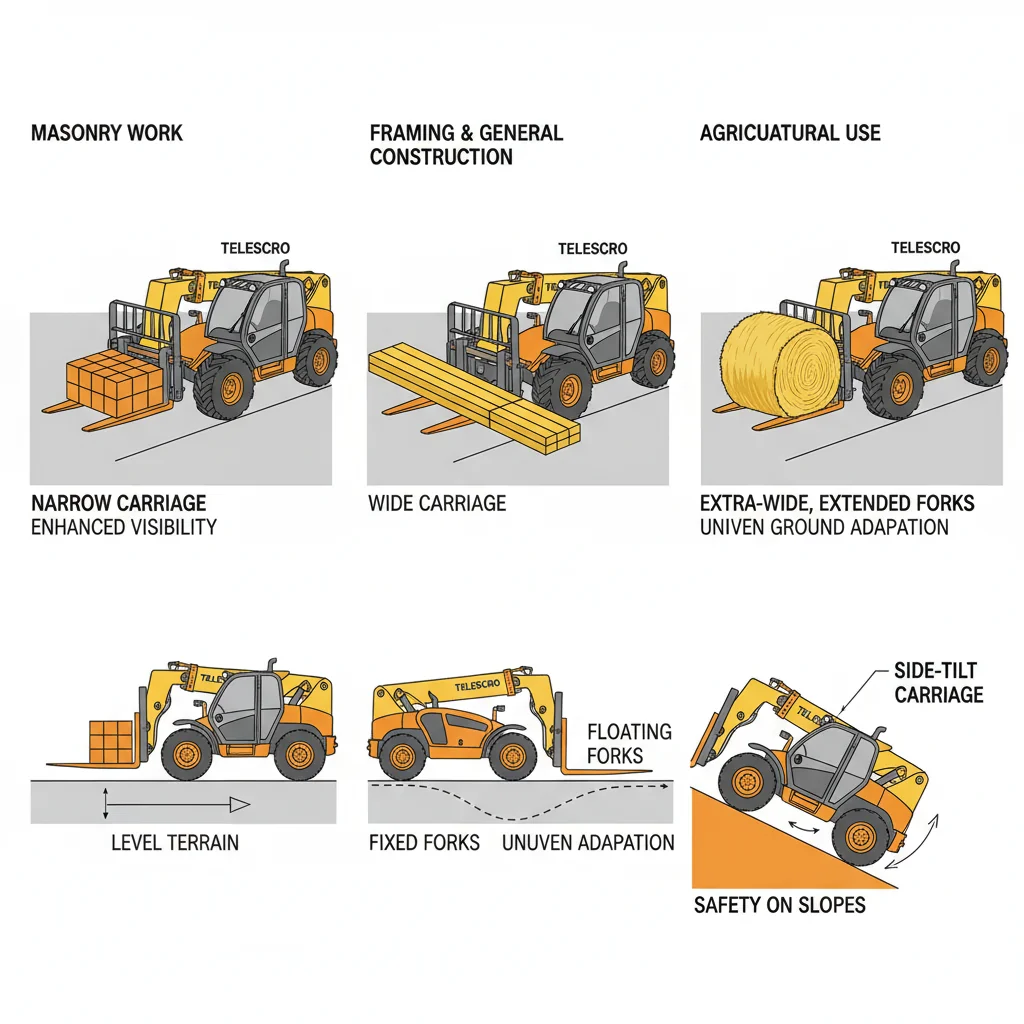
The biggest mistake I see is customers picking forks and carriages just based on “what fits.” That approach wastes time—and sometimes breaks materials. A contractor in Dubai called me last year. Their team used wide forks with a standard carriage on a masonry job, hoping for “maximum capacity.” In reality, the wide setup blocked visibility when placing bricks at height—costing them almost a full day in delays for rehandling and alignment. On tight masonry sites—especially above 8 meters—I always suggest a narrow carriage5, typically under 1,300 mm, matched with narrow forks. This combo keeps your view of the load clear, making precise placement much faster. For general construction or framing, a wider carriage (often 1,600 mm or more) pairs well with wide forks, giving better stability for long trusses or heavy wood packs. I saw this in Poland; framers lifting 6-meter roof panels with a 4-ton telehandler found the extra width stopped twisting and made unloading safer. In agriculture, it’s very common to choose forks over 1,500 mm long for bale handling—shorter forks just can’t support two or three big bales side by side. When it comes to jobsite ground, I look closely at fork mobility. Fixed forks are solid for level, paved yards with regular pallets. But many of my clients in rural Kazakhstan swear by floating forks. On rough or uneven ground, those forks can shift as needed, so damaged loads are much less common.
Using wider forks than the carriage width can reduce operator visibility by over 30% when positioning loads above 8 metersTrue
Forks that extend beyond the carriage can obstruct the operator’s line of sight, especially at height, increasing the risk of misalignment and rehandling delays, as demonstrated by reported jobsite inefficiencies.
Selecting forks based solely on maximum capacity rating always ensures optimal jobsite efficiency regardless of load type or heightFalse
Fork capacity alone doesn't guarantee efficiency; factors like fork length, width, carriage compatibility, and visibility critically affect safe and accurate load handling, especially on complex or elevated sites.
Key takeaway: Choosing the right fork width, length, and carriage features based on specific job tasks—such as masonry, framing, or agriculture—prevents damage, increases productivity, and minimizes costly repositioning. Mapping top applications ensures safety, load stability, and efficiency when operating a telehandler across varied field conditions.
How Do Terrain and Conditions Affect Fork Choice?
Terrain and site conditions directly impact telehandler fork and carriage selection. Rough or sloped ground often requires side-tilt carriages to maintain load stability, while floating forks compensate for uneven surfaces. Compact telehandlers with shorter forks are optimal for urban or indoor sites, whereas muddy or agricultural environments demand heavy-duty, contamination-resistant components. Effective load capacity must always be reassessed on non-level ground.
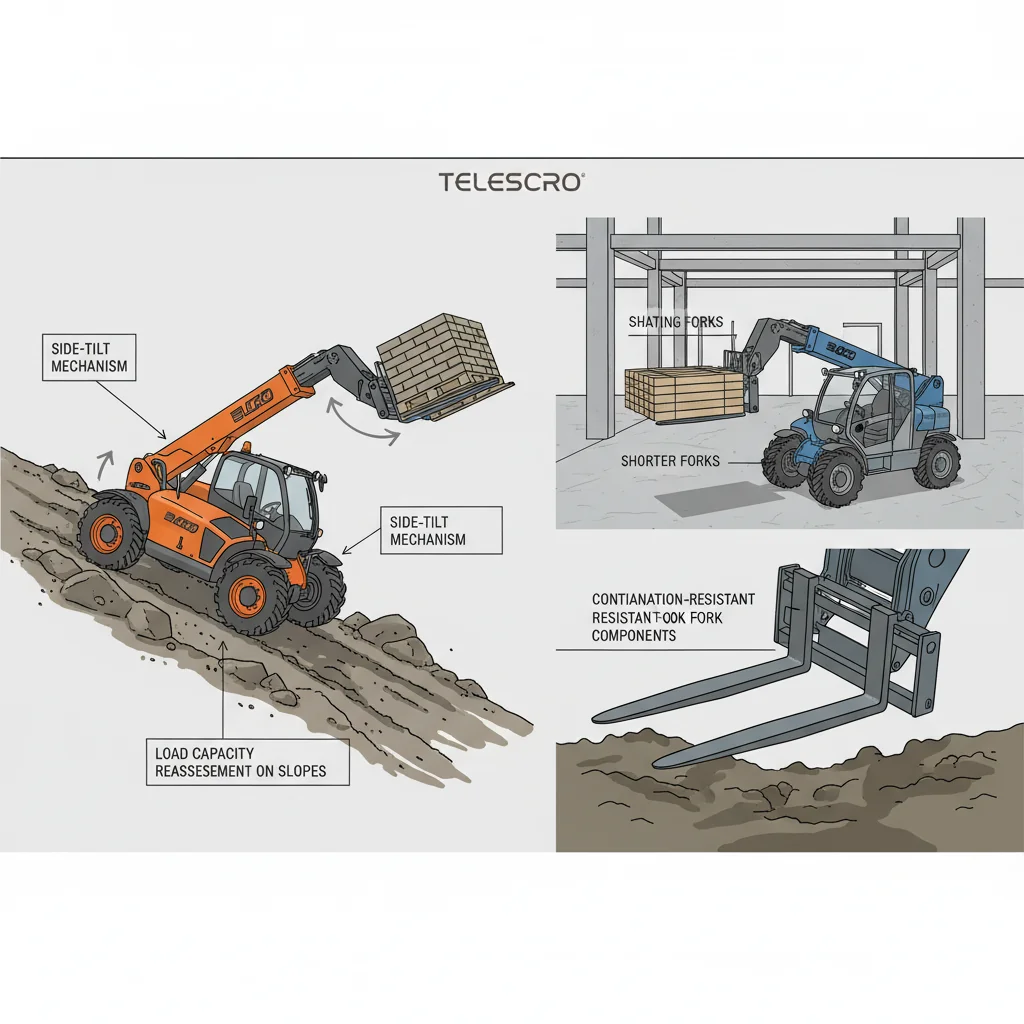
Here’s what matters most when matching forks and carriages to your actual jobsite conditions—especially if the ground isn’t smooth or flat. In Kazakhstan last year, one customer insisted on using standard fixed forks for a rutted outdoor warehouse. The result? Every time his team crossed uneven patches, pallets tilted dangerously. The load was only 1,000 kg—well below his telehandler’s max 3,000 kg rating—but the moment indicator kept flashing warnings. Standard forks couldn’t compensate for the ground, so stability suffered. Side-tilt carriages would’ve let him level the load and avoid constant repositioning.
For muddy construction sites or agricultural jobs, I always suggest investing in heavy-duty forks with sealed bearings. I’ve seen too many budget forks fail within a year because sticky soil clogs unprotected pins and bearings—maintenance downtime kills productivity fast. In rice fields around Guangdong, one farm upgraded to floating forks rated for 2.5 tons. Their team could place seed pallets even when the surface dipped up to 8 centimeters. That adjustment saved at least two hours a week on rehandling.
Tight urban sites bring a different set of problems. Shorter forks—around 1.1 meters—give you much better maneuverability inside narrow driveways or loading docks. In Dubai, a contractor told me that just 200 mm of extra fork length made turning in a basement parking ramp almost impossible without scraping columns. My main takeaway? Always check the actual working ground conditions, not just the data sheet. And reassess load capacity anytime you’re off level ground—what lifts safely on concrete isn’t always safe on slopes or rough jobsites.
Adjustable tilt forks can significantly improve load stability on uneven terrain by allowing operators to compensate for ground irregularities up to 10 degreesTrue
Adjustable tilt forks enable precise angling of the forks, which helps maintain pallet levelness on rutted or sloped surfaces, preventing load shifts even when the telehandler is operating on uneven ground. This adjustment capacity typically covers angles up to around 10 degrees, enhancing safety and reducing load damage.
Using longer forks always increases load capacity on telehandlers regardless of ground conditionsFalse
Fork length does not inherently increase load capacity; in fact, longer forks can reduce the telehandler’s effective load rating due to increased load center distance, especially on uneven terrain where leverage effects are amplified. Load capacity must be adjusted based on fork length and terrain to maintain safety.
Key takeaway: Selecting telehandler forks and carriages based on terrain and site conditions is essential to maintain safety, minimize load damage, and ensure efficient operation. Always consider stability, maneuverability, and fork robustness in line with the specific environment to avoid costly mistakes and operational risks.
What Safety Standards Must Telehandler Forks Meet?
Telehandler forks are regulated lifting devices that must display rated capacity6, manufacturer, and a serial number. In the EU, compliance with EN ISO 23307 is required, mandating independent fatigue and bend testing; North America uses ITA standards. Forks should never be welded, drilled, or repaired, as this voids certification and risks hidden structural damage.
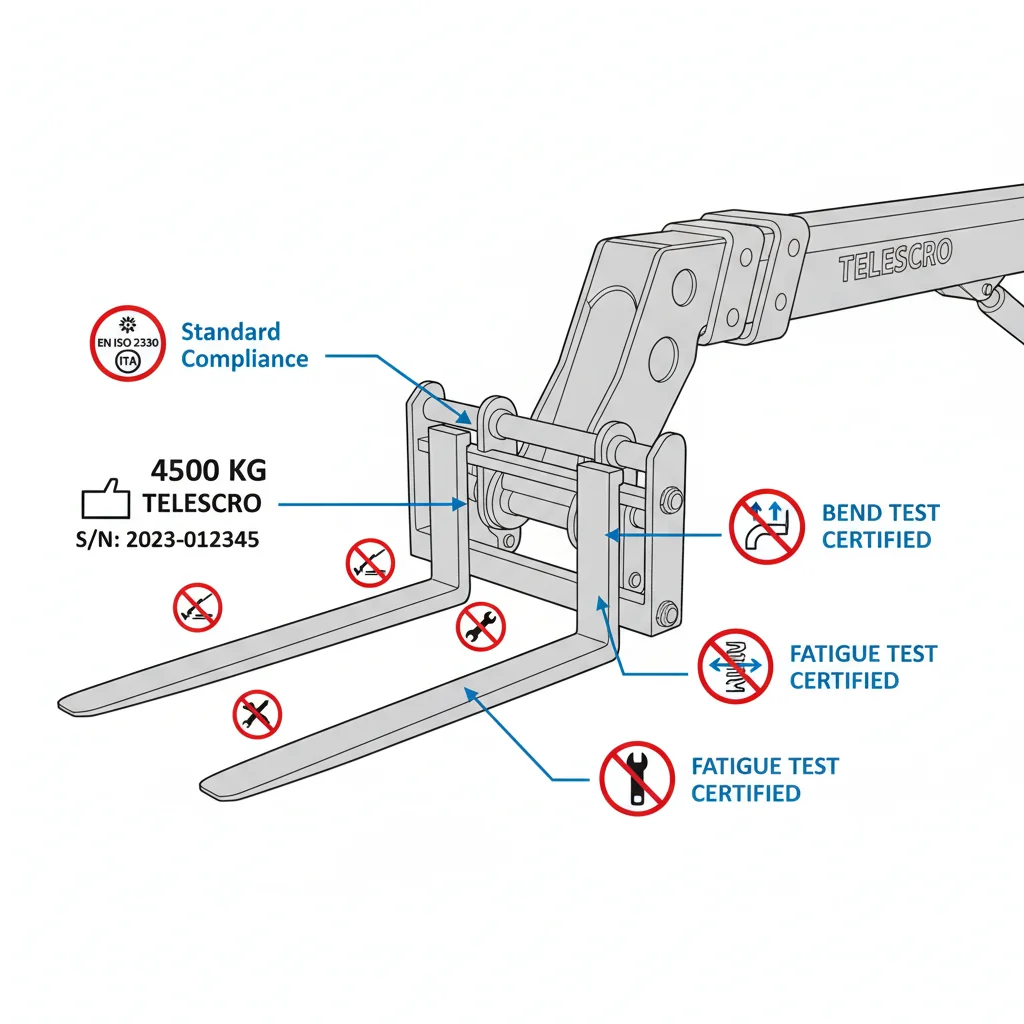
Let me share something important about telehandler forks—these aren’t just heavy pieces of steel. They’re precision lifting devices, and every country where I’ve worked treats them accordingly. Forks must have their rated capacity, manufacturer, and unique serial number clearly stamped, not just a sticker that wears off after a few dusty weeks. I’ve seen plenty of forks in Dubai markets that look solid, but if you can’t find those markings, walk away. Without those, you’ll likely fail a safety inspection or worse, face liability if there’s an accident.
In the EU, the rule everyone follows is EN ISO 2330. This standard isn’t just paperwork. It means the forks went through independent fatigue and bend tests—including cycling the fork thousands of times to check for hidden metal fatigue. I worked with a team in Poland using 4-ton machines. They showed me a set of forks that looked fine, but after I measured, one blade was bent over 40 mm on a 1200 mm fork—well outside the typically accepted 3% bend threshold. That’s not just minor damage. It’s a tripwire for accidents.
Never drill, weld, or try to straighten forks with heat—no matter how minor the damage seems. I’ve seen companies in Kenya risk this to save money, only to end up with serious hidden cracks. Insurance investigators always spot these modifications, especially during claim reviews.
To stay safe and compliant, I suggest inspecting forks every shift—look for cracks at the heel, twisted shanks, or visible wear over 10%. Always replace if in doubt; it’s not worth risking a team’s safety.
Telehandler forks must comply with EN 15512 standards in Europe, which specify dimensional and mechanical properties including minimum yield strength of 370 MPa for forged steel forksTrue
EN 15512 is a key European standard ensuring forks are manufactured to precise stress tolerances and material specifications, guaranteeing structural integrity and operator safety under defined load conditions. The 370 MPa yield strength indicates forks' resistance to permanent deformation under heavy loads.
Telehandler forks are allowed to have their rated capacity and serial number only on adhesive stickers as long as they are replaced annuallyFalse
Adhesive stickers are not considered reliable for critical safety markings because they can wear off or become illegible quickly in harsh working environments; permanent stamping or engraving of capacity, manufacturer, and serial numbers is required to maintain traceability and compliance with safety regulations.
Key takeaway: Only use certified, properly marked telehandler forks built to recognized regional standards like EN ISO 2330 or ITA. Any visible damage or unauthorized modifications invalidate certification, significantly increase accident risk, and can result in inspection failures and insurance complications.
How Should Telehandler Fork Cost Be Evaluated?
When selecting telehandler forks, upfront cost for standard ITA class III forks ranges from $180–$350 USD. However, unbranded, cheaper forks often lack adequate heat treatment8 and traceability, leading to premature failure. Certified OEM or CE/ISO-compliant forks may cost up to 1.5× more, but typically last 3–4× longer, reducing total ownership costs in demanding applications.
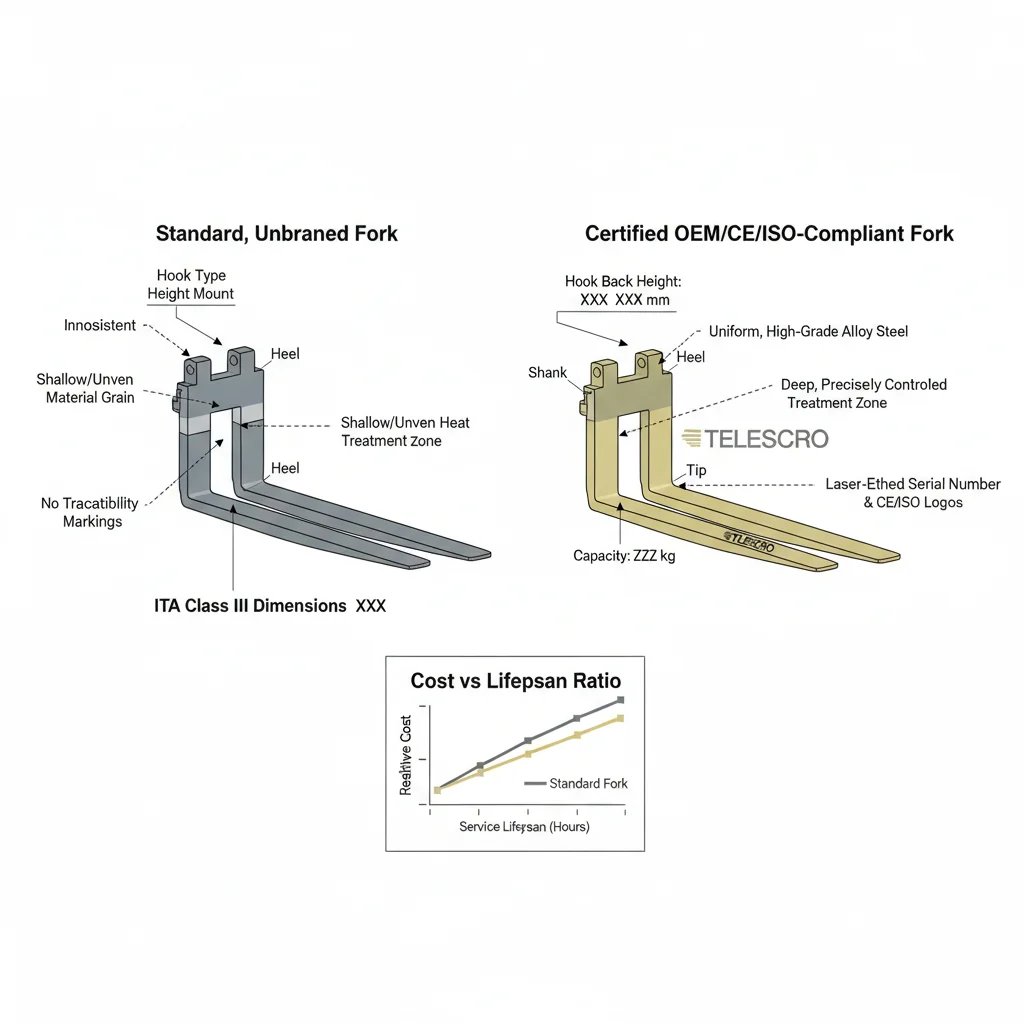
I’ve worked with customers who made the mistake of choosing the cheapest set of forks simply because the price looked right—especially in fast-growing markets like Kazakhstan. The problem almost always shows up a year later. I remember one client who bought unbranded ITA class III, 1200 mm forks for under $200 a set. On their 4-ton telehandler, used nearly every day to move palletized rebar, those forks started showing bends and surface cracks after just nine months. Their site lost at least three days swapping in spares and waiting for replacements—not to mention the risk of load failure if an operator didn’t spot the damage.
From my experience, that short-term saving turns into a bigger headache for high-utilization machines. Certified, CE- or ISO-compliant forks might cost $300–$500, but they’re built with proper heat treatment and strict traceability. On busy jobsites in Dubai or Singapore, I’ve seen these forks last three or four years even under tough use. That’s why I always suggest considering total cost of ownership9, not just the sticker price.
Technical details matter too. Look for manufacturers who document their load testing—ideally, each fork should be stamped with its rated capacity and production batch. If your application is lighter—like seasonal use or moving insulation panels—mid-tier aftermarket forks can offer value as long as they meet recognized standards and don’t skip essential treatments.
I suggest making sure your supplier offers quick parts delivery and proper warranty on forks. Minimizing downtime is worth more than saving $100 up front, especially when every day counts on site.
Choosing forks rated at least one size class higher than the telehandler's capacity can significantly reduce the risk of structural failure during heavy daily useTrue
Forks rated above the machine's nominal capacity provide a safety margin against unexpected stresses, especially in demanding applications like moving palletized rebar daily, which reduces bending and cracking risk.
Telehandler forks rated only by their length and width are sufficient for ensuring durability in heavy lifting applicationsFalse
Fork dimensions alone don’t guarantee durability; load rating, material grade, design standards (like ITA class), and manufacturer quality critically determine fork performance and resistance to fatigue and damage.
Key takeaway: Prioritizing certified telehandler forks from reputable manufacturers delivers better long-term value than simply choosing the lowest upfront price. For daily or heavy-duty use, investing in proven brands with strong dealer support decreases downtime and risk. Mid-tier, compliant forks can be cost-effective for low-duty cycles if quality standards are met.
When Do Quick-Attach Forks Make Sense?
Quick-attach telehandler forks10 are ideal when frequent attachment swaps—such as between forks, buckets, hooks, or powered tools—are required. Modern quick-attach systems like JCB’s Q-Fit allow operators to change attachments rapidly from the cab, cutting downtime dramatically. Compatible auxiliary hydraulics11 are essential for powered attachments, ensuring optimal performance in demanding material handling environments.
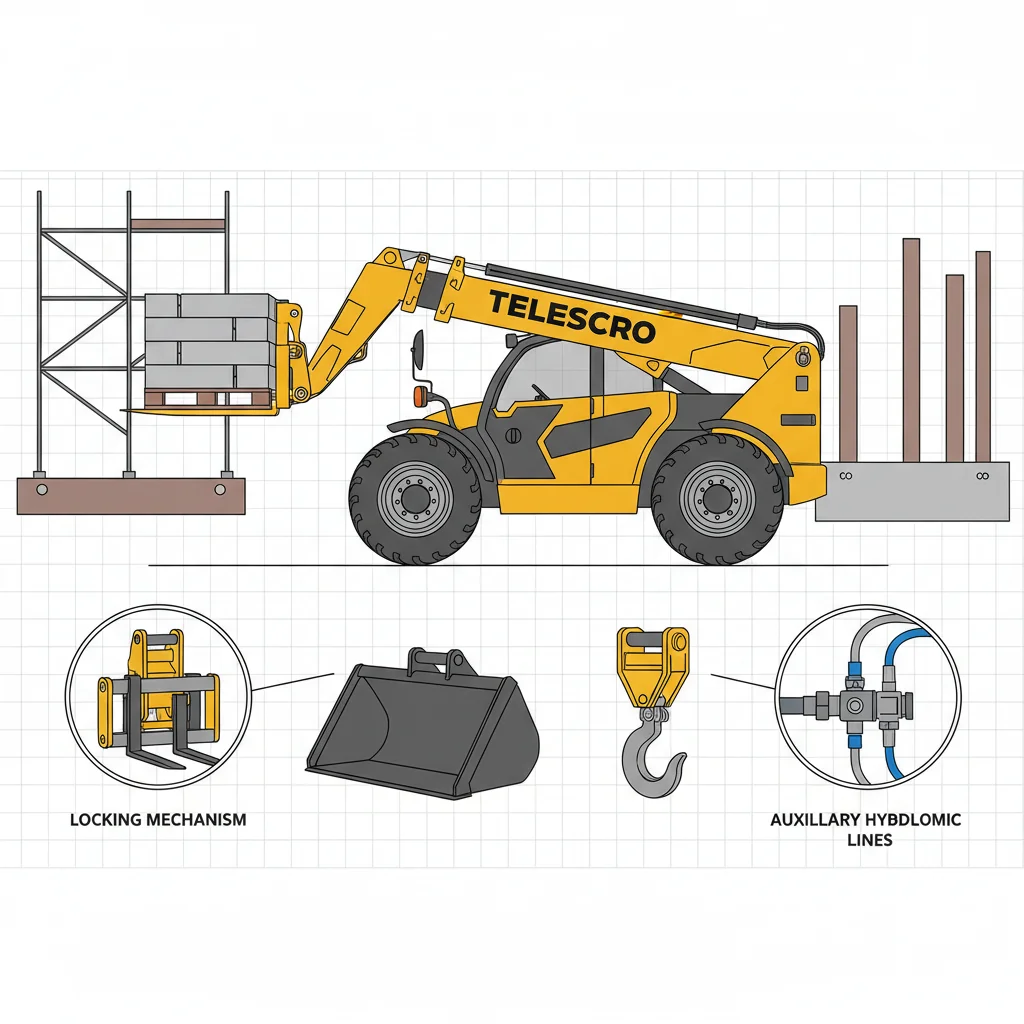
To be honest, the spec that actually matters is how quickly you can change attachments—especially if your team swaps between tools several times a shift. In South Africa, one customer ran a two-telehandler setup on a precast yard. They moved between forks for palletized slabs, buckets for gravel, and a lifting hook for setting rebar cages. Before upgrading, every attachment swap took about 15 minutes and required two people outside the cab. With a modern quick-attach system installed last year, changeovers dropped to under three minutes, and one operator swapped tools from the seat. That’s over an hour saved every day—significant when deadlines are tight and staff costs keep rising.
If you’re considering powered attachments like brooms or rotating grabs, check your telehandler’s auxiliary hydraulics. Most compact units provide 18–32 gallons per minute (gpm), which is enough for standard hydraulic tools. But I’ve seen cases in Dubai where customers underestimated flow and pressure. Their powered sweeper ran so slowly, it was nearly useless. Always confirm your machine’s circuit matches the demands of your future tools—not just today’s jobs.
I suggest thinking ahead when you choose your quick-attach coupler. Compatibility is everything. If your forks and buckets fit a universal frame, you’ll have more options to add or swap attachments down the road, and your telehandler will hold its value longer. It’s a decision that impacts both daily efficiency and long-term fleet flexibility. Considering all these factors up front will help avoid frustration—and unexpected costs—later on.
Quick-attach forks can reduce attachment change times from 15 minutes to under 5 minutes without requiring operators to leave the cabTrue
Modern quick-attach systems allow operators to switch between forks and other tools rapidly using hydraulic controls from inside the cab, eliminating the need for manual intervention and significantly improving jobsite efficiency.
Quick-attach fork systems increase overall machine weight by 20%, which reduces lifting capacity proportionallyFalse
While quick-attach mechanisms add some weight, the increase is typically minimal—usually less than 5%—and telehandler load charts account for attachment weights. A 20% weight increase is exaggerated and would drastically compromise lifting capacity, which is not the case in well-engineered systems.
Key takeaway: Investing in quick-attach systems and appropriate hydraulic capacity enhances telehandler productivity where multiple tools are used. Choose a coupler standard offering the broadest compatibility with current and future attachments to protect fleet flexibility and long-term value.
When Are Fork Extensions or Buckets Needed?
Fork extensions, hook attachments12, and buckets should be used when standard telehandler forks cannot safely handle oversized, awkward, or loose loads. Extensions increase length for stable support, hooks create lifting points for slings, and buckets efficiently move loose material. Each accessory must comply with de-rating guidelines and the machine’s load chart.
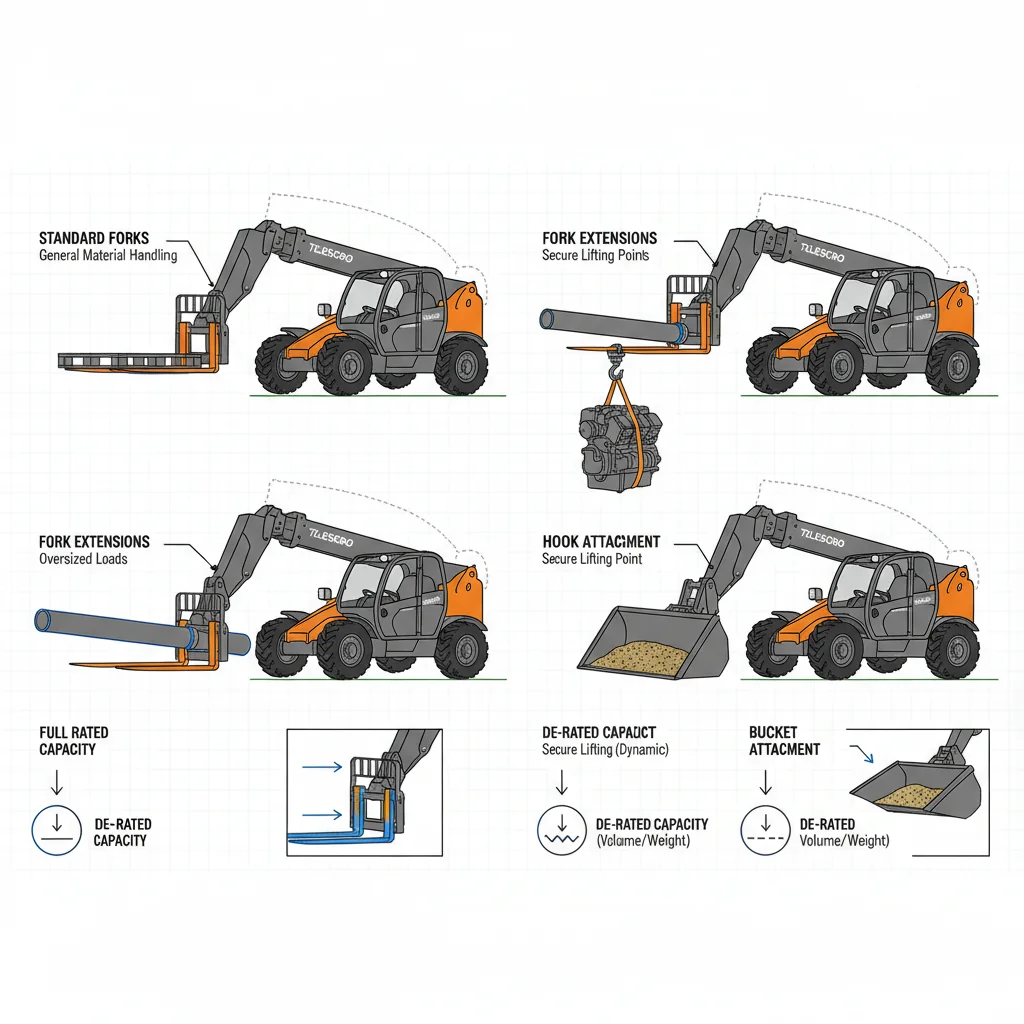
Last year, I advised a team in Dubai who struggled with long steel beams—standard forks just couldn’t support the overhang safely. They tried to manage by shifting the load, but it felt unstable and risked damaging both the cargo and the telehandler. That’s where fork extensions come in. By pinning secure extensions over your existing forks, you gain the extra length needed for longer loads. Just remember, the farther you extend, the less total weight you can safely lift—always check the machine’s load chart and apply the fork extension’s de-rating guidelines. In this Dubai case, their 4-ton telehandler could handle only around 1,300 kg at full extension with the extensions fitted—much less than the machine’s max rating, but still enough for their beams.
For awkward or unpalletized items, like concrete pipes or machinery parts, forks alone don’t help much. I’ve seen customers in Kazakhstan use hook attachments that slip over the forks for this. These hooks usually handle between 2 and 5 tons. The telehandler then works almost like a small crane—perfect for lifting with slings or chains when precise positioning is needed. But again, you have to factor in the extra weight of the hook itself and confirm your telehandler’s capacity at that particular boom angle.
Buckets are another story. Trying to scoop gravel or clear site debris with bare forks wastes time and risks spilling material. A general-purpose bucket, fitted in minutes, transforms your telehandler for loose loads. I always suggest weighing the bucket first and double-checking the load chart. If your jobs change daily, mixing these add-ons offers safe flexibility—just stay within rated limits.
Using fork extensions reduces the telehandler’s rated lifting capacity by approximately 50% when extended beyond 40% of the fork lengthTrue
Extending forks significantly increases leverage and stresses the mast and lifting components, so manufacturers specify load derations—commonly around 50% reduction when extensions exceed 40% of the original fork length—to maintain safe operation.
Fork extensions allow telehandlers to lift heavier loads than the original forks because they distribute weight more evenlyFalse
Fork extensions increase the reach but create additional leverage, which reduces the maximum safe lifting capacity. They do not enhance load capacity and can actually decrease stability if not used correctly.
Key takeaway: The right telehandler forks sometimes mean combining standard forks with specialized attachments. Fork extensions, hooks, and buckets enable safe, efficient handling of oversized, odd-shaped, or loose loads—if operating within manufacturer capacity limits and load charts. Evaluate workload needs before selecting or combining these accessories.
What Fork Maintenance Extends Telehandler Lifespan?
Routine telehandler fork maintenance focuses on inspecting for gradual heel wear13, corrosion, permanent bends beyond 3% of fork length14, and worn mounting pins. Operators should avoid dragging forks on hard surfaces, wash off corrosive residues, keep pivot points lubricated, and schedule inspections every 500 operating hours. These practices maximize safety, maintain productivity, and ensure regulatory compliance.
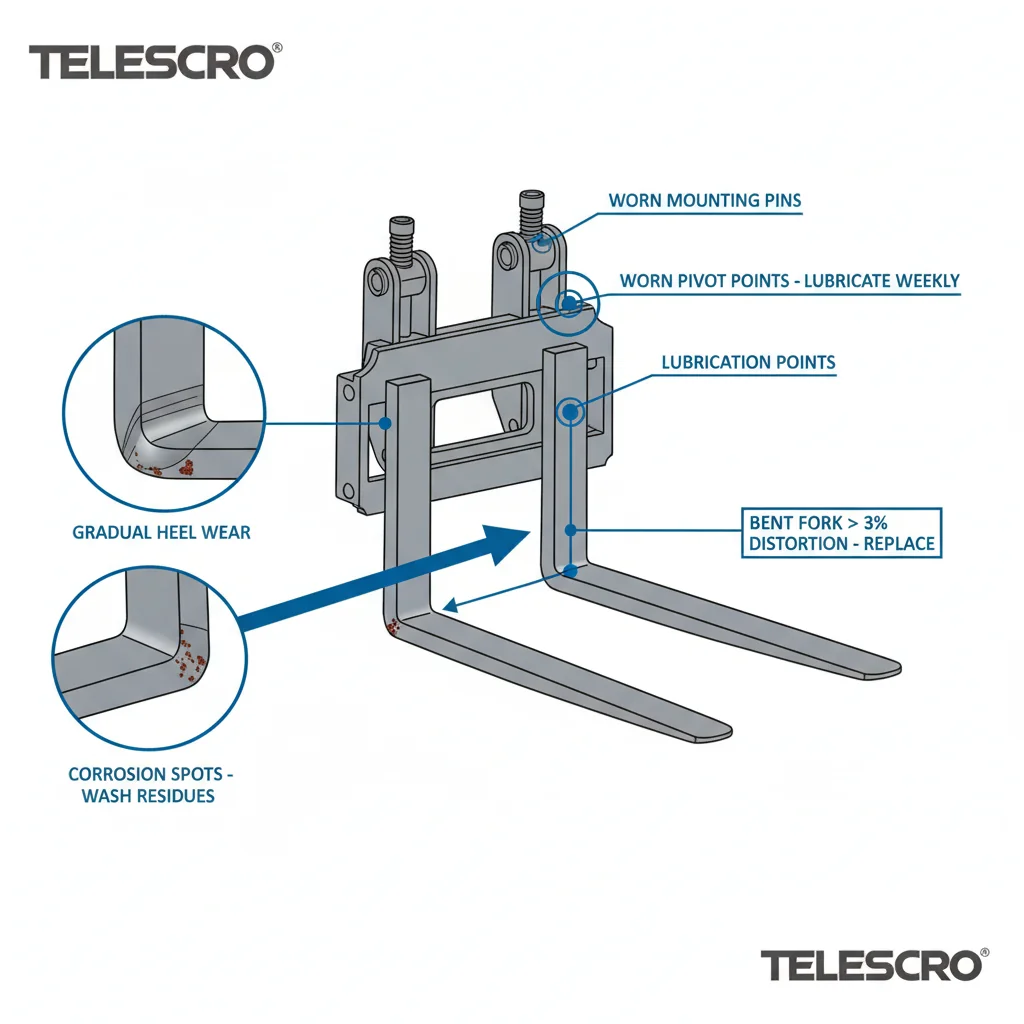
Routine telehandler fork maintenance focuses on inspecting for gradual heel wear, corrosion, permanent bends beyond 3% of fork length, and worn mounting pins. Operators should avoid dragging forks on hard surfaces, wash off corrosive residues, keep pivot points lubricated, and schedule inspections every 500 operating hours. These practices maximize safety, maintain productivity, and ensure regulatory compliance.
Key takeaway: Consistently checking for heel wear, corrosion, and straightness, combined with proper handling habits and regular cleaning, significantly reduces risk of fork failure. Simple preventive maintenance extends telehandler fork life, avoids unplanned downtime, and simplifies compliance with safety inspections and insurance requirements.
Permanent bends in telehandler forks exceeding 3% of the fork length must be corrected to prevent structural failure and ensure accurate load handlingTrue
Bends beyond 3% of fork length create stress concentrations and misalign load distribution, risking premature metal fatigue or fork failure, so detection during maintenance prevents accidents and extends fork service life.
Telehandler forks can be dragged frequently on hard surfaces without maintenance impact as long as the lifting capacity remains within rated limitsFalse
Dragging forks on hard surfaces causes abrasive wear and accelerates heel and edge degradation, compromising fork integrity and safety regardless of staying within rated load limits. Avoiding dragging helps maintain fork condition and lifespan.
Key takeaway: Consistently checking for heel wear, corrosion, and straightness, combined with proper handling habits and regular cleaning, significantly reduces risk of fork failure. Simple preventive maintenance extends telehandler fork life, avoids unplanned downtime, and simplifies compliance with safety inspections and insurance requirements.
How to Verify Telehandler Fork Quality?
Quality telehandler forks are identified by shank markings—rated capacity, manufacturer logo, serial number, and heat or steel batch ID. Buyers should request a material test report (MTR), proof-load or fatigue test data, and certifications such as EN ISO 2330 or ITA. Ultrasonic or magnetic particle inspection reports are recommended for high-risk applications.
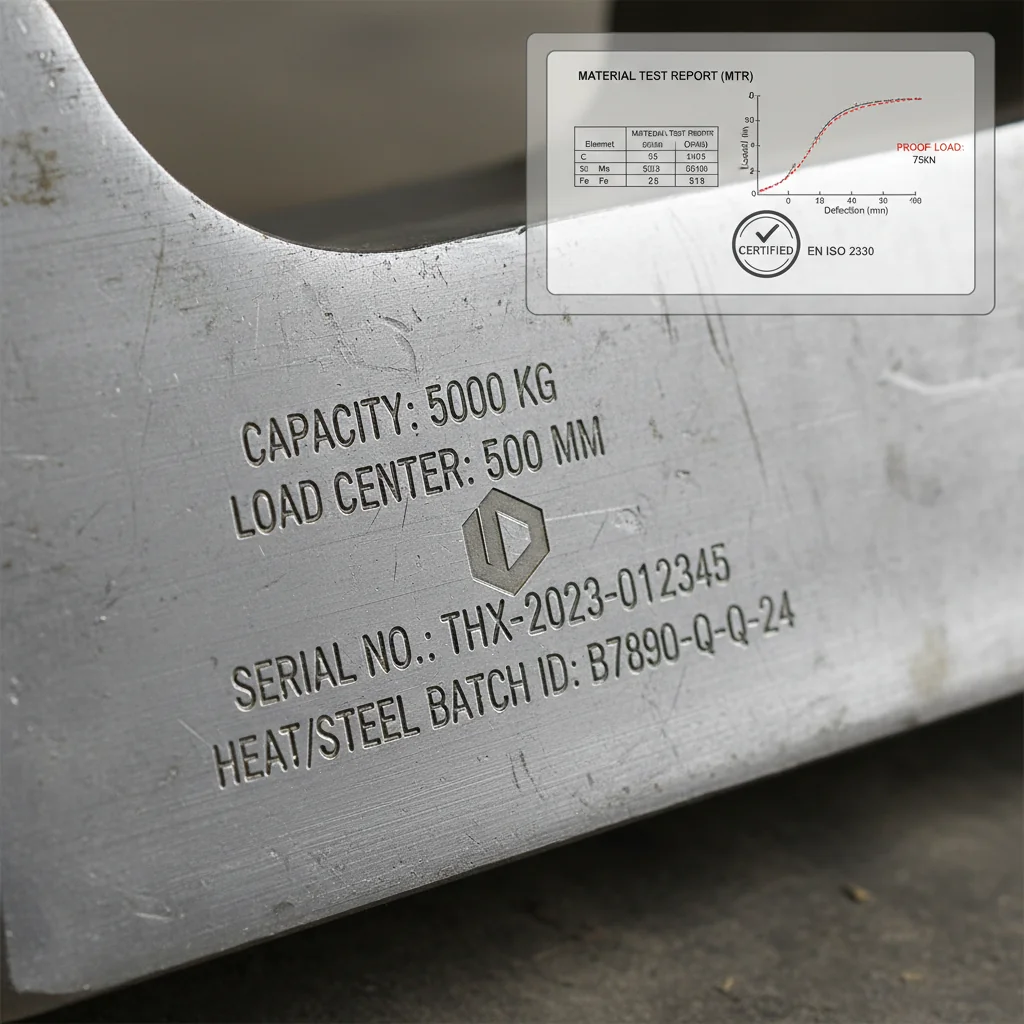
Last month, a contractor in Dubai sent me photos of “CE-marked” forks that arrived with no shank identification—no logo, serial, or rated capacity. He was worried. That’s a real red flag. Proper telehandler forks always have clear markings on the shank: the rated capacity, manufacturer logo, serial number, and usually a heat number or steel batch ID. If these aren’t present, you can’t trace the fork’s history or material—something I’ve seen go badly wrong when the steel quality isn’t verified, especially in 4-ton units working at full 14-meter reach.
For jobsites with constant heavy use (think block yards or mining projects in Kazakhstan), I always suggest asking for a material test report (MTR). This document lists the steel grade and batch, usually matching the heat number on the fork. Proof-load and fatigue test data15 are also important—these tests show the fork can handle loads above its rated limit or survive repeated cycles. I’ve seen customers skip this with cheap imports, then deal with bent or cracked forks within six months. It’s not worth the risk.
For high-risk environments—like chemical plants or wind farm lifts over 10 meters—consider going further: ask suppliers for ultrasonic or magnetic particle inspection (MPI) reports. These tests pick up internal flaws, even ones invisible on the surface. And always verify that certification matches your requirements, such as EN ISO 2330 or ITA standards.
I suggest cross-checking the rated fork capacity and class with your telehandler’s load chart before any purchase. Insisting on proper markings and full documentation up front protects your investment—and your crew’s safety—long term.
Telehandler forks without a heat number or steel batch ID cannot be reliably traced back to their certified material origin, increasing the risk of using substandard steel that may compromise safetyTrue
Heat numbers or steel batch IDs allow verification of metallurgical tests and certifications, ensuring the forks meet required mechanical properties and traceability standards; absence means material quality and origin cannot be confirmed.
CE marking alone guarantees that telehandler forks meet all international standards for rated capacity and material quality, making additional shank markings unnecessaryFalse
CE marking indicates conformity with EU safety directives but does not replace the need for visible shank markings such as rated capacity, serial number, and batch ID, which are crucial for traceability and safe operation verification.
Key takeaway: Sourcing reliable telehandler forks requires comprehensive traceability, including shank markings, material certification, and compliance documentation. Prioritizing proof-load, fatigue, and flaw inspection reports—especially for demanding environments—minimizes risk and deters counterfeit or substandard parts, safeguarding both operational safety and legal compliance.
Conclusion
We’ve looked at what really matters when choosing telehandler forks—making sure capacity, rating plate, and mounting class fit your toughest load scenario plus a safety margin. From my experience, the buyers who avoid headaches focus on the load chart at their real working reach and check how quickly they can get replacement forks or parts. I’ve seen too many crews stuck waiting, all because of "parts roulette" after picking based on price alone. If you’re weighing options or have questions about your specific site, feel free to reach out—I’m happy to share what’s worked for real jobsites. Every project is different; choose what actually fits your workflow.
References
-
Detailed explanation of load charts helps operators select correct forks, preventing overload, instability, and warranty issues. ↩
-
Provides detailed guidance on selecting telehandler forks to match load type, size, and safety standards for construction professionals. ↩
-
Details the benefits of floating forks in managing uneven terrain, helping operators maintain load stability and safety. ↩
-
Explores how side-tilt carriages maintain load balance on uneven ground, reducing accidents and improving telehandler performance. ↩
-
Explains how narrow carriages improve visibility and precision on masonry sites, reducing delays and material damage. ↩
-
Explains the significance of rated capacity markings on forks for safe lifting operations and avoiding structural failures on job sites. ↩
-
Detailed overview of EN ISO 2330 safety and fatigue testing standards for telehandler forks, essential for regulatory compliance and accident prevention. ↩
-
Explains how heat treatment enhances fork durability and prevents premature failure, backed by industry standards and case examples. ↩
-
Details how evaluating longevity and maintenance costs reduce long-term expenses, guiding smarter equipment investments. ↩
-
Explore how quick-attach forks reduce downtime by enabling rapid tool changes, boosting efficiency in busy material handling tasks. ↩
-
Understand the role of auxiliary hydraulics in powering attachments and how flow rates impact telehandler performance in demanding jobs. ↩
-
Learn how hook attachments enable telehandlers to lift unpalletized items and act like small cranes for precise load positioning. ↩
-
Explore detailed causes and prevention techniques for heel wear to extend telehandler fork lifespan and maintain safe operation. ↩
-
Understand how bends exceeding 3% fork length affect load distribution and risk fork structural failure, crucial for safe telehandler use. ↩
-
Detailed insights on testing that guarantees forks can handle loads beyond rated capacity and endure repeated stress cycles safely. ↩