










How Telehandler Wear Skews Specs: Field-Tested Accuracy Warnings
I’ll never forget the time an Italian site supervisor called in a panic—his three-year-old telehandler, supposedly well within the load chart, tipped alarmingly forward during a long outreach lift. Turns out, aging pins and soft tires had pushed reality far past the paper specs.
Telehandler load charts and published capacities are derived under the manufacturer’s specified setup conditions—firm, level ground; correct tire type and pressures; and a machine in serviceable condition. As components wear—pin and bushing clearances, mismatched or underinflated tires, hydraulic drift, and chain stretch1—the boom’s true geometry and the load’s effective radius can change, reducing practical capacity at long reach and making load indicators less reliable unless the machine is inspected, measured, and recalibrated per OEM procedures.
How Does Telehandler Wear Impact Load Charts?
Telehandler load charts are based on factory-new machines under specified conditions—level ground, correct tires, properly functioning hydraulics, and unworn components. As wear accumulates—loose pins, sagging tires, stretched chains—the effective load center can shift, reducing real-world stability margins2, especially at maximum reach. As a result, catalog specifications may overstate safe capacity for older or heavily used machines unless condition is verified.

Many operators view telehandler load charts as “best-case” guidance, without considering how machine condition changes over time. In practice, years of heavy use can subtly shift the balance. I encountered this on a project in Dubai, where a contractor relied on catalog data for a heavily worked long-reach unit. Inspection showed noticeable wear at the boom pivot and increased movement at full extension. Although the wear didn’t look dramatic, it was sufficient to reduce the real stability margin and cause the load moment indicator to activate sooner than anticipated during long-reach handling.
Here’s the thing: as the boom, chains, and tires age, small gaps add up. A sagging tire—or just a 40 mm difference across one axle—subtly tilts the machine, shifting the true tipping axis forward. The factory load chart is measured from the front tire edge to the attachment load center, but a worn machine may see this distance increase without anyone noticing. When stretched to maximum reach, even an extra 60 mm can cut your usable margin by 10–15%. Factor in a swinging load or a slight cross-slope, and you’re operating with virtually no buffer.
I always advise customers, especially on sites in Kenya and Southeast Asia, to treat rated capacity for older telehandlers as theoretical. Unless you’ve recently verified the machine’s condition and tested it under full load, don’t rely only on the catalog. Plan for less at maximum reach—maintenance and upfront checks will protect your project and your crew.
Wear in a telehandler’s boom and pivot points can significantly reduce lifting capacity at full extension, even though the official load chart doesn’t account for such deterioration.True
Load charts assume optimal, unworn conditions. As wear develops in pivot points and structural components, the ability to control and stabilize heavy loads diminishes, making real-world safe lifting limits lower than what the chart states.
As long as a telehandler passes its annual inspection, any amount of wear has no meaningful effect on its load chart ratings.False
Annual inspections can identify excessive wear but passing an inspection does not mean all wear is eliminated or inconsequential. Even within allowable limits, accumulated wear can impact load stability and effective safe capacity, making the load chart less accurate.
Key takeaway: Telehandler stability margins decline as machines wear, even if factory load charts indicate capacity is available. Always treat catalog specs as theoretical for older or well-used units, especially at long reach, unless the machine’s actual performance has been recently verified under load and on level ground.
How Does Boom Wear Impact Telehandler Capacity?
Boom pin and pivot wear in telehandlers increases clearance at critical joints over time. When the boom is fully extended, even small amounts of play can be amplified at the boom head, increasing the effective load radius and reducing real-world lifting capacity at long reach—often without being clearly reflected by standard gauges or indicators.

Let me share a customer case that illustrates how telehandler boom wear can catch operators off guard. On a site in Peru, a long-reach telehandler that had been in service for several years showed measurable side play at the boom pins and pivot points, exceeding 1 mm due to heavy use and inconsistent greasing. While this level of wear did not appear critical during routine checks, its impact became evident at full extension.
On this specific machine, operating at approximately 15–18 meters of reach, an estimated 1.5 mm of clearance at the pivots translated into roughly 60–100 mm of movement at the boom tip. During routine lifts around 13 meters, the effective load radius increased enough to activate the load moment indicator earlier than expected, even though dashboard readings appeared normal.
From my experience, many site teams rely heavily on the original rated capacity and dashboard indicators, assuming that if there is no visible cracking or deformation, the lift remains safe. In this case, however, accumulated boom wear gradually eroded the stability margin. At maximum extension, the machine struggled to handle loads that were theoretically within the load chart, indicating that actual lifting capacity had already fallen below nominal values.
This is why I recommend measuring boom head movement at full extension during inspections and evaluating the results against the manufacturer’s wear limits and service criteria. If excessive movement is confirmed, the machine should be derated or scheduled for corrective maintenance before undertaking high, long-reach lifts.
Progressive boom wear can lead to telehandler load charts becoming inaccurate, since excessive play at the boom tip may substantially reduce stability and safe lifting capacity at maximum extension.True
Load charts are developed based on specifications for new or well-maintained equipment. As boom wear increases, especially with excessive play at the pins and pivot points, the load at the tip may behave unpredictably, thereby invalidating the original rated capacities and compromising safety.
Minor wear at telehandler boom pivot points has no effect on load stability, as hydraulic compensation automatically offsets any slack during operation.False
Hydraulic systems do not compensate for mechanical play at pivot points. Even small amounts of wear can cause amplified movement at the boom tip, particularly at full extension, which affects load stability and can jeopardize both operator safety and the accuracy of rated capacities.
Key takeaway: Structural wear at boom pivots and joints can significantly undercut actual load capacity on long-reach lifts—sometimes before visible damage appears. Measuring boom head play and checking pin clearances during inspection is critical; exceeding limits requires immediate derating or rebuild to prevent unsafe operation.
How Do Telehandler Tires Affect Stability Specs?
Telehandler stability ratings in OEM manuals assume the specified tire size, ply rating, and inflation pressure. In service, underinflated, worn, or mismatched tires can alter chassis height and shift the machine’s center of gravity, reducing effective stability—especially during long-reach or near-capacity lifts. Tire condition and pressure should always be verified before operating close to rated limits.

When it comes to telehandler stability, tires are the true foundation of every lift. Load charts and rated capacities are based on the assumption that the machine is fitted with the correct tire size and ply, and that all tires are inflated to the manufacturer’s specified pressure.
On a customer site in Chile, I encountered a long-reach telehandler being pushed close to its working envelope while two tires were noticeably underinflated. During near-extension lifts, the machine exhibited excessive chassis movement on uneven ground and felt unstable during rotation. The load moment indicator began issuing low-margin warnings earlier than expected, despite the load appearing to remain within the charted capacity.
One of the most common issues I see is the use of mismatched tire sizes3, or mixing new and worn tires across axles. This is not merely a cosmetic concern. Even a visible difference in rolling diameter can cause uneven chassis height and shift the machine’s center of gravity, reducing lateral stability when the boom is extended.
I observed a similar situation on another site in Chile, where a 12-meter machine struggled to remain stable while handling roof trusses. Although the load was well below the rated capacity, a bulge in one front tire significantly reduced the real stability margin, and the tipping threshold was reached much sooner than expected.
For this reason, I always recommend checking tire condition and inflation as part of daily inspections—not only before major lifts, but every working morning—especially when operating near rated capacity or at long reach.
Uneven tire wear on a telehandler can lead to a shift in the machine’s center of gravity during lifts, creating unexpected instability even if the load chart limits are respected.True
Tire wear affects the contact patch and height of each tire, causing the chassis to tilt or compress unevenly; this alters the effective geometry, potentially making the machine behave unpredictably even within manufacturer-approved load ranges.
As long as telehandler tires are the right size, having mixed levels of tread wear won’t impact rated stability or safe operation.False
Different tread depths and wear profiles change the way each tire supports weight, which can result in uneven load distribution and compromise stability, making it unsafe to rely solely on tire size for specification accuracy.
Key takeaway: Even minor tire issues—such as low pressure, mismatched sizes, or advanced wear—can significantly decrease telehandler stability below what OEM load charts predict. Daily tire checks and strict adherence to specifications are essential for safe operation, especially at long reach or when operating near rated capacity.
How does chain stretch affect telehandler reach?
Chain stretch in telehandler boom lift chains gradually increases due to wear in pins and bushings, leading to elongation. Once chain stretch exceeds 2–3% over a measured length, boom tip position becomes less accurate, reach may increase mistakenly, and load chart alignment4 is compromised, affecting operational safety and load stability.
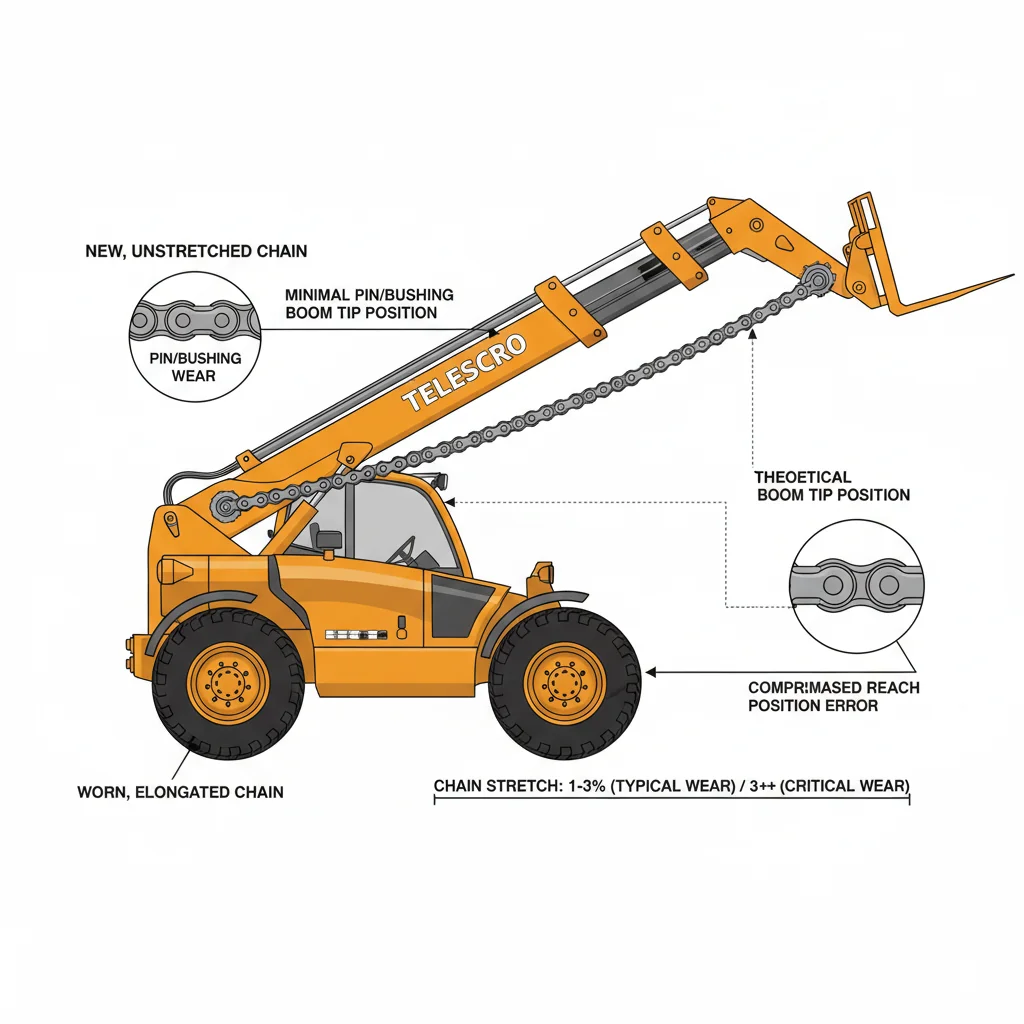
One of the most common mistakes I see is operators overlooking small changes in boom extension accuracy, particularly after the first year or two of regular use. Telehandler lift chains rarely fail suddenly; instead, they elongate gradually as pins and bushings wear with each load cycle.
On a customer site in Dubai, a 13-meter telehandler began showing measured chain elongation exceeding 3% after approximately 2,000 operating hours. Although the nominal reach remained 13 meters on paper, the actual boom tip position had shifted outward by nearly 400 mm. This deviation significantly affected load chart accuracy: at full extension, the machine could safely handle only about 900 kg, well below the 1,200 kg shown in the manufacturer’s chart.
Chain stretch can mislead both operators and machine systems. Load charts assume a precise and repeatable boom-to-axle geometry. As lift chains elongate, the boom tip sags and the effective load radius increases, even though position sensors and displays may continue to report nominal values. I have seen this contribute to unintended overload situations on sites in South Africa, where palletized loads shifted because operators relied solely on the display without verifying chain condition.
Because early-stage chain elongation is difficult to judge visually, I recommend using a calibrated chain gauge during scheduled inspections. Applying light measurement tension—typically around 1% of the chain’s rated load—helps ensure accurate readings. If chain elongation approaches or exceeds the commonly accepted 2–3% service limit, replacement should be planned promptly, as continued operation increasingly compromises reach accuracy and lifting safety.
Chain stretch in a telehandler's lift system can cause the actual boom tip position to differ from the geometry assumed in the manufacturer’s load chart, increasing the effective load radius at long reach.True
As lift chains elongate due to pin and bushing wear, the boom may sag or extend differently than assumed in the original load chart calculations. This alters the true boom-to-axle distance used for capacity assessment, even if sensors or displays continue to indicate nominal reach values.
Visual inspection of telehandler lift chains is sufficient to detect all performance-impacting chain stretch before load chart accuracy is affected.False
Chain elongation develops internally at the pin and bushing interfaces and often progresses without obvious external signs. Accurate assessment requires measured elongation using appropriate gauges rather than visual inspection alone.
Key takeaway: Monitoring and proactively replacing boom lift chains before stretch exceeds OEM limits is essential to maintain telehandler accuracy and real-world alignment with load chart specifications. Relying on tape measures can introduce error; use proper gauges and document wear at annual inspections for best practice safety.
How Does Hydraulic Wear Affect Lift Accuracy?
Hydraulic wear in telehandlers—due to seal degradation and internal leakage—reduces boom responsiveness and precision by 5–10% after around 2,000 operational hours if maintenance is subpar. Worn cylinders can cause boom creep5, making precise load placement unreliable and increasing safety risks near rated capacity limits.
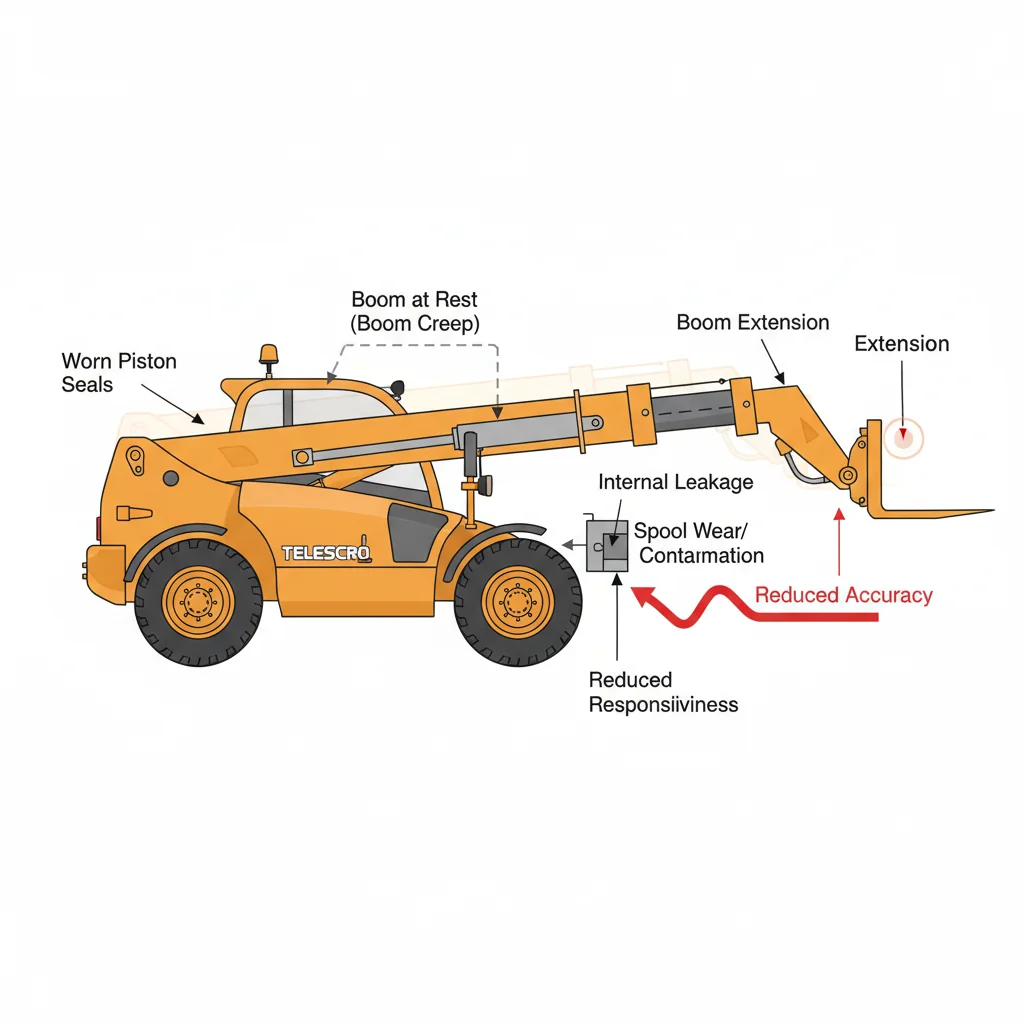
Last year in Dubai, I worked with a site supervisor who reported that his 4-ton compact telehandler was drifting out of position while placing roof trusses. Initially, the issue was assumed to be operator error. Upon inspection, however, the machine had accumulated nearly 2,500 operating hours, and wear at the tilt cylinder seals was evident. Even with experienced operators, this hydraulic wear introduced a subtle but dangerous form of boom creep—the boom would not hold steady under load. As a result, load placement accuracy degraded by approximately 5%, which proved critical when handling several hundred kilograms at maximum reach.
Hydraulic wear rarely presents as a sudden failure once a machine passes a certain hour threshold. From my experience, issues seldom appear immediately after 2,000 hours. Instead, operators begin to notice gradual changes such as sluggish response, minor oil leakage, or the need to increase engine speed to achieve normal boom movement. During functional checks, a brief delay between joystick input and boom response is often observed, which typically indicates internal leakage within the hydraulic pump or boom cylinders. These symptoms tend to worsen under heavier loads or elevated oil temperatures.
I encountered a similar situation with a customer in Kazakhstan who continued operating despite these warning signs. During a lift near a building edge, the boom crept approximately three centimeters while holding load—a movement small enough to be overlooked, but significant enough to create a serious safety risk. Fortunately, the issue was noticed before an incident occurred.
This is why regular monitoring is essential. Operators and maintenance teams should watch for creeping booms, inspect hydraulic oil for contamination, and document any changes in control response or holding performance. Addressing these early indicators is critical to maintaining lift accuracy and avoiding unintended overload conditions.
Progressive wear in a telehandler's hydraulic seals can cause internal fluid bypass, resulting in gradual boom drift that reduces precise load placement, even when control levers are in the neutral position.True
Seal wear leads to small but continuous leaks inside hydraulic cylinders, making it impossible for the boom to hold steady under load. This phenomenon, known as 'boom creep,' impacts accuracy without obvious external leakage.
Hydraulic wear primarily affects a telehandler’s travel speed, while lift accuracy remains mostly unaffected unless the wear is extreme.False
In reality, hydraulic wear mainly compromises the ability to control and hold loads precisely, so lift accuracy is directly impacted, whereas travel speed is usually controlled by the drive system and less sensitive to hydraulic seal condition.
Key takeaway: Hydraulic component wear undermines telehandler lifting precision, often before obvious malfunction occurs. Operators should regularly monitor for creeping booms and lagging controls, maintain hydraulic oil quality, and promptly service worn cylinders or valves to prevent safety risks and avoid misinterpreting load chart data.
When Does Fork Wear Invalidate Load Charts?
Load charts for telehandlers are based on original-spec forks and standard attachments. Fork wear—specifically a heel thickness reduction of 10%—can reduce the fork arm’s own load capacity by approximately 20%, as per ISO 5057. This may require fork replacement or capacity derating for continued safe operation.

A contractor in Kazakhstan shared photos of pallet forks used on his 4-ton telehandler, showing that years of service had worn the fork heels beyond 10% of their original thickness. This led to understandable confusion, as the machine’s load chart still indicated a rated capacity of 4,000 kg at minimum reach with standard forks installed.
However, fork wear represents a critical but often overlooked risk. Under ISO 5057 inspection guidance, a reduction of approximately 10% in fork heel thickness is a removal-from-service criterion, as it indicates a significant loss of structural strength. In practical terms, forks originally rated for 4,000 kg can no longer be assumed to safely carry that load once this wear limit is exceeded—particularly when dynamic effects, uneven ground, or impact loading are considered.
Here’s what matters most when applying the load chart: the numbers assume original-spec forks and standard attachments in perfect condition. The machine itself may still be structurally fine, but if the forks are worn, the weak link isn’t the telehandler—it’s the attachment. If side shift carriages, man baskets, or rotating forks are mounted, the factory load chart no longer tells the whole story either; each of those attachments shifts the load center, adds weight, and must be matched with its own capacity chart.
I always tell operators: don’t guess. Use a caliper to check fork heel thickness—compare it to the OEM spec. If the wear hits 10%, either replace the forks or use a conservative derate for planning. And if no attachment-specific chart is available, always play it safe and downgrade capacity or use a larger machine. This is how you avoid hidden capacity traps and keep everyone safe on site.
Even if a telehandler's load chart remains unchanged, worn fork heels can reduce the actual safe lifting capacity well below charted values.True
Load charts are based on the assumption that forks are in original, undamaged condition. Significant fork wear changes the strength characteristics, so the real capacity can be substantially lower than what the load chart shows.
As long as a load chart is displayed on the telehandler, the operator can safely lift up to the charted capacity regardless of fork wear.False
The load chart only applies to equipment in good condition. Worn forks are structurally weaker, meaning the maximum safe load is now less than the charted value, so ignoring fork wear creates a dangerous situation.
Key takeaway: Fork wear significantly impacts the load-carrying capacity of forks, but does not directly alter the machine load chart capacity. Regularly measure fork heel thickness; if wear exceeds 10%, either replace the forks or apply conservative derating—always using the load chart appropriate for the specific attachment and measured condition.
How does telehandler wear affect LMI accuracy?
Telehandler wear, such as boom play, chain stretch, and pad degradation, can cause load moment indicator (LMI) sensors—including angle sensors and pressure transducers—to drift from their original calibration. Even modest physical changes or repairs can distort LMI readings, leading to inaccurate load charts and potential safety risks until proper recalibration is performed.
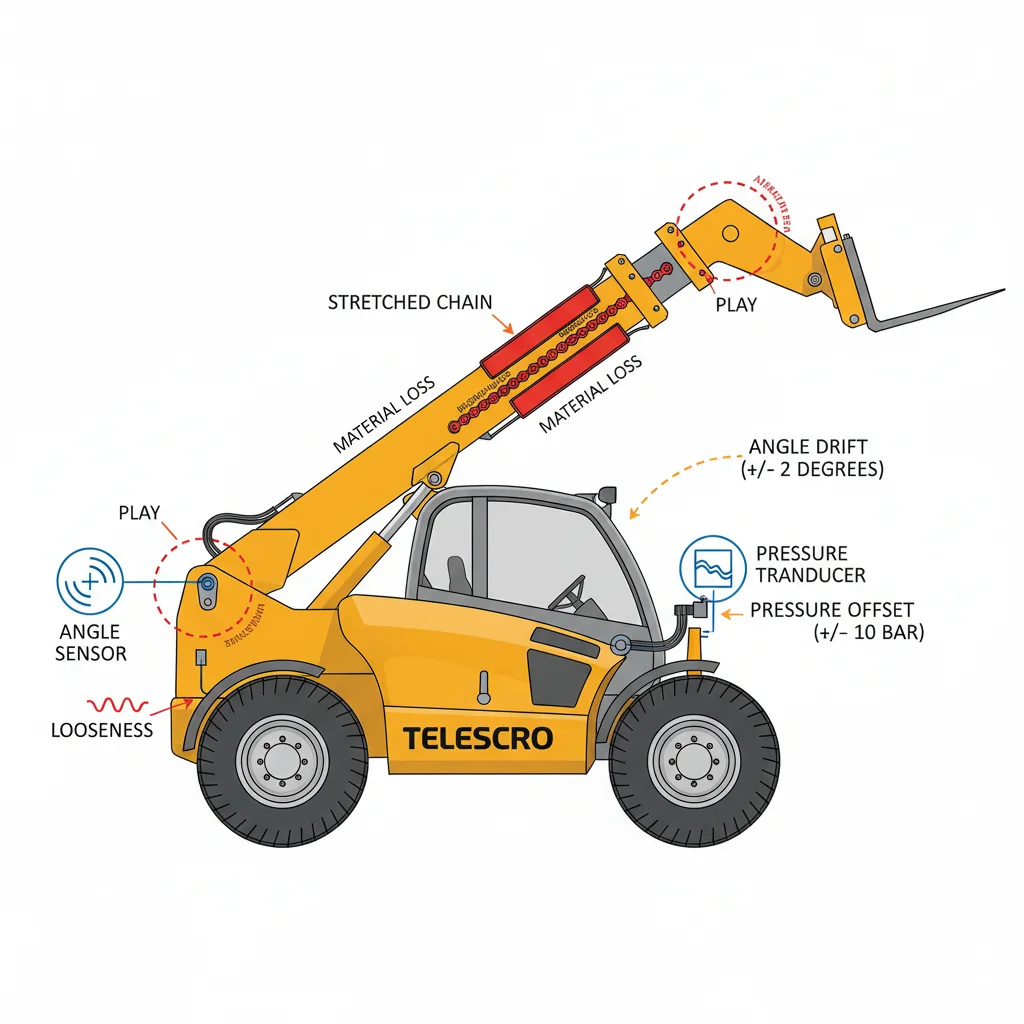
Operators often ask me why their load moment indicator (LMI) starts acting up a couple of years into service, even if the telehandler still “feels” solid. Here’s what matters: physical wear—like boom play, stretched chains, or worn sliding pads—causes tiny but crucial misalignments. The sensors don’t “know” the boom is moving differently. So even if the LMI’s angle sensor reads exactly as when it left the factory, the real-life load radius can be a few centimeters off. That’s enough to throw off an LMI reading by more than 5% at full extension. I’ve seen this first-hand with a 4-ton, 17-meter telehandler at a site in Turkey. The LMI started triggering early alarms when workers lifted concrete blocks, even though they were well under the supposed limit.
After a quick inspection, we found the boom wear pads6 had lost nearly 3 mm thickness after less than two years of harsh use. The chain was just starting to stretch too. Not exactly “end of life,” but those small changes meant the LMI’s calibration was no longer matched to the true boom geometry. When we ran a test with a certified 2,000 kg load, the indicator was off by more than 120 kg. That’s outside any reasonable tolerance for safe work.
If you ever see the LMI alarm on loads that “should” be safe, or notice a drift after hydraulic repairs, don’t rely on guesswork. I suggest scheduling both recalibration and a full mechanical check. That’s the only way to make sure your published load chart still reflects reality—not just what the electronics believe.
Physical wear in a telehandler's boom or pivot points can lead to cumulative misalignments that the LMI's sensors cannot detect, causing the system to overestimate or underestimate the actual load radius.True
LMI systems rely on sensor readings for boom angle and position. Mechanical wear like increased boom play or stretched components changes how the boom moves versus its expected geometry, so the sensor data no longer accurately represents the true position, affecting calculation of load radius and safe lifting limits.
LMI accuracy is unaffected by gradual telehandler wear because the sensors automatically compensate for changes in boom geometry.False
LMI sensors cannot detect internal wear such as increased play or deformation in the boom since they measure angles and lengths relative to fixed points. Without manual recalibration or maintenance, accumulated mechanical discrepancies persist and sensor compensation is not possible.
Key takeaway: Telehandler LMIs and related sensors can drift as a result of component wear, hydraulic work, or structural repairs. Calibration should always follow the manufacturer’s service requirements and be performed after major repairs or whenever indicated load behavior no longer matches actual machine response, to ensure load chart reliability and operational safety.
How does telehandler wear affect lift planning?
Telehandler wear in pins, chains, forks, hydraulics, and tires can significantly reduce actual lifting capacity, particularly at maximum reach or height. For fleets with older machines, critical lifts should be planned at only 70–75% of the catalog rated capacity, unless the telehandler was recently rebuilt and inspected. Always verify with a controlled test lift7 before approving near-limit configurations.
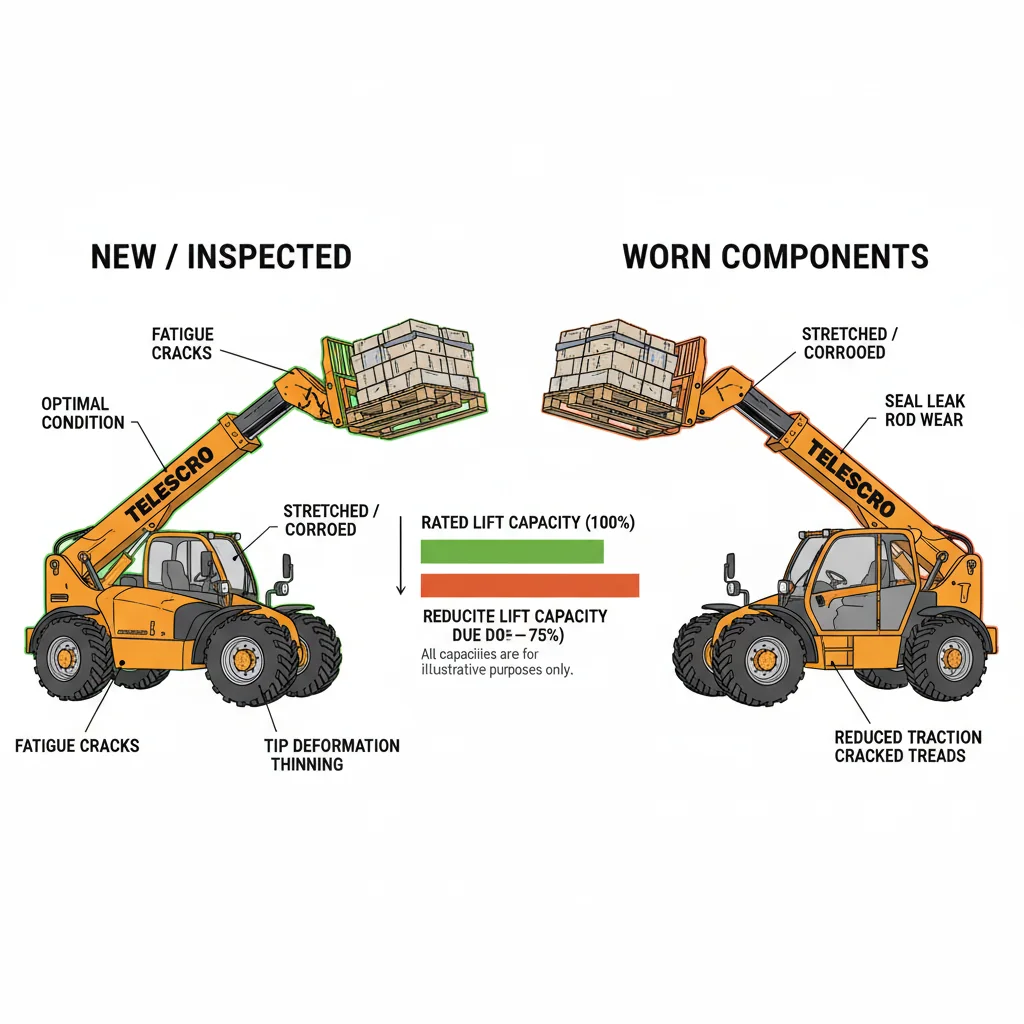
I’ve worked with customers in both Brazil and the Middle East who faced major issues because they ignored telehandler wear during lift planning. Pins, chains, and hydraulics take a beating over time—especially when machines are used outdoors and loaded near capacity. After seven or eight years, even well-maintained telehandlers can develop extra play at the boom head. I’ve measured more than 40 mm side-to-side movement on some older units, which directly affects lift accuracy and stability at full extension.
One example: a team in Dubai tried to lift precast panels weighing just under the rated 2,500 kg at 12 meters. The job-site manager relied on the catalog spec and skipped a test lift. As soon as the boom reached maximum forward position, the telehandler’s moment indicator alarmed and the boom dipped—hydraulic pressure couldn’t stabilize the load. Luckily, the site was clear and no one was hurt, but the lesson was clear: catalog numbers don’t account for hidden wear.
For mixed fleets or any machine a decade old, I always suggest planning critical lifts at no more than 70–75% of the listed capacity, unless it’s just been rebuilt and certified. That means treating 1,700 kg—not 2,500 kg—as your safe working ceiling at long reach. Before signing off on any near-limit setup, perform a controlled test lift with a certified load. Check fork heels, tire pressure, and see how much play is in the boom and fork carriage. If anything fails your checks, reduce load or use a newer, higher-capacity model. It’s not about paranoia—it’s about real-world safety.
Excessive boom head play caused by wear can result in load sway and unpredictable fork placement, leading to inaccurate lifts even if the telehandler is operated within its rated capacity.True
Wear introduces additional movement at connection points, which increases the margin of error when positioning loads. This means the operator’s inputs may not translate directly to controlled motions, especially at height or full extension.
Telehandler specification charts always account for possible wear and component play, so lift planning remains accurate regardless of machine age.False
Specification charts are based on new or properly maintained equipment and do not factor in deterioration from wear; relying on them for aging machines can lead to unsafe or inaccurate lift assessments.
Key takeaway: Always account for accumulated wear when planning lifts with used or mixed-age telehandlers. Recommend planning maximum lifts at 70–75% of rated capacity for machines more than 7 years old unless recently overhauled. Controlled test lifts are essential to confirm safe, real-world capacity before attempting near-limit operations.
How Does Wear Affect Telehandler Sizing?
Telehandler wear—such as pin looseness, tire sag, and fork/chains degradation—can reduce practical lifting capacity at required reach by 10–20% over time, forcing smaller lifts or extra trips. Industry experts recommend selecting a telehandler with 20–30% rated capacity headroom to maintain safe, reliable performance throughout the machine’s lifecycle and avoid costly under-capacity issues.
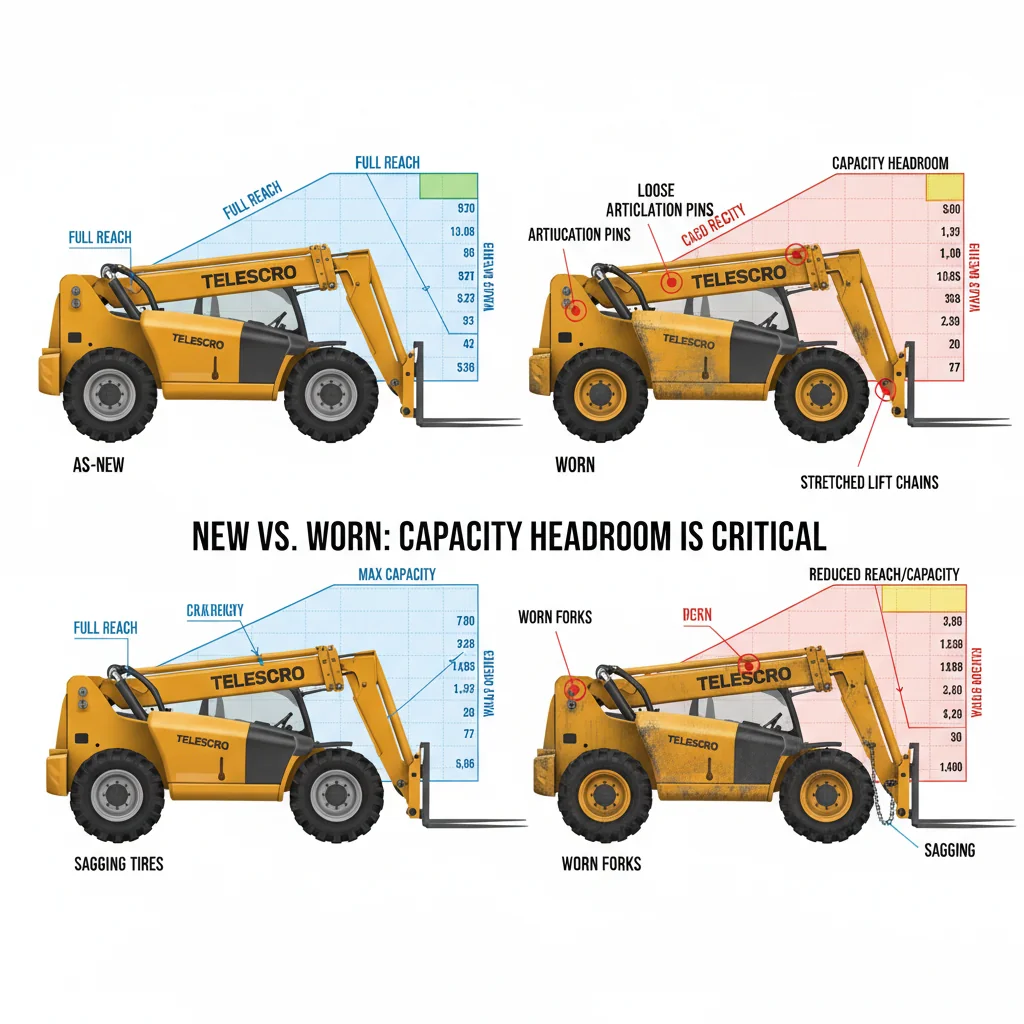
To be honest, the spec that actually matters is the working capacity you’ll get after two years on the jobsite—not the number stamped on the sales brochure. Every month I walk jobsites where telehandlers look solid, but the operator has to stop at 80% of the planned load. Why? Pins loosen a bit, tires lose shape, and the forks show visible wear. I’ve seen it in Poland, Malaysia—almost everywhere. A 3.5-ton unit rated at 12 meters may drop to under 3 tons of real-world capacity if the forks wear past their prime or the pins allow too much play.
Here’s what matters most: once wear sets in, the load chart values aren’t so reliable at maximum extension. On one project in Kenya, the foreman ordered lifts based on brand-new specs. By year three, side play in the boom was enough that safety sensors started to cut out with loads the machine should “theoretically” handle. This led to extra trips—sometimes double the planned movements—and at least one emergency rental that cost more than 1,000 USD per week. Running close to max load every lift accelerates this problem. I always explain that the moment indicator and hydraulic circuit are only as accurate as the machine’s mechanical health.
So, I recommend a margin—20–30% headroom for both capacity and reach. If your job calls for 3 tons at 10 meters, select a model rated for 3.5 or even 4 tons at 12–14 meters. This gives you room for wear, attachment swaps, and changing load centers without pausing your operation. The extra investment up front often saves more than it costs.
Over time, wear on critical components like pins and forks can significantly lower a telehandler's actual lifting capacity compared to its original rated specification.True
As telehandlers operate in tough site conditions, mechanical wear leads to greater flex and possible deformation in structural members, causing decreased efficiency and load-handling ability versus the manufacturer's stated specification.
Telehandler capacity ratings remain accurate for the entire operational life of the machine, regardless of on-site wear.False
Capacity ratings are based on new-condition testing under ideal scenarios, but real-world wear and tear on pins, tires, and forks degrade the telehandler’s structural integrity and performance, making the actual operational capacity lower over time.
Key takeaway: Specify telehandlers with at least 20–30% capacity and reach headroom over calculated needs. This proactively accounts for long-term wear, attachment variations, and minor job changes—avoiding unexpected productivity loss, emergency rentals, and high operational costs as machines age or conditions fluctuate.
How does telehandler wear affect rated specs?
Used telehandlers rarely match catalog specifications due to wear at key structural points. Vertical boom play exceeding 20–30 mm, chain elongation8 over 2–3%, or over 10% fork heel loss9 directly impact actual capacity. Tires must conform to OEM size and pressure. Several worn items require immediate capacity derate and refurbishment consideration.

Too often, I see buyers assume a used telehandler will still hit every number from the original spec sheet. The reality on site is usually different. Wear at key points—like the boom pivot, extension pads, or chain anchorages—directly impacts real lifting capacity and safe reach. I recently inspected a 4-ton compact telehandler in Vietnam that looked fine on paper. But at full extension, the vertical play at the boom head was almost 40 mm. That’s well past the 20–30 mm threshold. For that unit, I recommended an immediate 15% derate and a rebuild plan, not just a quick sale.
Always check more than just the hour meter. For example, chain elongation is a silent killer. If measurement shows more than 2–3% stretch, the risk of sudden chain failure or load drift jumps. On one site in Qatar, a chain showing 5% elongation cut the practical lifting capacity by at least 20%—and created a dangerous scenario during routine pallet work. Don’t forget the forks, either. According to ISO standards, if the heel is worn more than 10%, the fork’s own strength drops by about 20%, enough to demand immediate swap-out. That’s not just a maintenance issue—it’s a real safety hazard.
Another area I always focus on is tires. They must match the OEM’s specified size and pressure. Undersized or under-inflated tires can reduce ground contact and make the machine less stable, especially at full boom. The takeaway? Always measure these wear points before relying on catalog specs. If you find several items close to limit, plan a 10–20% derate and factor in the cost of repairs before deployment.
Excessive wear at the boom pivot can cause a telehandler to lose lifting stability before reaching the spec sheet’s rated load or reach limits.True
As wear increases at pivotal joints, mechanical play grows, affecting structural geometry. This reduces the machine’s ability to maintain full stability at limits that were safe when the equipment was new.
Specification ratings for used telehandlers remain fully accurate as long as the machine passes its general visual inspection.False
A general visual inspection cannot detect internal wear or excessive play at critical load-bearing points. Specification ratings depend on mechanical integrity at these points, not just on outward appearance.
Key takeaway: Always assess structural wear points—boom play, chain elongation, fork heel thickness, and tire conformity—against OEM specifications when evaluating used telehandlers. Significant wear should prompt a 10–20% operational capacity derate and factor into purchase or deployment planning decisions.
Conclusion
We looked at how telehandler specs can drift from real performance as your machine ages, even when the load chart says you’re still in the safe zone. From my own time on jobsites and supporting customers, I’ve seen the danger of trusting factory numbers on older units, especially when you’re working near max reach. Don’t let a “showroom hero, jobsite zero” situation catch you out—recheck actual capability under real loads and conditions whenever in doubt. If you have questions about assessing your telehandler’s true limits or want practical advice for your next purchase, I’m happy to help. Feel free to get in touch—the right info makes for safer choices on busy sites.
References
-
Explores how gradual chain stretch impacts boom accuracy and load safety, essential for telehandler maintenance and operation. ↩
-
Understand the critical role of stability margins in telehandler operation and how wear reduces safety by up to 15%, with examples. ↩
-
Details how uneven tire sizes cause chassis sag and shift the center of gravity, reducing lateral stability and increasing tipping risk. ↩
-
Details how incorrect load chart alignment from chain stretch can cause overload and instability, crucial for operator safety. ↩
-
Expert explanation of boom creep caused by worn cylinders and internal leakage, with safety and operational impacts at high loads. ↩
-
Discover expert analysis on boom wear pad degradation and its critical influence on telehandler load radius and sensor readings. ↩
-
Learn why controlled test lifts verify actual capacity and prevent accidents caused by unseen telehandler wear. ↩
-
Explore how chain elongation beyond 2-3% drastically reduces lift capacity and safety risks, vital for maintenance and operational integrity. ↩
-
Learn why over 10% fork heel wear can reduce fork strength by 20%, requiring immediate replacement to maintain safe lifting conditions. ↩