










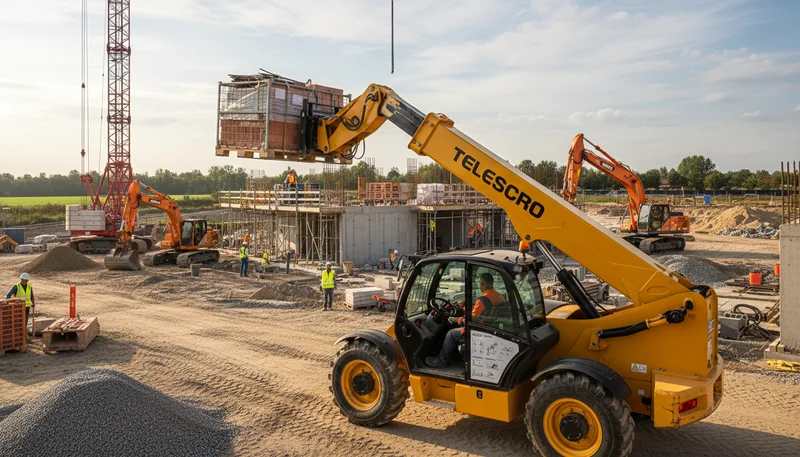
How Telehandler Load Charts Are Designed: Field Guide to Avoid Critical Mistakes
I’ll never forget the day a project supervisor from Dubai challenged me about a telehandler’s load chart, convinced his machine could handle “a little extra” weight because it felt stable. That misunderstanding could have easily sent a costly load—and his crew—into danger.
A telehandler load chart represents a detailed, configuration-specific map of safe operating limits determined by both stability and structural constraints at each possible boom position. Engineering teams construct these charts by applying international standards such as ANSI/ITSDF B56.6, EN 1459, and ISO 10896. The displayed lifting capacity at every point reflects the lower value between the stability limit (proximity to tipping) and the structural limit (maximum stress in components), incorporating safety factors for dynamic forces like wind or rough terrain. This ensures a reliable margin of safety for each operational condition.
What Does a Telehandler Load Chart Show?
A telehandler load chart represents a tested, standards-based map of the machine’s safe operating capacity at every boom angle, height, and reach—specific to one configuration. Each point on the chart reflects the lower value between stability and structural limits1, with applicable safety factors per ANSI/ITSDF B56.6, EN 1459, or ISO 10896 standards.
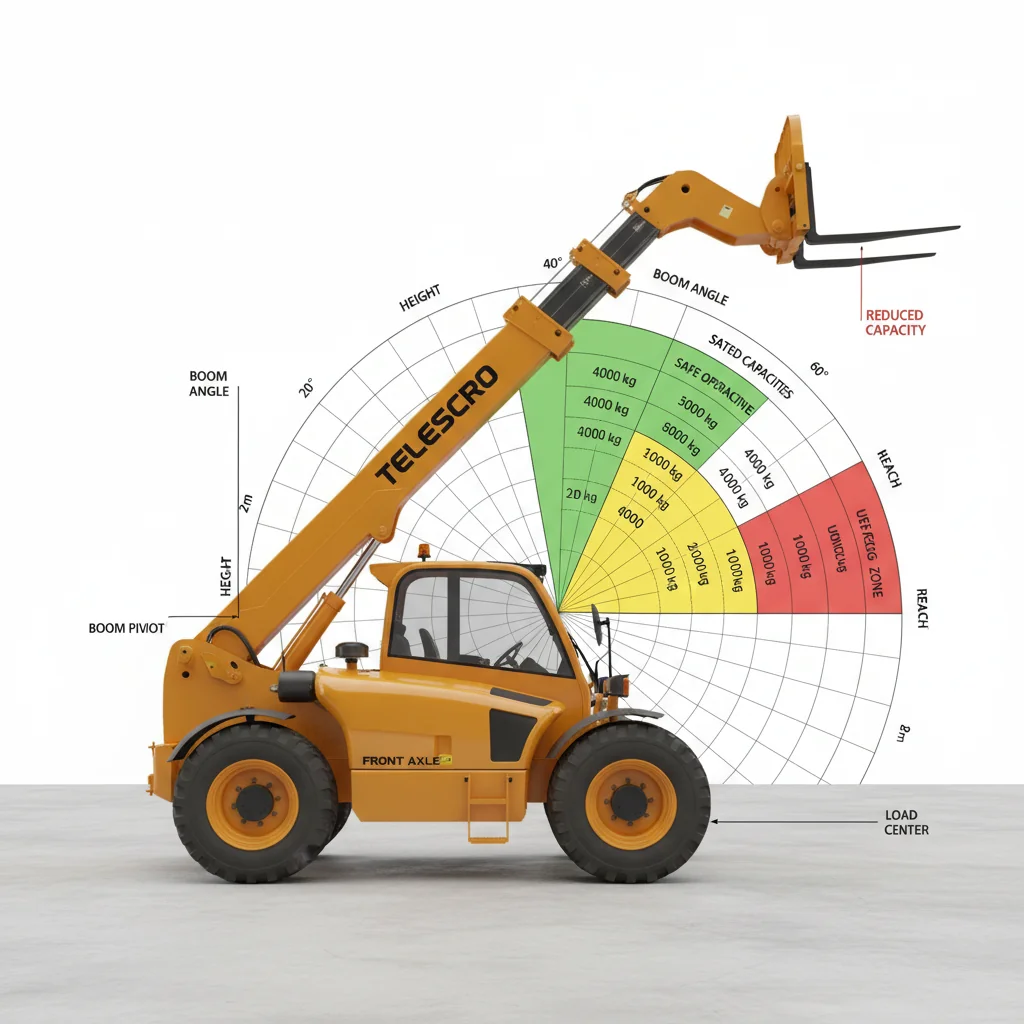
Most people think a telehandler load chart just tells you how much weight the machine can lift. The reality is much more detailed. A load chart is a tested, configuration-specific map—it shows exactly what load is safe at each height and reach, for a particular attachment, tire set, and stabilizer setting. Every grid point connects to two engineering checks: stability and structure. The permitted load is whichever number is lowest after applying safety factors from standards like EN 1459 or ANSI/ITSDF B56.6.
Let me share something important I learned from a project in Kazakhstan. The site engineer tried to use a 3.5-ton telehandler to pick a 1,800 kg load at nearly full reach—about 13 meters out. According to the spec sheet, it looked safe. But the load chart showed the rated capacity dropped to just 1,100 kg at that position (and that’s for level ground, with the specified fork attachment). They nearly tipped the unit before checking the chart and realizing the real margin. That’s a “3-meter blind spot” I see all over the world—ignoring the drop-off in capacity with reach.
Here’s the thing: the chart assumes everything matches the tested setup. If you change to a bucket, install foam-filled tires, or take the machine off a level slab, those chart numbers no longer apply. The tipping axis—usually at the front axle—can shift with stabilizers or frame leveling, altering safe capacity. I suggest reviewing the actual load chart for your exact configuration before making any lift, even for routine jobs. This habit keeps your team and machine safe.
A telehandler load chart takes into account both the selected attachment and the stabilizer setting, meaning the safe lifting capacity can change significantly if a different attachment or stabilizer configuration is used.True
This is true because telehandler load charts are highly configuration-specific. Engineering tests determine limits unique to the attachment type, stabilizer status, and other variables. Changing attachments or stabilizer deployment alters the machine's stability and structural load path, which is directly reflected in revised safe load values on the chart.
The maximum load rating shown on a telehandler's load chart represents the highest amount the machine can physically lift, regardless of how far the boom is extended or the angle at which it operates.False
This is false because the maximum load rating only applies under specific boom angles and lengths. Extending the boom or raising it to a different angle changes the load capacity due to stability and structural considerations. The load chart details permissible loads for every height and reach, and the maximum is often much lower at full extension than at minimum reach.
Key takeaway: Telehandler load charts are not generic maximum capacity values—they are precise, configuration-dependent safety maps based on both stability and structural engineering limits. Never assume alternative attachments, tire types, or machine configurations are covered unless specifically indicated by the manufacturer’s load chart.
How do safety standards shape load charts?
Telehandler load charts are engineered to comply with safety standards like ANSI/ITSDF B56.6 and EN 1459. Engineers apply stability criteria, such as the tipping axis, and calculate overturning versus resisting moments. Safety factors, typically around 1.33:1, are used to derate raw values for real-world risks like dynamic loads or rough terrain. The chart values represent absolute safety limits, not performance targets, ensuring that operators never exceed safe operational boundaries.
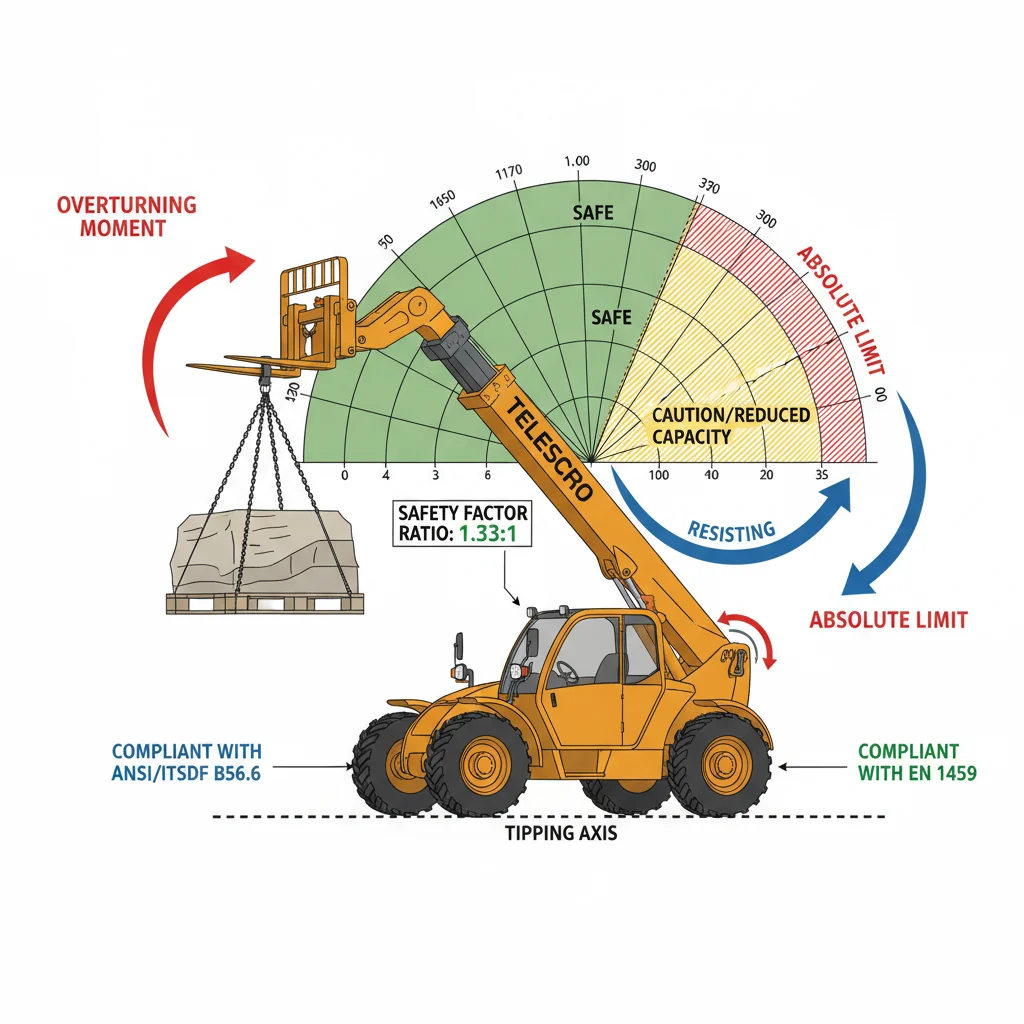
Let me share something important about how safety standards shape load charts—it goes much deeper than just crunching numbers. These charts aren’t just suggestions; they’re built around strict global rules, like ANSI/ITSDF B56.6 in North America or EN 1459 and ISO 10896 in Europe. Engineers start with technical stability criteria: at every boom angle and extension, they use the front axle or front tire contact points as the tipping axis. Then they measure the “overturning moment2” caused by the load trying to tip the machine forward, and compare it to all the factors holding the telehandler steady—machine weight, counterweight, even tire pressure. For each position, the load limit must leave a margin—usually a ratio of 1.33:1 or more—so even sudden shocks can’t easily push the machine over the line.
I remember working with a warehouse builder in Dubai who wanted to “push” an extra 500 kg on a 4-ton, 14-meter telehandler. On paper, the machine handled it, but looking at the real load chart, the capacity at his needed reach was only 1,250 kg. Using more than the chart allowed meant risking the entire safety margin. Engineers already factor in dynamic effects—like wind, braking, or a bumpy worksite—by derating the raw numbers. So the capacities are not mere guidelines, but hard boundaries set after covering all possible risks.
This is why I always tell customers: the numbers on your load chart are absolute limits, not performance targets. If you try to “stretch” them, you’re no longer protected by those built-in safety factors. For safe, reliable operation, treat the chart like law—no exceptions.
Load charts for telehandlers are directly shaped by international safety standards, requiring engineers to use the front axle or tire contact points as the defined tipping axis during load stability calculations.True
This is true because safety standards like ANSI/ITSDF B56.6 and EN 1459 specify that the tipping axis—usually the front axle or tire contact points—must be used when calculating and illustrating the machine's safe operating limits. This ensures consistency and safety in load chart creation.
Telehandler load charts are based solely on the rated lifting capacity of the hydraulic system, without accounting for machine stability or industry safety regulations.False
This is false because load charts are not created just from hydraulic lifting capabilities. They are carefully developed to reflect the stability of the machine under varying operating conditions and are strictly regulated by safety standards that require consideration of tip-over risk, not just mechanical lift strength.
Key takeaway: Telehandler load charts reflect strict engineering to meet global safety standards, incorporating significant stability margins and safety factors to cover dynamic influences and manufacturing variations. Capacity values shown are absolute regulatory limits—exceeding them risks machine instability and violates OEM and industry guidelines.
How are telehandler 3D load charts created?
Telehandler load charts are based on a 3D kinematic model that considers factors such as boom angle, extension, carriage, and attachment. Manufacturers perform tests or calculations at multiple grid points to determine safe load limits, creating a 3D capacity envelope. The in-cab chart you see is a 2D projection of this comprehensive, data-driven model, providing operators with precise, real-world safety limits.
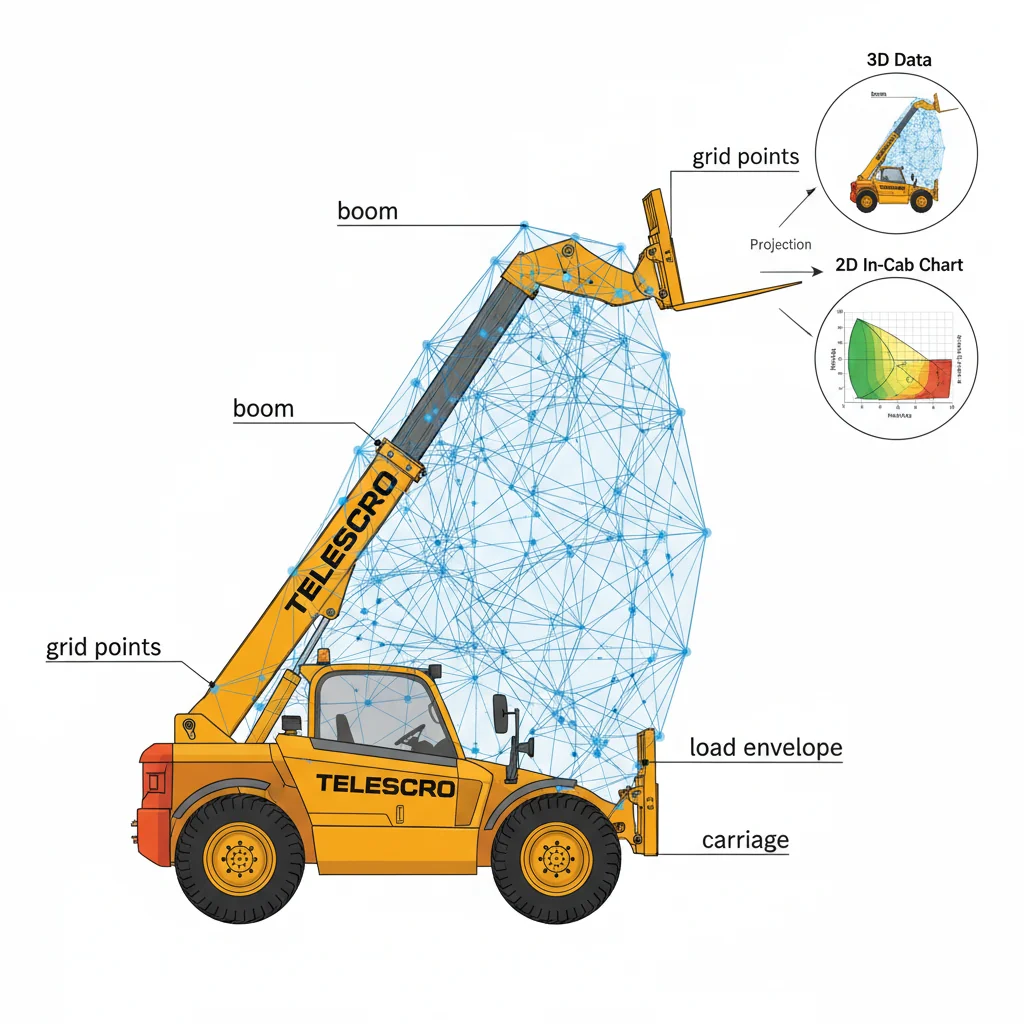
The biggest mistake I see is treating a telehandler load chart as just a simple “height versus weight” table. That’s not how manufacturers create real-world limits. Each load chart actually comes from a full 3D kinematic model of your exact machine—boom sections, extension ranges, carriage, and even which attachment you’ve bolted on. The engineers or test teams run calculations (and sometimes physical tests) at dozens or hundreds of grid points: different boom angles, different extensions, and defined load centers—usually 500 or 600 mm, but some markets use 610 mm or more. Each point is checked for both structural limits and stability. The safe working envelope you see in the cab, with zones and curves, is a 2D slice of this 3D data.
Last year, I worked with a contractor in Kazakhstan using a 17-meter high-lift unit, expecting it could handle two-ton loads at near max extension. The load chart, however, showed only 750 kg was allowed at full stretch, even on level ground. They were frustrated at “losing” capacity, but this is exactly what the 3D capacity envelope is protecting you from—overturning or boom failure. The chart’s vertical axis is lift height, horizontal is reach, measured from the front tire edge to the center of gravity of your load.
Here’s what matters most: every point on that chart was calculated with specific test conditions—machine fully level, standard attachment, and official load center3. If you’re working at the outer edge of any zone, there’s almost no tolerance left for uneven ground or a load center even 10 cm too long. I always suggest planning your lifts with a solid margin, not just “inside the rated curve.”
Telehandler 3D load charts account for variations in attachments, since each attachment can affect the machine’s center of gravity and safe lifting limits.True
Manufacturers must model how forks, buckets, or man-baskets change the load's position and machine stability, so they run load chart calculations for each permissible attachment configuration.
Once a telehandler load chart is created for a basic fork carriage, it can be universally applied to all other attachments without changes.False
Every attachment can alter the load’s leverage and center of gravity, so load charts must be individually generated or adjusted for each type based on how it affects the machine’s stability and lifting capacity.
Key takeaway: Telehandler load charts are founded on detailed, model-specific 3D engineering that incorporates real data for every combination of reach and height. Each point on the chart represents calculated stability and structural limits, so staying just inside rated zones leaves minimal room for error or field variation.
How do load center and attachments impact capacity?
Telehandler load charts for fork carriages are engineered using a specific horizontal load center4, typically 24 in (610 mm) from the fork face, matching a 48 in pallet with centered load. Any deviation—such as longer pallets, heavy attachments, or alternate implements—shifts the load moment, reducing safe capacity and requiring OEM-specific engineered load charts.

A lot of buyers I talk to assume the rated capacity is locked-in, no matter what attachment or pallet they use. That’s far from reality. Telehandler load charts are engineered for a very specific load center—usually 24 inches (610 mm) out from the fork face, which matches a standard 48-inch pallet with a balanced load. Change this setup, and you’re no longer playing by the original rules.
Last year, a customer in Dubai swapped from forks to a heavy jib attachment for lifting steel trusses. Their team checked the standard load chart, figured they were safe, and only caught the problem when the boom moment indicator5 triggered at half-rated load. The issue? That longer attachment shifted the entire load further out, multiplying the tipping moment. Even using a slightly longer pallet or stacking material off-center creates the same risk. If your real-world loads aren’t sitting perfectly at the specified load center, you’re working outside the safe envelope.
Here’s what you need to watch for—a quick checklist I always share on jobsite walkdowns:
- Attachment weight: Every accessory—from a basic side-shift carriage to a platform or bucket—eats into your available machine capacity.
- Load center distance: Longer pallets and uneven stacks move the center of gravity further forward.
- Attachment geometry: Rotators, jibs, and long forks shift weight outward, affecting tipping risk.
- OEM load chart: Always get the correct, engineered chart for each attachment you plan to use.
I always suggest: if your load setup doesn’t match the OEM’s stated conditions, ask the manufacturer for a revised chart or apply extra margin. Never guess—your team’s safety depends on it.
Using a jib or boom attachment instead of standard forks typically shifts the load center farther from the telehandler’s front tires, which decreases the rated lifting capacity significantly compared to the base configuration.True
Load charts are calibrated for a specific load center; any attachment that extends the load outward increases leverage forces, reducing maximum safe capacity regardless of the telehandler's overall rating.
As long as the total weight of your attachment and load does not exceed the published capacity, the load center and attachment type do not affect telehandler stability.False
Attachment type and load center play a critical role in stability because they influence leverage, not just weight. Even at or below rated capacity, moving the load farther out or using heavier attachments can exceed safe operating limits and compromise stability.
Key takeaway: Telehandler capacity is highly sensitive to load center and attachment changes. Always reference the OEM’s engineered load chart for each attachment and stated load center. Never use a single chart or flat derating; if load geometry differs, obtain a revised engineered capacity chart for safety.
When Do Structural Limits Govern Load Charts?
Not all telehandler load chart limits are due to tipping risk. At low reach and small boom angles, structural limits—such as boom, chassis, axle, and carriage stresses—may define rated capacity. In these regions, engineers set chart limits using finite element and strain-gauge testing, preceding stability as the primary constraint.
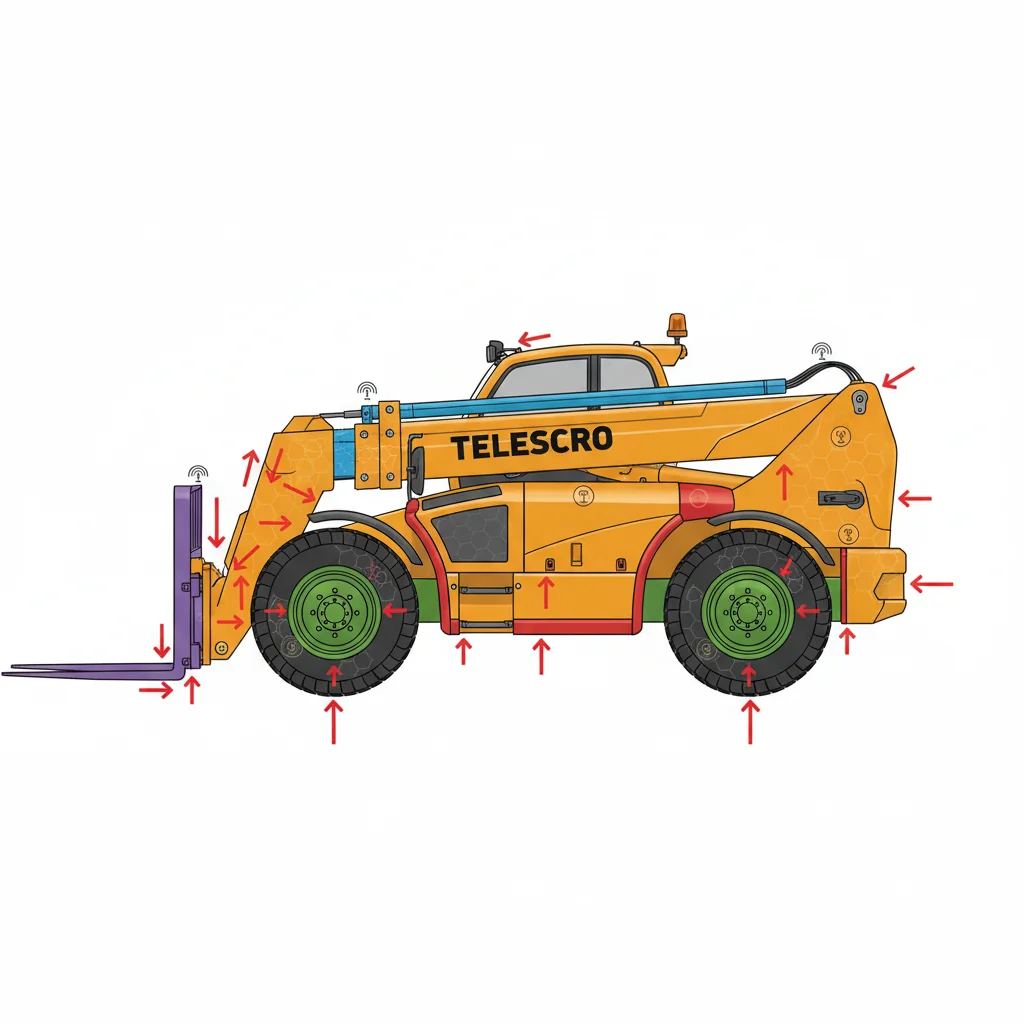
Most people don’t realize that structural limits—like boom stress or carriage forces—can actually define a telehandler’s rated capacity at certain boom positions, long before stability or tipping becomes an issue. I’ve seen this surprise even experienced operators, especially when they expect to use “full capacity” just because the machine is stable at low reach and a shallow boom angle. For example, a customer in Qatar once called me asking why his 4-ton telehandler could only handle about 2,900 kg with the boom retracted, even though the machine was rock-solid. The answer? At boom-in, the stress on the boom and axle reaches the structural design limit—not the tipping point.
Here’s the thing: Engineers set those chart limits using both finite element analysis6 and real strain-gauge tests on prototypes. They push the machine until bearings, chassis joints, and boom welds approach the maximum safe stress under repeated loading. In these positions, you’re operating against the strength of materials, not just gravity or counterweight. That’s why two telehandlers in the “4-ton class” can behave totally differently—one robust model might keep over 3,500 kg capacity close-in, while a more lightly-built unit drops quickly. From my experience in Europe and Dubai, this difference hits jobs moving heavy palletized loads at ground level where max reach isn’t even needed.
So, don’t just shop for “tonnage class.” I always suggest studying the shape of the load chart, not just the headline number. If you plan to do most of your work at low reach, check if the structrual zone is actually the limiting factor for your real operations. That’s how you avoid nasty surprises and downtime on site.
Structural limits can restrict a telehandler’s rated capacity at low boom angles and retracted positions, even when the machine remains highly stable.True
At certain boom positions, the capacity is limited by the structural strength of the boom, chassis, or carriage, not just stability against tipping. Manufacturers account for these stress factors to prevent damage, so rated capacity can drop despite excellent stability.
Telehandler load charts always base rated capacity solely on the point of tipping, regardless of boom position or machine design.False
Load charts consider both stability limits and structural limits. At some positions, the structural integrity of components governs maximum capacity instead of stability, so the rated load may be set below the tipping threshold.
Key takeaway: Structural limits often govern telehandler load chart capacity at short reach and low boom angles—before stability becomes critical. Operators and specifiers should not rely solely on “max capacity” ratings, but must analyze the chart shape to understand real-world structural and stability constraints.
What site conditions do telehandler load charts assume?
Standard telehandler load charts assume ideal conditions: firm, level ground with sufficient bearing capacity, correctly specified tires with proper inflation, and, if present, stabilizers fully deployed and leveled7. Charts are based on unit loads placed on forks—not suspended loads or improvised rigging. OEMs do not build in allowances for slopes, soft ground, wind, or travel with the boom raised.
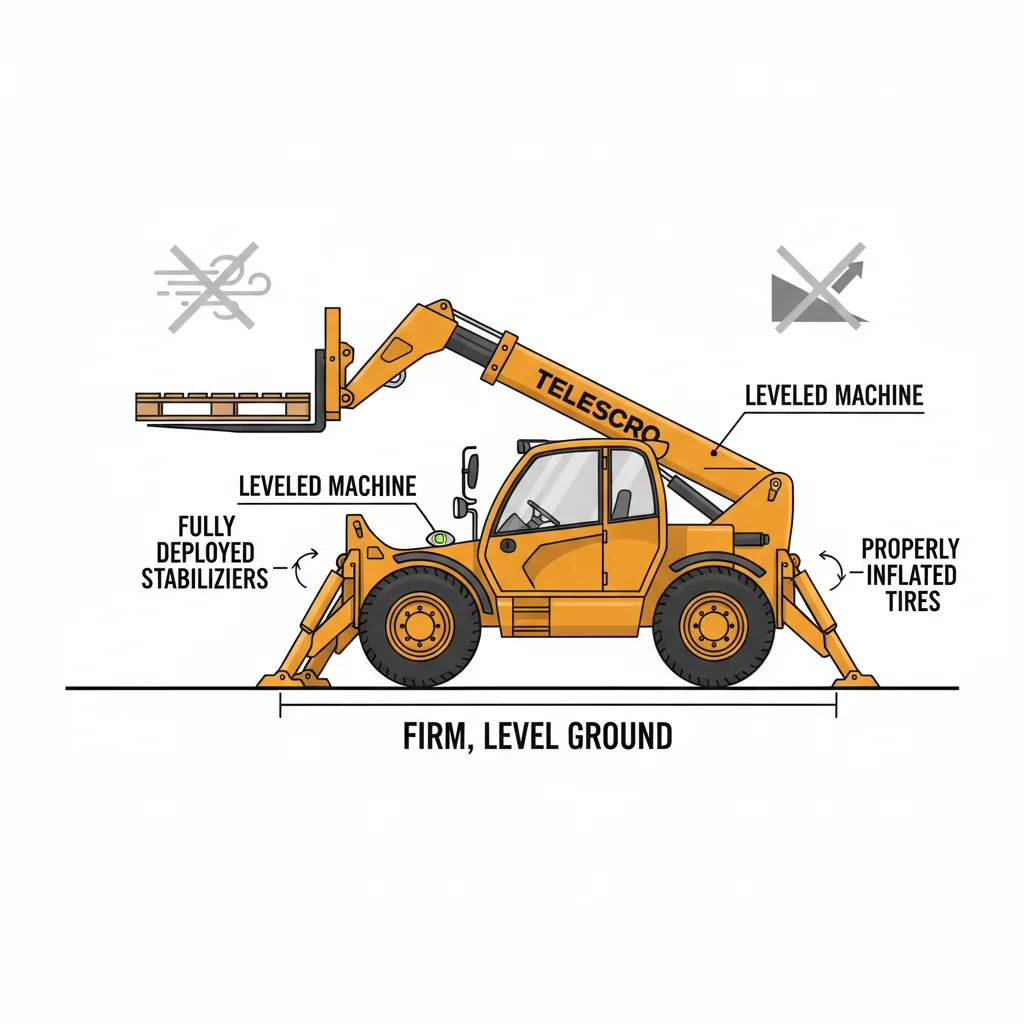
Here’s what matters most when reading a telehandler load chart: every number assumes you’re working on absolutely ideal ground. I’m talking about surfaces that are level within 3 degrees, solid enough to support the full weight of the loaded machine, and with no major potholes or soft patches. Most models specify this clearly in the manual, but on actual jobsites—like the rail project I supported in Kazakhstan last year—that kind of ground is a luxury. The local crew wanted to lift loads near max reach on compacted fill, but the site was still settling. Their foreman didn’t factor in the softer section under one tire—result: the telehandler nosed down when it hit 10 meters of reach with a 1.8-ton pallet.
Load charts also assume your machine is fully prepared: tires set to OEM-specified pressures, correct load center (like 500 or 600 mm depending on your region), and any stabilizers fully deployed and leveled. For telehandlers with stabilizers, manufacturers list separate “on-tires” and “on-stabilizers” capacities—never mix them up. I’ve seen operators in Dubai try to use the higher capacity numbers with stabilizers retracted. That’s outright dangerous.
Unit loads placed securely on forks are another key part of the equation. If you’re using slings, working with suspended loads, or traveling with the boom up, the load chart doesn’t give you any margin; manufacturers expect you to follow extra reduction tables or find another solution. Whenever real conditions—slopes, uneven pads, gusty winds—don’t match the book, I always advise clients to derate and check with the manufacturer. The chart isn’t lying, but it’s not covering you if you bend the rules.
Telehandler load charts are calculated assuming the machine is on ground that is level within approximately 3 degrees.True
Manufacturers base rated capacities in load charts on the assumption that the machine is operating on nearly flat, stable ground, typically within a small margin such as 3 degrees of level. Exceeding this can cause significant stress and instability, affecting safe lifting limits.
Telehandler load charts are designed to account for uneven or partially compacted ground commonly found on jobsites.False
Load charts show maximum rated capacities based on ideal site conditions, specifically flat and stable surfaces. They do not factor in common jobsite challenges like uneven or unstable ground; operating outside these parameters reduces stability and lifting capacity.
Key takeaway: Telehandler load charts reflect performance under ideal conditions—level, firm ground with manufacturer-specified setup. Any deviation, such as slopes, soft pads, or unstable weather, requires derating or alternative configuration; capacity is overstated if real site conditions differ from chart assumptions. Never rely on the load chart for non-standard setup.
How do LMIs use telehandler load charts?
Load Moment Indicators8 (LMIs) in modern telehandlers digitally map the same rated capacity envelope shown on the printed load chart. Sensors track boom angle, extension, and hydraulic pressure, comparing real-time load moments to engineered limits for each position. Exceeding limits triggers warnings or may inhibit risky movements, ensuring precise, chart-based safety protections.
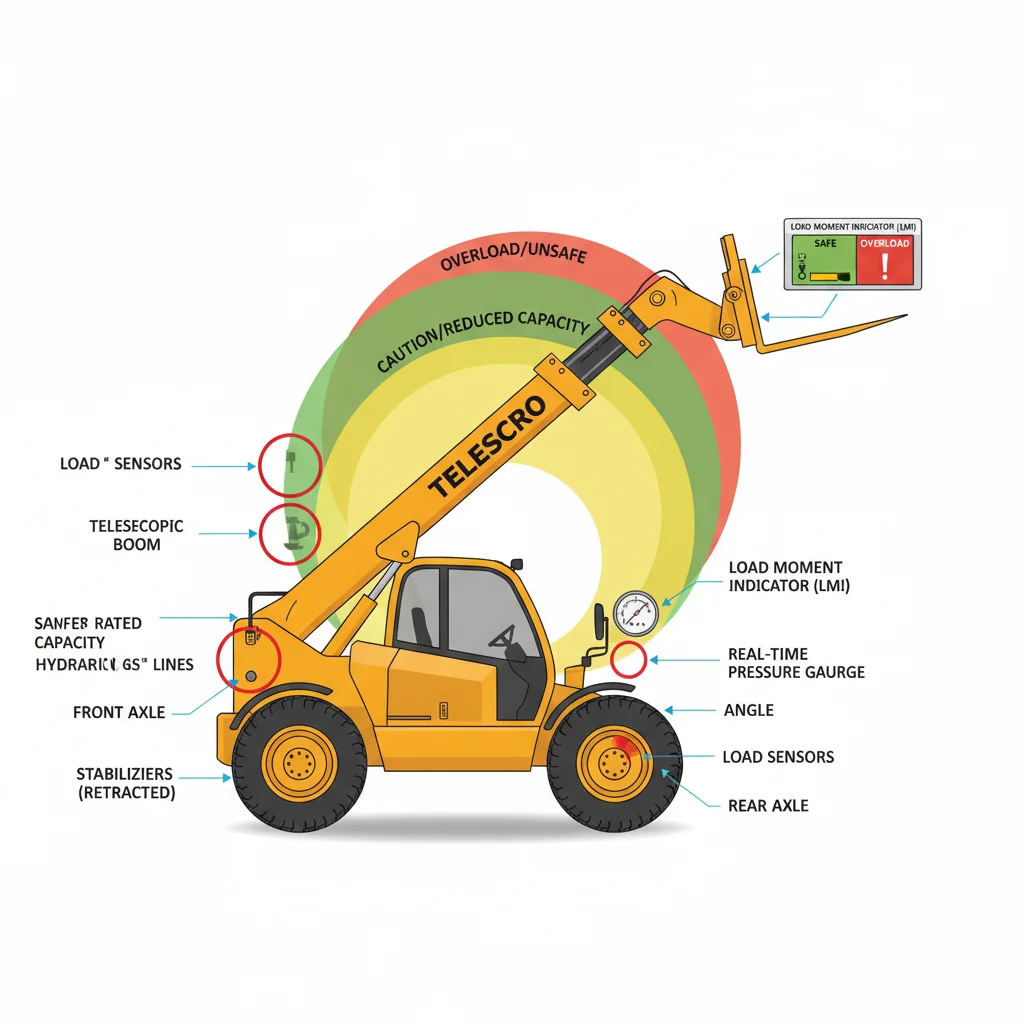
Here’s what matters most when talking about LMIs and telehandler load charts—the two systems work hand in hand, but it’s the LMI that makes those paper ratings work on real jobsites. I’ve seen this on sites from Dubai to Poland. The printed load chart gives you a safe “envelope” based on engineering. But, the LMI uses sensors to track boom angle, extension, and hydraulic pressure, mapping every movement against that digital envelope. For example, a customer in Brazil once loaded drywall slabs using a 4-ton telehandler—at 12 meters reach. The LMI warned him before he hit the red zone, stopping further extension.
On most modern machines, the LMI’s job is to track:
- Boom angle—where your boom is pointing
- Extension—how far you’ve pushed the boom out
- Hydraulic pressure—the real weight you’re lifting
- Machine inclination (sometimes)—whether you’re on a slope
The system reads those signals and compares the actual “moment” (the combination of load and reach) to the line in the load chart. Get close to the limit, you hear a warning. Exceed it, and the LMI locks out risky movements—usually won’t let you extend, raise, or pick up more.
But here’s a caution. If you change an attachment—like swap forks for a jib—or even install non-standard tires, the LMI’s programmed boundaries can be wrong unless you recalibrate. I always tell customers: after any structural change, check with the factory or a certified technician so your safety margins match the real machine limits.
LMIs (Load Moment Indicators) digitally interpret telehandler load charts by comparing real-time sensor data with pre-programmed load map envelopes, alerting operators before the crane approaches safe working limits.True
This is true because LMIs are engineered to constantly monitor variables such as boom length, angle, and hydraulic load, dynamically referencing the digital equivalents of paper load charts and providing proactive warnings or lockouts to prevent unsafe operations.
Telehandler LMIs automatically adjust the machine’s hydraulic capacity to increase lifting limits when lighter attachments are used, effectively extending the safe zones displayed on the load chart.False
This is false because LMIs do not alter the telehandler’s lift capacity or dynamic envelope; they only monitor and enforce the pre-set parameters defined in the load chart regardless of attachment weight. The machine’s maximum limits remain based on engineering safety margins, not on real-time attachment recognition.
Key takeaway: Electronic LMIs translate the telehandler’s engineered load chart boundaries into real-time monitoring, helping prevent overload mistakes. However, their accuracy depends on machine configuration; any attachment changes or structural repairs require recalibration with OEM data to maintain valid capacity monitoring and avoid dangerous discrepancies.
Why Do Telehandler Load Charts Vary?
Telehandler load charts are configuration-specific, changing with tires, stabilizers, tire size, and steering setup. Capacities shown depend on exact machine conditions—such as “on tyres” versus “on stabilizers” (correctly: stabilizers for telehandlers9). Each printed envelope is valid only for the configuration stated, and misapplying them risks serious safety errors.

Last month, a contractor in Kazakhstan asked why his new telehandler couldn’t lift the same load “on tyres” as it could with stabilizers deployed. Here’s the truth: every load chart is built for a specific configuration—right down to the exact tire type, stabilizer state, and even the steering system. If you look at a typical 4-ton, 17-meter model, you’ll find two totally different envelopes. On tyres, maybe the chart allows for 1,200 kg at maximum reach. On stabilizers, with firm ground and both deployed correctly, that can jump to nearly 2,000 kg. But mix up those charts—or use the wrong one in the cab—and you can tip the machine in seconds.
From my experience, buyers often change tire types looking for puncture resistance, swapping from pneumatic to foam-filled or solid tires. What seems like a small upgrade actually shifts the machine’s center of gravity and can cut rated capacity by several hundred kilos—if it’s not already OEM-approved and accounted for in the updated load chart. I’ve seen this exact mistake on a Dubai high-rise site: after switching tire types, the “official” capacity went down by 300 kg at mid-reach. The operator only found out when a safety inspector caught the mismatch.
Another detail most people ignore is steering and axle lock. Some machines show a higher capacity when the rear axle is locked versus in full-steer mode. Never assume—always check the envelope for your current working setup. Treat every load chart as configuration-specific documentation, not a suggestion. Before making any changes, get written confirmation from the OEM and update the chart in your cab. That’s how you avoid expensive—or dangerous—surprises.
Telehandler load charts change depending on whether the machine is on tyres or on stabilizers because the stability and tipping point shifts based on the equipment configuration.True
The support provided by stabilizers substantially increases the stability of the telehandler, allowing it to safely lift heavier loads at greater reaches than when operating solely on tires. The engineering principle behind every load chart is to reflect the maximum safe load in each specific operating state.
All telehandler load charts are universally applicable to any tire or stabilizer setup as long as the maximum rated load is not exceeded.False
Load charts are highly specific to the telehandler's setup, including factors like tire type and stabilizer usage. Ignoring the exact configuration can lead to unsafe operations, since the load capacity changes dramatically based on how the machine is positioned and supported.
Key takeaway: Telehandler load charts reflect specific combinations of tires, stabilizers, and steering systems. Always use the OEM chart that matches the machine’s exact configuration; never substitute between “on tyres” and “on stabilizers.” Any configuration change must be confirmed with updated OEM documentation to ensure rated capacity and safety.
Why Are Telehandler Capacity Ratings Misleading?
Headline telehandler capacities like “3.5 t at 13 m” typically describe maximum lift with the boom retracted at low height, or maximum lift height with a much lower load. These figures rarely represent mid-reach or daily working positions—actual performance can differ greatly and only full load charts show safe handling capabilities at critical working points.

I’ve worked with customers who made expensive mistakes by trusting headline telehandler ratings10—numbers like “3.5 tons at 13 meters” sound great, but they rarely hold up in real jobs. Those big figures usually mean one of two things: either max load with the boom fully retracted and low, or max height with a load much lighter than the rated capacity. That’s not where most lifting happens on a construction site. If you’re moving bricks to a third-floor balcony (maybe 8 meters up and 4 meters out), the true safe capacity could drop below 1,500 kg—even on a machine “rated” for double that. I saw this last year in Dubai—a contractor bought a “budget” 3-ton telehandler, expecting it to handle 2.5-ton pallets at 8-meter reach. He ended up shuttling loads in half-pallets, which wasted time every day.
Here’s what matters most when making this decision: the full load chart11 is your roadmap. Each box on that chart shows exactly what the telehandler can lift at every height and reach, measured from the front tire edge to the load center of your forks or attachment. That’s how you see the real difference between machines in the same tonnage class. Chassis design, counterweight, and boom structure can shift mid-reach capacity by several hundred kilos—even if two models look identical on paper.
I always suggest picking your frequent working point—like 1,800 kg at 8 meters with a specific attachment—and checking that spot on the load chart for each model. Ignoring this detail can quietly drive up handling costs or force you to rent a crane when productivity stalls.
Telehandler load charts are designed to show maximum capacities at very specific boom positions and angles, which often do not represent the capacities available during typical extended reach operations on real jobsites.True
Manufacturers generate rated capacities under controlled conditions, often with the boom fully retracted or raised straight up. In everyday site use, operators are more likely to need capacity with the boom partially extended and raised at an angle, resulting in significantly lower actual lifting capability.
If a telehandler is rated for 3.5 tons, it can safely lift that amount to its maximum reach at any boom extension.False
Telehandler rated capacities do not represent what can actually be lifted at full reach or any boom extension. As the boom extends or raises, leverage factors reduce effective capacity—actual lifting ability at maximum extension is much lower compared to the headline figure.
Key takeaway: Never rely on headline capacity figures for telehandler selection. True operating capability depends on the detailed load chart, especially at mid-reach and typical working heights. An apparent bargain machine with weak mid-reach capacity may lead to hidden costs or safety risks.
How to Compare Telehandler Load Charts?
Valid telehandler load chart comparison requires identical conditions: same attachment and load center, same machine setup (e.g., on tyres, level ground), and the same key working points. Operators should plot matching reach-height points and compare rated capacities, as capacity can vary significantly within the same tonnage class.

From my experience, the main confusion starts when buyers look only at the tonnage rating and ignore how fast the rated capacity drops as the boom extends. I’ve met project managers in the UAE who were shocked—a “4-ton” telehandler that claims 17 meters reach could only manage 1,400 kg at full extension. That’s why I always tell customers: real jobsite performance lives on the load chart, not the big number on the side. So, how do you compare load charts the right way? First, you need to “normalize” all settings: use the same attachment (usually standard forks) and the same load center (check if it’s 500 mm or 610 mm, as this varies by market and brand). Next, confirm the operating mode—on tyres (no stabilizers), machine leveled, on firm ground.
After that, pick specific working points that match your actual task. For example, if your crew needs to place pallets at 7 meters high and 3 meters away from the tires, find that point on every chart.
Here’s a simple load chart comparison I helped a contractor in Kenya with last year:
| Model Class | Attachment | Load Center | Setup | Capacity @ 7m Height, 3m Reach |
|---|---|---|---|---|
| 4-ton, 14m (standard) | Forks | 600 mm | On tyres | 2,100 kg |
| 4-ton, 17m (hi-reach) | Forks | 600 mm | On tyres | 1,500 kg |
| 3.5-ton, 13m (compact) | Forks | 500 mm | On tyres | 1,800 kg (adjust to 1,200 kg for actual use) |
A telehandler's load chart shows that maximum lift capacity decreases significantly as both boom length and boom angle increase, meaning a machine rated for heavy loads at minimal extension may handle much less at full outreach.True
Telehandler load charts are designed to reflect real-world physics: as the boom extends or is raised to higher angles, leverage on the chassis increases and stability decreases, which necessitates reducing the allowed load. Many people overlook this, only seeing the headline lifting capacity and not realizing the capacity curve drops steeply with increased reach.
Two telehandlers with identical maximum capacity and lift height will always perform the same on-site, regardless of manufacturer, if their load charts have matching headline numbers.False
Load chart performance depends on the entire capacity curve, not just the headline figures. Different models may have the same maximum capacity and height but very different stability cuts, frame geometry, or hydraulic limitations, resulting in dramatically different capacities at partial or full boom extension. Real jobsite suitability requires a full chart comparison, not just headline specification matching.
Key takeaway: Always compare telehandler load charts using the same attachment, load center, and operating configuration—never just by tonnage. Matching reach/height points across models and maintaining a clear working margin ensures both performance and safety. Load charts, not tonnage, define true capability.
How should telehandler load charts guide job planning?
Telehandler load charts must be used by first identifying the required furthest placement point, marking this on the chart, and reading the allowed capacity at that reach and height. Always compare with the heaviest realistic load, allowing an extra margin of capacity to account for variation and site conditions.

The biggest mistake I see is teams planning jobs based on a telehandler’s headline rated capacity12, not the load chart’s real numbers out at full reach. Every jobsite I visit, it’s the same story—someone expects their 3.5-ton telehandler to actually lift that much at maximum reach. The reality? At 12 or 15 meters out, you might be limited to just 1,000 kg, even on level ground. The load chart is your roadmap here. Start with your furthest placement point—measured from the front edge of the tires to where the load will actually sit, not just the end of the forks.
Last year in Dubai, a façade contractor showed me his load chart, marked up with their most challenging window install—13 meters out, 14 meters up. They needed to lift panels weighing about 1,400 kg after packaging. On the chart, that combination gave them 1,700 kg capacity. That looked okay at first glance, but I always advise leaving at least 300 to 500 kg of margin at those tricky positions. Why? On a hot afternoon, a bit of sand on the tires, slight mis-stacking, or a slightly heavy load, and you’re suddenly at the tipping limit.
To be honest, this margin saves jobs. If your required point lands outside the load chart envelope—or right at the edge—don’t force the issue. Reposition closer if you can. Or look at a higher-spec machine. I always tell customers: the load chart, not the spec sheet, prevents jobsite headaches and unsafe workarounds. Check the real number where your heaviest load needs to go, and protect that margin before anything else.
Telehandler load charts are specifically designed to show how lifting capacity decreases as the boom extends or the load is moved further from the machine's front tires.True
Load charts graphically represent how reach and height affect safe lifting capacity, accounting for mechanical leverage and stability limits. This helps operators plan safe lifts, rather than relying on maximum capacity ratings.
If a telehandler’s load chart states a maximum capacity of 3.5 tons, it can safely lift that amount at any reach along the boom.False
The maximum capacity rating only applies when the boom is retracted and the load is close to the machine. As the boom extends or the load is placed farther from the tires, the safe lifting capacity drops significantly according to the load chart.
Key takeaway: Effective telehandler job planning begins by working backwards from the placement point on the load chart, prioritizing the highest expected load, and leaving a prudent margin above this figure. If adequate capacity is not available, consider higher-spec equipment or reposition the machine to maintain safety and efficiency.
How does maintenance affect telehandler capacity?
Telehandler load charts reflect rated capacity for new, fully in-spec machines. Wear—such as boom pin degradation, bent forks, underinflated tires, or structural repairs—erodes true safety margins. Even moderate tire pressure loss13 can significantly reduce tipping stability compared to chart assumptions. Factory-rated capacity should never be assumed unless machine condition closely matches original test criteria.
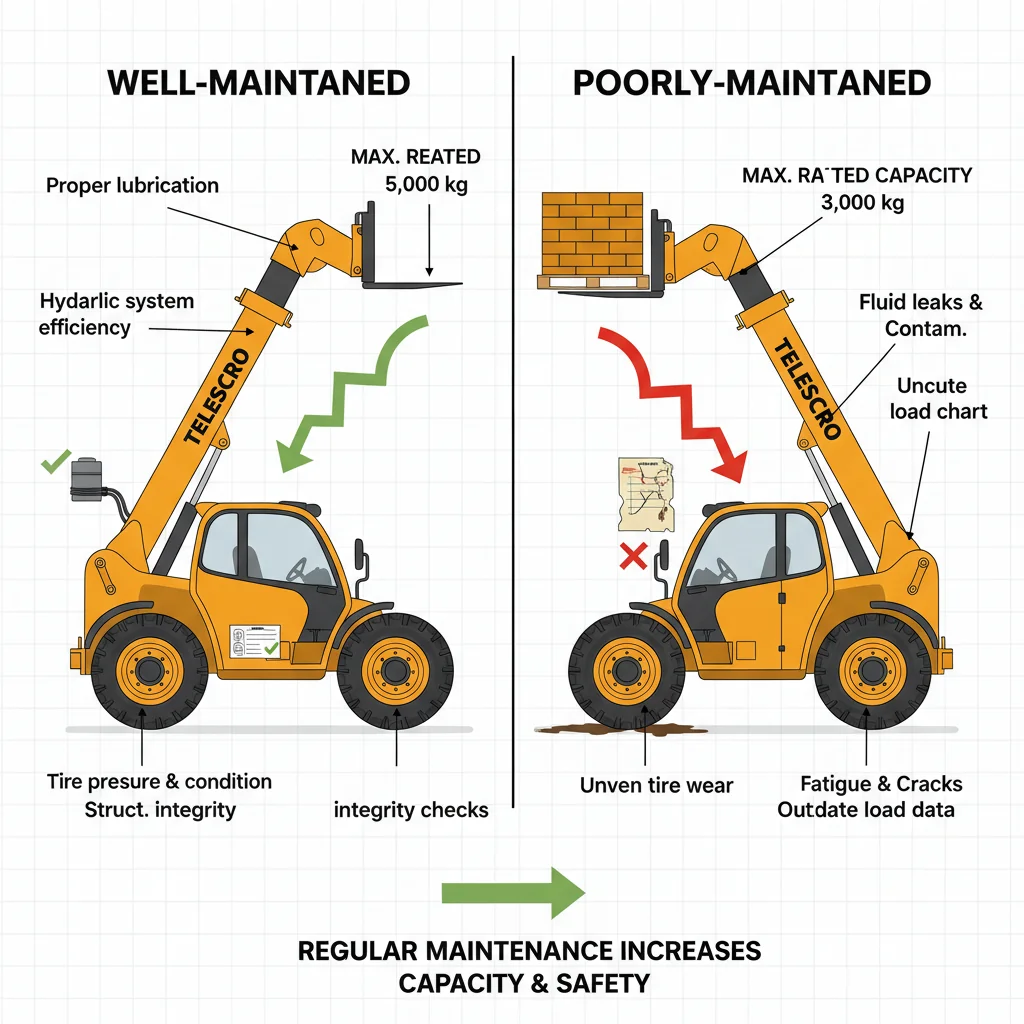
The reality is, load charts only tell the truth if your telehandler is as fresh as the day it left the factory. As soon as wear sets in—maybe the boom pins loosen slightly, or those forks pick up a bend from a tough job—your real safe capacity starts dropping quietly behind the official numbers. I visited a site in Dubai last year where the operator was lifting four-meter steel beams with a 3.5-ton telehandler. Everything looked fine, but one tire was down by almost 25%. After checking, we found the tipping line had shifted enough to cut their stability margin by at least 15%. That’s the sort of detail even seasoned crews miss.
Wear isn’t just about obvious cracks or dents. Every day, boom bushings develop extra play, the carriage mounting holes widen, and even a small drop in tire pressure can reduce ground contact—especially with foam-filled or mismatched tires. One customer in Brazil thought repairs "restored" his machine after a bent frame—but after I asked for the OEM’s re-certification checklist, we realized the structure was still less stiff than new. It didn’t tip, but every extra millimeter added uncertainty.
Here’s what matters most: load charts are valid only for machines that match the manufacturer’s original test config. If you skip daily tire checks, ignore pin wear, or swap out parts for “almost fits,” you’re gambling with narrower safety margins than you think. I always recommend a quick visual check before every shift, and a full inspection after any structural repair. That’s how you keep the printed numbers real—and your people safe.
Telehandler load charts are based on ideal equipment condition, and even minor wear like slight boom pin play can substantially reduce actual lifting capacity compared to the chart values.True
Load charts assume the telehandler is in perfect working order as per factory standards. Minor component wear such as boom pin play, bent forks, or tire pressure loss can all negatively influence the machine’s stability and safe working load, leading to real-world lifting capacities being significantly lower than the chart indicates.
Routine visual inspections alone are sufficient to ensure telehandler capacity remains consistent with the load chart throughout the machine’s lifespan.False
While visual inspections are important, they can miss less obvious signs of structural fatigue or internal wear that impact safe capacity. Proper maintenance requires both regular detailed inspections and preventative servicing to ensure that critical components like booms, pins, and hydraulic systems maintain the performance assumed in load chart calculations.
Key takeaway: Telehandler load chart capacities only apply if the machine remains in OEM-tested, new condition. Structural wear, tire issues, and post-repair deviations compromise stability and may render the load chart invalid. Daily inspection and strict adherence to OEM maintenance schedules are essential for safe load handling.
Why Do Regional Load Chart Standards Matter?
Telehandler load charts are verified under regional safety standards14 such as ANSI/ITSDF B56.6 (North America), EN 1459 (Europe), or ISO 10896. These standards dictate stability tests, safety margins, and operational limits. Mismatched standards—especially in imported machines—can lead to compliance failures with local regulations and insurance requirements.

A lot of contractors overlook just how much regional load chart standards affect day-to-day work. Let me share a recent scenario: a rental company in Dubai imported several telehandlers from Europe. On paper, the machines looked perfect—good reach, solid rated capacity. But during a compliance check, local authorities flagged the load charts for not matching the Gulf’s safety certification. The European units followed EN 1459, which had slightly different stability test methods compared to local requirements based on ISO 10896. That meant the site’s insurance wouldn’t accept the machine ratings. Their project stalled until every load chart was reverified and new declarations issued by the OEM.
This isn’t just a one-off problem. I’ve seen similar cases in Kenya and South America. Even two telehandlers with the same tonnage rating might follow different standards—one using a 500 mm load center under EN rules, another using 24 inches (about 610 mm) for the North American ANSI code. The result? The numbers on the page look stable, but the safety margin, test slope, or even approved stabilizer configurations might not line up with what your local regulations or your insurer expects.
So here’s the thing—before you mix imported units into your fleet, ask for the exact safety standard behind each load chart. Insist on a conformity statement or test summary from the OEM, not just a brochure. If there’s any doubt, clarify the load center reference and machine configuration. I always suggest being proactive. The cost of getting this wrong isn’t just paperwork—it could mean failed audits or denied claims if there’s ever an incident.
Regional load chart standards influence telehandler design details such as stability margins and allowable boom angles, leading to machines tuned differently for safety in different markets.True
True: Load chart standards are shaped by local regulations and testing protocols, which can require different design parameters (like stability factors or permitted operating envelopes). This means a model certified under one region’s standard might not meet another’s safety expectations, reflecting in physical and operational differences.
All telehandler load charts are based on a universal global standard, so machines imported from one region will always have compliant load charts in another.False
False: No single global standard exists for telehandler load charts. Regions such as Europe, North America, and the Middle East often use different certification systems (like EN 1459, ANSI, or GCC authorities), which can have significant differences in safety requirements and load chart calculations.
Key takeaway: Always confirm which safety standard a telehandler’s load chart is based on, especially in mixed or imported fleets. Request clear documentation from the OEM. Aligning standards with local regulations reduces risk during audits, investigations, and insurance reviews, ensuring operational compliance and safety.
Conclusion
We’ve walked through how telehandler load charts are carefully designed around real-world configurations, not just headline numbers. From my experience, the crews who stay safe and productive always check the actual load chart for their specific machine setup—not just what’s listed on spec sheets. It’s easy to get caught up in brochure max capacities, but that can turn into a “showroom hero, jobsite zero” situation if you overlook the details. If you’re unsure how a certain attachment, tire, or boom length affects your project, I’m happy to help break it down for your application. Reach out anytime with your questions or scenarios—the right answer depends on your workflow, not just specs on paper.
References
-
Explore detailed engineering methods defining telehandler load capacities beyond tipping risk, including finite element and strain-gauge testing insights. ↩
-
Understand the physics behind overturning moments, a key factor in telehandler stability and safe load capacity calculations. ↩
-
Explains how load center variations affect telehandler capacities and jobsite safety, crucial for selecting the right machine for tasks. ↩
-
Explore how the horizontal load center affects telehandler stability and capacity with expert insights and engineering principles. ↩
-
Learn how boom moment indicators work to prevent tipping by monitoring load shifts and ensuring safe telehandler operation. ↩
-
Learn how finite element analysis helps engineers test stress points and set safe load limits on telehandler components for reliable operation. ↩
-
Explains the critical role of proper stabilizer deployment and leveling for maximizing telehandler lifting capacity and safety. ↩
-
Explore how LMIs use sensors to prevent overloads by tracking boom angle, extension, and pressure, enhancing jobsite safety. ↩
-
Understand the critical role of stabilizers in increasing load capacity and preventing machine tipping, backed by real-world site examples. ↩
-
Explore the limitations of telehandler capacity labels and understand how to interpret real-world lifting capabilities to avoid costly mistakes. ↩
-
Learn how full load charts provide accurate data on telehandler capacities at various heights and reaches, ensuring safe and efficient operation. ↩
-
Explains the common misconception about telehandler capacity ratings and the importance of load chart data to prevent lifting accidents. ↩
-
Understand technical effects of tire pressure variations on tipping stability and the importance of proper maintenance in telehandlers. ↩
-
Explore how regional safety standards ensure telehandler compliance with local regulations and avoid costly project delays or insurance issues. ↩