










How Does Telehandler Depreciation Work? Expert Tips to Protect Value
A few months ago, a rental fleet manager from Chile called in, frustrated. He’d kept his telehandlers polished and running, but when it came time to trade them in, the offers were thousands lower than he expected. The real culprit? Depreciation—hidden in plain sight.
Telehandler depreciation follows a predictable curve shaped by both age and operational hours. Typically, a new telehandler drops 20–30% of its market value in the first year, then declines by roughly 10–15% annually during years two through five. By five years, units often retain only 40–60% of their original value, depending largely on reported hours, service records, and visible condition. Environment, maintenance quality, and duty cycle further influence resale prices.
How Fast Do Telehandlers Depreciate?
Telehandlers typically lose 20–30% of their value in the first year, then depreciate by 10–15% annually over the next four years. By year five, well-maintained units sell for 40–60% of their original price. Both machine age and engine hours significantly influence resale values, especially around 2,500–3,000 hours.

Most people don’t realize just how steep the first-year drop in telehandler value can be. On jobsites in Saudi Arabia and Mexico, I’ve watched brand-new 4-ton units lose nearly a quarter of their price tag within the first twelve months—even if they had under 400 hours on the clock.
The next few years aren’t as painful, but value still falls fast.By the time a machine hits year five, it’s common to see resale offers between 45% and 60% of the original purchase, especially if hours are climbing over 2,500.
To be honest, hours matter just as much as machine age. A customer in Kazakhstan learned this the hard way. They ran their 3,500 kg compact telehandler hard—almost 800 hours per year. When they hit 3,200 hours, buyers started flagging concerns about the boom and hydraulic circuit, since that’s when major overhauls creep up. Even though the unit was only four years old and serviced regularly, offers dropped sharply.
The biggest mistake I see is ignoring the value curve when planning fleet rotation. If you keep an older telehandler past 3,000 working hours, expect tough negotiations at resale—component risk goes up and so does buyer caution. On the other hand, replacing a unit around year four, with hours still under 2,500, often means stronger trade-in value and fewer “second-year surprises” with big repairs.
I suggest tracking both age and hours closely. Knowing these patterns lets you budget smarter—sometimes upgrading early saves more than run-to-failure costs in the long run.
Telehandlers can lose up to 25% of their value within the first year even with fewer than 400 operating hours due to rapid market depreciation and high initial usage perceptionTrue
The steep first-year depreciation reflects buyers’ preference for newer equipment and suspicion about wear despite low hours, causing a sharp initial drop in resale value for telehandlers.
Telehandler resale values remain above 80% of original purchase price after five years if maintenance logs are well-documented, regardless of operating hoursFalse
Even with excellent maintenance, telehandlers typically depreciate to 45%-60% of their original value by year five, as factors like technological obsolescence and industry demand affect price more than documentation alone.
Key takeaway: Telehandler depreciation is steepest in the first year and closely tied to both age and working hours. Understanding typical value loss curves helps owners plan purchases, negotiate trades, and assess fleet replacement timing to minimize total cost of ownership over a machine’s lifecycle.
What Drives Telehandler Depreciation Fastest?
Telehandler depreciation accelerates primarily due to poor physical condition, missed services1, and incomplete maintenance records, often reducing resale value by 10–15% compared to well-maintained units. Environmental exposures, such as long-term outdoor storage and harsh-duty cycles, also expedite wear. Documented maintenance, indoor storage, and targeted usage patterns preserve value and dealer confidence at trade-in.

Let me share something important about what really eats away at telehandler value—the things you can actually control. It’s not just about age or engine hours. Physical condition speaks volumes, sometimes louder than the odometer ever could. For example, I’ve seen two 4-ton units with similar 12-meter reach and just under 2,500 hours each. The one stored outside in South Africa, with faded paint and dry, cracked hydraulic hoses, dropped nearly 15% in resale value compared to the same model kept indoors in Kazakhstan. That’s a difference of several thousand dollars—simply due to weather exposure.
Missed services are the quickest way to lose “dealer confidence.” Buyers often overlook logbooks and service records, but in reality, these documents can make or break a trade-in deal. I once worked with a contractor in Dubai who had a 3-ton telehandler that ran heavy-duty cycles moving concrete debris. He skipped several key hydraulic oil changes. When it came time to sell, the incomplete maintenance history resulted in a much lower offer—over $4,000 less than he expected.
Abnormal wear becomes obvious in high-duty jobs. If the boom sections are heavily scored or the electrics corroded, any savvy buyer will factor in repair costs immediately. Even a well-maintained 5,000 kg machine with moderate hours loses value fast if it’s been used on aggregates day after day.
My advice? Stick to the manufacturer’s maintenance schedule, document everything, and keep machines under cover. It’s the simplest way to protect thousands in long-term value.
Telehandler resale value can drop by up to 15% simply due to external cosmetic degradation like faded paint and cracked hydraulic hoses, independent of engine hours or mechanical wearTrue
Visible physical wear signals poor maintenance to buyers, leading to a disproportionate depreciation that isn't reflected by usage data alone, as maintaining aesthetic and hydraulic integrity can extend machine desirability and value.
Telehandler depreciation is primarily determined by engine hours rather than storage conditions or physical appearanceFalse
While engine hours are important, storage environment and physical condition—such as exposure to UV damage or hydraulic hose integrity—can accelerate depreciation more significantly by impacting perceived reliability and maintenance costs.
Key takeaway: Proactive maintenance, complete service documentation, and protected storage environments minimize telehandler depreciation. Machines with solid records and good condition consistently earn higher resale and trade-in values, while those showing neglect or harsh exposure see rapid value erosion—often by thousands of dollars, regardless of age or operating hours.
How Is Telehandler Tax Depreciation Calculated?
Telehandlers are classified as 5-year MACRS property for tax depreciation in the U.S. Section 1792 expensing and bonus depreciation3 provisions enable businesses to deduct a substantial portion—or 100%—of the purchase cost in the first year if qualifications are met, enhancing cash flow and reducing immediate tax liability. Used machines may qualify if IRS usage rules are satisfied.

The biggest mistake I see is businesses ignoring the real cash flow impact of telehandler depreciation rules. Just a few months ago, a project manager in Dubai called after buying a 4-ton, 14-meter unit for about $115,000. He didn’t realize he could deduct most—or even all—of that amount in the first year under U.S. tax law, as long as the machine is new to his business and used primarily on the jobsite. Instead, his company planned for much smaller deductions over five years using the standard MACRS schedule, missing out on almost $28,000 in up-front tax savings.
Here’s what matters most when you’re looking at the rules: for most telehandlers, Section 179 lets qualified businesses expense up to $1,160,000 in equipment right away, as long as the total asset purchases don’t exceed the IRS limit for that year.
Bonus depreciation can cover the balance, and it even applies to used machines—as long as you’re the first business to use it in your company and it hasn’t already been fully depreciated by someone else. I’ve seen customers in Brazil and Kazakhstan take full advantage of this. One client bought two used 3-ton telehandlers for about $150,000 total and wrote off nearly everything right in the first year.
To be honest, the specification you track for tax purposes isn’t market value or maintenance cost—it’s the original purchase price minus any trade-in. Always confirm the deduction amount and the latest IRS limits with a tax professional before you commit. It can make a real difference to your project’s bottom line.
Under the U.S. IRS Section 179 deduction, a new telehandler costing up to $1,080,000 can be fully depreciated in the first year if used more than 50% for business purposesTrue
Section 179 of the IRS tax code allows businesses to expense the entire purchase price of qualifying equipment, such as telehandlers, in the year of purchase instead of depreciating it over several years, provided the equipment is new or new to the business and primary business use exceeds 50%. This can significantly improve cash flow.
Telehandler depreciation must always be calculated over a fixed 10-year period, regardless of the machine's purchase price or usageFalse
Telehandler depreciation periods vary depending on tax regulations and asset classification; typically, IRS guidelines classify telehandlers as 7-year property, not a fixed 10-year schedule, and accelerated methods like Section 179 or bonus depreciation can shorten this time frame.
Key takeaway: Tax laws let businesses write off most or all of a telehandler’s purchase price in the first year using Section 179 or bonus depreciation, greatly improving cash flow. Confirm eligibility criteria and deduction limits with a qualified tax professional before proceeding with major equipment acquisitions.
How Do Section 179 and Bonus Depreciation Work?
Section 179 allows expensing of qualifying telehandlers up to an annual cap, with larger purchases subject to a phase-out. After electing Section 179, bonus depreciation permits deduction of the remaining cost basis immediately. This combination enables buyers to potentially write off the full value of multiple telehandlers acquired in a single tax year, subject to IRS thresholds and limits.
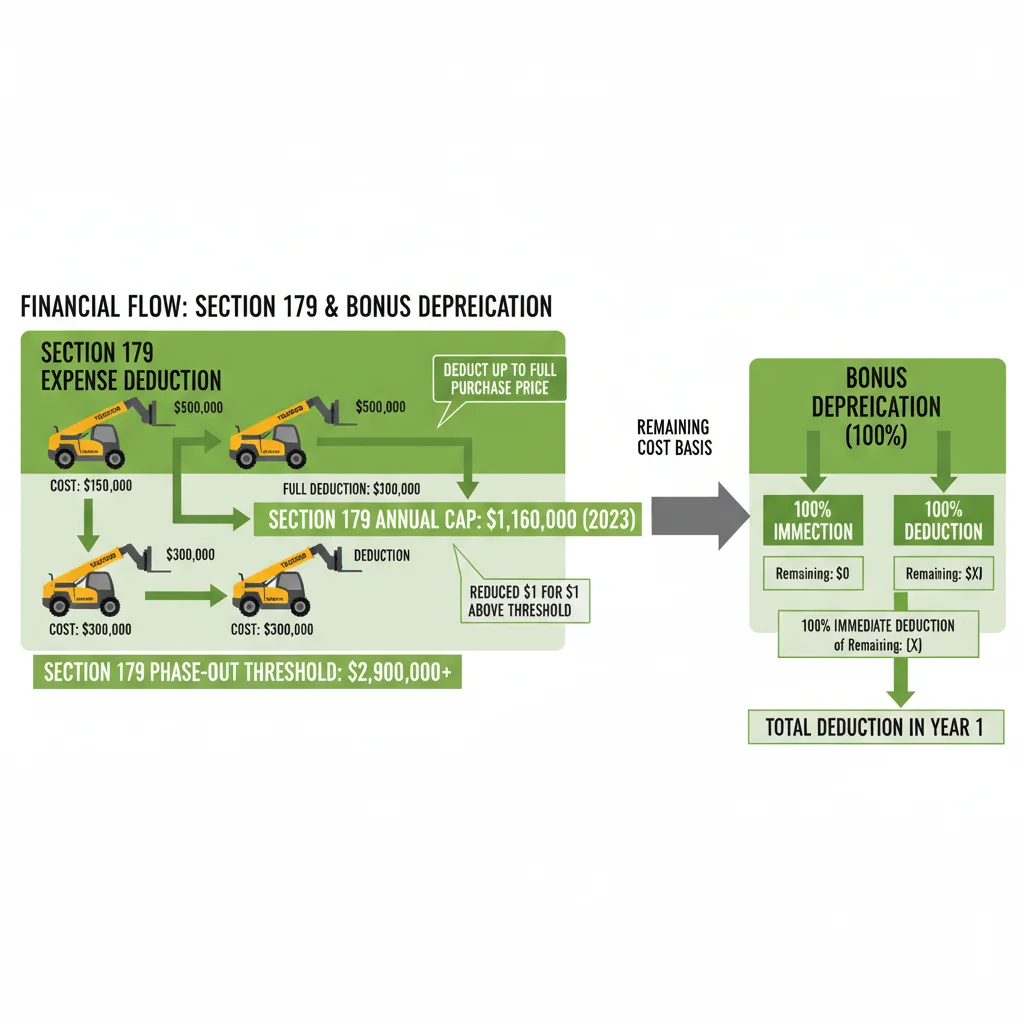
Last year, I worked with a customer in Dubai who needed to expand his equipment fleet—fast. He was looking at three new 4-ton telehandlers, each with about a 15-meter reach. The conversation quickly turned to how he could recoup as much of the purchase cost as possible through tax deductions. That’s where Section 179 and bonus depreciation came up, and to be honest, understanding how they interact can make a real financial difference.
Here’s what matters: Section 179 lets you deduct up to an annual maximum (recently over $1 million) right away, as long as your total equipment purchases don’t go above a certain limit (around $2.5 million last year). Once you hit that cap, the deduction gradually phases out.
For example, my client wanted to buy all three machines in the same year—costing around $350,000 each. He applied Section 179 for the first chunk—just over $1 million covered. After that, bonus depreciation let him deduct the remaining value of his telehandlers in the same year.
I’ve seen this strategy help contractors in the U.S., Australia, and even Kazakhstan. On jobsites with tight margins, getting a full deduction for several high-capacity telehandlers (instead of spreading it over several years) frees up cash for hydraulics upgrades, attachments, or spare parts. The key is coordination.
I always suggest talking to your accountant before finalizing large deals. Timing your purchases—making sure you don’t hit the phase-out threshold or leave deductions unused—can protect your company’s long-term value.
Under Section 179, telehandlers used more than 50% for business purposes can have up to $1,160,000 deducted in the first year of purchase, significantly accelerating depreciation benefitsTrue
Section 179 allows businesses to expense a large portion of qualifying equipment costs immediately, with specific dollar limits that can reach over one million, provided the equipment is primarily used (over 50%) for business, which maximizes upfront tax relief.
Bonus depreciation only applies to new telehandlers purchased from manufacturers and cannot be claimed on used equipmentFalse
Bonus depreciation can be applied to both new and used equipment, as long as it meets certain criteria, such as being the first time the buyer uses the equipment, allowing businesses to accelerate depreciation even on used telehandlers.
Key takeaway: Coordinating Section 179 and bonus depreciation can maximize first-year deductions for telehandler purchases. Large buyers should consult tax professionals to strategically time and structure acquisitions, ensuring optimal deductions without exceeding cap and phase-out limits. Proper planning protects value and avoids unused deduction capacity.
When Should Telehandler Purchases Be Timed?
Optimal timing of telehandler purchases impacts both resale value and available tax incentives. The asset must be operational in the business to qualify for Section 179 and bonus depreciation in that tax year. Delivery delays or advancing purchases by weeks can shift eligibility, potentially altering thousands in tax savings due to phase-downs in bonus depreciation rates.

Here’s what matters most when deciding when to purchase a telehandler: it’s not just about finding a good deal—it’s about aligning the purchase, delivery, and commissioning dates to maximize both financial and operational returns. For example, a customer in Dubai nearly missed out on significant tax savings last year. They placed an order for a 4-ton telehandler with 17-meter reach, counting on the current year’s bonus depreciation.
But freight delays pushed the delivery into January. Since their machine wasn’t operational in the business by December 31, they had to claim depreciation at the new, lower rate—costing them roughly USD 8,000 in potential tax deductions.
From my experience, it pays to watch the calendar carefully, especially as bonus depreciation rates change. In the US, I’ve seen the shift from 100% down to 80% for bonus depreciation catch out more than one client. If you’re planning to buy and put a machine into service near year-end, check the latest rates and be realistic about delivery and setup times.
Even small delays can have a big impact. Also, some countries require proof that the asset was “placed in service”—meaning commissioned and ready to work, not just sitting at your yard.
Market timing also comes into play. I always suggest considering upcoming regulations and machine life cycle. For instance, one client in South Africa sold their aging 3.5-ton unit just before new emission standards took effect, avoiding a sudden drop in resale value. Timing your buy and eventual sale around these windows helps you avoid the “second-year surprise” of major repairs or regulatory headaches.
Bonus depreciation eligibility for telehandlers depends on the delivery date being within the tax year the purchase was made, not the order dateTrue
Tax regulations typically require that the asset is placed in service within the tax year to qualify for bonus depreciation. Delays in delivery or commissioning that push the use of the telehandler into the next fiscal year can disqualify the buyer from current year tax benefits.
Ordering a telehandler before year-end guarantees eligibility for that year's bonus depreciation regardless of when delivery occursFalse
Tax rules require the asset to be placed in service in the relevant tax year; simply placing an order does not qualify for bonus depreciation if delivery and commissioning happen in the following year.
Key takeaway: Strategic timing of telehandler acquisition is crucial to maximize depreciation-based tax advantages and minimize the risk of lost resale value. Carefully align purchase, delivery, and commissioning dates to leverage favorable bonus depreciation percentages and avoid unfavorable market conditions like new regulations or upcoming major repairs.
Conclusion
We’ve looked at how telehandler depreciation works, from the biggest drops in year one to how both age and working hours shape long-term value. From my experience, the owners who manage costs best pay attention to expected maintenance and spare parts—not just initial price—because hidden costs often show up as "the second-year surprise." If you’re planning your next purchase or trade, I suggest reviewing typical value-loss curves for your working environment and checking how easily you can source parts locally.
Need help with a value retention plan or have questions about your specific machine? I’m happy to share what’s worked for owners in different markets—just reach out anytime. Every jobsite is different—choose what fits your actual workflow.
References
-
Explains how skipping maintenance accelerates depreciation and reduces trade-in offers, with real case examples. ↩
-
Comprehensive insights into Section 179 tax deductions and how timely telehandler purchases can maximize business tax benefits. ↩
-
Detailed explanation of bonus depreciation’s impact on tax savings for telehandler buyers, including eligibility and timing considerations. ↩