










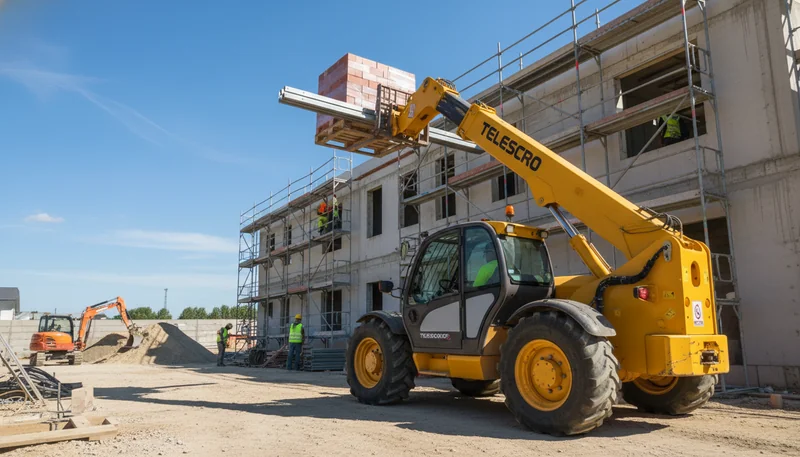
How Does a Telehandler Move Loads to Elevated Locations? Field-Tested Insights
Not long ago, I watched a crew in Poland try to squeeze a loaded telehandler between steel beams on a multi-story build. Their biggest question wasn’t about the engine—it was whether their machine could safely reach over an unfinished floor and set a pallet exactly where it was needed, without risking stability.
Telehandlers use telescopic booms—typically built from multiple nested steel sections—powered by hydraulic cylinders1 and guided by wear pads. As hydraulic pressure raises and extends the boom, the center of gravity shifts upward and forward, reducing stability at greater reach or height. Load charts2 define safe working limits by height, reach, load center, and attachment, with allowable capacity decreasing as extension increases.
How Does a Telehandler Boom Operate?
A telehandler’s telescopic boom consists of nested steel sections extended by hydraulic cylinders. Joystick movements direct high-pressure oil into these cylinders, raising, lowering, or extending the boom. Wear pads and optional synchronizing systems ensure smooth section movement, while dedicated tilt cylinders3 at the boom head adjust attachment angle for precise load positioning.
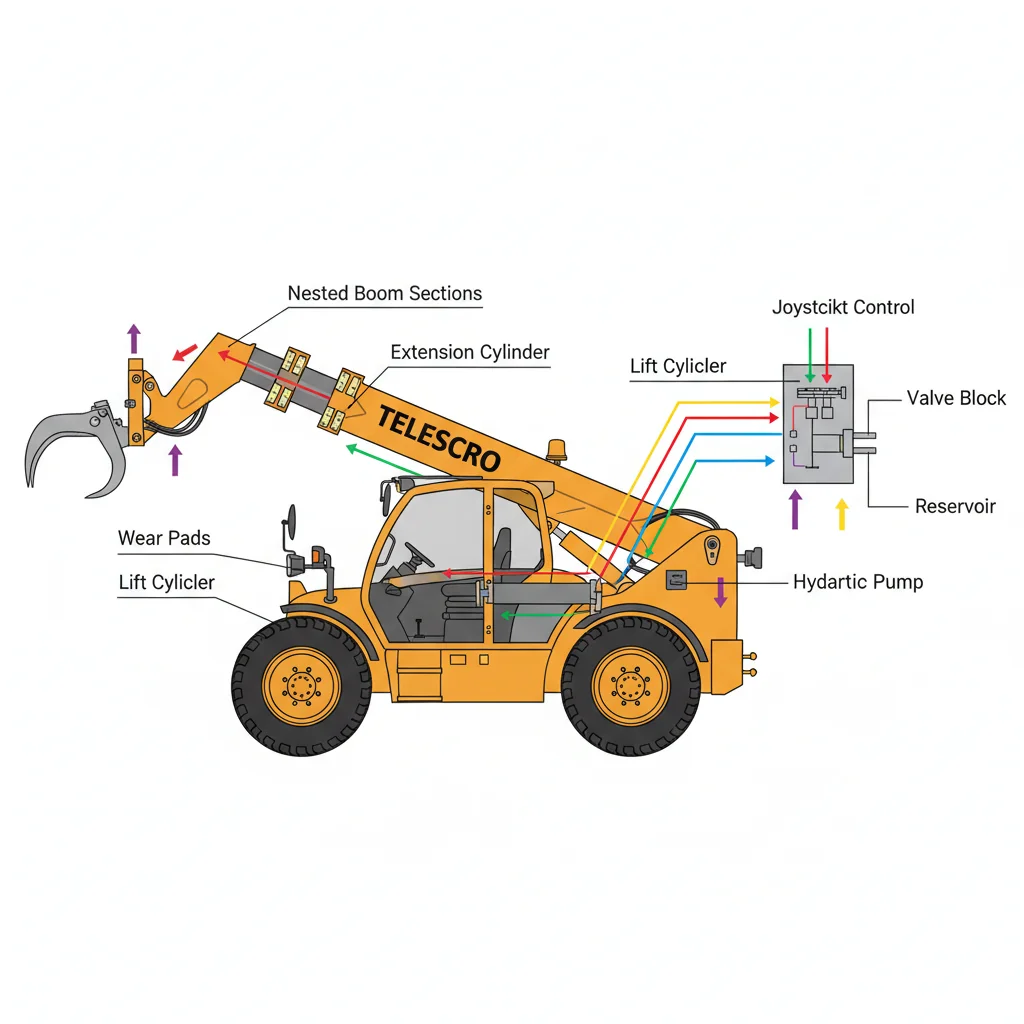
A practical point about telehandler boom operation is often overlooked on jobsites. The boom is built from several nested steel sections—typically two to four—that slide on wear pads and, on some models, a synchronizing system to help coordinate section movement.
When the operator moves the joystick, hydraulic oil is routed to the lift or extension cylinders to raise, lower, or telescope the boom for additional reach. Operating pressure, hydraulic tank capacity, and temperature performance vary by model and duty cycle, so the most reliable reference is the OEM specification for the exact machine and hydraulic fluid grade being used—especially for cold-start or high-heat environments.
I’ve worked with a team in Dubai where precise load placement was key. Their job? Placing window panels eight meters high, but also three meters inside the edge of the building. The main boom gave them the height, while the telescoping sections reached forward deep into the structure. But what really mattered was the tilt cylinder at the end of the boom—without it, lifting was easy, but leveling and positioning the panels safely at height would have been almost impossible. Too often, buyers skip this detail and end up slowing down installs.
Most buyers focus on maximum rated capacity4 or lift height, but the real work happens when the boom is extended partway and loads are off-center. I always suggest checking both the maximum forward reach and actual load chart5 values at working positions before purchasing. Check this on your site plans—otherwise, you might get caught by that "3-meter blind spot" specs never mention.
A synchronizing system in some telehandler booms ensures that all sections extend and retract uniformly, minimizing binding and excessive wear on the boom structure.True
Synchronizing systems use chains or cables to coordinate the movement of each nested boom section, maintaining balance and reducing mechanical stress as the boom telescopes.
Telehandler booms operate primarily through electric motors housed inside each section, which directly drive the extension and retraction of the boom.False
Telehandler booms use hydraulic cylinders, not electric motors, to lift, lower, and telescope the boom sections. Hydraulic systems provide the necessary force and control for heavy loads and precise movements.
Key takeaway: A telehandler moves loads to elevated locations by combining vertical lift and telescopic reach, controlled through advanced hydraulic systems. Buyers should compare both maximum lift height and forward reach to ensure suitability for their specific site and application requirements.
How Do Load and Reach Impact Stability?
As a telehandler boom lifts and extends, load stability decreases due to the changing center of gravity, which moves upward and forward, narrowing the stability triangle and increasing tip-over risk. Rated capacity sharply drops with reach; always reference the load chart and keep booms low and retracted during travel.

The biggest mistake I see is operators treating the telehandler’s rated capacity as if it always applies—no matter the boom position. That’s just not how the machine works. The reality is, once you start lifting or extending the boom, the stable base gets narrower. The load and the center of gravity both move forward, working like a lever over the front axle. Even a 3.5-ton machine that feels rock solid when the boom is down may tip at half that weight if you extend too far or too high.
I remember a project in Dubai where a contractor needed to place 1,200 kg pallets onto the sixth floor—roughly 14 meters out. The operator assumed “rated for 3.5 tons” meant no problem. But when he checked the load chart, the maximum at that outreach was only around 1,100 kg. Too close for comfort. They had to split every load or risk a tip-over. That’s the kind of jobsite scenario where a miscalculation isn’t just expensive—it can be dangerous for everyone nearby.
When planning a lift, always start with the load chart—the diagram showing allowable capacity at specific boom heights and reaches. Keep the boom as low and as retracted as possible while traveling around the site, and only raise or extend once the machine is correctly positioned.
Rated capacities shown on the load chart assume firm, level ground and proper machine setup in accordance with manufacturer guidance. Before each critical lift, confirm your actual working height and horizontal distance rather than relying on nominal figures. This approach protects the operator, the crew, and the machine from unnecessary stability risk.
A telehandler’s rated lifting capacity decreases significantly as the boom is extended upward and outward, due to the shifting center of gravity and increased leverage effect.True
When the boom is extended, the load moves farther from the telehandler’s front axle, acting like a longer lever and increasing the tipping moment, which reduces the machine’s stable lifting capacity. This is why load charts are necessary for every boom position.
"AsFalse
"Stabilizers
Key takeaway: Telehandler stability is sensitive to boom height and reach. The further and higher the load, the smaller the margin for error. Operators must reference load charts for each position, and avoid assuming ground-level lifting limits apply to elevated or extended loads.
How Do Load Charts Limit Lift Height?
A telehandler’s rated capacity decreases sharply as boom height and reach increase. Load charts display allowable weight relative to boom extension and attachment type. Actual safe lifting points depend on height, reach, and configuration, not just the model’s top-rated figure. Consulting the load chart is mandatory before elevating heavy loads.
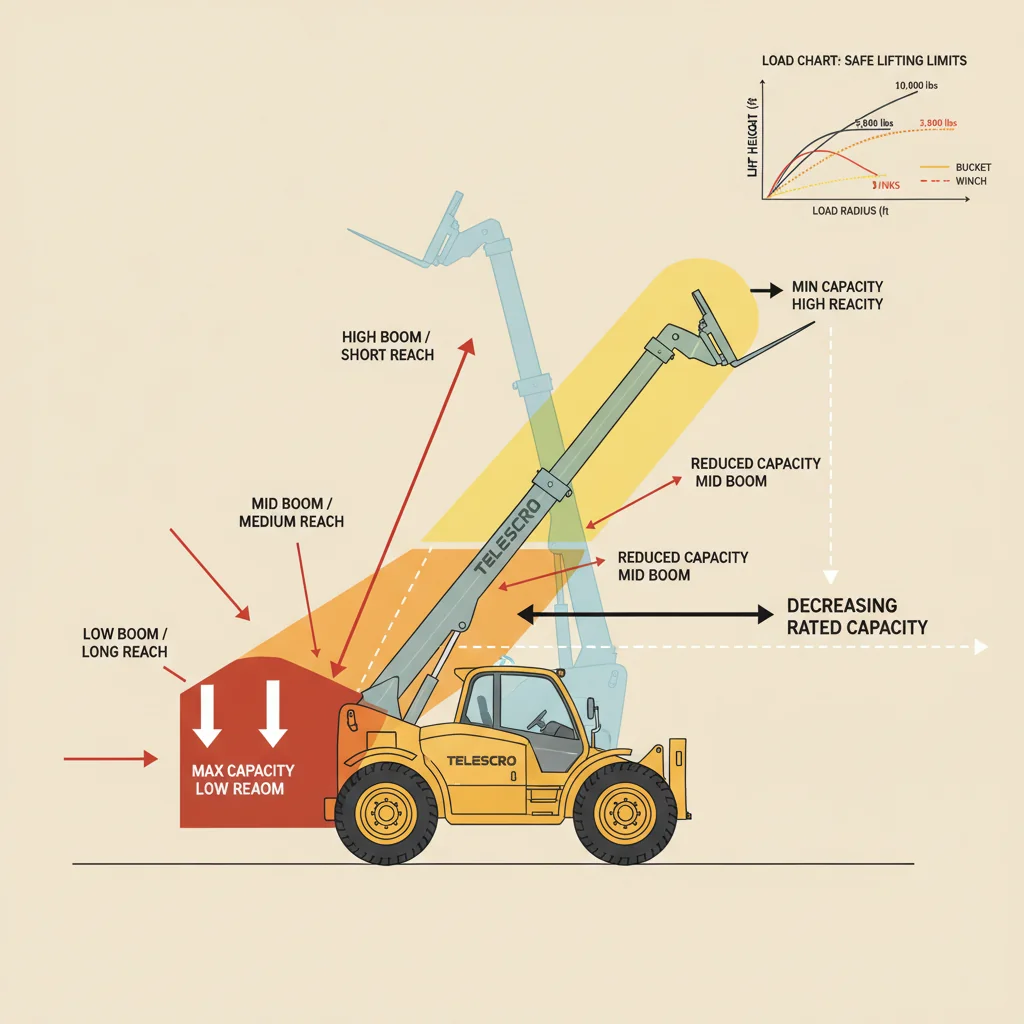
Many buyers don’t realize that a telehandler’s rated capacity rarely applies beyond its lowest boom height and shortest reach. I’ve seen customers in Dubai assume a “4-ton” machine can lift 4 tons anywhere in the air, which is a common misunderstanding.
In practice, once the boom is raised or extended forward, allowable capacity begins to drop quickly due to stability limits. With standard forks and the specified load center, a machine may handle near its headline rating at short reach, but at longer outreach or higher lift points, safe working capacity can fall to a fraction of that number, depending on the model and boom position.
This behavior is clearly shown on the load chart, which maps allowable load for every combination of height and reach. That chart—not the headline rating—is the only reliable reference for determining what a telehandler can safely lift at a given working position.
A customer in Brazil purchased an 18-meter telehandler assuming it could lift their full precast panel load to the sixth floor. When we reviewed the load chart together, it became clear that at long reach and with a work platform installed, the allowable capacity was far lower than expected. They were close to overloading the machine before catching the mismatch between the application and the chart.
This scenario comes up frequently. Buyers focus on the headline number on the spec sheet and overlook the shaded limit zones on the load chart. In reality, every attachment—buckets, jibs, suspended hooks, or work platforms—changes the load envelope. The setup also matters: allowable capacity differs significantly when working on tires versus with front stabilizers deployed.
Here’s the thing: I always suggest plotting your heaviest anticipated load on the chart before deciding if a telehandler is right for the job. If your scenario sits anywhere near the capacity edge, you’re running a real risk. Give yourself a buffer. I recommend aiming for 70–80% of the charted maximum at your operating point—never push right to the line.
A telehandler’s maximum rated lifting capacity is only valid when the boom is fully retracted and at its lowest angle, because extending or raising the boom significantly reduces stability and lift strength.True
Load charts account for changes in leverage and stability as the boom is raised or extended, so the maximum safe load decreases rapidly to prevent tipping or structural overload.
A telehandler can always lift its maximum rated capacity to the maximum boom height as long as the machine is on level ground.False
Even on level ground, extending or raising the boom increases leverage on the machine, making it unsafe to lift the full rated capacity at higher or longer reach positions.
Key takeaway: Always reference the specific load chart for the planned attachment and lift scenario. Rated capacity only applies at minimal reach and height, and decreases rapidly as the boom extends or lifts higher. Safe operation requires confirming each job’s lifting point sits well within the allowable chart area.
How Do LMIs Prevent Telehandler Tip-Overs?
Modern telehandlers use a Load Moment Indicator (LMI) to monitor boom length, angle, and hydraulic pressure. The LMI calculates stability margins in real time, warning the operator as limits are approached and blocking dangerous actions if exceeded. This prevents tip-overs by enforcing the manufacturer’s load chart restrictions.
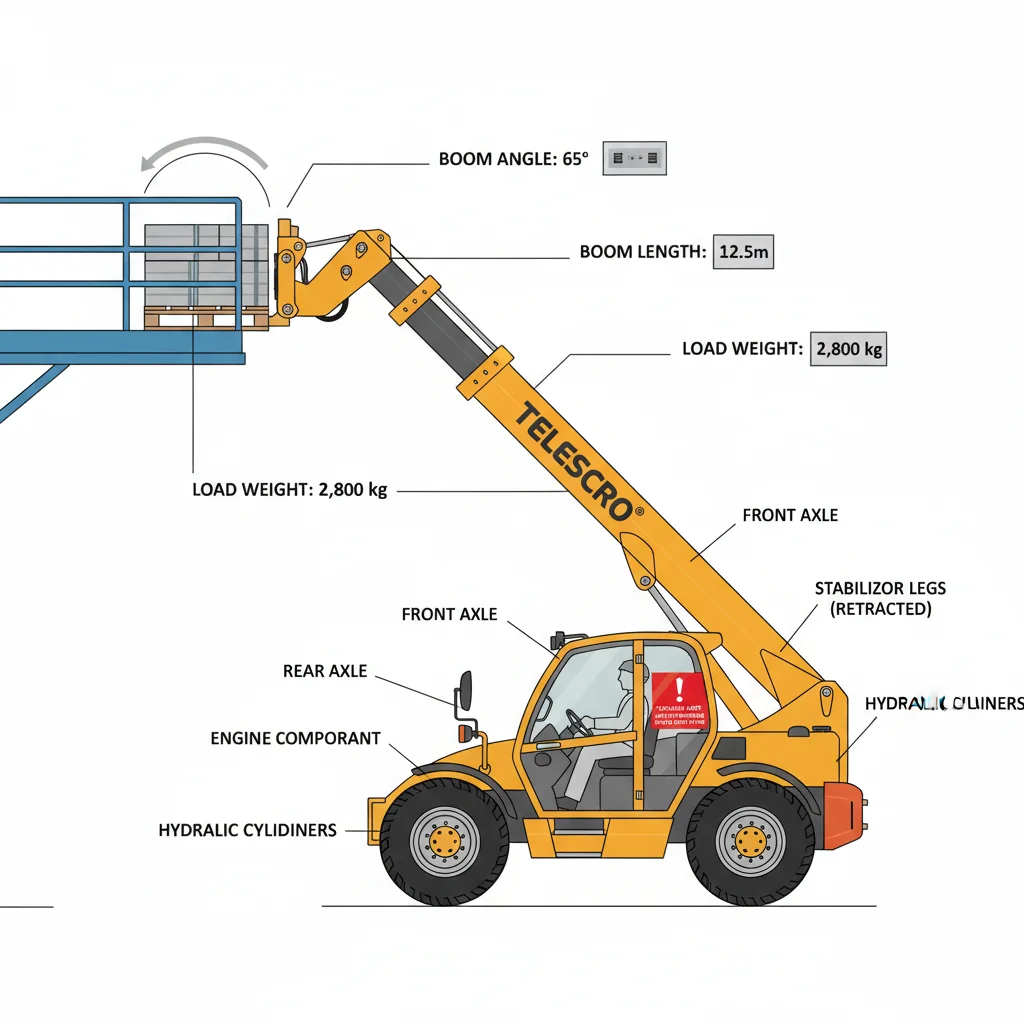
I’ve worked with quite a few contractors who wondered why their telehandler suddenly “locked out” certain functions while they were moving loads. Here’s what’s happening: the Load Moment Indicator, or LMI, is constantly monitoring the boom’s angle, extension, and the pressure in the main lift cylinder. It uses these inputs to calculate something called the overturning moment—basically, how close the machine is to tipping over. When an operator gets too close to the safe limits shown in the load chart, the LMI triggers a warning: lights, alarms, or even a message on the display.
But the crucial part is what happens next. If you push a bit further—say, stretching the boom out with a pallet of bricks already near max height—the LMI will actually prevent you from making things worse. You might still be able to raise or retract the boom (which brings the load closer and increases stability), but you’ll be blocked from lowering or extending further. I saw this save a project in Dubai when a new operator tried to push a 3,500 kg load to 14 meters; the machine hit the safety lockout and refused to move outward. That feature alone likely prevented a serious tip-over.
I always tell my customers: trust the LMI, and don’t bypass or ignore its warnings. It’s doing the complex stability math you can’t see from the cab—especially when you’re operating on level ground at full extension or with shifting, loose materials. Proper training on reading both the load chart and the LMI system is non-negotiable if you want to avoid costly accidents.
LMIs on telehandlers can restrict boom movement in real-time when calculated overturning moments approach unsafe thresholds, preventing further extension or lift to avoid tip-overs.True
LMIs integrate sensors and control systems that actively monitor operational parameters and automatically intervene if loading conditions become unsafe, stopping the operator from exceeding stability limits.
A telehandler’s LMI system uses GPS location data to determine if it is at risk of tipping over during load handling.False
LMIs assess risk based on dynamic inputs like boom angle, extension, and hydraulic pressure, not geographic location; GPS data is not relevant to calculating a machine’s tip-over risk.
Key takeaway: Load Moment Indicators enhance telehandler safety by continuously monitoring key parameters and enforcing manufacturer-defined stability limits. Operators should always follow LMI warnings without bypassing them and receive proper training to interpret load chart limits, especially when operating near maximum height, reach, or with shifting loads.
When Are Stabilizers and Frame Leveling Critical?
Stabilizers (often called stabilizers, not outriggers, in telehandler terminology) and frame leveling are essential for maintaining rated capacity on uneven or sloping ground. These features matter most when handling heavy loads at maximum height or reach, especially near the edge of the load chart. Machine must be level (≤3°) to achieve rated capacity.

Last month, a contractor in Dubai called me frustrated about a high-reach pallet job. They were trying to set 1,200 kg tiles on a second-floor balcony, nearly 13 meters out. The telehandler could hit the height, but they found the stability alarm cutting out whenever the ground sloped more than a few degrees. This is where stabilizers and frame leveling really show their value. Rated capacity—the advertised limit—is only guaranteed when the machine sits level, usually within 3°. Any more tilt, and your actual safe load drops dramatically.
I’ve seen many buyers focus on machine size, but forget what happens on real jobsites. Most high-reach telehandlers only have front stabilizers. You hydraulically extend these until the wheels lift slightly or at least unload. This spreads the weight and creates a rigid base for the boom to work safely—even at max height or full reach. For example, I helped a project in Kazakhstan where the contractor lifted 4,000 kg roof panels with a 17-meter unit. On tires, the load chart allowed just 1,500 kg at full extension; with stabilizers down, it was more than double. That’s a huge difference if you’re lifting near your limits.
To be honest, using frame leveling is non-negotiable on uneven ground. You tilt the chassis hydraulically, correcting for small slopes before extending the boom. Always double-check your load chart—there are separate ratings for ‘on tires’ versus ‘on stabilizers’ positions. I suggest verifying the site so you can deploy these systems and avoid overloading risk. It’s about staying safe, not just meeting specs.
Stabilizers and frame leveling are crucial for achieving full rated lift capacity on uneven ground, because even a small slope can trigger stability alarms and reduce safe operating limits.True
A telehandler’s rated capacity assumes a level base, typically within a few degrees. Exceeding this slope compromises stability, leading to automatic load limiting or alarm activation, especially at high reach. Stabilizers and frame leveling help maintain a level position, ensuring the machine operates safely at its intended performance.
Frame leveling systems can compensate for any amount of ground slope, allowing telehandlers to operate at full capacity regardless of terrain.False
Frame leveling on most telehandlers only compensates for a limited range of slope (usually a few degrees). If the ground is excessively sloped, neither stabilizers nor frame leveling can guarantee stability, and operating at full rated capacity becomes unsafe.
Key takeaway: For safe high-reach or maximum-load operations, stabilizers and frame leveling are essential, especially on uneven terrain. Rated capacity assumes the machine is level, so always deploy these systems as required, and consult the load chart for variations between ‘on tires’ and ‘on stabilizers’ configurations.
How Do Attachments Affect Lifting Height?
Attachments directly impact a telehandler’s ability to lift loads to elevation. Each attachment adds weight and moves the load center7 forward, reducing rated capacity and reach. Manufacturers publish specific load charts per attachment. Standard pallet forks, bale clamps, buckets, and man baskets each impose different limitations, requiring precise chart reference for safe, effective operation at height.
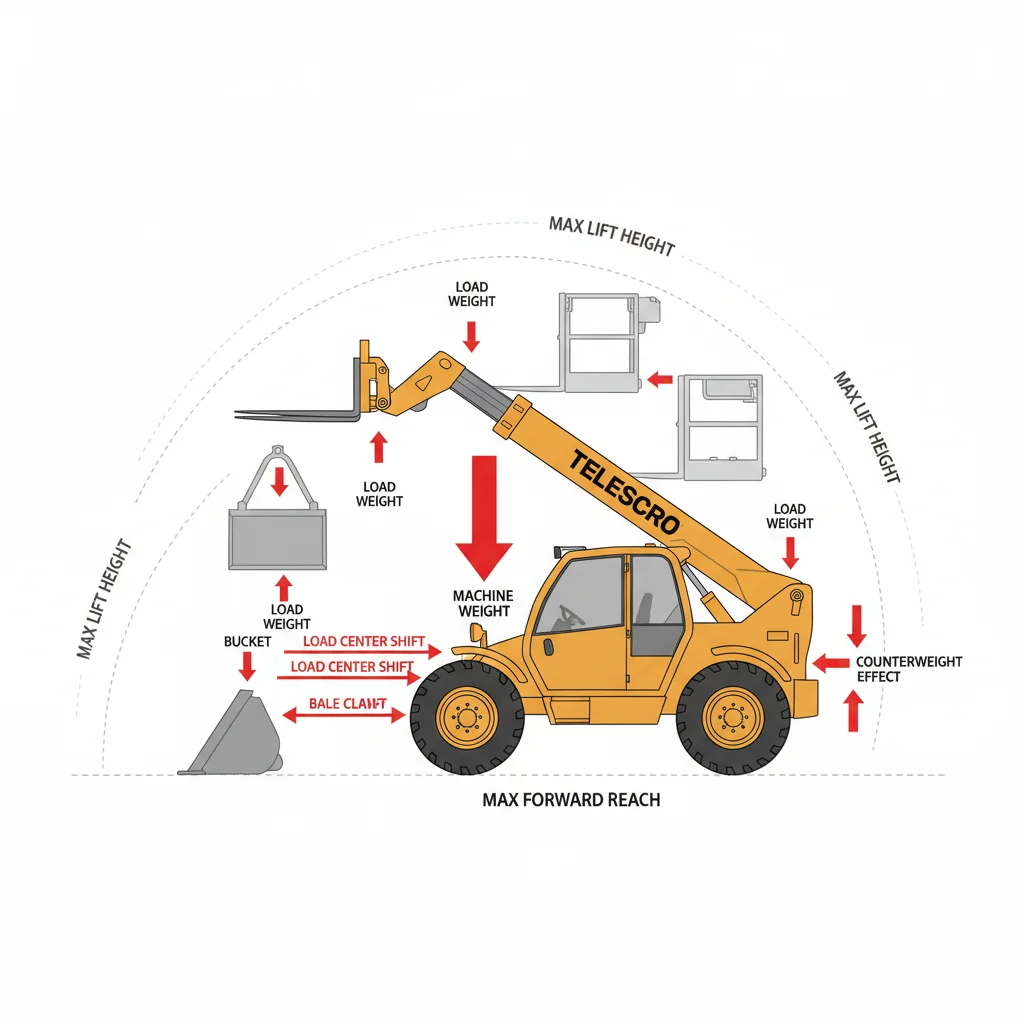
Here’s what matters most when you’re planning lifts at height: every attachment—not just its own weight, but also how it shifts the load center—reduces what your telehandler can safely lift the higher you go. Standard pallet forks are ideal for most building materials, but add a bale clamp, bucket, or man basket, and suddenly your effective lifting range changes. I’ve seen customers in Kazakhstan try to stack 4 hay bales at 6 meters using a mid-size machine and bale clamp rated for 1,000 kg, only to find the load chart limited them to just 750 kg at that reach. That’s a tough lesson if you’ve already filled the barn.
Attachments directly affect both rated capacity and maximum safe elevation. Here’s how different tools typically impact your telehandler’s performance:
- Pallet forks – Minimal extra weight, used for brick, block, or bagged materials. Little impact up to mid boom, but check rated capacity over 10 meters.
- Bale clamps/sofhands – Extra clamp weight plus a changed load center. Standard models take 800–1,000 kg bales, but max stacking height is often lower than the boom’s true max.
- Buckets/high-tip buckets – Add substantial dead weight, plus they push the load center further out. Expect a big capacity reduction at full extension.
- Man baskets/work platforms – Count basket weight and occupants. Most machines derate sharply above 12 meters to remain safe.
From my experience, I always insist customers get the actual load chart matching their main attachments—not just the one printed for forks. That’s the only way to avoid surprises with reach or capacity when working up high.
Using a heavier or longer attachment, such as a bucket or bale grab, moves the load center farther from the telehandler's front axle, which reduces both maximum lifting height and safe rated capacity at height.True
Attachments alter the telehandler’s load chart by extending the load farther out, increasing leverage on the boom. This effect reduces stability and capacity as boom extension and height increase, which is a critical consideration in lift planning.
Switching from standard pallet forks to a man basket attachment does not affect the telehandler's lifting height as long as the attachment stays within the rated load capacity.False
A man basket changes the load configuration—both weight and load center—and often requires a derating of both height and capacity, even if within nominal capacity. Operator and load safety regulations also mandate a lower working height and revised load charts with platform attachments.
Key takeaway: Choosing the right telehandler configuration requires knowing how each attachment affects load capacity and lifting height. Always consult attachment-specific load charts, not just the base machine rating, to ensure safety and meet operational requirements for every load and elevation scenario.
How does telehandler boom geometry aid reach?
A telehandler’s boom geometry enables both vertical lift and telescopic forward extension, allowing safe placement of loads over obstacles such as trenches or building edges. Unlike mast forklifts, this design permits operators to park clear of hazards while accurately reaching target locations at height. Always reference the load chart for safe outreach and capacity limits.

I’ve worked with customers who made this mistake—comparing a telehandler’s spec sheet to a standard forklift and assuming both can drop loads right at the same spot. The reality? Boom geometry changes everything. Unlike a mast forklift, which can only move up and down in a fixed arc, a telehandler’s boom combines vertical lift with telescopic reach. This lets operators park safely away from hazards—rebar cages, trenches, scaffolding—and still position materials exactly where they’re needed, even several meters past the edge.
One contractor in Kazakhstan asked me why their 3.5-ton, 14-meter telehandler could only place 800 kg at near full extension. I explained that as the boom stretches forward—say, 10 or 12 meters from the wheels—the leverage effect on the chassis increases massively. The load chart (usually posted in the cab) shows this clearly: rated capacity drops significantly as outreach grows. I always remind users that a telehandler isn’t just about how high you can reach, but whether you can safely deliver a full pallet to that second row behind a formwork or over a deep pit.
In agriculture, I’ve seen the same challenge stacking bales two or three rows deep. On a 7-meter reach machine, usable lifting drops off for that back row. The smart operators check the load chart at exactly the outreach they need. My strong advice—don’t just look at maximum lift height or “4 tons” printed in big letters. Simulate your typical obstacle, measure your real outreach, and double-check the chart. That’s how to avoid nasty surprises on site.
A telehandler's telescopic boom enables it to extend loads horizontally over obstacles, allowing placement in locations unreachable by vertical-mast forklifts.True
This is true because the boom geometry of a telehandler allows for both upward and outward movement, making it possible to position loads over trenches, barriers, or up onto higher surfaces—something a traditional forklift cannot achieve.
Telehandler booms are limited to vertical movement and cannot position loads horizontally beyond the front tires.False
This is false because telehandler booms are specifically designed for telescopic extension, which allows for significant horizontal reach beyond the chassis and front tires. This reach is precisely what differentiates telehandlers from standard forklifts.
Key takeaway: Telehandler boom geometry allows operators to reach over obstacles and place loads at height while maintaining a safe distance. Usable capacity depends on both vertical lift and horizontal outreach; always verify model-specific load charts to ensure stability and safety in real field conditions.
Why is telehandler boom maintenance vital?
Precise high-level load placement with a telehandler relies on the boom’s structural integrity and hydraulic system condition. Worn wear pads, pins, or guides can cause side play, making alignment difficult, while hydraulic leaks or contamination result in jerky or drifting movements—creating significant safety risks aloft, particularly when using personnel platforms.
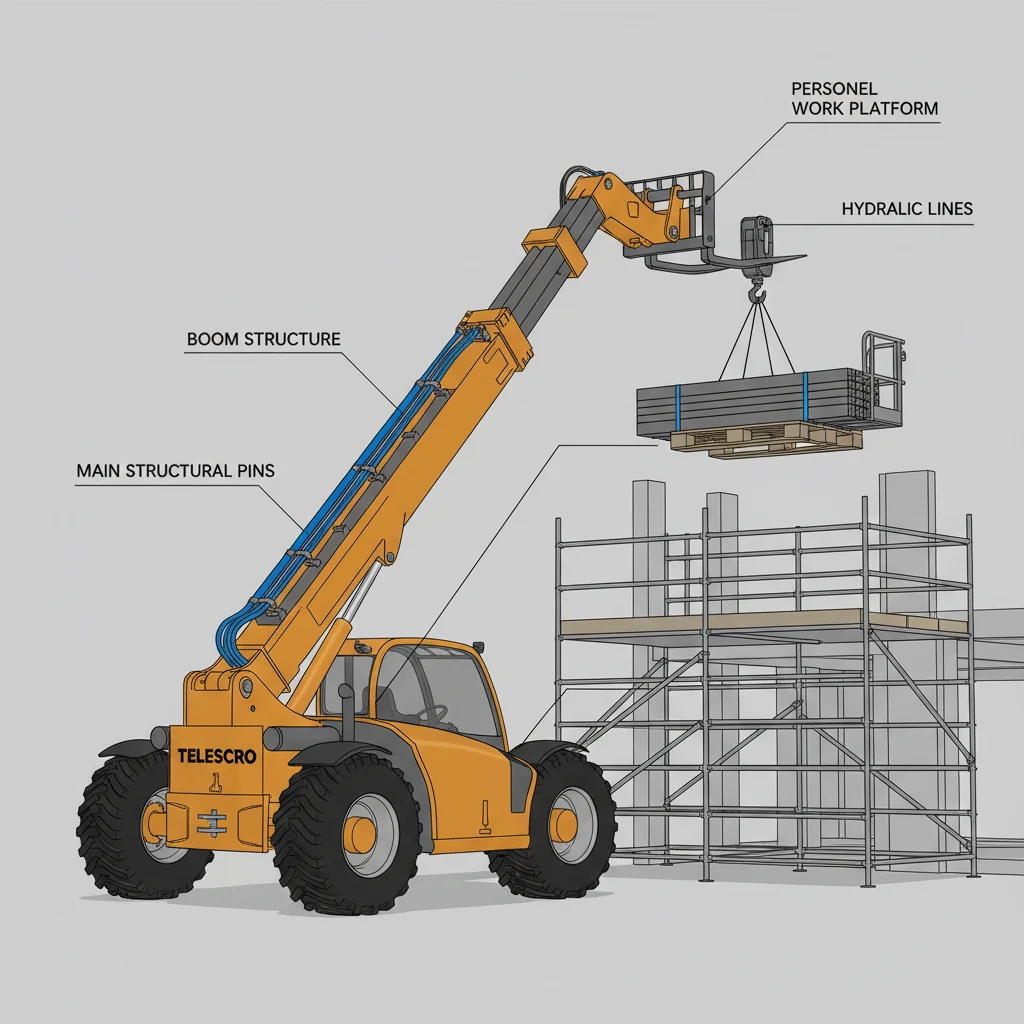
To be honest, the spec that actually matters is how smooth and reliable your boom and hydraulics stay after the first year. You’d be surprised how many operators think minor “play” in the boom is harmless. In reality, even a few millimeters of slop between boom sections can create enough side movement to make precise pallet placement difficult, especially when you’re trying to slot forks onto a narrow rack at 12 meters up. I’ve seen this firsthand on a site in Kazakhstan—an 18-meter unit with worn wear pads ended up delaying steel installation by two full shifts because every pallet rocked or drifted at the top.
On jobs where you’re lifting people in a work platform, any jerky or drifting movement from the hydraulics becomes a real safety concern. One customer in Brazil had a 4-ton telehandler with slow hydraulic leaks—when fully extended, the boom would start drifting after 40 seconds. The operator had to constantly correct, which made everyone nervous working aloft. In that case, hydraulic fluid contamination was the real issue, not just low oil. The clean-out, inspection, and pad change cost less than a week’s rental, but it prevented a much more expensive incident.
My advice is simple: always inspect the boom for dents, pitting, suspect welds, and visible wear pads before every project—especially if the telehandler’s working above 10 meters. Run the boom in and out under load. If you feel roughness or see the boom shift sideways, stop and service it. Keeping pivots greased and replacing wear pads when needed doesn’t just protect your gear—it protects your crew.
Excessive play in the telehandler boom sections can significantly amplify side-to-side movement at full extension, making high-reach pallet placement less precise and increasing the risk of dropped loads.True
When wear occurs between boom sections, minor internal gaps become magnified as the boom extends. This reduces operator control at height, especially when maneuvering loads onto narrow racks, because a small amount of looseness at the base results in much larger sideways movement at the tip.
Regular boom maintenance is only necessary for high-capacity telehandlers, since light-duty models aren't affected by section wear during elevated loading.False
All telehandlers, regardless of capacity, are susceptible to boom wear that can impair load placement accuracy. Light-duty models still rely on tight tolerances between boom sections for safe operation, especially when lifting to significant heights.
Key takeaway: Regular boom and hydraulic maintenance is essential for accurate, safe, and efficient load handling at height. Inspect for structural wear, corrosion, or leaks before use, and follow OEM service intervals to prevent dangerous instability, drifting, or rough motion during critical elevated operations.
How Should Telehandler Lift Height Be Sized?
Selecting telehandler lift height requires analyzing both maximum height and reach at that height. Identical headline heights can mask major differences in rated capacity for loads at full extension. Operators must consult the load chart for horizontal reach, height, and load specifics before choosing models.
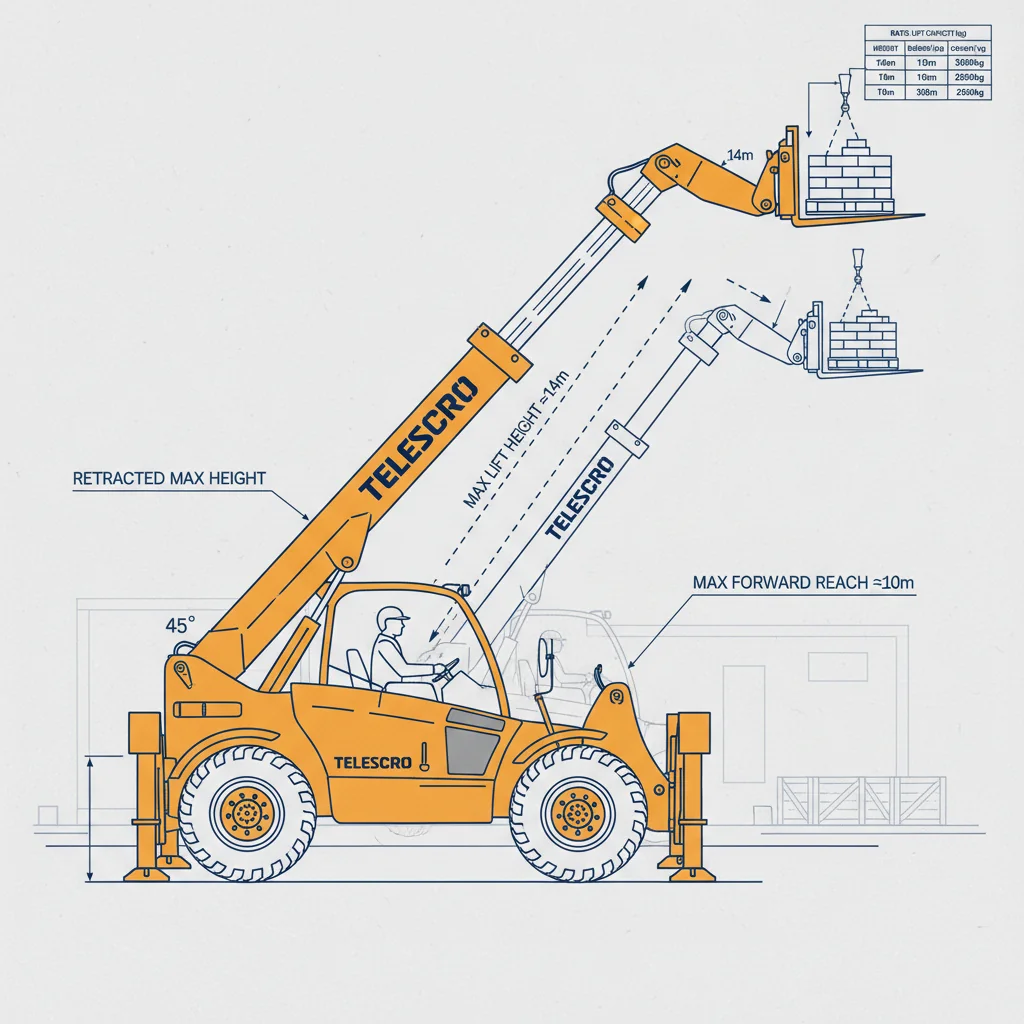
From my experience, buyers often focus on the highest lift height in the brochure, thinking that covers every need. But height alone doesn’t guarantee the telehandler can safely place your load exactly where you need it. On a project in Kazakhstan, a team needed to position 1.2-ton glass panels on a façade, 7 meters above ground and 2.5 meters behind a slab edge. Their 14-meter telehandler looked perfect on paper. In reality? At that horizontal reach, the machine maxed out at just 900 kg—unsafe for the real-world load.
The real challenge is matching both height and forward reach to your job conditions. Two 14-meter models may offer totally different rated capacities when working 8 meters out horizontally. One might manage a 1.5-ton pallet onto the third story; its competitor might only lift 800 kg at that same spot. This is why I always double-check the load chart—a technical map showing safe lifting limits at every height and reach. These charts factor in boom angle, extension, and load center, so it’s never a flat number.
Before shortlisting models, map out your typical scenario: how far from the building edge, desired elevation, and real load including the attachment weight. Share this sketch with dealers and ask them to mark that precise working point on the machine’s load chart. I suggest looking for units that give a comfortable safety margin at your actual working position, not just at maximum reach. A little time spent upfront here prevents lost days onsite chasing extra capacity.
A telehandler’s maximum lift height does not indicate its maximum lifting capacity at that height, especially when loads need to be placed beyond the edge or at full forward reach.True
Telehandlers have different load charts that show safe capacities at various heights and reach distances. As the boom extends and the load moves away from the machine, lifting capacity drops substantially due to leverage and stability limits. Sizing solely by lift height can lead to dangerous overloading if horizontal reach and load chart limitations aren’t considered.
If a telehandler can lift its maximum rated load at ground level, it can safely place the same load at maximum height and reach.False
Telehandler rated capacity decreases as the boom extends and lifts higher, and even more so when reaching out horizontally. The further out and higher the load is positioned, the more limited the machine’s capacity. Relying on ground level ratings for elevated, offset placements is a critical and unsafe mistake.
Key takeaway: Never rely solely on maximum boom height when selecting a telehandler. True suitability depends on the rated capacity at specific reach and elevation for each real-world scenario. Always cross-check job requirements with the manufacturer’s load chart to ensure safety and performance.
Is a larger telehandler always better value?
A larger telehandler, such as moving from a 7 m to a 14 m model, increases boom complexity, fuel use, and operating costs while reducing maneuverability. For typical loads—like 1.5 t at 6–8 m reach—a well-matched mid-size (10–12 m) telehandler often offers safer operation with lower total cost per hour.
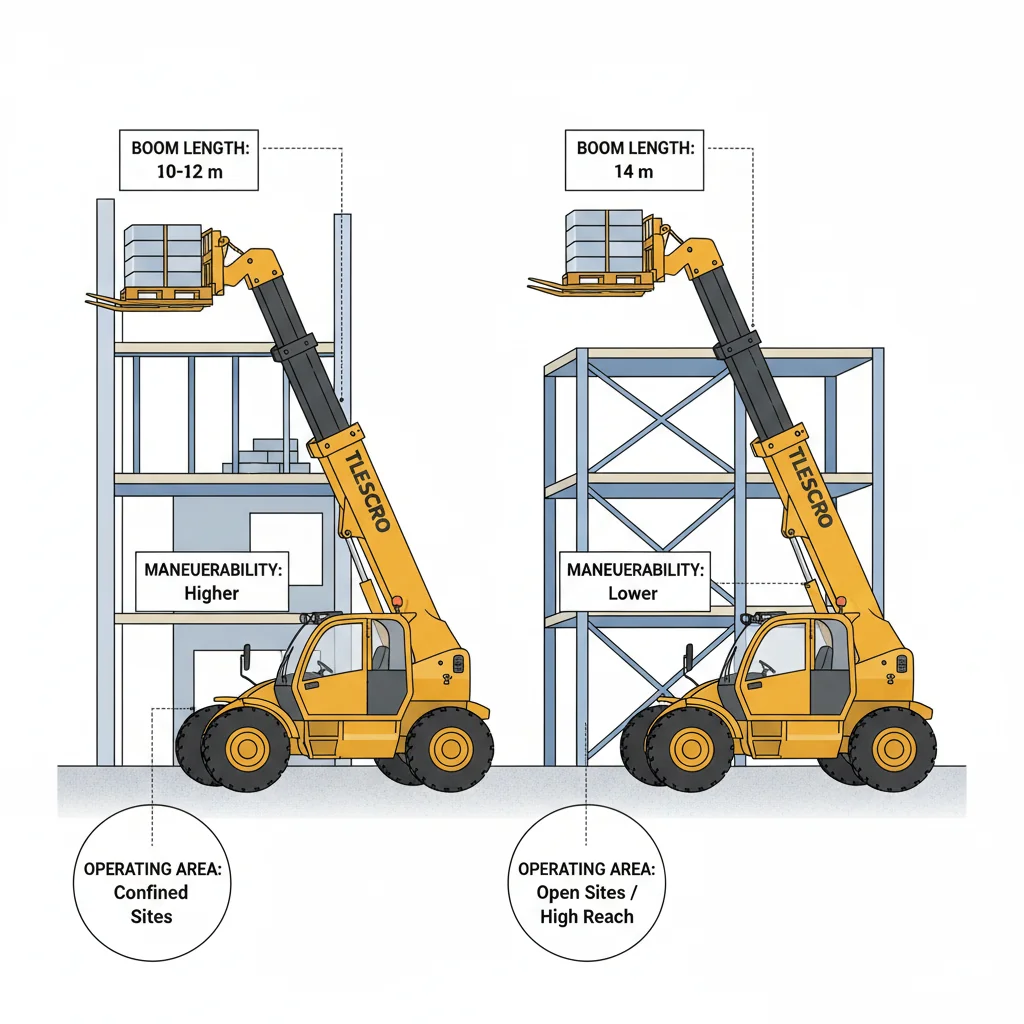
You might think a bigger telehandler always brings better value. But I’ve watched many customers, especially in Kazakhstan and Egypt, regret going up to a 14-meter machine when their typical work really required much less. Last year, a farming client in Hebei, China, replaced his old 7-meter model with a new 14-meter telehandler. The result? He found it too bulky for his dairy barns and noticed his fuel cost almost doubled. Worse, squeezing through tight yard corners was a daily headache.
Let’s break down where bigger telehandlers often fall short for everyday loads:
- Higher running costs8 – Larger machines burn more diesel, wear out bigger tyres, and demand pricier maintenance. Expect your yearly fuel budget to jump by at least 30% when stepping up.
- Less maneuverability9 – That extra reach comes with a much-wider turning circle—hard to manage in crowded sites or small farm sheds.
- Increased boom complexity – Extra boom sections mean more hydraulic hoses, more joints, and extra daily checks. More points can leak or fail.
- Difficult transport – Moving a 14-meter telehandler between sites often means a specialist truck, adding cost and hassle.
From what I’ve seen on jobs in Brazil and Vietnam, most contractors lift 1.5 to 2 tons to 6–8 meters—not the full 14-meter reach. A quality 10–12 meter machine safely covers these needs, with easier handling and less cost per hour.
I always suggest evaluating your real maximum load and reach. Check the load chart, not just the sticker on the boom. The right-sized telehandler makes daily work safer, smoother, and cheaper.
A telehandler uses its telescopic boom and hydraulic system to raise and position loads at elevated locations, allowing for precise placement even in confined spaces.True
The boom extends hydraulically, giving the machine its signature reach and lift capabilities, while stabilization and controls allow for accurate load placement.
Larger telehandlers always lift heavier loads to higher elevations than smaller models, regardless of boom extension.False
While larger telehandlers often have higher maximum capacities, their lifting ability at full extension is actually limited by stability and leverage factors—so a small telehandler near its base may outlift a larger one at maximum reach.
Key takeaway: Bigger telehandlers do not always offer better value for most contractors or farmers. Matching the telehandler’s rated capacity and reach to actual elevated lifting requirements typically provides a better balance of running costs, maneuverability, and safety compared to choosing the highest-specification or tallest models.
When is a Rotating Telehandler Ideal?
Rotating telehandlers (RTH) use a turret-mounted boom10 rotating 360°, letting operators position loads around the machine without moving the chassis. This capability is valuable on tight urban sites, courtyards, or multi-side façade work. However, higher costs and complexity mean RTH models suit advanced applications, not basic palletized loads.
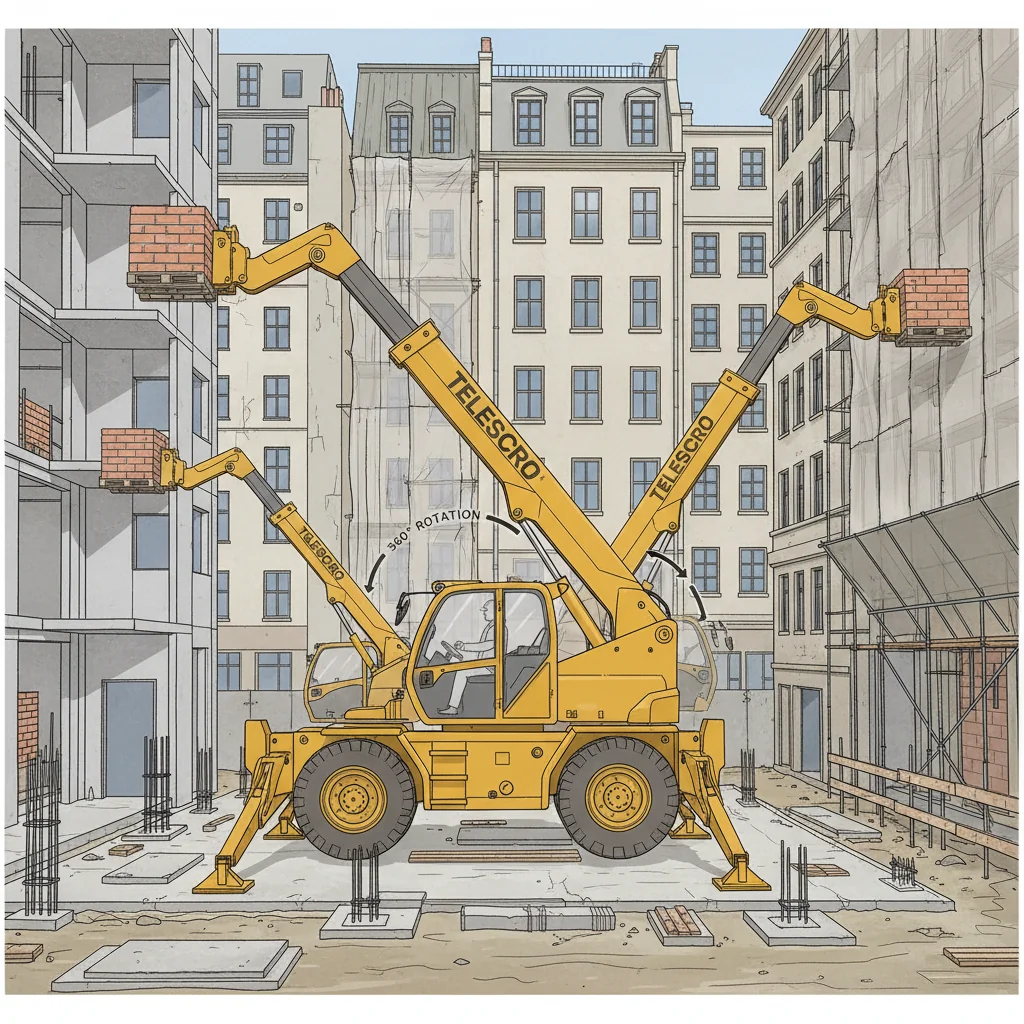
One question I hear a lot: When does it actually make sense to invest in a rotating telehandler? From what I’ve seen across different jobsites, RTH models become the right tool when your material placement needs go way beyond simple forward-and-back. Their 360° rotating boom lets you stay parked and reach multiple sides or levels—something a standard telehandler just can’t do without constant repositioning.
Last year, I worked with a contractor in Singapore tackling a multi-story office build. The space was tight, boxed in by other buildings. They needed to deliver curtain wall panels and HVAC units to all sides, but there was no room to move a machine around the structure. By setting up a 5-ton rotating telehandler with stabilizers, they managed safe placements up to 21 meters in several directions—without shifting the chassis even once. That single machine covered the work of a crane for smaller loads, and also handled forks and buckets. The project saved at least two full weeks compared to using multiple machines for staging and hoisting tasks.
But here’s the thing—those benefits only matter if your job really needs that flexibility. For most material delivery—like loading roof tiles or moving palletized insulation—a conventional telehandler is more economical, simpler for operators, and quicker to maintain. RTH models have higher costs, more hydraulic and electronic complexity, and need specially trained crews to avoid stability errors. I suggest running the numbers: unless you’re frequently working in confined urban footprints or managing lots of multi-directional lifts, stick with standard models for everyday construction demands.
Rotating telehandlers can place loads onto elevated balconies or roofs without needing to be repositioned, thanks to their 360-degree rotating boom and precise outrigger stabilization.True
The ability to rotate the boom allows operators to deliver materials from a stationary position to multiple high or hard-to-reach locations, which is not possible with standard telehandlers that require frequent repositioning. The use of outriggers adds necessary stability for these elevated placements.
Rotating telehandlers require the base vehicle to move closer to each pickup or set-down point, much like standard telehandlers, making them less efficient for multi-story projects.False
A key advantage of rotating telehandlers is that their rotating boom allows materials to be placed at various points around the machine without moving the base vehicle, which increases efficiency and safety, especially on confined or multi-story jobsites.
Key takeaway: A rotating telehandler is worth considering for projects demanding multi-directional placement in confined or complex environments, such as façade or roof work. For routine, forward-reach lifting or general pallet handling, a conventional telehandler is typically more economical and appropriate.
Conclusion
We’ve covered how telehandlers combine vertical lift and forward reach, powered by hydraulics, to place loads where you need them. It’s not just about maximum specs—real-world performance depends on how the machine handles your typical loads at working height. From my experience, buyers who look beyond showroom numbers and study load charts at 75% extension avoid the “showroom hero, jobsite zero” issue. Before you decide, check local parts availability too—unexpected downtime can cost more than you think. If you’d like help comparing options for your project, feel free to reach out. I’m happy to share what’s worked for real jobsites across 20 countries. Every site is different—choose what actually works for your workflow.
References
-
Detailed explanation of hydraulic cylinders’ role in telehandler boom movement and load precision control under high pressure. ↩
-
Explore detailed explanations on using load charts to ensure safe telehandler operations and avoid overloading at various boom heights. ↩
-
Explores how tilt cylinders adjust attachment angles for precise load positioning in construction equipment versatility. ↩
-
Learn why rated capacity decreases as boom extends, backed by real-world examples and safety implications for operators. ↩
-
Expert explanation of load charts helps operators understand capacity limits as outreach increases, preventing unsafe lifting conditions. ↩
-
Explore how stabilizers enhance telehandler stability and load capacity on uneven terrain to ensure safe lifting operations near load limits. ↩
-
Explains load center shifts caused by attachments and their impact on telehandler stability and safe lifting operations. ↩
-
Explore detailed insights on how fuel use, tyre wear, and maintenance escalate with telehandler size to optimize cost-efficiency. ↩
-
Understand the impact of telehandler dimensions on turning radius and handling to improve site safety and efficiency. ↩
-
Understand how turret-mounted booms allow multi-directional load placement, improving efficiency on confined and complex construction sites. ↩