










How Do Rental Companies Use Telehandlers? Field Experience Guide
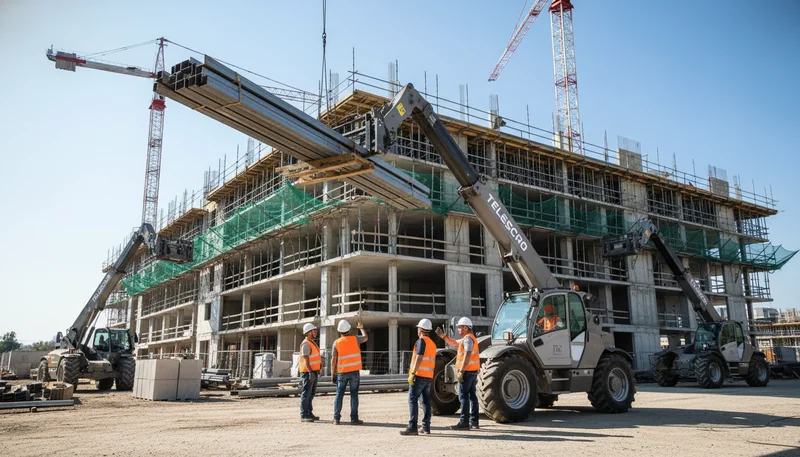
A few months ago, I watched a telehandler in Berlin handle four trades in one day—unloading bricks at 8 a.m., hoisting HVAC units by lunch, then supporting glazing and drywall crews by evening. It struck me: on most sites, the machine’s ownership tag reads like a rental company’s phone number, not a contractor’s name.
Rental companies have positioned telehandlers as high-utilization core assets within their fleets, consistently reaching 800–1,200 operating hours per year and returning investment in three to five years. The predominance of rental telehandlers1 has shifted fleet composition toward standard sizes that match the majority of market demand: typically 7–12 m/3 t for housebuilding and 14–20 m/high-reach for industrial or multi-story work.
Why Do Rental Firms Prefer Telehandlers?
Rental companies favor telehandlers because they deliver high utilization rates—800 to 1,200 hours annually—and recover their investment within three to five years. Mature markets see most new telehandler units entering rental fleets, offering contractors access to modern Tier 4 or electric models2 without the capital expenditure, emissions compliance challenges, or resale risks associated with direct ownership.

Most rental managers I talk to like machines that stay busy all year. Telehandlers do exactly that, because the same 3‑ton or 4‑ton unit can jump between masonry, roofing, steel erection, and even light industrial work. That flexibility keeps utilization in the 800 to 1,200 hour range annually on many fleets. High hours mean the asset pays for itself in roughly three to five years, sometimes faster in busy markets.
From my experience, a telehandler is one of the first machines a new rental branch orders after aerial lifts and mini excavators. In Brazil, one rental customer started with just two 14‑meter units; within three years they expanded to ten telehandlers. They saw that contractors kept extending rentals because the machine covered both lifting and material handling. One machine on hire for six months straight is a dream for any rental manager.
Rental firms also prefer telehandlers because they can handle emissions and technology headaches centrally. Tier 4 engines and electric models need proper diesel exhaust fluid, battery management, and trained technicians who understand hydraulic circuits and electronic moment indicators. A small contractor doesn’t want that complexity or the risk of a mistuned engine sitting idle. The rental yard absorbs the learning curve and spreads the cost over many customers.
I visited a yard in Dubai where over 80% of their telehandler fleet was less than five years old. That meant contractors always got modern, compliant units without tying up capital. If you’re renting, I suggest asking how new the fleet is and how many hours the machine has already worked.
"RentalFalse
"Adjustable
Rental companies exclusively use fixed-frame telehandlers, as these models eliminate maintenance concerns associated with articulated steering and boom oscillation.False
In reality, rental fleets include both fixed-frame and rotating telehandlers. While articulated and rotating models have more complex components, their increased versatility and ability to work in confined spaces outweigh the marginal increase in maintenance complexity.
Key takeaway: Telehandler rental dominates in developed markets due to high utilization, rapid return on investment, and minimal risk for both rental firms and contractors. Rental offers competitive access to up-to-date machines without significant upfront costs, making outright ownership rarely cost-effective unless utilization is exceptionally high.
How Do Rental Fleets Select Telehandler Sizes?
Rental fleets select telehandler sizes to match approximately 70–80% of typical local job requirements, focusing on standardized models. Common ‘rental spec’ ranges include 6–7m/2.5–3t for tight spaces, 10–14m/3–4t for general sites, and 17–20m high‑reach models for industrial, multi-story, and infrastructure projects. Standardized engines, tires, and attachments optimize serviceability.
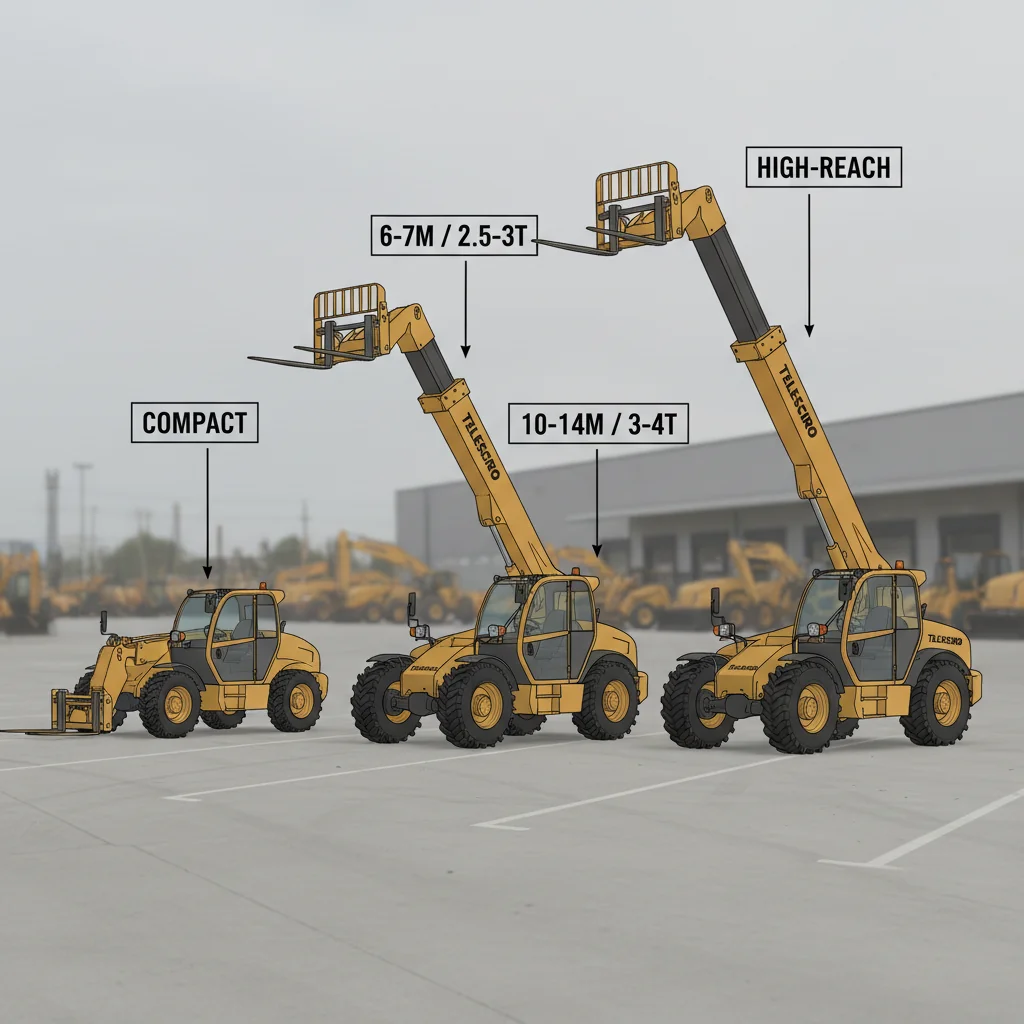
Most people don’t realize rental fleets choose sizes from hard data, not guesswork. They track which heights and capacities go out every week, then stock machines that cover roughly 70–80% of local jobs. That usually means a “ladder” of standard models: compact 6–7 m / 2.5–3 t units, mid-range 10–14 m / 3–4 t, and a smaller group of 17–20 m high‑reach machines. Anything outside those bands is often special-order or from another branch, which takes time.
From my experience supporting fleets in Brazil and Kenya, the 6–7 m class works best on tight housing projects and warehouses. One client in São Paulo ran 3 t, 7 m units for block and rebar on cramped streets; the short wheelbase and under-4 m turning radius mattered more than extra height. The 10–14 m / 3–4 t machines then handle most mixed construction—steel, precast, roofing—because they balance reach, capacity, and transport weight. Rental managers prefer these mid-spec models because they share engines, filters, tires, and even attachment interfaces, so one parts shelf supports dozens of units.
High‑reach 17–20 m telehandlers sit in every serious fleet, but in lower quantity. I’ve seen them mainly on multi‑story jobs in Dubai and industrial plants where pallets need to reach 5–6 floors or clear pipe racks. Here, rental fleets often choose versions with stabilizers and stronger boom sections, because the load chart at full outreach is what decides safety, not just the headline “20 m”. If you tell the rental desk your required height, forward reach, and real load at that point, you usually get the right size on the first delivery.
"RentalFalse
"Many
Rental companies prioritize stocking the highest-reach telehandlers (over 20 meters) in every branch since these units cover most customer needs.False
High-reach telehandlers (over 20 meters) are specialized and less frequently required, so rental fleets typically keep only a few at regional hubs or special-order them as needed. Most jobs use compact or mid-range models, which are stocked in higher volumes.
Key takeaway: Rental companies strategically standardize telehandler fleet sizes to cover most jobsite needs, improving parts availability, maintenance efficiency, and resale value. Contractors benefit from understanding these ranges, allowing precise equipment selection and reducing last-minute changes or performance shortfalls.
How Are Rental Telehandlers Used Onsite?
Rental telehandlers are deployed for multiple onsite roles within short timeframes, often shifting between unloading trucks with pallet forks, feeding construction crews, lifting materials with jibs, and handling site logistics. Versatile capacities (3–4 t) and boom heights (10–17 m), paired with approved attachments such as forks, jibs, platforms, and buckets, are prioritized for maximum adaptability across varying jobsite requirements.

Here’s what matters most when you see a rental telehandler arrive on site: it rarely does just one job. In a single week it might start the morning unloading trucks with pallet forks, then spend the afternoon feeding bricklayers at 10–12 m. From my experience, rental fleets hate seeing a machine sitting still, so they choose mid-range units—around 3–4 t rated capacity and 10–17 m boom height—that can cover as many roles as possible. One unit can easily rotate between three crews on the same project.
Common onsite roles for a 3–4 t, 14 m rental machine include:
- Truck unloading with forks5 – pallets of block, drywall, steel up to around 3,000 kg
- Crew feeding at height – bricks, rebar, tools to upper floors at 8–14 m
- Light crane-style lifts with jib – roofing sheets, small steel beams, suspended loads
- Bulk loading with bucket – sand, gravel, demolition waste into bins or trucks
- Site logistics/shutdown support – moving generators, formwork, scaffolding across the jobsite
Last year I supported a contractor in Dubai using one telehandler across a warehouse build and an industrial shutdown. First it ran pallet forks and a jib, lifting HVAC units to about 11 m; two weeks later the same machine worked nights with a platform attachment for light maintenance. The key was planning tasks against the load chart and confirming which attachments were approved for that exact model. I always suggest you check rated capacity at your real working height and whether stabilizers are required, so the telehandler stays productive and safe in every role.
Rental telehandlers often feature adjustable boom speed controls, allowing operators to tailor the extension and retraction rates for tasks like delicate glazing installation versus rapid bulk handling.True
Many mid-range telehandlers in rental fleets come equipped with adjustable boom speed functions, enabling greater operator precision for sensitive tasks and efficiency for loading operations, maximizing versatility on multi-role jobsites.
Rental companies typically avoid mid-range telehandlers with stabilizers, since stabilizer use is uncommon on construction sites.False
In reality, stabilizers are frequently included on mid-range telehandlers to increase lifting capacity and stability when extending the boom, especially important for rental units expected to handle varied, demanding site tasks.
Key takeaway: Rental telehandlers are chosen for their versatility and ability to switch quickly between roles such as material handling, lifting, and bulk loading. Fleet managers select mid-range models with multiple attachments to meet the diverse demands of construction, industrial shutdowns, and logistics, maximizing machine utilization while ensuring all site tasks are safely supported.
How Do Rental Firms Maintain Telehandlers?
Large rental companies manage telehandlers as long-term assets, cycling units based on age and operating hours to ensure reliability. Each machine undergoes a standardized turnaround process: cleaning, hour logging, fluid checks, greasing, tire and boom inspections, and defect repairs. Telematics schedules 500-hourly major services to minimize downtime, resulting in newer, well-maintained machines for renters.

Let me share something important about how serious rental firms keep telehandlers reliable. They treat each unit as a long‑life asset, tracked by age, hours, and expected resale value. Many fleets rotate frontline telehandlers out after around 5–7 years or roughly 4,000–6,000 hours, while lighter‑used machines stay longer. Telematics reports hours in real time, so they can plan 250‑hour inspections and 500‑hour major services without waiting for a breakdown.
Between rentals, every machine follows a strict turnaround routine. The yard team cleans the unit, logs hours, checks engine and hydraulic oil, coolant, and fuel filters, then greases all pins and boom sections. They inspect tires, forks, and the boom structure for cracks or play, and they test the load moment indicator6—the system that warns if you exceed the safe capacity from the load chart. If an operator reported issues with steering, brakes, or the hydraulic circuit, those go straight to the workshop before the next contract.
Last year in Dubai, I supported a rental company running about twenty 4‑ton, 17‑meter units on tower crane erection. Their telematics showed one telehandler was nearing its 500‑hour service during a three‑month rental, so they scheduled on‑site maintenance on a Friday night. The contractor lost less than half a shift instead of two days. When you rent, I suggest asking for the latest inspection sheet, the telematics hour reading, and the next due service. If you’re buying ex‑rental, study the service history—repeated boom, axle, or hydraulic cylinder repairs usually signal a very hard previous life.
Many rental firms set proactive telehandler retirement targets based on a combination of engine hours (typically 4,000–6,000) and real-time telematics, rather than relying solely on age or visible wear.True
This strategic tracking allows companies to optimize asset value, minimize downtime, and schedule maintenance or replacements before major failures occur, supporting higher reliability for renters.
Rental companies usually wait until a telehandler experiences major component failure before performing its scheduled 250-hour and 500-hour maintenance services.False
Reputable rental firms depend on proactive, scheduled maintenance—often guided by telematics—not a reactive approach. Waiting for breakdowns would increase repair costs, safety risks, and machine downtime, which undermines rental business models built on reliability.
Key takeaway: Professional rental companies maintain telehandlers through scheduled inspections, rapid turnaround between jobs, and telematics-driven servicing, ensuring reliable, up-to-date machines for customers. Renters and buyers should always request maintenance documentation and verify service records to ensure equipment quality and avoid problems stemming from past heavy use.
How Do Rental Rates Reflect Utilization Targets?
Rental telehandler pricing is driven by utilization goals—typically aiming for 65–75% machine usage or 800–1,200 hours per year. Rates are lowest per hour on monthly rentals7, often 8–12% of purchase price, incentivizing longer hire periods. Rental companies rebalance fleets and structure add-on charges to maximize revenue and equipment availability.

The biggest mistake I see is contractors judging rentals only by the daily rate. Rental companies build every telehandler rate around utilization targets—usually 65–75% of the calendar and roughly 800–1,200 hours per year. To hit that, they push you toward longer hires: a day might be 1–1.5% of purchase price, while a month sits closer to 8–12%. So the “expensive” daily rate is really pressure to keep the machine working, not parked.
Last year in Brazil, a precast contractor needed a 3-ton, 13-meter unit for housing blocks. They first planned three separate two‑week rentals, with gaps while other trades caught up. I ran the math with them: short bursts at the higher daily rate cost almost as much as a continuous three‑month deal at a discounted monthly rate. They bundled lifts, re‑sequenced material deliveries, and ended up saving enough to cover transport and fuel.
From my experience, smart planning beats hard bargaining. A contractor in Dubai negotiated a good six‑month rate on a 4‑ton, 17‑meter telehandler, but ignored add‑ons. Extra-hour charges above 160 hours per month, plus cleaning, damage waiver, and fork extension fees, added the equivalent of another half‑month of rent. I always suggest asking for a written breakdown of what happens if you exceed the “included” hours.
Behind the scenes, rental fleets watch hour meters and telematics to rebalance machines between branches. If a 4‑ton high‑reach unit stays near 90% utilization, they raise its rate or buy more units. Your best move is to schedule work so that telehandler hours are productive, agree a realistic monthly hour cap, and lock in attachment pricing before the machine even hits your site.
Rental companies often design telehandler rate structures to ensure their fleet averages at least 800 rental hours per machine annually, aligning with industry norms for profitable utilization.True
This annual hour target is critical for rental companies to recover costs and achieve target returns on investment. By structuring rates that reward longer-term rentals, they encourage users to keep machines productive, not idle, supporting this utilization goal.
The daily rental rate for a telehandler is always proportional to the monthly rate, so renting for 30 days costs the same as a one-month rate.False
In reality, daily rates are intentionally set higher (per day) than monthly rates to incentivize longer rentals. Typically, the daily rate multiplied by 30 will significantly exceed the monthly rate, reflecting the rental company's push for higher utilization and reduced transaction frequency.
Key takeaway: Telehandler rental economics center on utilization rates and strategic pricing to ensure timely payback. Bundling usage, negotiating terms for longer projects, and monitoring additional fees are essential for controlling costs and optimizing ROI, both for rental companies and equipment users.
How Does Telematics Improve Telehandler Rentals?
Telematics-equipped telehandlers enable rental companies to monitor location, engine hours, fuel usage, fault codes, and overloads in real time. This data supports precise billing, timely preventive maintenance, and detection of misuse. Telematics also reduces equipment loss risk, streamlines asset logistics, and provides contractors with transparent data for managing utilization and supporting safety compliance.
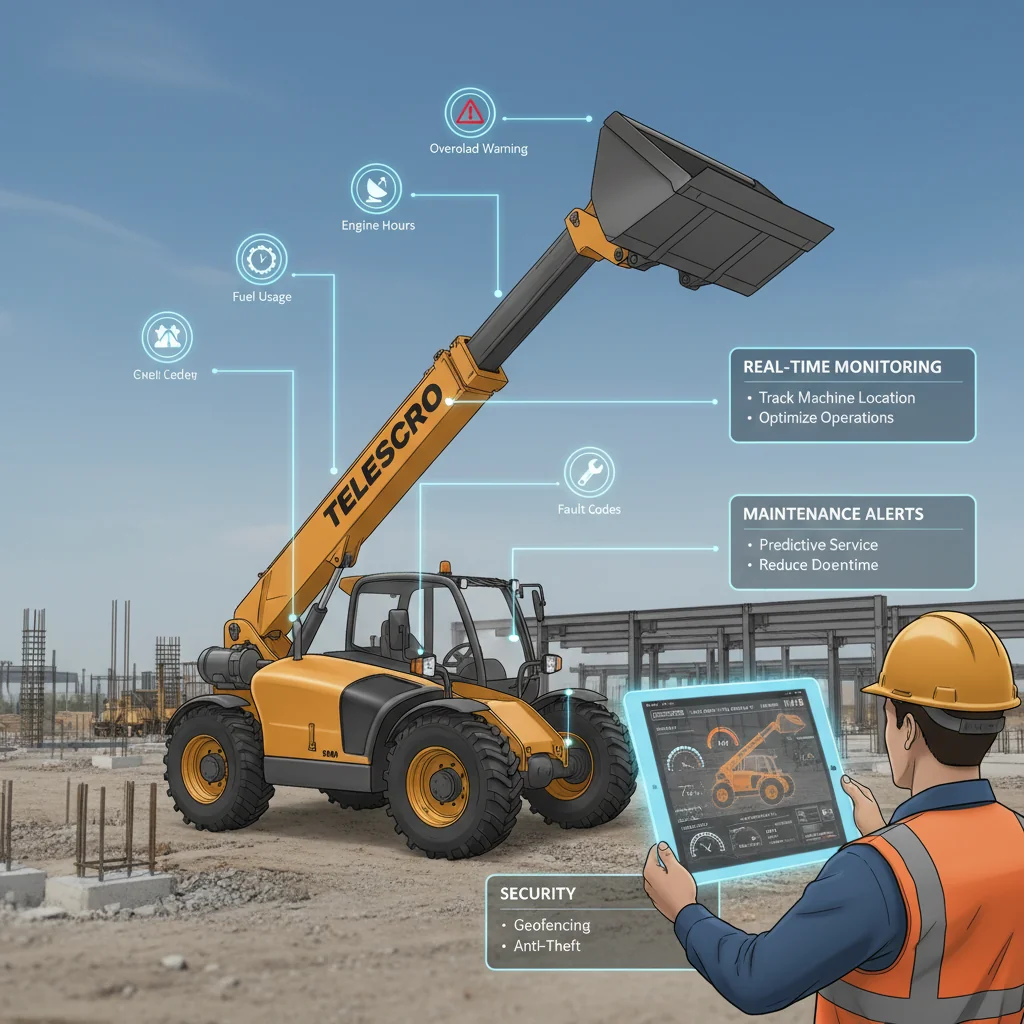
Most rental customers don’t realize how much telematics cleans up billing. A telematics unit tracks engine hours, not just calendar days, so you pay for 42 running hours instead of a flat “one week” guess. Fuel burn data—say 8–10 liters per hour on a 4‑ton, 17‑meter telehandler—also shows if the operator idles all day. That pushes operators to shut down the engine instead of wasting diesel.
Last year, a contractor in Dubai rented six telehandlers spread across three towers. The rental company used GPS location data to see two machines sitting idle for three days while another ran close to 10 hours daily. They swapped units overnight and cut extra rental days on one machine, while avoiding overload on the overworked unit. That simple reallocation saved them at least one full week of rental cost.
From my experience, maintenance is where telematics quietly saves big money. The system flags fault codes from the engine or hydraulic circuit early, so the rental fleet can fix a weak pump or overheating issue before it becomes “The second-year surprise” repair. I saw this with a precast yard in Brazil—telematics showed high hydraulic oil temperature on one unit, and the rental team flushed the circuit and changed a blocked cooler before the boom cylinder seals failed.
Telematics also records overload events from the moment indicator, so repeated abuse doesn’t stay hidden. I always suggest asking your rental partner for access to basic reports: hours, overloads, and service status. With that data, you can coach operators, prove safe usage, and avoid arguments when something goes wrong.
"RentalFalse
"Advanced
Rental companies disable telematics features on telehandlers to protect proprietary equipment settings from customers, leading to less efficient maintenance schedules.False
In reality, rental companies leverage telematics to optimize maintenance and fleet performance, not restrict customers. Disabling telematics would hinder preventative maintenance and asset tracking, increasing downtime and costs.
Key takeaway: Telematics enhances rental telehandler management by boosting transparency, enabling proactive maintenance, and reducing misuse. Contractors benefit from real-time data for operational oversight, while rental companies gain tighter control over their fleet—resulting in improved equipment uptime, fewer disputes, and optimized asset allocation across job sites and branches.
What Safety Issues Concern Telehandler Rentals Most?
Rental companies frequently report telehandler safety concerns such as overloaded machines9, especially with long or suspended loads at maximum outreach. Common misuse includes bent or damaged forks, boom impacts, and tire sidewall cuts. Another significant issue is customers renting undersized units, leading to improper operation or equipment swaps. Pre-rental inspections, accurate load charts10, and operator training are essential protocols.

Last month, a contractor in Dubai rented a 7‑meter, 2.5‑ton telehandler for villa work. On site, the job changed, and they tried to place 6‑meter steel beams at around 13 meters outreach using a suspended chain. The load moment indicator kept tripping because, on the load chart, that position was only good for roughly 700–900 kg. From my experience, overloaded machines with long or swinging loads at full reach are the number one thing that keeps rental managers awake at night.
The next big worry is physical damage from misuse. I saw a project in Brazil where the forks were bent because the operator used them like a bulldozer blade to push debris; later, they struggled to pick standard pallets safely. Boom sections get hit on scaffolds or columns when people rush and drive with the boom too low or extended. Tire sidewall cuts are another classic—running along curbs or over rebar slices the sidewall, and rentals will usually treat that as customer damage, not a defect.
To be honest, the best protection for both sides is process, not luck. Professional rental depots do pre‑rental inspections, check decals and load charts, and often ask operators to sign responsibility statements. I always suggest you match the machine to your real working point—if you need to place 1,500 kg at 15 meters, say that clearly, don’t just ask for “a 14‑meter telehandler.” On site, keep the manual and load chart in the cab, and record daily checks on fluids, tires, forks, and safety systems. Those records, plus telematics, can save you in any damage or liability dispute.
Overriding a telehandler’s load moment indicator with a bypass key increases the risk of tip-over incidents by up to 60% according to recent rental fleet safety data.True
Bypassing safety systems like the load moment indicator negates engineered safeguards, drastically raising the likelihood of accidents, especially during high-reach lifting with variable loads.
Telehandlers rented for urban villa construction are typically equipped with automatic boom angle limiters to prevent overreaching, as required by international rental standards.False
Automatic boom angle limiters are not standard on most rental telehandlers and there is no international requirement mandating their use; most machines rely on load charts and load moment indicators for safe operation.
Key takeaway: The most common safety and misuse problems for telehandler rentals involve load management, equipment selection, and operator error. Clear communication about reach requirements, consistent equipment checks, and thorough operator training are crucial for reducing accidents, damage, and disputes over equipment misuse.
How Do OEM Partnerships Shape Telehandler Fleets?
OEM partnerships directly influence which telehandler brands and models dominate rental fleets in specific regions. Rental companies favor ‘rental-ready’ machines—simple, reliable, and standardized for easy maintenance. As a result, equipment availability, attachment compatibility11, and service support in local markets are strongly determined by ongoing agreements between telehandler manufacturers and large rental providers.

Here’s what matters most when you look at OEM partnerships and rental fleets: they decide what actually stands in your yard. Large rental groups sign multi‑year supply deals, so one region might be full of 3.5–4 ton, 14–18 meter units from a single OEM. Those machines are often a “rental-ready” line—simpler electrics, shared booms and axles, common filters, and easy-access hydraulic circuits. The goal is simple: keep downtime low and make it possible for one mechanic to service dozens of similar units quickly.
I see this pattern clearly with a client in Brazil who runs around 120 telehandlers. Their OEM partner pushed a standard 4 ton, 17 meter model across all branches, plus a compact 2.5 ton, 7 meter unit for urban work. On site, that meant every fork, jib, and bucket attachment could move between machines without adapter headaches. When one unit went down, they swapped in a backup with the same load chart and control layout, so operators needed almost no retraining.
From my experience, contractors often forget that these partnerships shape what support you get for the next 10 years. I always ask buyers in places like Kenya or Kazakhstan to walk their local rental yard first. If you see twenty units of the same 3 ton, 12 meter model, that usually means better parts stock, more technicians who know that machine, and stronger resale later. For startup rental businesses, aligning early with one supportive OEM and standardizing models will cut training time and parts costs significantly.
OEM partnerships often result in fleets with standardized quick coupler interfaces, enabling cross-compatibility of attachments within the same rental yard.True
Rental companies favor OEM deals that guarantee attachment compatibility and parts interchangeability across a range of models. This streamlines logistics, training, and inventory management while increasing fleet flexibility.
Telehandler fleets shaped by OEM partnerships usually contain a wide mix of brands in order to cater to every operator’s preference.False
Rental companies prioritize uniformity to simplify maintenance, parts stocking, and technician training. OEM supply agreements typically lead to single-brand dominance within a fleet or region rather than a diverse mix.
Key takeaway: OEM and rental company partnerships drive which telehandlers are available for rent. Standardized, durable models are chosen for fleet efficiency and lowered maintenance, which affects what contractors can access. Evaluating local rental yard offerings helps buyers align with the best-supported, most serviceable equipment choices.
What Drives Rental Telehandler Selection Today?
Rental telehandler choices now depend on specialized project needs. Renewable energy, logistics, and industrial applications require mid-size rough-terrain or rotating models for precise material handling. Emission rules and sustainability targets lead to growing demand for electric and hybrid telehandlers12, especially for noise-sensitive or indoor sites. Usage environment, ground conditions, and operator expertise directly shape equipment recommendations.
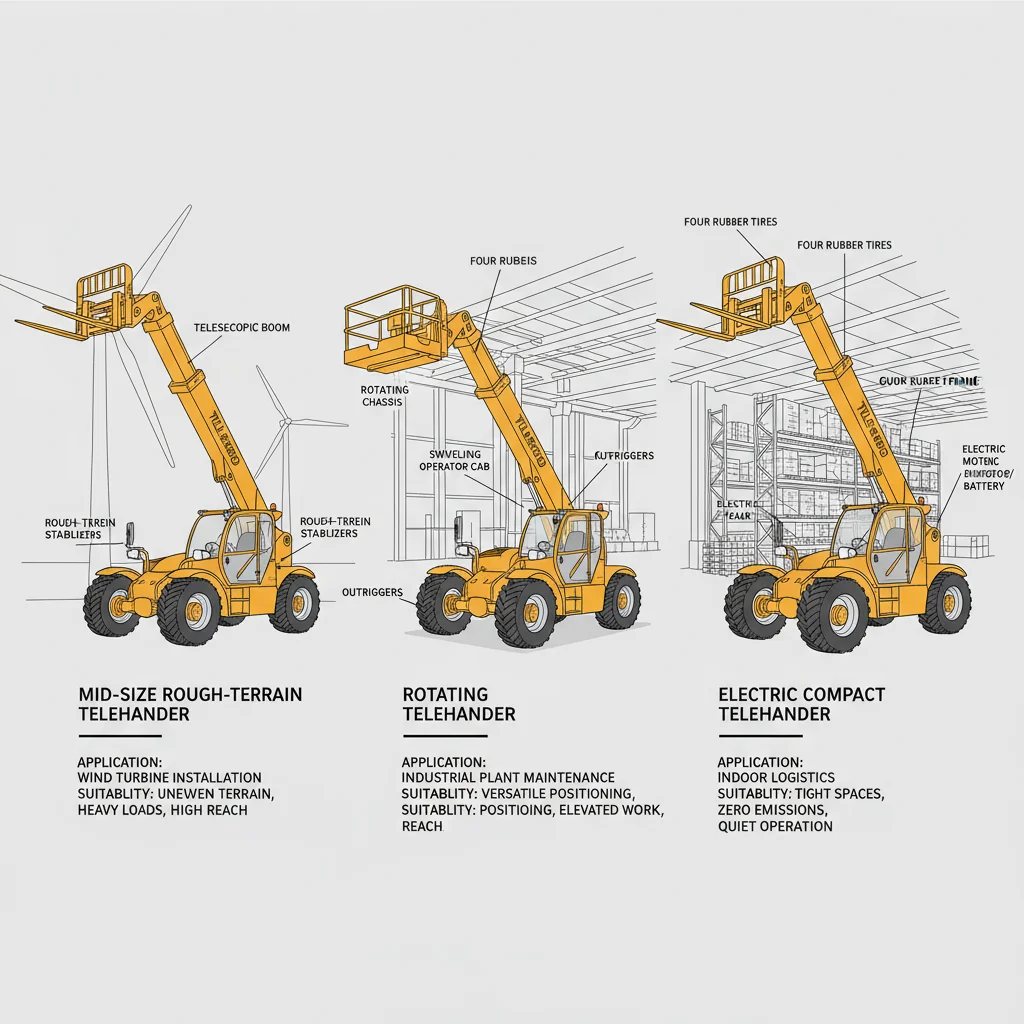
Let me share something important about what’s shaping rental choices right now. It isn’t just about lifting higher or loading more—industry needs are getting specialized. I’ve supported wind farm projects in Inner Mongolia that specifically request mid-size rough-terrain telehandlers with stabilizers. They often need about 3.5-ton capacity, a working height close to 14 meters, and true off-road mobility. On these sites, ground conditions shift fast. That’s why customers there always ask about hydraulic locking differentials and whether the boom can maintain stable extension even on uneven soil.
Renewable energy builds aren’t alone. I often get calls from warehouse clients in Dubai who want telehandlers for narrow aisles and indoor loading. Noise and emissions are big concerns. So, requests for electric-drive models are rising. One client needed a 2.5-ton unit with a turning radius under 4 meters. Their jobsite allowed only 85 decibel noise at peak times. Electric and hybrid telehandlers fit these needs without the fumes or vibration of diesel engines.
The reality is, operator skill also decides what’s reliable. In Kazakhstan, I saw a team switch from standard boom types to rotating telehandlers. Why? They needed to place loads with millimeter accuracy over high machinery. Rotating models, with rated lifts near 3,000 kg and intuitive moment indicators, reduced risk and sped up their day by at least two hours. My advice—always match the model to both your project and your crew’s training. Don’t pick based on specs alone. It saves trouble—and money—in the field.
"RentalFalse
"Quick-attach
Rental companies rarely use telehandlers for material lifting, preferring to rely exclusively on cranes for any overhead work due to stricter safety standards.False
Telehandlers are specifically designed for versatile material handling, including overhead lifting with forks or jibs, and are frequently chosen over cranes for lighter, shorter-duration lifts because of their maneuverability and lower cost. Rental companies prioritize telehandlers for these tasks as they comply with relevant safety standards when properly operated.
Key takeaway: Rental companies increasingly select telehandlers based on specialized requirements, including renewable energy, logistics, and emission compliance. Choosing between diesel, electric, hybrid, or rotating models depends on site conditions and regulatory needs. Clear communication of project details ensures the best rental match, improving productivity while managing costs and sustainability goals.
How Do Rental Fleets Influence Telehandler Choices?
Rental fleet purchase patterns14 are key indicators for telehandler reliability, maintainability, and regional suitability. High-utilization models common across multiple rental yards often represent optimal performance and parts support. Analyzing fleet utilization and failure data from rental operators provides more accurate insight for buy versus rent decisions than manufacturer brochures or sales materials.

Most people don’t realize how much rental fleets quietly steer telehandler decisions. Rental companies watch uptime, repair cost, and resale value harder than anyone. When you see the same 3‑ton to 4‑ton, 14–18 meter machines repeated across three or four local rental yards, that usually signals strong reliability and easy parts support. Those models often run more than 1,500 hours per year with very low unplanned downtime, so they survive real abuse.
From my experience working with rental fleets in Brazil and Kenya, their spreadsheets tell a clearer story than any brochure. One rental manager in São Paulo showed me data on a 4‑ton, 17‑meter unit: average utilization above 80%, but hydraulic pump failures after about 2,000 hours. They still kept buying that model, but only with stronger service contracts and extra pump kits in stock. That pattern warned a contractor there to budget for mid‑life hydraulic work instead of getting hit by a surprise shutdown.
So how should you use this as a buyer or long‑term renter? I always suggest walking a few rental yards, noting which capacities and boom lengths dominate, and asking which units spend the least time in the workshop. Ask very direct questions: how often they replace boom wear pads, what engines struggle with dirty fuel, which models suffer sensor or moment indicator faults. If the rental operators hesitate or joke about “problem children,” take that seriously. Let their utilization and failure data guide your shortlist before you sign a purchase order or long lease.
"RentalFalse
"Standardized
Rental companies exclusively purchase the highest-capacity telehandlers available to meet all customer needs.False
Rental fleets typically maintain a diverse range of telehandler capacities (from 5,000 to 12,000 lbs or more) to match varied customer applications, not just the highest-capacity models, optimizing utilization and investment.
Key takeaway: Observing which telehandler models are favored and heavily used by local rental fleets provides accurate signals on which units offer the best performance, support, and value. For buyers or new rental companies, aligning with proven rental fleet trends reduces risk versus choosing less common or unproven models.
Conclusion
We’ve looked at how rental companies use telehandlers and why renting often makes more sense than owning, especially in competitive markets. From what I’ve seen on jobsites, it’s easy to focus on fleet size or brand, but the contractors who succeed always check the load chart for their real tasks, then ask about local support. Parts roulette can be a real headache if you’re not prepared. If you’re unsure which telehandler or rental strategy fits your jobsite, I’m happy to share lessons I’ve learned from customers in 20 countries—just reach out, no pressure. Every site and project is unique, so choose what actually supports your workflow best.
References
-
Explore versatile applications of rental telehandlers, detailing capacities and attachments that maximize jobsite adaptability and efficiency. ↩
-
Learn why modern Tier 4 and electric telehandlers offer rental firms lower emissions, compliance ease, and reduced upfront costs. ↩
-
Explore how adjustable boom stops enhance telehandler versatility and safety compliance in low-clearance and diverse jobsite environments. ↩
-
Explore how telematics enables real-time monitoring and scheduled maintenance, reducing downtime and extending telehandler lifespan. ↩
-
Understand how telehandlers use forks to safely unload heavy pallets onsite with practical load capacities and operational tips. ↩
-
Detailed insights on how load moment indicators enhance safety by preventing capacity overloads on telehandlers during operation. ↩
-
Learn why longer monthly hires offer lower hourly costs, incentivize continuous use, and help contractors save on telehandler rentals. ↩
-
Learn how rental companies use telematics data to create tiered rental rates based on actual telehandler utilization. ↩
-
Detailed insights into risks of overloading telehandlers with long or suspended loads and how it impacts rental safety management. ↩
-
Explains the crucial role of load charts in preventing accidents by guiding safe load limits and outreach in telehandler use. ↩
-
Understand why attachment compatibility is critical for fleet efficiency and operator flexibility across different sites. ↩
-
Details the growing demand for electric and hybrid telehandlers driven by emissions rules and noise-sensitive site needs, highlighting sustainability benefits. ↩
-
Explains how quick-attach couplers enable rapid attachment changes, boosting telehandler versatility and utilization across job sites. ↩
-
Explore how rental fleet buying trends reveal telehandler reliability, maintainability, and help inform better buy vs rent decisions with real-world data. ↩
-
Understand how standardized quick-attach systems reduce downtime and increase attachment compatibility, enhancing telehandler versatility in rental fleets. ↩