









Capacité nominale et capacité réelle des chariots télescopiques : ce que la plupart des acheteurs négligent
D'après mon expérience auprès de clients dans plus de 20 pays, la plus grande erreur que je vois commettre les acheteurs est de se fier aveuglément à la “ capacité nominale ” indiquée dans la brochure d'un chariot télescopique. Je ne compte plus le nombre de fois où quelqu'un pensait que sa machine pouvait soulever en toute sécurité 3 000 kg, quelles que soient la hauteur, la portée ou l'accessoire.
Cet article explique la différence entre la capacité nominale (les chiffres indiqués dans les catalogues) et la capacité de levage réelle sur les chantiers.
Je vais vous expliquer comment. diagrammes de charge1 fonctionnent vraiment, ce qui se passe lorsque vous changez d'accessoires et pourquoi les chiffres baissent rapidement lorsque vous allongez la flèche ou travaillez sur un sol irrégulier.
En quoi la capacité nominale diffère-t-elle de la capacité réelle ?
La capacité nominale est la charge maximale de sécurité2 dans des conditions d'essai idéales : flèche rétractée, sol stable, fourches standard et charges compactes. La capacité réelle en conditions réelles d'utilisation est souvent bien inférieure, en raison de l'extension de la flèche, du niveau du sol, des accessoires ou des charges difficiles à manipuler, qui réduisent considérablement les limites de levage en toute sécurité.

La plupart des gens ne réalisent pas à quel point l'écart entre la capacité nominale et la capacité réelle d'un chariot télescopique peut être important. Sur le papier, un engin de 4 tonnes peut sembler être la solution idéale pour presque tous les travaux. Mais dès que vous déployez la flèche ou que vous remplacez les fourches standard par un godet à matériaux, la limite de levage réelle diminue rapidement. J'ai vu des équipes à Dubaï lutter pour déplacer des palettes de 2 000 kg à pleine portée, pour finalement découvrir que la charge maximale en toute sécurité était en réalité inférieure à 1 000 kg dans cette position. tableau de charge3 l'a clairement indiqué. En réalité, les brochures mettent généralement en avant les performances avec le bras rétracté et la machine posée sur une surface parfaitement plane, des conditions que l'on rencontre rarement sur un chantier réel.
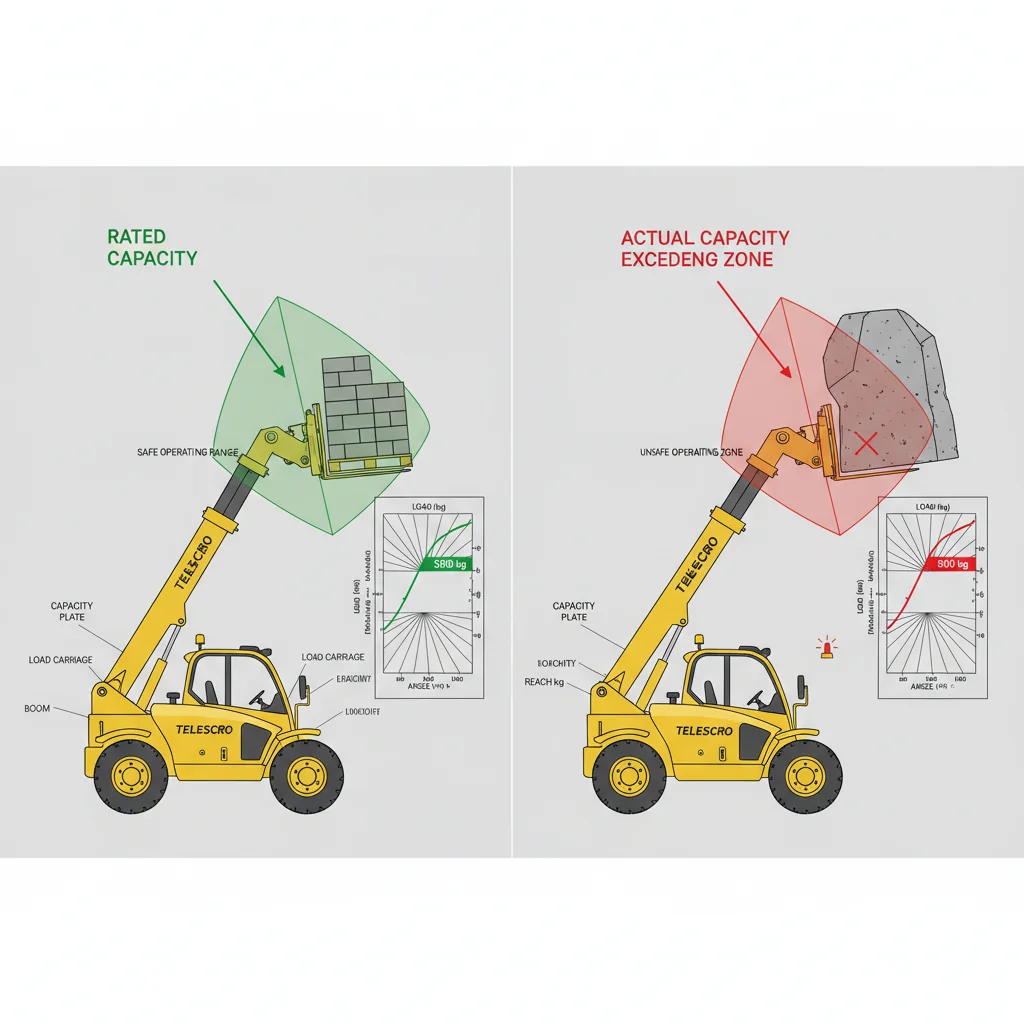
Voici ce qui importe le plus : chaque modification que vous apportez a une incidence sur les limites de levage en toute sécurité. Travailler sur un terrain en pente, utiliser un chariot rotatif ou à déplacement latéral, voire ramasser des matériaux en vrac : chaque facteur réduit la charge maximale. Au Brésil, un client m'a appelé après qu'une flotte de location lui ait livré un modèle compact de 3,5 tonnes. Il prévoyait de soulever des briques jusqu'au quatrième étage, à environ 12 mètres de hauteur, mais ne pouvait pas soulever plus de 800 kg en toute sécurité à cette hauteur. L'opérateur n'avait pas consulté le tableau de charge affiché dans la cabine, qui indique la charge de travail sécuritaire pour chaque extension et angle. C'est un exemple classique de “ héros en salle d'exposition, zéro sur le chantier ” : tout semble parfait dans le catalogue, mais les chiffres réels proviennent de scénarios concrets.
Si je peux vous donner un conseil, c'est celui-ci : ne vous fiez pas uniquement aux chiffres indiqués dans les titres. Consultez toujours le tableau de charge et tenez compte des conditions réelles de votre site avant de planifier des levages lourds.
La capacité nominale d'un chariot télescopique est toujours spécifiée avec la flèche complètement rétractée et sans autre accessoire que les fourches standard.Vrai
Les capacités nominales sont généralement basées sur la configuration de la machine avec la flèche complètement rétractée et des fourches standard afin d'établir une base de référence ; toute extension de la flèche ou tout changement d'accessoire modifie la dynamique de charge, réduisant considérablement les charges réelles sécuritaires.
La capacité nominale d'un chariot télescopique reste constante quel que soit l'angle de la flèche, car le système hydraulique compense automatiquement.Faux
La capacité nominale varie en fonction de l'angle et de la portée de la flèche en raison des effets de levier et de la stabilité de la machine ; le système hydraulique facilite le fonctionnement de la machine, mais ne peut modifier les limites mécaniques et de stabilité définies dans le tableau de charge.
Point clé à retenir: Les chiffres de capacité nominale indiqués dans les brochures sur les chariots télescopiques reflètent des scénarios de test idéaux, et non une utilisation réelle. Les opérateurs doivent évaluer la capacité réelle lors de tâches spécifiques, en tenant compte de la position de la flèche, des conditions du sol, des accessoires et du type de charge afin de garantir la sécurité des opérations et de respecter les limites mécaniques réelles.
Comment les tableaux de charge des chariots télescopiques expriment-ils la capacité ?
Les tableaux de charge des chariots télescopiques indiquent la capacité de levage réelle sous forme de grille, en fonction de la longueur, de la hauteur et de l'angle de la flèche. Une capacité nominale de 4 000 kg peut tomber à 2 500 kg à mi-portée et à 1 200 kg à extension maximale. Les opérateurs doivent consulter ces tableaux avant d'effectuer des levages difficiles.
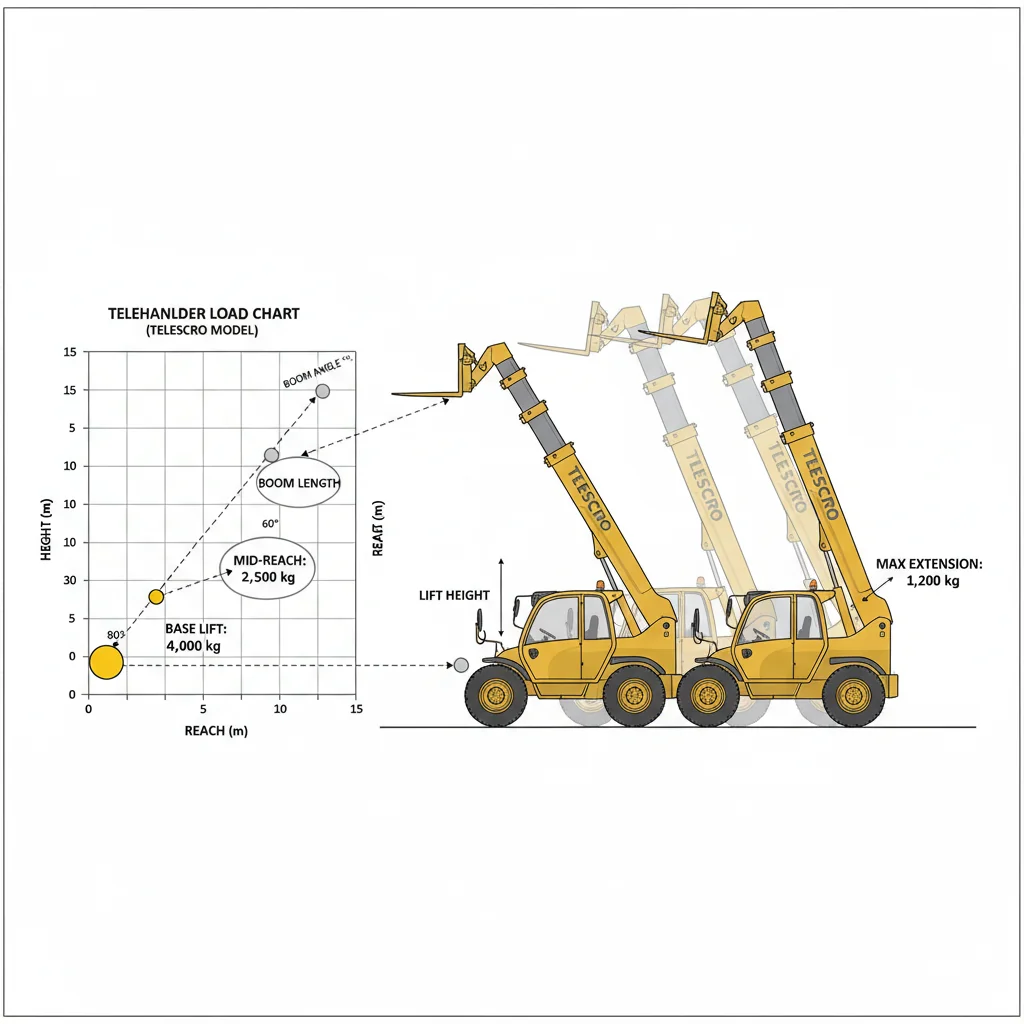
Permettez-moi de vous faire part d'une information importante concernant les tableaux de charge des chariots télescopiques : il ne s'agit pas seulement de soulever une charge lourde au niveau du sol. Le véritable test intervient lorsque vous devez atteindre une hauteur plus élevée ou allonger davantage la flèche. L'année dernière, un entrepreneur du Kazakhstan m'a appelé après avoir découvert que son nouveau chariot télescopique d'une capacité nominale de 4 000 kg pouvait à peine soulever 1 200 kg à pleine extension. Il s'était fié au chiffre annoncé, sans se rendre compte à quel point la capacité diminue rapidement à mesure que la portée augmente.
Les tableaux de charge illustrent cela à l'aide d'une grille : l'angle de la flèche d'un côté, la portée ou la hauteur de l'autre. Chaque case indique la charge maximale sécuritaire pour cette position. Par exemple, avec un chariot télescopique d'une portée de 12 mètres, vous pouvez voir une capacité de 4 000 kg à l'extension minimale, 2 700 kg à mi-portée et un peu plus de 1 100 kg à la portée maximale. La différence est considérable, et cruciale si vous prévoyez des levages en hauteur ou à grande distance. À Dubaï, j'ai vu un projet rencontrer des difficultés lors de l'empilage de blocs de 10 mètres de haut. L'opérateur pensait que le levage serait sûr, mais le tableau de charge indiquait une forte baisse de la capacité maximale au-delà de 8 mètres.
Les fabricants testent ces limites sur un sol plat et avec des fourches ou des accessoires standard. Les conditions réelles ne sont pas toujours aussi parfaites. Si vous soulevez des charges sur du béton rugueux ou utilisez un accessoire différent, la capacité réelle peut être encore plus faible. Je conseille toujours à mes clients de se concentrer sur les plages indiquées dans le tableau qui correspondent à leurs travaux habituels, qu'il s'agisse de levages fréquents à mi-hauteur ou de tâches ponctuelles à hauteur maximale. Comparez les tableaux entre les modèles, et pas seulement les spécifications en gras. C'est ainsi que vous trouverez la machine adaptée à votre travail réel.
Les tableaux de charge des chariots télescopiques indiquent généralement une diminution de la capacité nominale pouvant atteindre 70% à l'extension maximale de la flèche par rapport à la capacité nominale au niveau du sol.Vrai
Étant donné que le télescopage de la flèche augmente l'effet de levier et réduit la stabilité, les tableaux de charge indiquent une baisse significative (souvent d'environ 70% ou plus) par rapport à la capacité nominale maximale lorsque la flèche est complètement déployée, afin de garantir un fonctionnement sûr.
" LeFaux
" Noté
Point clé à retenir: La capacité nominale n'est qu'un point de départ. Les acheteurs et les opérateurs doivent analyser les tableaux de charge pour connaître les capacités de sécurité à des hauteurs et des portées spécifiques de la flèche, en tenant compte des conditions réelles d'utilisation et non seulement des conditions de laboratoire. Comparez toujours les tableaux entre les différents modèles afin de choisir l'équipement qui correspond aux exigences réelles du travail.
Pourquoi la capacité nominale des chariots télescopiques est-elle trompeuse ?
La capacité nominale désigne la charge maximale qu'un chariot télescopique peut soulever en toute sécurité, mais uniquement à des angles de flèche et des positions rétractées spécifiques. À portée maximale, la capacité réelle en toute sécurité peut diminuer considérablement, parfois jusqu'à un tiers ou moins, ce qui rend dangereux de supposer que les limites nominales s'appliquent partout.
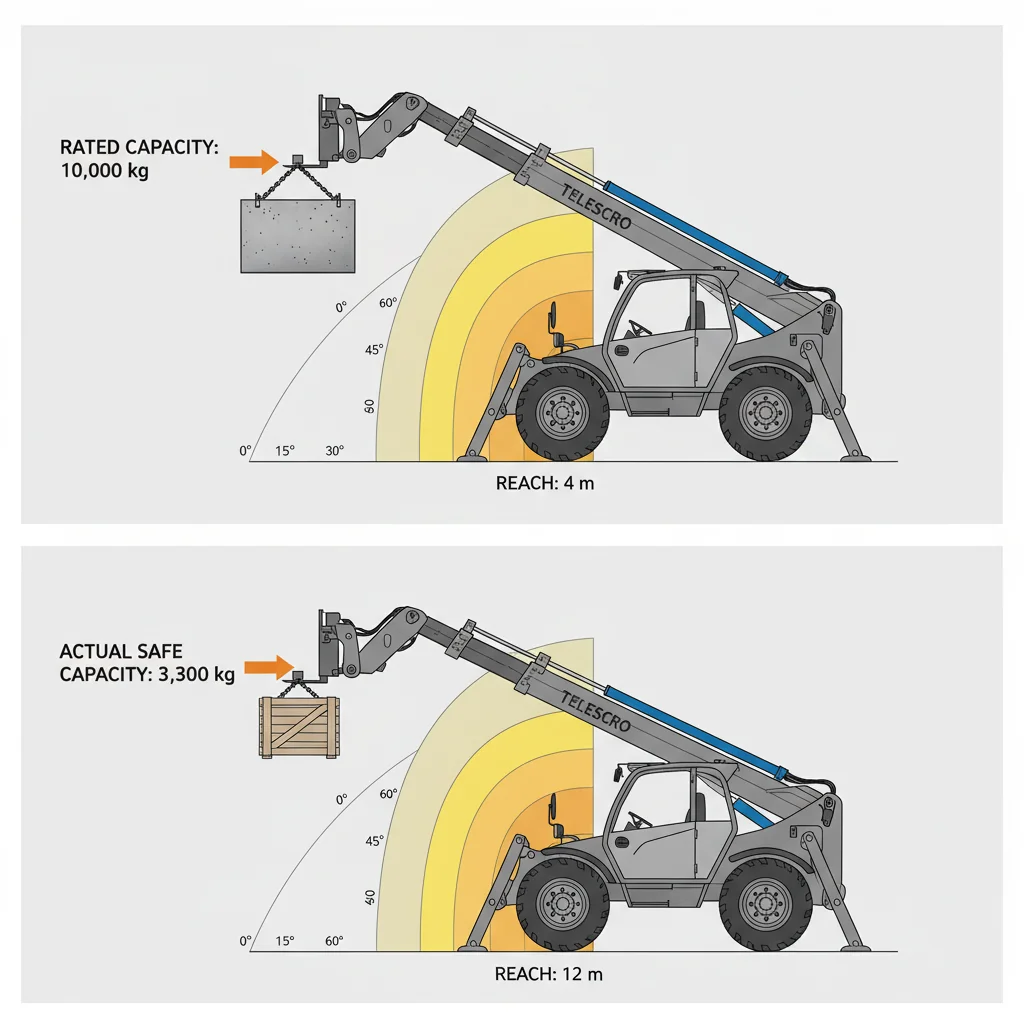
La plus grande erreur que je constate est de supposer que la capacité nominale indiquée sur la fiche technique d'un chariot télescopique est toujours disponible, quelle que soit la position de la flèche. C'est le meilleur moyen de s'attirer des ennuis. Par exemple, j'ai travaillé avec une équipe à Dubaï qui utilisait un chariot télescopique à grande portée d'une capacité nominale de 4 000 kg. Sur un chantier exigu, ils ont essayé de soulever une palette de blocs de 2 800 kg jusqu'à une dalle au troisième étage, à environ 14 mètres de distance, avec la flèche presque entièrement déployée. La machine a commencé à basculer et l'opérateur a été contraint d'abaisser immédiatement la charge. Lorsque nous avons vérifié ensemble le tableau de charge, la capacité de sécurité à cette portée maximale était en fait légèrement inférieure à 1 200 kg. C'est un problème courant. Beaucoup de gens pensent : “ Si la machine a une capacité nominale de 4 000 kg, je suis en sécurité avec tout ce qui est en dessous. ” Mais le tableau de charge (ce diagramme présent dans chaque cabine indiquant la capacité à chaque portée et hauteur) raconte une toute autre histoire.
D'après mon expérience sur des marchés tels que le Brésil et le Kazakhstan, ce malentendu entraîne non seulement des pertes de chargement, mais aussi de graves risques pour la sécurité. La stabilité d'un chariot télescopique dépend du moment de charge : le poids multiplié par la portée. À mesure que la flèche s'étend, l'effet de levier augmente et les roues arrière peuvent se soulever du sol si vous êtes en surcharge, même si le système hydraulique peut le soulever. Les machines modernes peuvent être équipées d'un indicateur de moment qui vous avertit ou vous arrête avant un renversement, mais j'ai vu des chantiers ignorer ces alarmes simplement pour gagner du temps. Le problème ne vient pas de la technologie, mais du fait de considérer la capacité nominale comme une garantie absolue.
Voici ma suggestion : examinez le tableau de charge pour chaque levage et formez les opérateurs à repérer les limites de sécurité aux positions les plus courantes de la flèche. Cette habitude permet d'éviter des erreurs coûteuses, des temps d'arrêt des équipements et, surtout, d'assurer la sécurité de votre équipe.
La capacité nominale d'un chariot télescopique est déterminée avec la flèche complètement rétractée et à sa hauteur la plus basse, de sorte que la capacité diminue à mesure que la flèche s'étend ou s'élève.Vrai
Les fabricants évaluent les limites de charge des chariots télescopiques en fonction des positions optimales du centre de gravité, généralement avec la flèche rétractée et abaissée. Lorsque la flèche s'étend ou se soulève, l'effet de levier augmente, ce qui réduit la capacité de levage réelle afin de maintenir la stabilité et d'éviter tout basculement.
Faux
" Noté
Point clé à retenir: Considérer la capacité nominale d'un chariot télescopique comme une limite universelle entraîne des risques majeurs pour la sécurité. Consultez toujours le tableau de charge pour connaître la capacité réelle spécifique à chaque position, investissez dans la formation des opérateurs et appliquez des règles claires sur le chantier afin d'éviter les renversements, les dommages matériels ou les sanctions réglementaires.
Comment la capacité nominale et la capacité réelle influencent-elles le choix ?
La capacité nominale reflète les conditions idéales en laboratoire à portée minimale, mais les exigences réelles du travail dépassent souvent cette valeur. Évaluez la hauteur de levage, le poids de la charge et la portée, puis consultez le tableau des charges pour obtenir la capacité utile réelle pour vos tâches. Un dimensionnement adéquat maximise la sécurité et la rentabilité.

Pour être honnête, la spécification qui importe réellement est la capacité de levage réelle du télescopique dans vos positions de travail les plus difficiles, et non pas seulement le chiffre indiqué dans la brochure. La capacité nominale suppose souvent que la flèche est complètement rétractée, que la hauteur de levage est faible et que le sol est parfait. Mais sur les chantiers réels, dans des endroits comme Dubaï ou le nord de la Chine, les conditions correspondent rarement à celles de ces laboratoires. J'ai vu des clients pris au dépourvu lorsque leur machine, d'une capacité nominale de 4 000 kg, ne pouvait soulever qu'environ 1 600 kg à 8 mètres avec la flèche déployée.
Voici une comparaison rapide pour mettre en évidence l'écart :
| Spécification | Brochure (classée) | Monde réel (portée de 8 m) | Avec plate-forme d'une tonne |
|---|---|---|---|
| Capacité maximale | 4 000 kg | ~1 600 kg | ~600 kg |
| Hauteur maximale | 17 m | 8 m | 8 m |
| Centre de charge | 500 mm | 600 mm | 600 mm |
J'ai travaillé avec une entreprise de logistique au Kazakhstan l'année dernière. Leur site devait placer des bobines de câbles lourdes, pesant près de 1 500 kg chacune, sur des rayonnages de huit mètres de haut. Leur plan initial prévoyait l'utilisation d'un chariot télescopique de 2,5 tonnes. Après avoir examiné ensemble le tableau de charge, nous avons constaté que la charge maximale pouvant être soulevée en toute sécurité à cette hauteur était à peine de 1 000 kg. Ils ont opté pour un modèle de 4 tonnes et ont ainsi évité une erreur coûteuse.
La clé ? Déterminez toujours vos charges les plus lourdes et vos portées les plus élevées avant de choisir une machine. Demandez le tableau des charges pour vos tâches critiques. Je vous suggère de passer en revue au moins deux scénarios de travail avec votre fournisseur avant de finaliser les spécifications. Cela vous évitera des achats excessifs coûteux ou des sous-dimensionnements dangereux. C'est pourquoi la capacité réelle l'emporte toujours sur la puissance nominale indiquée dans le catalogue.
Les capacités nominales des chariots télescopiques sont généralement mesurées avec la flèche complètement rétractée et à faible hauteur de levage, ce qui peut entraîner une diminution de la capacité réelle pouvant atteindre 60% lorsque la flèche est déployée à des positions plus élevées.Vrai
Les capacités nominales sont déterminées dans des conditions idéales : flèche rétractée, hauteur de levage minimale et assise stable. L'extension de la flèche modifie le centre de gravité et réduit considérablement la capacité de levage, parfois de plus de moitié, en raison des effets de levier et des limites de stabilité de la machine.
La capacité nominale d'un chariot télescopique correspond toujours à sa capacité de levage réelle sur n'importe quel chantier, car les machines modernes s'adaptent automatiquement à la position du sol et de la flèche.Faux
La capacité nominale correspond à des conditions de laboratoire idéales et ne tient pas compte des variables réelles telles que le terrain accidenté, l'extension de la flèche ou la hauteur de levage. Les machines n'ajustent pas dynamiquement leurs limites structurelles, de sorte que la capacité réelle varie souvent et est généralement inférieure à la capacité nominale dans des conditions difficiles.
Point clé à retenir: Ne vous fiez jamais uniquement aux caractéristiques techniques indiquées dans les catalogues lorsque vous choisissez un chariot télescopique. Analysez vos scénarios de travail, consultez le tableau des charges pour vos levages critiques et adaptez la capacité réelle à vos besoins. Cette approche permet d'éviter les surdimensionnements coûteux et les risques pour la sécurité liés aux sous-dimensionnements.
Comment les accessoires affectent-ils la capacité d'un télescopique ?
Les accessoires tels que les godets ou les nacelles augmentent le poids et modifient le centre de gravité, réduisant ainsi la capacité de levage réelle d'un chariot télescopique de 20 à 40%, voire plus. Les fabricants fournissent des informations spécifiques. tableaux de déclassement6 pour chaque accessoire, ce qui rend indispensable une évaluation précise de la capacité pour garantir la sécurité de l'utilisation.
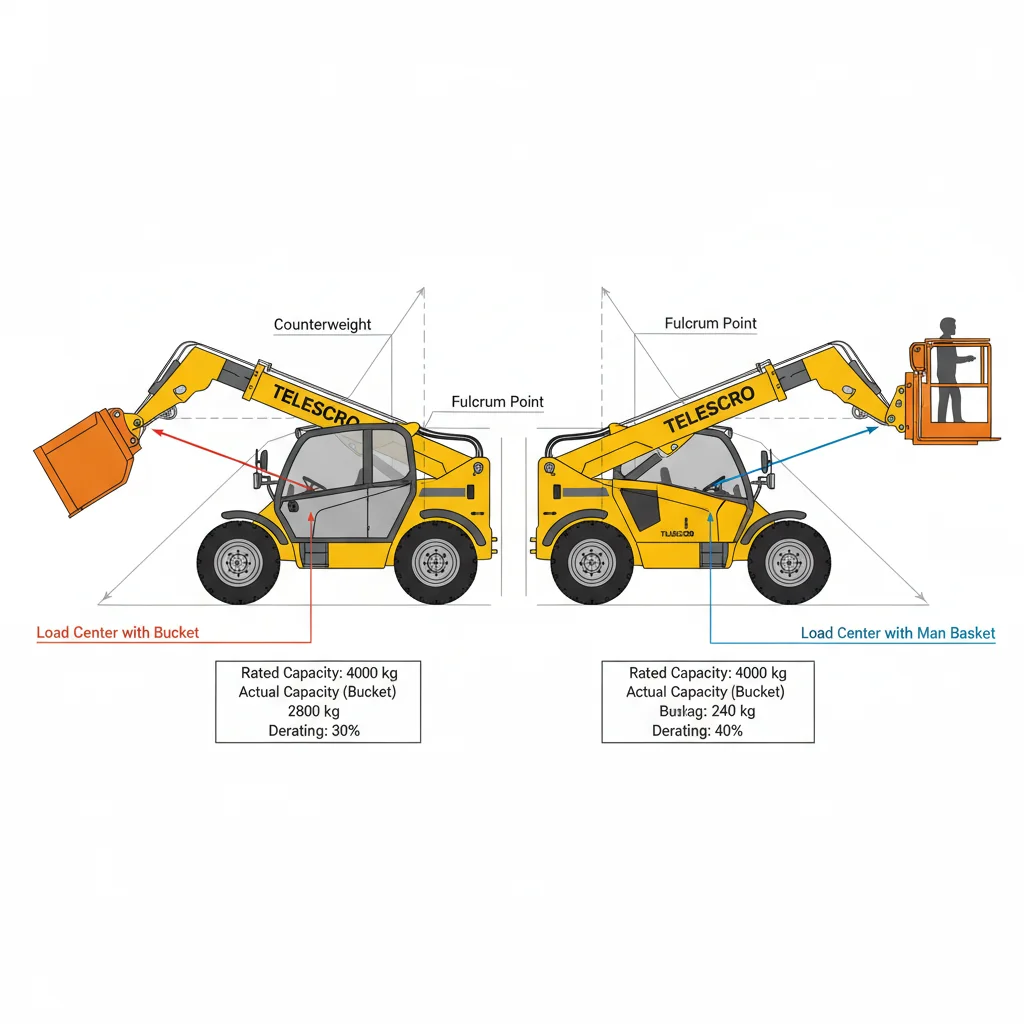
Voici ce qui importe le plus lorsque vous changez d'accessoire sur un télescopique : chaque outil, qu'il s'agisse d'un godet, d'une nacelle, d'une fourche rotative ou même d'une pince à grains, modifie à la fois le poids sur votre flèche et le point d'application de ce poids. J'ai récemment discuté avec un chef de chantier à Dubaï qui a été surpris d'apprendre que la capacité de levage de leur télescopique de 4 tonnes tombait à un peu plus de 2 700 kg lorsqu'il utilisait un godet lourd à pleine extension. Ce n'est pas une différence négligeable. La plupart des accessoires réduisent la capacité de levage sécurisée de 20 à 40 %, voire davantage si l'accessoire est particulièrement encombrant ou dispose d'une portée supplémentaire.
Que se cache-t-il derrière ces chiffres ? Tout d'abord, chaque accessoire ajoute du poids à l'extrémité de la flèche. Ensuite, il déplace le centre de gravité plus loin, créant ainsi un effet de levier plus important qui sollicite davantage le système hydraulique et le châssis du chariot télescopique. La machine devient moins stable et votre marge d'erreur diminue. Les fabricants testent tous les accessoires homologués et fournissent des tableaux de déclassement spécifiques pour chacun d'entre eux. Je rappelle toujours à mes clients : si vous utilisez un accessoire non approuvé ou si vous ignorez ces tableaux, vous soulevez à l'aveuglette, sans aucune garantie que votre charge nominale reste sûre.
Voici une liste de contrôle rapide pour vous aider à minimiser les erreurs :
- Toujours respecter le tableau de charge affiché dans la cabine pour l'accessoire spécifique installé.
- Ne présumez jamais que la capacité “ nominale ” correspond à la capacité réelle avec un accessoire.
- Étiqueteuses dans les flottes à fixations multiples — une signalisation simple et efficace
- Pour les unités locatives, confirmez quelles pièces jointes ont des tableaux approuvés.
- Vérifiez la capacité aux positions les plus utilisées de la flèche — ne vous contentez pas d'examiner les spécifications maximales.
Je suggère d'informer régulièrement votre équipe sur la réduction de la capacité des attaches. Un graphique négligé peut mettre en danger la sécurité de l'équipe, en particulier lorsque les conditions sur le site changent.
La capacité nominale d'un chariot télescopique est calculée avec l'accessoire standard le plus léger. L'installation d'accessoires plus lourds ou plus volumineux peut donc réduire considérablement la capacité de levage réelle en toute sécurité pour une extension de flèche donnée.Vrai
Les capacités nominales sont généralement basées sur une machine équipée d'un accessoire minimal afin de normaliser les classifications, mais les accessoires plus lourds ou volumineux déplacent le centre de gravité et ajoutent du poids, ce qui réduit la stabilité et donc la charge de travail sécuritaire réelle. Cette différence peut atteindre 30% ou plus selon l'accessoire et la position de la flèche.
La capacité nominale d'un chariot télescopique reste constante quel que soit le type d'accessoire ou l'extension de la flèche, car la protection intégrée contre les surcharges ajuste automatiquement les limites de charge en temps réel.Faux
La capacité nominale est une valeur fixe déterminée par le fabricant dans des conditions spécifiques et ne change pas automatiquement. Bien que certains chariots télescopiques soient équipés de systèmes d'alerte de surcharge, ceux-ci ne modifient pas la capacité nominale, qui doit être ajustée manuellement en fonction de la configuration de l'accessoire et de la flèche afin de garantir la sécurité.
Point clé à retenir: L'utilisation d'accessoires modifie la répartition du poids et les limites de levage sécuritaires d'un chariot télescopique. Consultez toujours le tableau de charge du fabricant pour l'accessoire spécifique utilisé et affichez clairement les valeurs nominales pertinentes dans la cabine afin d'éviter toute surcharge accidentelle et de maintenir la sécurité du chantier.
Comment les conditions du site affectent-elles la capacité d'un chariot télescopique ?
Les capacités nominales des chariots télescopiques sont basées sur un sol plat et ferme. Dans des conditions réelles (pentes, ornières ou sol meuble), la stabilité diminue et la capacité de levage réelle doit être réduite de 20 à 40 %. L'utilisation à proximité des limites sur un sol en mauvais état présente un risque de basculement ; ajustez toujours les limites et envisagez d'améliorer le sol ou d'utiliser un autre équipement.
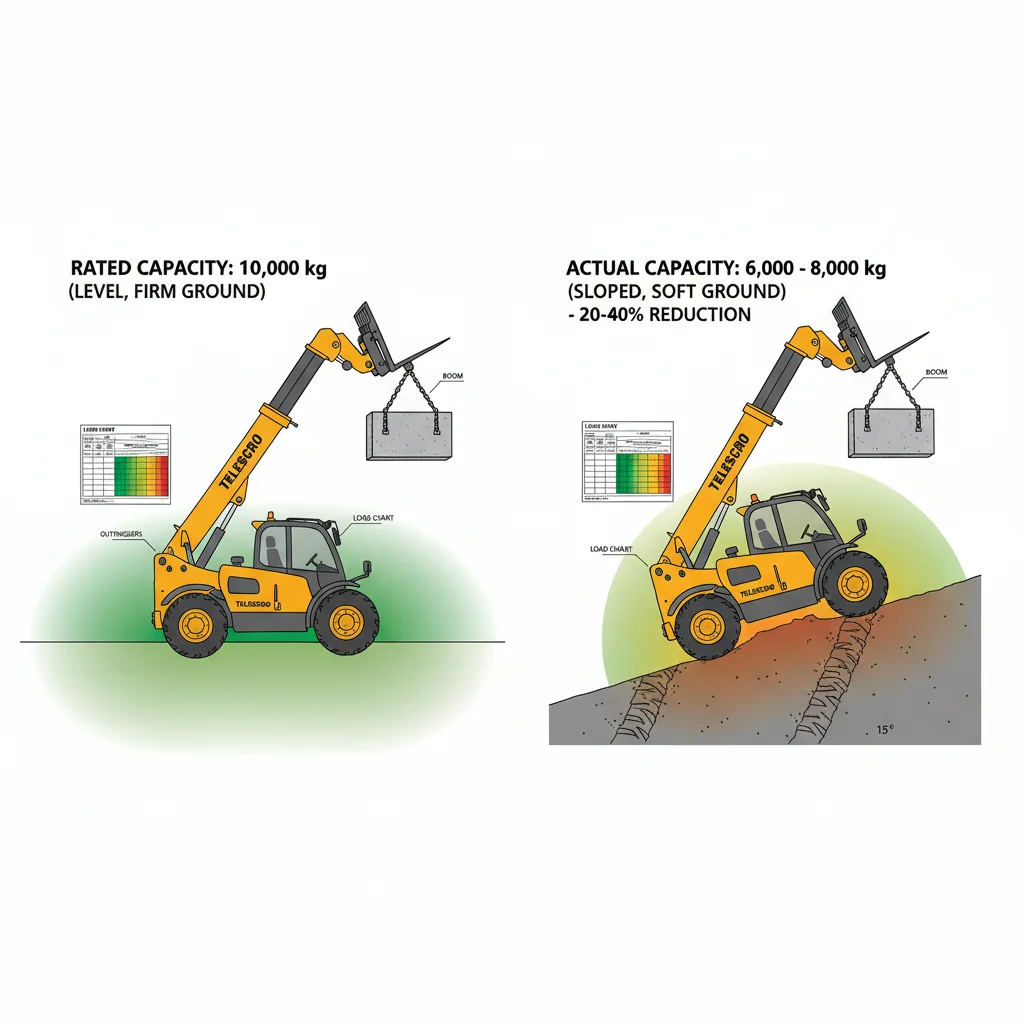
Le mois dernier, un entrepreneur de Dubaï m'a appelé après que son équipe ait failli renverser un chariot télescopique de 4 tonnes alors qu'il soulevait des briques sur une allée en pente. La capacité nominale semblait correcte (3 900 kg à cette portée), mais ils travaillaient sur une rampe en gravier compacté avec une pente latérale d'environ 7 degrés. La stabilité de la machine a radicalement changé. Lorsqu'une roue a heurté une zone meuble, les chiffres du tableau de charge sur papier n'avaient plus beaucoup de sens. Ce jour-là, ils ont frôlé l'accident, même avec la flèche à moitié déployée.
D'après mon expérience, les limites réelles de levage diminuent rapidement sur un sol meuble. J'ai vu des sites au Brésil et au Kazakhstan où le sol meuble ou les ornières ont coûté aux équipes la moitié de leur capacité habituelle. Il ne s'agit pas seulement du risque d'enfoncement des roues : votre centre de gravité se déplace dès que la surface n'est plus ferme et plane. Les chariots télescopiques dépendent d'un sol en bon état pour maintenir les charges dans la “ zone de sécurité ” indiquée sur le tableau de charge. Toute pente, tout trou ou tout point mou rapproche cette limite plus que vous ne le pensez.
La technologie sur chantier aide : la plupart des nouveaux modèles sont équipés de alarmes de stabilité7 ou des indicateurs de moment de charge. Ces systèmes avertissent ou coupent le système hydraulique avant qu'un renversement ne se produise, mais ils ne sont pas parfaits si les conditions du sol sont vraiment mauvaises. Si vous travaillez quotidiennement sur des surfaces instables, je recommande toujours d'améliorer d'abord le sol : utilisez des tapis en acier, posez des pierres compactées ou planifiez le travail lorsque le sol est plus sec. Sur les chantiers où le terrain est constamment mauvais, j'ai vu certaines équipes passer à des équipements à chenilles ou à des chariots télescopiques plus grands, ajoutant ainsi une marge de sécurité au lieu de prendre des risques à chaque levage. Cette approche a un coût initial, mais elle est rentable car elle réduit les retards et les risques.
Les valeurs de capacité nominale sont calculées en supposant un sol parfaitement plat, et même une pente latérale de 5 degrés peut réduire la capacité de levage réelle d'un télescopique jusqu'à 20%.Vrai
Les tableaux de charge des chariots télescopiques sont basés sur une base stable et plane ; les pentes déplacent le centre de gravité de la machine, ce qui réduit sa stabilité. Les fabricants recommandent de réduire la capacité de charge dès que la pente atteint 5 degrés afin d'éviter tout risque de renversement.
La capacité nominale d'un chariot télescopique s'ajuste automatiquement en temps réel en fonction du type de surface détecté par les capteurs embarqués.Faux
La plupart des chariots télescopiques s'appuient sur des tableaux de charge statiques et les indications de l'opérateur pour déterminer les limites de capacité. Bien que certains modèles avancés puissent être équipés de fonctions d'aide à la stabilité, ils ne modifient pas de manière dynamique la capacité nominale en fonction des conditions du sol.
Point clé à retenir: La capacité nominale suppose des surfaces planes idéales. Un sol meuble, irrégulier ou en pente peut réduire les limites de sécurité de 20 à 40%. Adaptez toujours l'utilisation à l'état réel du terrain, utilisez les chariots télescopiques avec prudence sur un sol en mauvais état et améliorez les surfaces ou choisissez un équipement plus adapté pour les travaux réguliers dans des environnements difficiles.
Comment la surcharge affecte-t-elle la durée de vie d'un chariot télescopique ?
L'utilisation régulière d'un chariot télescopique à proximité ou au-delà de sa capacité réelle sollicite fortement des composants clés tels que le système hydraulique, la flèche et le châssis. Cela entraîne une usure accélérée, augmentant ainsi le risque de fuites hydrauliques8, fissures structurelles, goupilles desserrées et annulation de la garantie, ce qui augmente finalement les coûts d'entretien et réduit la durée de vie.

La plus grande erreur que je constate est que les opérateurs pensent qu'un chariot télescopique peut “ supporter un peu plus ” que sa charge nominale, en particulier lorsque les délais approchent. Au Kazakhstan, j'ai aidé un client qui utilisait un engin de 4 tonnes et 17 mètres pour soulever des panneaux préfabriqués de près de 4 000 kg à presque pleine extension. Après seulement neuf mois, ils ont remarqué de nouvelles fuites hydrauliques et entendu des cognements provenant de la flèche. Les réparations leur ont coûté près de deux semaines d'immobilisation et une partie importante de leur budget annuel de maintenance. Ce scénario n'est pas rare : la surcharge ne se limite pas à un risque de renversement. Elle use silencieusement les soudures de la flèche, étire les goupilles et les bagues, et chauffe les circuits hydrauliques au-delà des limites de sécurité.
D'après mon expérience, de nombreux responsables de chantier ne vérifient que la capacité maximale, sans tenir compte du tableau de charge (qui détaille les charges sécuritaires à différentes hauteurs et portées). Les chariots télescopiques d'une capacité nominale de 4 tonnes atteignent rarement cette capacité à leur hauteur maximale : un modèle type de 18 mètres peut descendre à 1 000-1 200 kg à pleine extension. Le fait de repousser sans cesse ces limites provoque une fatigue prématurée du châssis principal et des flèches. J'ai vu des fissures apparaître au niveau des points de pivotement des flèches en moins d'un an lorsque les opérateurs ignoraient les alarmes d'avertissement ou les indicateurs de surcharge.
Les données télémétriques d'une flotte que j'ai suivie à Dubaï ont mis en évidence une augmentation des coûts de maintenance (près de 251 TP3T supplémentaires) sur les unités signalées pour des surcharges fréquentes. Pour être honnête, gagner du temps en forçant des charges lourdes peut finir par vous coûter cher en réparations imprévues et en perte de productivité sur le chantier. Je suggère de suivre l'historique des charges, de former les opérateurs à respecter les signaux d'avertissement et d'envisager une unité plus grande si les surcharges sont fréquentes. C'est un investissement qui s'avère rentable en termes de longévité des équipements.
La capacité nominale d'un chariot télescopique est mesurée lorsque la flèche est complètement rétractée et à l'angle le plus bas, et non à pleine extension ou à portée maximale.Vrai
Les capacités nominales des chariots télescopiques sont généralement spécifiées avec la flèche dans les configurations les plus stables (complètement rétractée et à faible angle), car le levage de charges à pleine extension soumet la flèche et le châssis à des contraintes plus élevées, ce qui réduit considérablement les limites de levage en toute sécurité.
La capacité réelle d'un chariot télescopique est toujours égale à la capacité nominale moins une marge de sécurité fixe de 10%, indépendamment de la longueur de la flèche ou de la position de la charge.Faux
La capacité de levage réelle varie de manière dynamique en fonction de l'extension de la flèche, de la hauteur et de la position de la charge, et non pas selon un pourcentage fixe. Les tableaux de charge indiquent différentes capacités pour différentes configurations, en tenant compte de l'effet de levier et de la stabilité. Par conséquent, une déduction forfaitaire de 10% ne reflète pas fidèlement les charges sécuritaires.
Point clé à retenir: Le fait de pousser fréquemment un chariot télescopique à ses limites nominales accélère l'usure et peut annuler les garanties. Les machines surchargées présentent des pannes plus fréquentes, des coûts de réparation plus élevés et une durée de vie utile plus courte. La surveillance des événements de charge et le traitement des surcharges récurrentes peuvent éviter des temps d'arrêt coûteux et le remplacement prématuré des équipements.
Comment les réglementations définissent-elles les limites de capacité des chariots télescopiques ?
Les réglementations telles que OSHA et EN1459 exigent des fabricants de chariots télescopiques qu'ils publient les capacités nominales et réelles, accompagnées de tableaux de charge clairs. Les employeurs doivent s'assurer que les opérateurs sont formés pour respecter ces limites. Les infractions peuvent entraîner des amendes, des fermetures et des responsabilités en cas d'incidents dus à une surcharge ou à une utilisation inappropriée de la capacité.
J'ai travaillé avec des clients qui sous-estimaient la rigueur avec laquelle les limites de capacité des chariots télescopiques sont appliquées sur les chantiers réels. Au Royaume-Uni, par exemple, un client a un jour supposé que tant que la capacité maximale de son engin était de 4 000 kg, il pouvait soulever ce poids en toute sécurité à n'importe quelle extension. Il ne savait pas que le tableau de charge (qui indique les capacités de sécurité à différents angles et portées de la flèche) est juridiquement contraignant. Lors d'une inspection de routine, le chef de chantier a remarqué qu'un élévateur à palettes était presque à pleine extension, bien au-delà de la capacité indiquée dans le tableau pour cette hauteur. Cette seule erreur a déclenché un avertissement et un audit de suivi. Cela aurait pu être bien pire.
Les réglementations telles que l'OSHA aux États-Unis et l'EN1459 en Europe accordent une grande importance à deux éléments : la capacité nominale (ce que la machine peut soulever dans des conditions idéales et testées) et la capacité réelle (la valeur de sécurité réelle dans toutes les positions de la flèche et avec tous les accessoires). Les règles exigent que les fabricants affichent clairement les tableaux de charge dans la cabine. Il ne s'agit pas seulement de paperasserie : les responsables de chantier et les opérateurs doivent savoir interpréter ces tableaux. Si vous dépassez la limite nominale ou si vous utilisez un godet alors que le tableau indique des valeurs pour une fourche, vous vous exposez à des amendes, des problèmes d'assurance ou des arrêts de travail.
D'après mon expérience, les meilleures équipes intègrent des contrôles réguliers des capacités dans leur routine quotidienne. Elles tiennent à jour des tableaux de charge pour chaque machine, en particulier lors du remplacement des accessoires, et documentent la formation de chaque opérateur à la lecture de ces tableaux. Je suggère de les passer en revue avec votre équipe au moins une fois par mois. Cette habitude à elle seule peut éviter de sérieux problèmes de conformité et d'accidents.
Au Royaume-Uni, les opérateurs de chariots télescopiques doivent respecter strictement les tableaux de charge qui précisent les capacités réduites en cas d'extension accrue de la flèche, sous peine de sanctions légales en cas d'infraction.Vrai
La réglementation britannique fait du tableau de charge un document juridiquement contraignant, obligeant les opérateurs à respecter les capacités réduites indiquées pour différents angles et portées de la flèche afin de garantir la sécurité du fonctionnement de la machine et de prévenir les accidents. Toute infraction peut entraîner des amendes ou la fermeture du chantier.
La capacité nominale d'un chariot télescopique correspond toujours au poids maximal que la machine peut soulever lorsque la flèche est complètement déployée, quelle que soit la position de la charge.Faux
La capacité nominale varie en fonction de l'angle et de l'extension de la flèche ; la capacité nominale maximale est généralement atteinte lorsque la portée de la machine est la plus courte, et la capacité diminue considérablement à pleine extension afin de maintenir la stabilité et la sécurité.
Point clé à retenir: Familiariser votre équipe avec les réglementations relatives à la capacité des chariots télescopiques et veiller à leur strict respect peut prévenir les accidents, les amendes et les retards coûteux dans les projets. Fournissez une documentation accessible, dispensez une formation continue aux opérateurs et référez-vous toujours aux tableaux de charge actuels afin de prouver votre diligence raisonnable en cas d'inspections ou d'incidents.
Conclusion
Nous avons examiné pourquoi la capacité nominale d'un chariot télescopique n'est pas toujours celle que vous pouvez soulever en toute sécurité sur le chantier. Les travaux réels comportent des variables (angle de la flèche, conditions du sol, accessoires) qui peuvent toutes limiter la capacité réelle. D'après mon expérience, les meilleures décisions découlent de la connaissance de vos scénarios de levage types et de l'étude attentive du tableau de charge, et non pas seulement de la confiance accordée aux spécifications des brochures. Cela permet d'éviter l'erreur “ héros en salle d'exposition, zéro sur le chantier ” qui piège de nombreux acheteurs. Si vous ne savez pas comment interpréter un tableau de charge ou si vous avez besoin de comparer différentes options pour vos tâches, n'hésitez pas à me contacter. Je serai ravi de vous faire part de mes connaissances pratiques acquises lors de projets menés dans 20 pays. Chaque chantier est différent : choisissez ce qui fonctionne réellement pour votre flux de travail.
Références
-
Explique comment les tableaux de charge indiquent les capacités de levage sécuritaires à différents angles de flèche, ce qui est essentiel pour la conformité réglementaire et la sécurité sur les chantiers. ↩
-
Explique comment la charge maximale de sécurité varie en fonction de l'extension et de l'angle de la flèche, ce qui est essentiel pour planifier des levages en toute sécurité sur les chantiers de construction. ↩
-
Apprenez à lire les tableaux de charge des chariots télescopiques afin d'éviter tout levage dangereux en tenant compte de l'extension de la flèche, des accessoires et des conditions du sol. ↩
-
Explique en détail comment le déplacement du centre de gravité affecte la stabilité et la capacité, ce qui est essentiel pour les opérateurs qui utilisent des accessoires lourds ou volumineux sur des chariots télescopiques. ↩
-
Informations détaillées sur la manière dont les pentes et la souplesse du sol affectent les limites de levage et la sécurité des chariots télescopiques, essentielles pour une planification précise des charges. ↩
-
Explique comment les tableaux de déclassement indiquent les limites de charge sécuritaires avec des accessoires, ce qui est essentiel pour prévenir les surcharges et les accidents sur le chantier. ↩
-
Explication détaillée de la technologie de sécurité du chariot télescopique qui alerte et empêche le renversement, essentielle pour travailler sur des terrains difficiles. ↩
-
Découvrez comment les fuites hydrauliques entraînent une augmentation des coûts de maintenance et des temps d'arrêt grâce aux conseils d'experts et à des astuces de prévention. ↩