










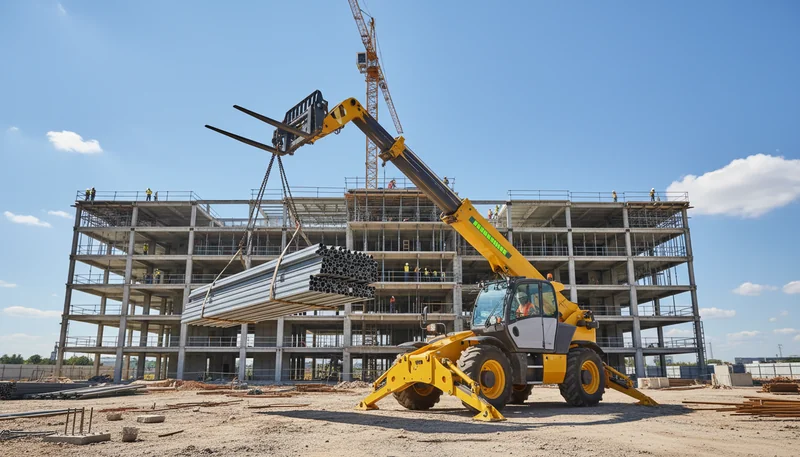
Does Overload Protection Guarantee Telehandler Rated Capacity? Field-Proven Answers for Buyers
Not long ago, a project manager in Australia sent me a photo: his telehandler looked steady on packed soil, yet the warning alarm blared before he hit the brochure-rated capacity. He wanted to know—does overload protection actually guarantee those published numbers on site?
Overload protection systems in telehandlers, such as Load Moment Indicators1 (LMI) or Rated Capacity Limiters (RCL), compare boom geometry and hydraulic pressure signals against stability limits validated under specified test conditions. However, these systems cannot account for jobsite variables such as slope, ground settlement, tire condition, attachment mass, or off-center loads. Rated capacity is defined for a correctly configured, well-maintained machine on a firm, level supporting surface with the approved attachment and the specified load centre.
Does Overload Protection Ensure Rated Capacity?
Overload protection systems in telehandlers help reduce the risk of exceeding rated load moment, but they do not make rated capacity universally safe in every jobsite condition. Rated capacity is defined for the OEM-specified configuration on a firm, level supporting surface. Factors such as slope, ground settlement, tire condition, attachment mass, and load placement can reduce stability margins even when the system has not yet issued a warning.
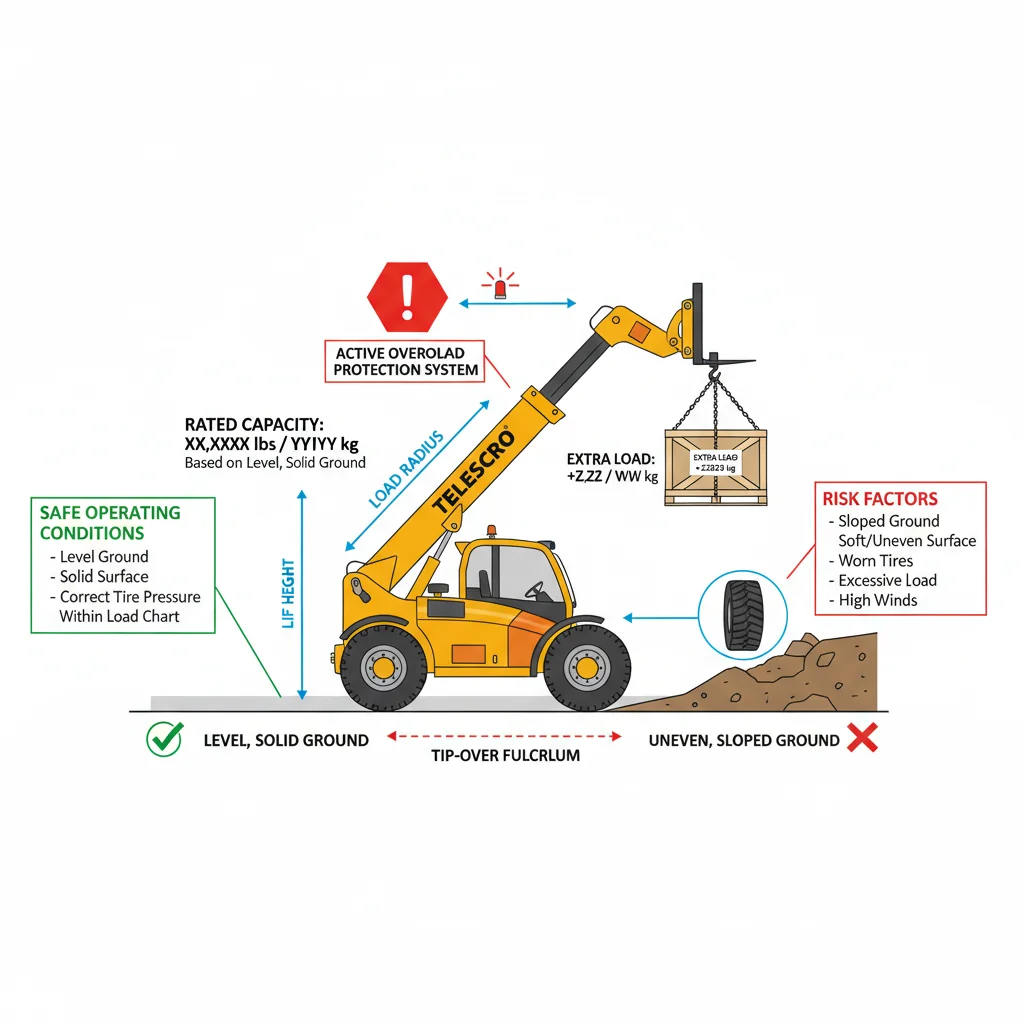
Most people assume overload protection means you can max out the load chart2 every time. That’s not how it works on real jobsites. Overload systems—like load moment indicators—just monitor your current load, boom position, and hydraulic pressure compared to a theoretical “safe zone.” But the system only knows what’s on its sensors, not what’s happening under the tires or in the mud.
Last month, a customer I support in Dubai found this out the hard way. They tried to lift 2,500 kg of bricks at full boom extension, on what looked like firm ground. The display stayed “green” the entire time—but as soon as the wheels settled three centimeters into soft fill, the front of the machine started to tip. No warning from the system, because the load wasn’t technically “over” the factory limit. That’s why I say, overload protection gives you a warning—physics often gives you none.
Rated capacity is established under defined test conditions set by the manufacturer: a firm, level supporting surface, correct tires in serviceable condition, standard forks, and a specified load center3—commonly 600 mm from the fork face, depending on model and market. Any deviation—such as worn or under-inflated tires, ground slope, uneven support, or heavier or extended attachments—reduces the available safety margin, even if the display does not indicate an overload. In practice, the load chart should be treated as a reference for these test conditions, not as a guarantee under variable site conditions, and reviewed before each lift accordingly.
To stay safe, I suggest treating overload protection as your backup, not your primary safety check. Always level the machine and verify your exact configuration against the load chart—especially if the ground looks questionable.
Overload protection systems on telehandlers may not account for ground instability, such as uneven or muddy terrain, which can still result in tip-overs even if the displayed load is within rated limits.True
Overload sensors measure load versus boom configuration, but cannot detect changes in ground support or stability. The machine may be at its rated capacity according to sensors, but poor ground conditions can compromise safety regardless.
If a telehandler’s overload protection system shows the load is within limits, the machine is fully stable and safe to lift under any site conditions.False
Overload protection sensors do not consider external factors such as ground slope, surface strength, or tire condition. These factors can affect overall stability, meaning a 'safe' reading does not guarantee real-world safety.
Key takeaway: Overload protection is a critical safety feature, but does not override physics or site conditions. Always treat rated capacity as valid only under strict test criteria and consult load charts for specific worksite factors. Rely on best practices, not the system alone, for safe operation.
Does reach reduce telehandler rated capacity?
Telehandler rated capacity applies only at minimum reach on level ground. Safe lifting capacity decreases sharply as boom height and reach increase, due to higher moment (load × distance) around the front axle. Always reference the load chart for net capacity at actual operating positions—not just the maximum rated figure.

Let me share something important about telehandler capacities that many operators miss. Rated capacity—the big number you see on spec sheets—is based on the boom fully retracted, machine on level, firm ground, and a specified attachment. As soon as you lift the boom or extend it forward, safe capacity drops fast. For example, I’ve seen compact 4-ton units in South Africa handle the full load at minimum reach. But extend the boom to 11 meters, and the real capacity might sink below 1,100 kg. These reductions are not minor—they can cut lifting ability to less than a third of the headline figure.
I’ve worked with contractors in Romania and Turkey who didn’t consult the load chart before bidding on high-reach jobs. Their machines could technically reach the target—say, 15 meters up and 10 meters out—but the load chart showed only about 1,500 kg was allowed in that position. One team learned this the hard way, after trying to place a 2,200 kg precast slab and triggering the machine’s overload alarm halfway through the lift. The hydraulic system might be strong enough, but if the front axle would tip, the safety system shuts everything down.
The key here is understanding “moment”—that’s load weight multiplied by distance from the front tires to the load center. Every extra meter of reach acts like a lever, pulling harder on the chassis. My advice: always plan your lifts around the load chart numbers for your actual working position, not just the brochure capacity. This protects both your crew and equipment.
Overload protection systems on modern telehandlers do not maintain maximum rated capacity at all reaches; their role is to prevent operation above safe limits as the boom extends and capacity drops.True
Overload protection systems monitor load and geometry, alerting or restricting operation when stability thresholds are approached, but cannot alter the fact that capacity decreases as reach increases.
If a telehandler is equipped with an overload protection system, it can safely lift its maximum rated capacity at any boom extension.False
Even with advanced overload protection, rated capacity is always based on specific boom and attachment positions. Extending the boom reduces stability and leverage, meaning maximum capacity cannot be carried throughout the entire range of motion.
Key takeaway: Telehandler rated capacity is not a universal value and only applies at minimum reach under specific test conditions. Each increase in boom reach or height reduces safe capacity, so buyers and operators must consult the OEM load chart for their exact working positions.
Do Overload Systems Ensure Rated Capacity?
Telehandler overload protection systems do not guarantee that rated capacity can be safely used in every situation. These systems estimate stability based on boom angle, extension, and hydraulic pressure signals, but they do not directly account for site conditions such as ground support, slope, wind effects, attachment mass, or off-center load placement. For rated capacity to be valid, operators must reference the OEM load chart and ensure the machine is configured and supported in accordance with the manufacturer’s specified conditions.

The biggest mistake I see is assuming an overload system means you can safely lift anything up to the rated capacity—no matter the circumstances. That’s not how these systems work in reality. Overload protection relies on sensors for boom position and hydraulic pressure. Basically, it estimates whether you’re approaching the stability limit based on machine geometry and pressure readings. What it cannot do is measure your exact load weight, the center of gravity, or detect changes like heavy wind or ground settlement under the tires.
I’ve worked with a customer in Dubai who ignored uneven ground while using a 4-ton telehandler at nearly full outreach. The jobsite overload system didn’t catch a soft spot under one tire. He thought the warning lights meant it was safe, but as the operator started lowering the boom, the machine shifted and the load slid. Nobody got hurt, but the pallet of glass panels didn’t survive. The OEM load chart had clearly marked that rated capacity only applied with the machine level and standard forks. That’s the kind of real risk you don’t see in the sales brochure.
Here’s what matters most when working near the limit: always check the load chart before every task, not just when a warning light flashes. Rated capacity is based on ‘ideal world’ conditions—solid, level ground (within around 3° tilt), the manufacturer-specified attachment, and the defined load center. I suggest verifying the actual site conditions match these requirements every time, especially if you’re lifting close to maximum reach. Treat the overload system as a safety backup—not your main decision-maker.
Overload protection systems typically estimate load moment using boom position sensors and hydraulic pressure signals; unless the machine is equipped and correctly configured with an approved weighing/attachment-recognition setup, the system may not reflect unknown load mass, off-center loading, or configuration changes with full accuracy.True
Many telehandler systems infer load from geometry and hydraulic pressure. Without verified attachment selection and calibrated weighing/recognition where applicable, factors like load placement, attachment mass, and off-center loading can reduce stability margin even before a warning is triggered.
As long as the overload protection system is active and has not triggered a warning, operators can always lift loads up to the telehandler's rated capacity regardless of attachment or load placement.False
The overload protection system estimates risks, but does not account for attachment differences or shifts in load center of gravity. Improper attachments or off-center loads can cause instability before the system triggers, so staying within rated capacity still requires judgment and adherence to the load chart.
Key takeaway: Overload protection systems in telehandlers are an invaluable safety backstop, but do not measure load weight or all risk factors directly. Rated capacity assumes ideal test conditions—level ground, specified attachment, and correct load center. Always follow the OEM load chart rather than relying solely on electronic overload warnings.
Do Ground Conditions Affect Telehandler Rated Capacity?
Ground conditions significantly impact telehandler rated capacity. Load charts and overload protection assume firm, level ground—typically within ±3°—but field surfaces are rarely ideal. Uneven terrain, soft soil, or mild slopes can reduce actual stability and usable capacity well before overload warning systems detect any risk or signal a limit breach.

When evaluating telehandler rated capacity, it is essential to recognize that load chart values apply only when the machine is supported on firm, level ground. In practice, many jobsites do not meet these conditions.
On one project in Dubai, a contractor was lifting precast panels from a packed gravel base. The lift initially appeared to be within the load chart limits, but as the boom was extended, a rear tire began to unload and lift slightly off the ground. No overload alarm activated, yet the situation was clearly unstable and unsafe to continue.
Rated capacity assumes the load is balanced and the chassis remains level. Even a mild slope or uneven fill beneath a single tire can shift the tipping axis forward or laterally. This loss of stability often occurs well before any overload warning is triggered.
A common scenario on wet or unprepared sites is localized soft ground beneath one wheel. The telehandler may settle by only a few centimeters, but this reduces rear axle support and significantly alters weight distribution. As a result, the effective stability triangle4 shrinks, and usable lifting capacity drops sharply without any electronic intervention.
I have seen similar conditions on thawing ground in Kazakhstan, where crews were forced to reduce load size by roughly half simply to keep all wheels planted during routine lifts. There is no universal derating formula in these cases—soil bearing capacity, compaction quality, tire specification, and inflation all influence the real limit.
For this reason, applying additional safety margins whenever ground conditions deviate from ideal test assumptions should be standard practice, rather than relying solely on overload protection or load chart values.
Telehandler overload protection systems do not compensate for the loss of rated capacity caused by uneven or unstable ground conditions.True
Overload protection is designed to prevent lifts that exceed the rated capacity according to the load chart, which is based on ideal ground conditions. These systems do not detect or adjust for variations in support caused by soft, sloped, or unstable surfaces, meaning lifts may become unsafe even before the overload system activates.
As long as the telehandler’s overload protection is functioning, the machine can safely lift to its rated capacity even on sloped or soft ground.False
Overload protection systems are not able to sense changes in stability due to ground conditions. The rated capacity specified by manufacturers assumes the telehandler is operating on firm, level surfaces; anything less reduces stability and may lead to tipping, regardless of overload system status.
Key takeaway: Load charts and rated capacities are valid only for firm, level ground. Real-world conditions—such as soft soil, mild slopes, or uneven terrain—reduce true telehandler capacity before electronic protection systems react. Always apply additional derating and strict site-specific rules whenever ground conditions deviate from ideal test assumptions.
Do Attachments Affect Telehandler Rated Capacity?
Attachments such as forks, buckets, jibs, and work platforms alter a telehandler’s load center and add dead weight, which can drastically reduce actual rated capacity. OEMs provide separate load charts for each approved attachment. Using non-approved or modified attachments invalidates overload protection, as control systems may miscalculate safe operating limits, risking unintentional overloading.
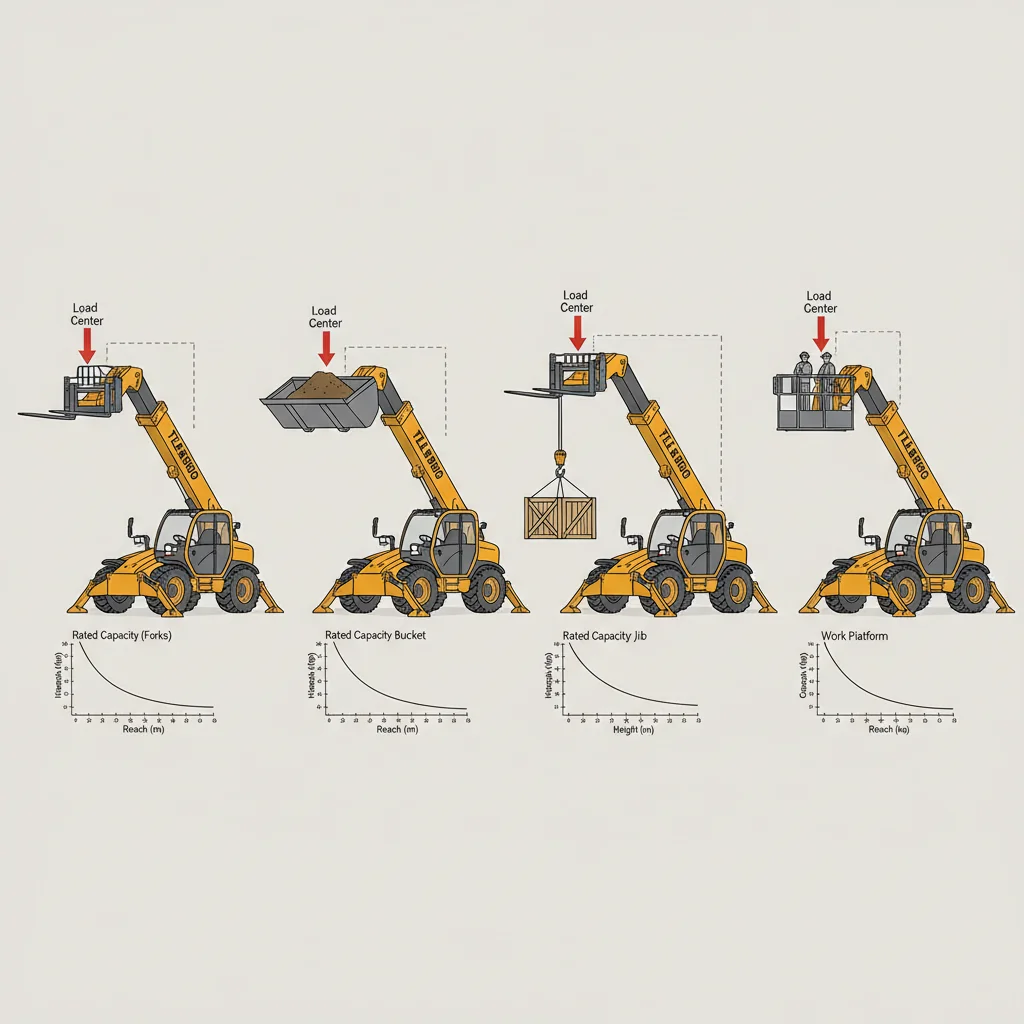
Most people don’t realize just how much adding or swapping attachments can change a telehandler’s safe lifting capacity. I’ve seen this issue firsthand—last year, a site in Dubai switched from standard forks to a full-width brick grab for block handling. Their machine was rated for 4,000 kg, but after fitting the heavier grab, actual capacity at mid-reach dropped to less than 2,500 kg—almost halved. Their supervisor never checked the revised load chart and trusted the machine’s “safe” indicator. That’s a dangerous assumption.
Here’s why this happens: every attachment—forks, buckets, jibs, work platforms—affects two things engineers care about most:
- Load center shifts: Attachments like buckets or jib booms push the load further forward, increasing “reach from front tire edge to load center,” which is how all OEMs define reach.
- Added dead weight: Heavier attachments eat into available capacity, because the boom must support both the tool and the load.
- Different geometry: Some attachments lift the payload higher or further away than the standard forks, multiplying the tipping force.
- System confusion: If you use non-approved or modified attachments, the control system’s moment indicator may miscalculate safe working limits—leading to hidden overload risks.
I always insist customers get the correct OEM load chart for each approved attachment. In Kazakhstan, a customer welded lifting hooks to his fork carriage to “save time.” But the control system never got updated, so the real tipping point came much sooner than the screen showed. My advice? Never use homemade attachments or skip the correct chart—no machine protection system can compensate for the wrong data. That’s how tipping accidents happen.
Fitting a heavier attachment to a telehandler can reduce its rated lifting capacity at a given reach, even if the main boom and chassis remain unchanged.True
This is true because the attachment’s weight becomes part of the load the telehandler must lift and balance, affecting stability and structural limits. The rated capacity is calculated based on both the load and anything attached to the carriage, which is why load charts must be adjusted for different attachments.
A telehandler’s overload protection system automatically recalibrates for any new attachment, ensuring the displayed rated capacity is always accurate.False
This is false because most overload protection systems only monitor hydraulic pressure and tipping limits. They do not automatically detect or adjust for different attachments. Operators must manually reference the correct load chart for each attachment to ensure safe operation.
Key takeaway: Telehandler rated capacity relies on both the attachment type and precise load chart data. Using heavier, extended, or non-approved attachments without updating system parameters can result in overload risk—despite active protection systems. Always require attachment-matched charts, and ban undocumented modifications to uphold safety and true rated capacity.
Does Overload Protection Ensure Rated Capacity (Continued)?
Overload protection requirements described in standards such as ISO 10896 (for variable-reach rough-terrain trucks) and EN 15000 (for longitudinal stability control on certain European telehandlers) are validated under specified test and configuration assumptions. Compliance indicates a baseline level of protection, not a jobsite guarantee—site conditions, attachments, maintenance state, and operating practice still determine whether rated capacity can be used safely.
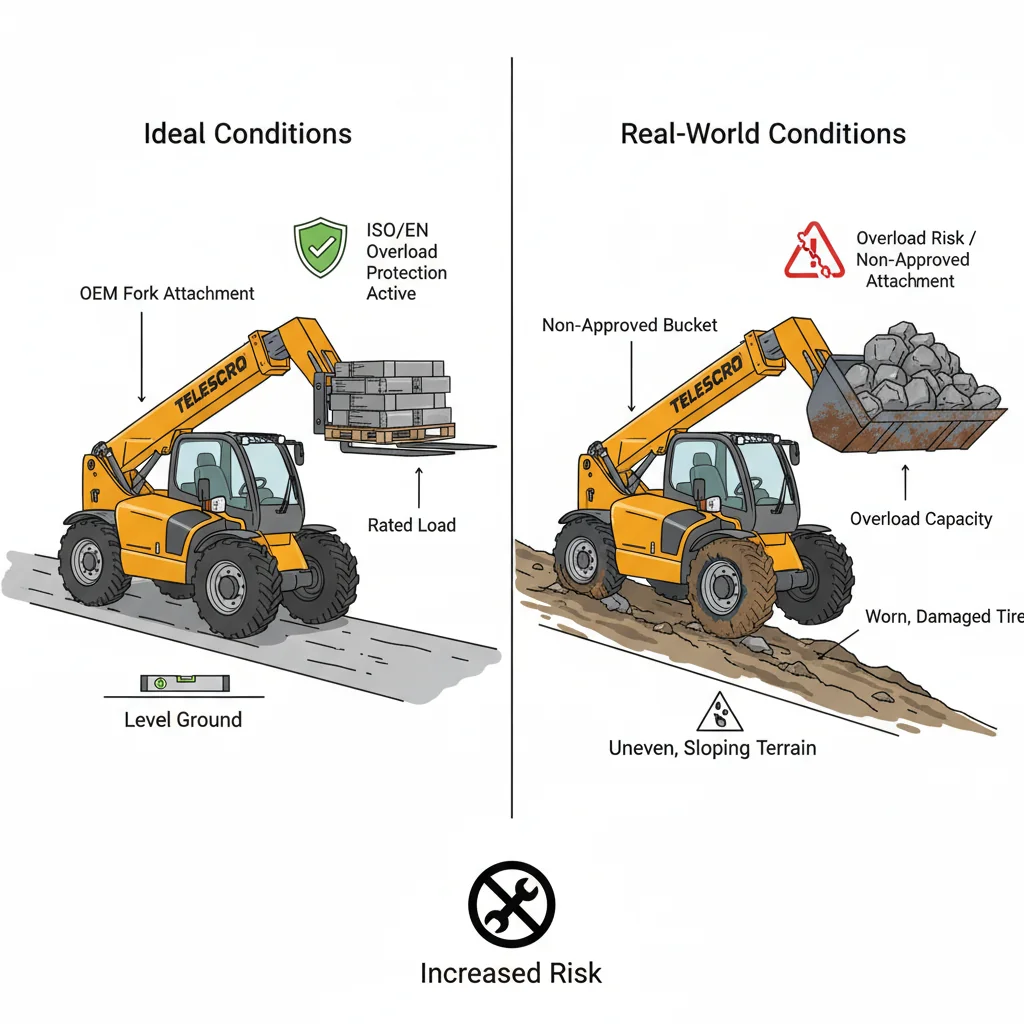
Last month, a project manager in Dubai called me after a load incident. His telehandler passed all ISO 10896 checks at the factory, and the overload system worked fine during annual maintenance. But on site, they operated on a compacted sand pad—nowhere near as stable as concrete. When the operator extended the boom to 14 meters with 1,600 kg of rebar, the ground settled slightly. The moment indicator flashed, but by that point, the load had already shifted and the telehandler tilted forward. No injuries, but the scare was real.
I’ve seen this pattern from Kenya to Poland: buyers rely on rated capacity, assuming the overload system means they’re safe as long as that warning isn’t triggered. The reality? Rated capacity only holds on level, solid ground, with the exact attachment listed in the manual. Swap a fork for a long jib, or work on even a gentle 4° slope, and your real safe load can drop by 20-40%. Most overload protection logic won’t detect a slow tire sink or a side slope unless you set up a warning system for every non-ideal scenario.
From my experience, a smart policy goes way beyond standard compliance. I always suggest requiring site-specific derating for soft or uneven terrain, only allowing OEM-approved attachments, and giving your operators regular training—especially on how to read and apply the load chart, not just watch for dashboard lights.
If your procurement team relies only on standards, that’s just the starting line. To protect people and assets, treat overload protection as a safety net—not the whole job.
Telehandler overload protection systems do not account for ground stability, so rated capacity can be compromised even if the system is functioning correctly.True
Overload protection sensors measure load moment based on machine geometry and hydraulic pressures, but they cannot detect if the supporting surface is unstable. Ground settling or uneven terrain can alter the telehandler’s center of gravity, increasing the risk of tip-over before overload limits are reached.
If a telehandler's overload system passes ISO 10896 factory checks, it will always maintain rated capacity on any jobsite surface.False
Passing ISO 10896 checks ensures system functionality under standard test conditions, typically on stable surfaces. However, jobsite surfaces such as loose or compacted soils introduce variables the system cannot detect or compensate for, making rated capacity unreliable in those conditions.
Key takeaway: Standard-compliant overload protection confirms that a telehandler meets certified rated capacity under controlled conditions, but does not guarantee safety on real sites. Procurement and safety policies should treat compliance as the minimum—implement derating, attachment approval, operator training, and site-specific procedures to ensure genuine lifting safety.
Are All Overload Protection Systems Equal?
Not all telehandler overload protection systems provide the same level of safety. Basic systems may only monitor hydraulic pressure, missing key factors like boom angle and extension. Advanced systems use full-envelope LMIs or RCIs with multiple sensors, handling attachment differences and logging overload events for standards compliance.

The biggest mistake I see is assuming every overload protection system provides the same level of real-world safety. On some low-cost telehandlers I’ve seen in Southeast Asia, the only “protection” is a hydraulic pressure switch5—one sensor set at a fixed threshold. That ignores the most critical variables: boom angle, reach, and attachment type. When you’re lifting a 1,500 kg pallet at full extension, that kind of basic cutout can let you get dangerously close to tipping, especially if you swap in a longer jib or bucket.
I remember a rental fleet in Kenya where operators switched attachments daily—standard forks in the morning, a bucket after lunch. The simple system had no way of detecting those changes, so the warning light never matched actual risk. One day, a new operator tried to lift loose material with a bucket at maximum reach. The boom dropped fast, the machine lurched, and they narrowly avoided an accident. After that, the client upgraded their fleet to machines with full-envelope load moment indicators (LMIs). These used angle sensors, extension feedback, and attachment selection to track the true safe working zone for every configuration. If they hit the boundary, it would lock out dangerous movements and log the event—essential for compliance with EN 15000 and ISO 10896 standards.
To be honest, I always suggest checking for three things before making a purchase: Does the system reference the full load chart? Can it handle multiple attachments without manual recalibration? And, most importantly, does it actually prevent overloads in the field—not just in theory? That’s what real safety looks like.
An overload protection system that only measures hydraulic pressure may not prevent a telehandler from exceeding its rated capacity at certain boom angles and extensions.True
Hydraulic pressure alone does not account for boom position, reach, or attachment type, which all affect load moment and stability. Exceeding capacity can still occur even if hydraulic pressure thresholds are not crossed, especially at high extensions.
All overload protection systems automatically adjust for every different attachment installed on the telehandler, ensuring the rated capacity is never exceeded.False
Basic and even some advanced protection systems may not identify or compensate for every possible attachment change, leading to scenarios where the machine can be overloaded if an unaccounted-for attachment alters the load chart or center of gravity.
Key takeaway: Overload protection varies significantly by system type. Buyers should verify whether a telehandler’s system is a true load-moment indicator referencing the load chart, supports multiple attachments, and meets relevant standards. Never assume all overload protection offers equal rated capacity assurance or operational safety.
Should Telehandler Loads Be Internally Derated?
Yes—internal derating of telehandler rated capacity is recommended in real operating conditions. Internal derating6 is commonly applied because real-world factors—such as uncertain load weights, attachment variation, operator differences, component wear, and variable ground support—reduce the safety margins assumed in load charts. Many fleets adopt a conservative operating margin below charted capacity so that overload protection functions as a secondary safeguard rather than the primary control.

I’ve worked with several international fleet managers who underestimated just how quickly site realities can eat into a telehandler’s safety margin. Take a project in Kazakhstan last year. The team was lifting concrete blocks—supposedly 1,900 kg each—right at the chart limit for their 4,000 kg, 14-meter unit. But one block turned out heavier, and the ground had just been regraded, leaving a slight slope and loose fill. The result? The overload system kicked in mid-lift, and the machine lurched forward—fortunately, no one was hurt, but it rattled everyone on site.
Here’s what matters most when deciding on internal derating: rated capacity in the load chart assumes the telehandler is on firm, level ground (typically within about 3°), with the right attachment and load center. In reality, you might face uneven gravel, half-worn tires, or new crew who haven’t fully mastered the controls. If you push the machine up to 100% of rated values, every small variable eats away at your safety margin. I recommend fleets set policy limits at about 80–85% of charted capacity for each critical height and reach zone.
To be honest, treating the overload protection as your daily safety net is risky. It’s meant as a backup, not your frontline defense. I’ve seen operators ignore small warning signs, because they trust the buzzer will always save them. Document your internal derating limits in the lift plan and make it part of every toolbox talk. This keeps your operations consistent—even if ground conditions or staffing changes day to day.
Internal derating of telehandler loads accounts for real-world factors like load density, uneven ground, and attachment weight, which are not reflected in standard rating charts.True
Manufacturers' rated capacities are typically determined under ideal conditions, so internal derating compensates for the unpredictable variables and site-specific risks that affect safe lifting limits.
Overload protection systems ensure a telehandler can always lift up to its full rated capacity, regardless of site conditions.False
Overload protection devices only react after unsafe conditions arise and do not account for factors like uneven surfaces, load distribution, or ground integrity, which can reduce actual safe lifting capacity on site.
Key takeaway: Load charts reflect ideal test conditions and should not be treated as absolute limits on active jobsites. Experienced fleets typically apply a documented internal derating policy—often in the range of 80–85% of charted capacity at a given height or reach—based on site conditions, task criticality, and risk tolerance. Formalizing these limits in lift plans and site procedures helps reduce tip-over risk, structural fatigue, and unplanned downtime while improving operational consistency.
Does Overload Protection Ensure Rated Capacity (Part 3)?
Overload protection systems serve as a critical last line of defense but do not guarantee safe telehandler operation at rated capacity. Safe lifting requires advance planning via the manufacturer’s load chart and applying suitable derating. Overload indicators only react after a threshold breach—never use alarms as a substitute for proper lift planning.
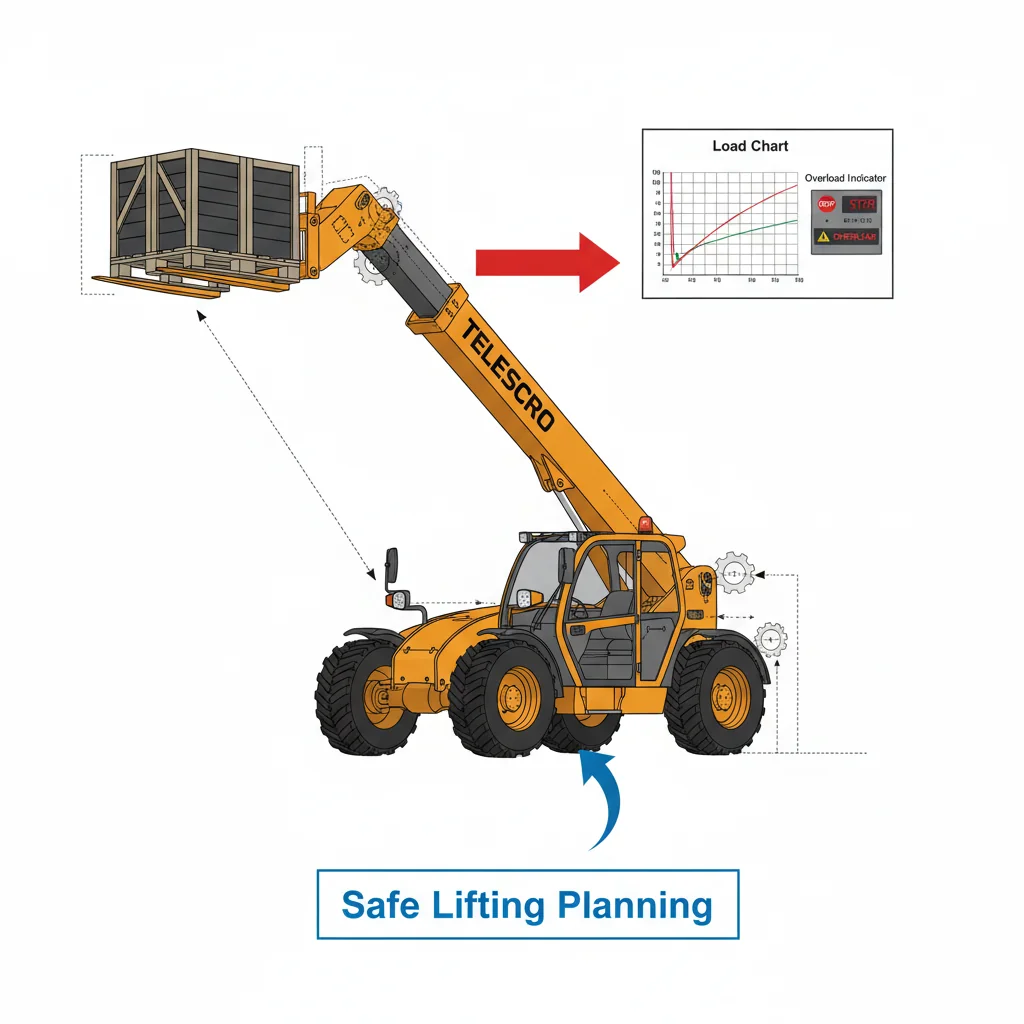
Here’s what matters most when planning a safe telehandler lift: it all begins with the load chart, not the overload alarm. I’ve seen too many jobsites—like one in Kazakhstan last year—where people placed blind trust in the machine’s overload warning system. Their logic sounded reasonable: “If the alarm doesn’t go off, we’re working safe.” But in reality, overload protection is a last-ditch safety measure. It only reacts after the machine senses you’ve passed a critical limit. By that point, margin for correction gets dangerously thin.
Operators need to start with the basics: confirm the expected boom height, outreach, and attachment. Always check the load chart inside the cab—that chart is based on rated capacity under strict test conditions. Rated capacity means the ground is level (usually within 3°), the right attachment is used, and the load sits at the specified load center (I often see 500 mm or 600 mm, but it depends on the manufacturer). I suggest applying your own derating, around 10–20% below the published numbers, to give yourself a safety buffer for unexpected factors: soft ground, uneven terrain, or a heavier-than-listed pallet.
This discipline matters. In Brazil, I worked with a team who tried nudging the controls after the overload alarm sounded, hoping to “finish the lift.” The overload indicator flashed red, the hydraulic circuit locked the boom, and only then did they pause to reassess. That’s not real risk management. If the protection system triggers, back off. Retract, lower, check all jobsite conditions, and reference the load chart again before restarting the lift. Treat overload protection as your safety net—not your roadmap.
Overload protection systems on telehandlers activate only after the machine approaches or exceeds its rated load moment, rather than preventing you from reaching unsafe conditions in real-time.True
Overload protection devices work as reactive safeguards; they respond when the machine senses instability or excessive load rather than continuously verifying that every lift remains fully within the envelope defined by the load chart. This means the operator can still overshoot safe margins before the system intervenes.
If the overload protection alarm does not activate during a lift, it guarantees the load is within the telehandler’s rated capacity for the boom position and attachment in use.False
The absence of an overload alarm does not confirm the lift is within safe working parameters. Load charts account for complex variables like boom angle and extension, and relying only on the alarm neglects potential errors in load placement, attachment compatibility, or changing ground conditions that could still exceed safe capacity.
Key takeaway: Telehandler overload protection is not a substitute for thorough lift planning. Operators must always reference the specific machine’s load chart, confirm correct configuration, and derate capacity for safety. Overload systems are essential—but should be treated as a backstop, not primary assurance of safe operation.
Do Pre-Use Checks Affect Overload Protection?
Overload protection in telehandlers depends critically on correct calibration and rigorous pre-use checks. Sensor drift, wiring faults, or outdated load charts can cause the system to misjudge actual capacity. Leading practices require annual test-weight verification, frequent inspections after maintenance, and daily functional checks to ensure accurate rated capacity protection and compliance with OEM load chart specifications.

The reliability of overload protection depends heavily on correct calibration and routine verification. Even a well-designed system can provide misleading reassurance if sensors drift or checks are skipped.
On one site in Kazakhstan, a 4-ton telehandler failed to issue an overload warning while lifting an overloaded pallet at approximately 12 meters of reach. Investigation showed that a hydraulic pressure sensor had drifted by about 7% from its calibrated value. The system had not been function-tested with known weights after recent boom maintenance, allowing the error to go unnoticed.
Similar issues occur when daily checks are reduced to visual inspections only. Overload protection relies on multiple sensors; small deviations in boom angle transducers or extension encoders can materially affect calculated stability limits. For this reason, overload protection should not be treated as a “set-and-forget” system.
A practical pre-use approach should include the following steps:
- Function-test the overload system using a known test weight at defined boom positions (at least annually or every 1,000 operating hours, and always after repairs involving sensors, the boom, or hydraulic cylinders).
- Inspect wiring, connectors, and sensor housings for damage, corrosion, or looseness, particularly at boom pivot points and moving interfaces.
- Verify that the load chart in the cab matches the machine configuration and installed attachment, as mismatches remain common on mixed-use sites.
- Carry out a documented daily functional check, confirming that visual and audible warnings and any motion cut-outs activate as expected when approaching a safe, predefined limit.
This level of verification ensures overload protection functions as intended and that rated capacity guidance remains meaningful during daily operation.
Regular pre-use checks that include a functional test with real weights are necessary to ensure that a telehandler’s overload protection system remains accurate over time.True
Overload protection relies on sensors and calibration; without periodic verification under load, sensor drift or mechanical faults can go undetected, leading to unsafe lifting conditions even if the system appears to function.
If a telehandler is fitted with an overload protection system, it will always prevent the machine from exceeding its rated lifting capacity regardless of maintenance or calibration.False
Overload systems can malfunction or provide false readings if components become faulty or lose calibration, so neglecting checks means rated capacity is not always enforced.
Key takeaway: Overload protection only ensures telehandler rated capacity if sensors are regularly calibrated and systems function-tested. Neglecting periodic verification or daily checks can result in inaccurate capacity readings and increased risk. Consistent maintenance and adherence to load chart specifications are essential for reliable safety performance.
Conclusion
We’ve talked about how overload protection plays a key safety role, but it doesn’t change the real limits set by physics or tough site conditions. From what I’ve seen on jobsites, the safest, most efficient crews always trust the load charts first, not just the protection system. If you only look at showroom specs, you might end up with a "showroom hero, jobsite zero"—that’s a common pitfall.
If you have questions about applying load charts to your daily work or want to check what’s practical for your site, just reach out—I’m happy to share field-tested advice from real projects. Every site is different, so the right telehandler is always the one that fits your real workflow.
References
-
Explains how load moment indicators monitor load and boom position to prevent overloads with real-world jobsite insights. ↩
-
Understand how consulting telehandler load charts at actual operating positions prevents overloads and tipping, improving job site safety and efficiency. ↩
-
Explores how different attachments shift the load center, impacting telehandler stability and rated capacity with technical insights. ↩
-
Learn how the stability triangle influences telehandler tipping risk on uneven ground, guiding safer lifting practices at construction sites. ↩
-
Expert analysis of limitations in basic hydraulic pressure switches versus advanced sensor systems for preventing telehandler tipping accidents. ↩
-
Explains how derating telehandler capacity enhances safety by accounting for real-world conditions that reduce load margins. ↩