










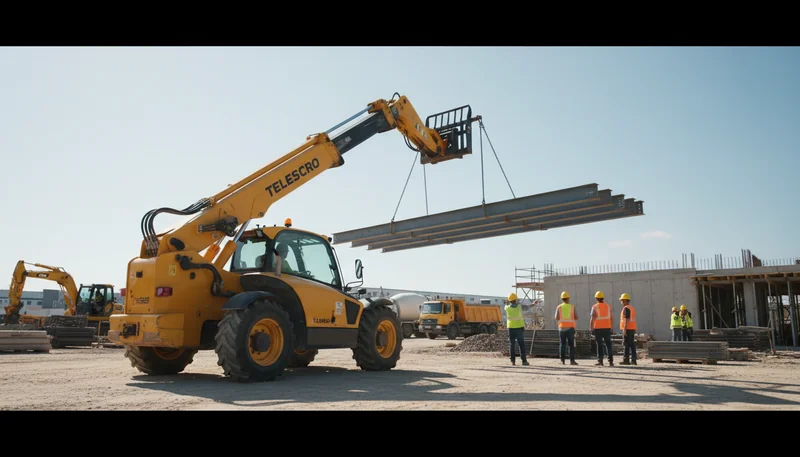
Does Boom Extension Sequence Affect Telehandler Capacity? Field-Tested Answers Buyers Miss
Not long ago, an Italian foreman texted me, completely puzzled. His two telehandlers—same max specs on paper—could barely handle the same load at mid-reach. One breezed through, the other hit its warning limits early. It wasn’t a worn tire or lazy hydraulics. The answer was all about boom extension sequence.
Boom extension sequence refers to the programmed order in which a telehandler’s boom sections telescope, which can change how boom mass is distributed relative to the chassis as the boom moves through intermediate extension stages. Controlled by hydraulic or electro-hydraulic sequencing, it influences the machine’s stability margin and the resulting tipping moment1 at different reach points. Depending on the boom design (uniform vs. staged extension), some machines may retain more usable capacity in the mid-reach working zone—but the only reliable comparison is the OEM load chart for the specific model, attachment, and load center.
Does boom extension sequence impact capacity?
The boom extension sequence—whether inner or outer boom sections telescope first—directly affects usable telehandler capacity at each reach point. Designs extending inner sections first keep more boom mass close to the chassis, often maintaining higher capacity at mid-reach compared to models extending outer sections early, where capacity declines sooner.

Most buyers underestimate how much boom extension sequence can change what a telehandler can actually lift on site. I saw this clearly on a logistics project in Chile, where a contractor was operating two different 4-ton class telehandlers. One model used a more inboard, staged boom extension approach, while the other reached forward earlier in its extension sequence. On paper, both machines shared the same rated capacity2.
In real operation, however, the difference showed up in the mid-reach working zone. At roughly the same forward reach, one machine could handle a full pallet in a single lift, while the other triggered load warnings and required partial unloading. Nothing was wrong with the machine—this was simply how the boom geometry and stability envelope were designed. The contractor had assumed “same tonnage, same ability,” which turned out to be a costly misconception once real reach and load conditions were involved.
The key factor behind these differences is the overturning (tipping) moment, which is driven by both load distance and how the boom’s own mass is distributed as outreach increases. When more boom mass remains closer to the chassis during intermediate extension stages, the machine generally maintains a larger stability margin as reach increases.
As outreach grows, the combined center of gravity moves toward the machine’s forward tipping line defined by the stability triangle. Designs that shift boom mass outward earlier tend to reach this limit sooner, so usable capacity can decline more rapidly in the mid-reach working zone—even when both machines share the same 4,000 kg rated capacity at minimum reach.
I always suggest comparing the full load chart3, not just the headline figure. Before you decide, check what each model can actually lift at the reaches and heights where you’ll work most. You’ll often find two “4-ton” telehandlers perform very differently in real site conditions. That’s the detail that matters most.
Telehandlers that extend inner boom sections first generally maintain higher lifting capacities at mid and full reach compared to those that extend outer sections first.True
Extending inner boom sections first keeps more of the load supported closer to the base of the machine, improving leverage and structural support, which helps maintain higher capacities at extended reaches.
The sequence in which a telehandler extends its boom sections has no effect on the rated capacity at any boom length.False
The boom extension sequence directly impacts the machine's leverage and stability, meaning the way sections are extended can significantly affect the load chart, especially at longer reaches.
Key takeaway: Two telehandlers with the same rated capacity may perform very differently in real work due to boom extension sequence. Always examine the load chart details for each model—not just headline tonnage—since extension geometry directly alters usable capacity across the working envelope.
Does Boom Extension Reduce Telehandler Capacity?
Telehandler capacity decreases as reach increases and boom angle4 lowers, regardless of the extension sequence. This occurs because increased reach and a shallow boom angle shift the load center further from the tipping axis, raising overturning forces. Load charts5 always show higher capacities at minimum reach and steep angles, dropping sharply when extended.

Let me share an important point about boom extension and telehandler capacity, because many buyers are surprised by this in real projects—especially on large sites in Kazakhstan and Kenya. Regardless of brand or model, the same physical principles apply. As the boom extends, the load moves farther forward, increasing the overturning moment and reducing forward stability.
This is why rated capacity always decreases with increased reach. Load charts clearly illustrate this effect: at minimum reach and a steep boom angle, a 4-ton class telehandler may handle its full rated load. As the boom extends outward and approaches a flatter angle, allowable capacity drops sharply. The exact limit at maximum reach varies widely by model, attachment, load center, and chart standard—but it is always significantly lower than the headline rating.
Last month, a customer in Dubai asked why his new 3.5-ton telehandler could barely lift a pallet at full stretch. The answer was simple—he relied on the "tonnage class" without checking the actual load chart envelope. The working reality? At 14 meters reach and a low boom angle, the rated capacity had dropped by more than 80%. The machine’s sensors and load moment indicator wouldn’t even allow him to boom out with a full load. That’s not a fault—it’s built-in protection.
From my experience, always reference the load chart for your actual working height and reach, not just the headline rating. Tonnage class only sets the baseline. I suggest verifying capacity at your worst-case extension before committing. If you size machines by max rating, you may end up with a "showroom hero, jobsite zero"—strong on paper, weak where it counts.
The boom extension sequence—whether sections extend from the base outwards or from the tip inwards—can impact the telehandler’s capacity at maximum reach, because some designs place more weight further from the chassis during extension, altering load chart values and stability margins.True
Boom extension sequence affects the position and leverage of each boom section as the load moves away from the machine. Outward-extending booms (from the base first) typically concentrate mass closer to the chassis longer, maintaining higher capacity at intermediate reaches compared to tip-first extension, which pushes more weight forward sooner and reduces allowable capacity.
Once the boom is fully extended, it does not matter which sections were extended first; all telehandlers will have an identical maximum load capacity at maximum reach regardless of the boom extension sequence.False
Boom extension sequence can change the effective lever arm and how the machine’s weight is distributed. Designs that extend outer sections first raise the center of mass more rapidly, often reducing stability and safe capacity sooner than inner-outward designs. Manufacturers specify different capacity charts based on their boom extension mechanisms, so maximum load can vary even at full reach.
Key takeaway: Telehandler capacity is fundamentally limited by physics—longer reach and lower boom angles always reduce lifting ability, regardless of extension sequence. Operators and buyers must reference the load chart for specific reach and height combinations, not rely on maximum ratings or generalized figures.
Does Boom Extension Sequence Affect Capacity?
Yes, boom extension sequence directly affects a telehandler’s rated capacity at different reaches. Machines that extend inner boom sections first maintain higher load capacities in the mid-reach zone (6–10 m), while designs extending outer sections early usually sacrifice capacity in this critical working range, despite identical headline ratings.

Here’s what matters most when comparing telehandler capacity: the actual load chart, not just the rated numbers in the brochure. Many buyers are surprised when two machines both labeled “4,000 kg / 17 m” perform very differently on site. Rated capacity always looks good on paper, but the reality on your jobsite depends on how the boom extends and where the machine carries its weight. The difference between keeping the inner boom extended longer versus sending out the outer sections first is massive—especially at mid-range reaches, where most real work happens.
Last year, a customer in Dubai needed to offload 2,000 kg concrete blocks at about 8.5 meters forward reach—typical mid-zone for a high-lift telehandler. On one model, that was no problem with a safe margin. On another, the moment indicator hit the cut-out at just 1,500 kg at the same geometry. Both machines were rated “4,000 kg,” both had similar maximum reach, but boom extension sequence changed the whole stability envelope. The load chart (measured from the front tire edge to load center) clearly reflected it. Designs that extend inner sections first keep the block’s center of gravity closer to the chassis, which means more stability and better usable capacity in the mid-zone.
From my experience working with sites in Brazil, Kazakhstan, and Southeast Asia, buyers rarely dig into these details until lifting performance becomes an urgent problem. I always suggest lining up actual load charts, radius-by-radius, for every telehandler you consider—especially between 6 to 10 meters reach. The right choice is the one that matches your heaviest mid-zone lifts, not just the biggest headline number.
The sequence in which a telehandler boom extends—whether the inner or outer sections extend first—can significantly alter the lifting capacity at certain reach points.True
Boom extension sequence affects how the machine's weight is distributed and the leverage forces exerted on the chassis, directly impacting stability and capacity limits at various outreach positions.
As long as the total boom length is the same, the order in which boom sections extend has no effect on a telehandler's capacity across all reach points.False
Capacity is influenced not just by boom length but also by how the boom's mass is distributed during extension. Extending heavier inner sections first keeps more weight closer to the machine, improving stability compared to extending lighter outer sections first.
Key takeaway: Telehandlers with the same rated capacity can perform very differently due to boom extension sequence and chassis design. Always compare load charts at actual working reaches and heights, not just the maximums. Brochure numbers do not guarantee equivalent mid-reach capacity or stability on site.
Does Boom Sequence Impact Rated Capacity?
Boom extension sequence directly affects a telehandler’s rated capacity at varying reaches. Load charts display how capacity changes based on boom angle and measured reach from the front tires. Interpreting intermediate extension points (such as 50% or 75%) reveals if outer or inner sections extend first, which shapes performance in real work zones.

The biggest mistake I see is buyers trusting a telehandler’s rated capacity number without checking the full boom extension sequence on the load chart. That number usually applies only with the boom fully retracted—when the machine is at its most stable. But the real challenge comes once you start extending the boom for pallet placement higher or further out. For example, last year a project in Dubai picked a 4-ton, 17-meter unit based on rated capacity alone. On site, they quickly realized at 8 meters reach and 11 meters height—right where most of their lifts happened—they could only safely pick up around 1,500 kg. They had to rent a second machine just to keep on schedule. Here’s what I tell customers: the order in which the boom sections extend has a direct impact across mid-range positions, not just the max reach. If the outer section extends first, capacity drops fast past 3 or 4 meters reach, then holds steady further out. If the inner section goes out first, capacity holds higher for longer, then falls sharply right before maximum extension. I worked with a warehouse build crew in Kazakhstan that needed 1,400–1,600 kg at 7–9 meters for most deliveries. Their supervisor compared two load charts—one showed a strong 1,800 kg at mid-reach; the other started off well but dropped below 1,200 kg after the first boom stage. Choosing the right machine saved them days of double-handling.
A telehandler’s rated capacity drops significantly as the boom is extended, because leverage and stability decrease with boom outreach.True
As the boom extends, the center of gravity moves outward, increasing tipping risk and reducing how much weight the telehandler can safely support. The capacity is highest with the boom fully retracted and diminishes as the boom is raised or extended.
A telehandler’s rated capacity remains nearly the same at all boom positions as long as the total load does not exceed the specified maximum.False
This is incorrect because the load chart is designed to show how capacity changes based on the boom's height and outreach. Maximum rated capacity typically only applies when the boom is fully retracted. Extending or raising the boom always reduces safe load limits due to stability and leverage factors.
Key takeaway: When evaluating telehandler capacity, buyers must interpret the load chart’s capacity variations throughout the extension range, not just at minimum or maximum reach. The boom extension sequence significantly influences safe lifting limits across typical working heights and reaches. Always request charts with intermediate extension data for valid comparisons.
Does Boom Sequence Impact Telehandler Capacity?
Modern telehandler safety systems, such as Load Moment Indicators (LMI) and stability software, assume the boom extends in the factory-defined sequence. Modifying valves, bypassing sensors, or altering extension order disrupts this, making real-time capacity calculations inaccurate and increasing tip-over risk. Attachment mode can further adjust boom behavior to enhance safety for specific tasks.
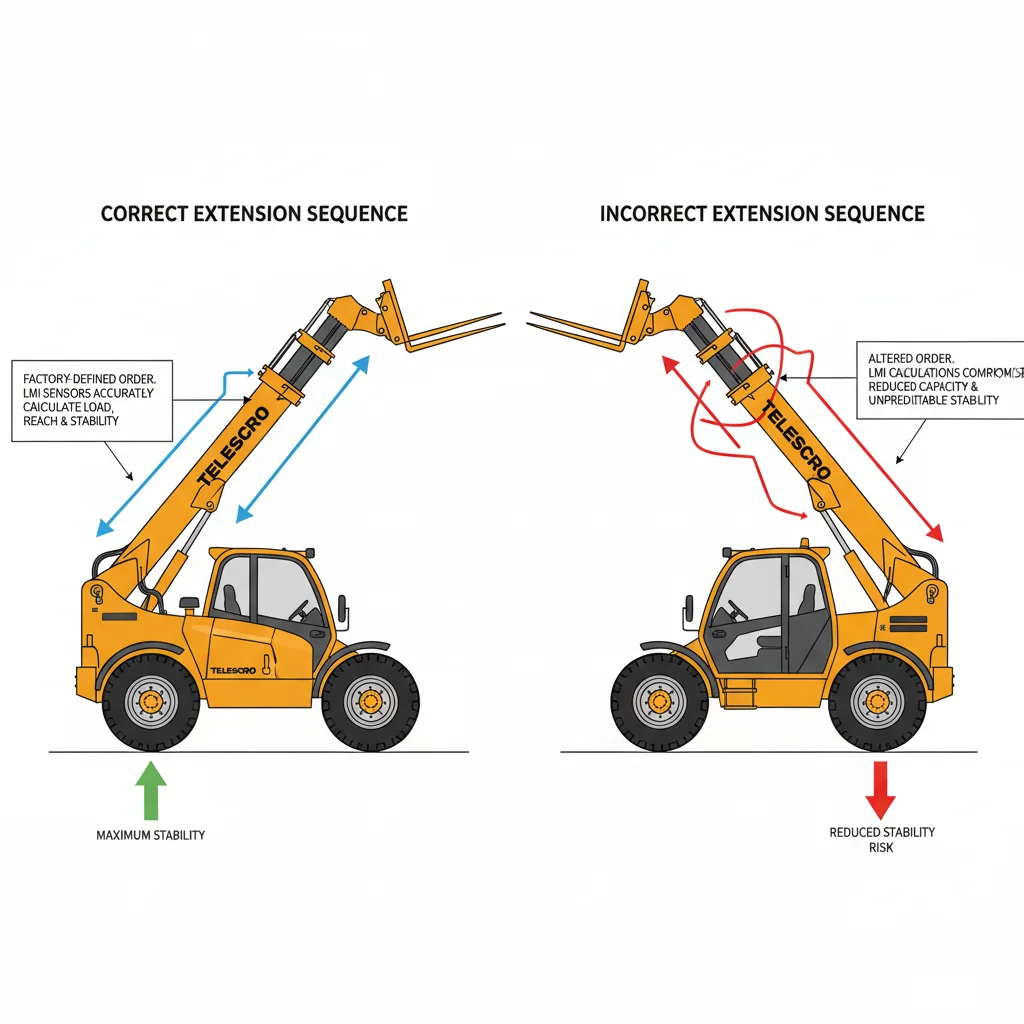
Last year, a project manager in Spain shared photos from a site where a 4-ton telehandler appeared to be operating within safe limits according to the display, yet felt increasingly unstable as the boom extended. Investigation showed that a local hydraulic adjustment had altered how the boom sections extended, creating a mismatch between the actual boom geometry and the system’s calibrated assumptions.
Load management systems rely on correctly calibrated inputs—such as boom length, boom angle, and axle or pressure sensing—to calculate stability margins. When hydraulic modifications, sensor bypasses, or improper adjustments change real boom behavior without corresponding recalibration, the system’s capacity indications can become unreliable. I’ve seen similar situations in other markets after attempts to “speed up” boom motion or work around faulty sensors. Any abnormal extension behavior should be treated as a critical stop-and-check issue, not a minor tuning problem.
To be honest, I’ve watched this mistake cost crews weeks or worse. On one site in Kazakhstan, a telehandler tipped when the outer boom section extended too early while lifting bricks at about 13 meters height—this happened even though the operator thought he was within the rated envelope. The LMI “green zone” meant nothing because the input sensor sequence was off. It’s not just about mechanics either. Some telehandlers change boom movement depending on attachment mode—like restricting outer extension for man basket use, keeping mass closer to the chassis for better stability. If a boom extends abnormally—hesitates, skips sections, or pulls out of order—it’s a red flag.
I always tell fleet managers: When you spot abnormal boom movement, stop the machine and investigate—don’t risk “good enough.” Only the original hydraulic and sensor configuration can give you true load monitoring and real jobsite safety.
An incorrect boom extension sequence can cause the telehandler's Load Moment Indicator to miscalculate lifting capacity, even though all hardware is functioning properly.True
The LMI software relies on a fixed sequence of boom extension to perform accurate load calculations. If the actual hydraulic sequence changes, the LMI uses incorrect geometry, making its capacity readings unreliable and potentially unsafe.
"AsFalse
Key takeaway: Tampering with boom sequencing or allowing abnormal extension behaviors undermines safety systems, as stability software calculates limits based on factory settings. Only the manufacturer’s specified extension sequence ensures accurate load monitoring. Treat unauthorized modifications or irregular boom motions as critical safety issues requiring immediate investigation before further operation.
Do Attachments Change Telehandler Load Chart?
Attachments alter a telehandler’s load center, directly affecting rated capacity and load chart sequencing. Manufacturers issue specific load charts for different attachments (forks, jibs, buckets, platforms), incorporating these geometry changes. Regional standards, such as ANSI or EN, also influence chart conservatism. Always verify the attachment-specific, region-compliant load chart before specifying or operating any telehandler.
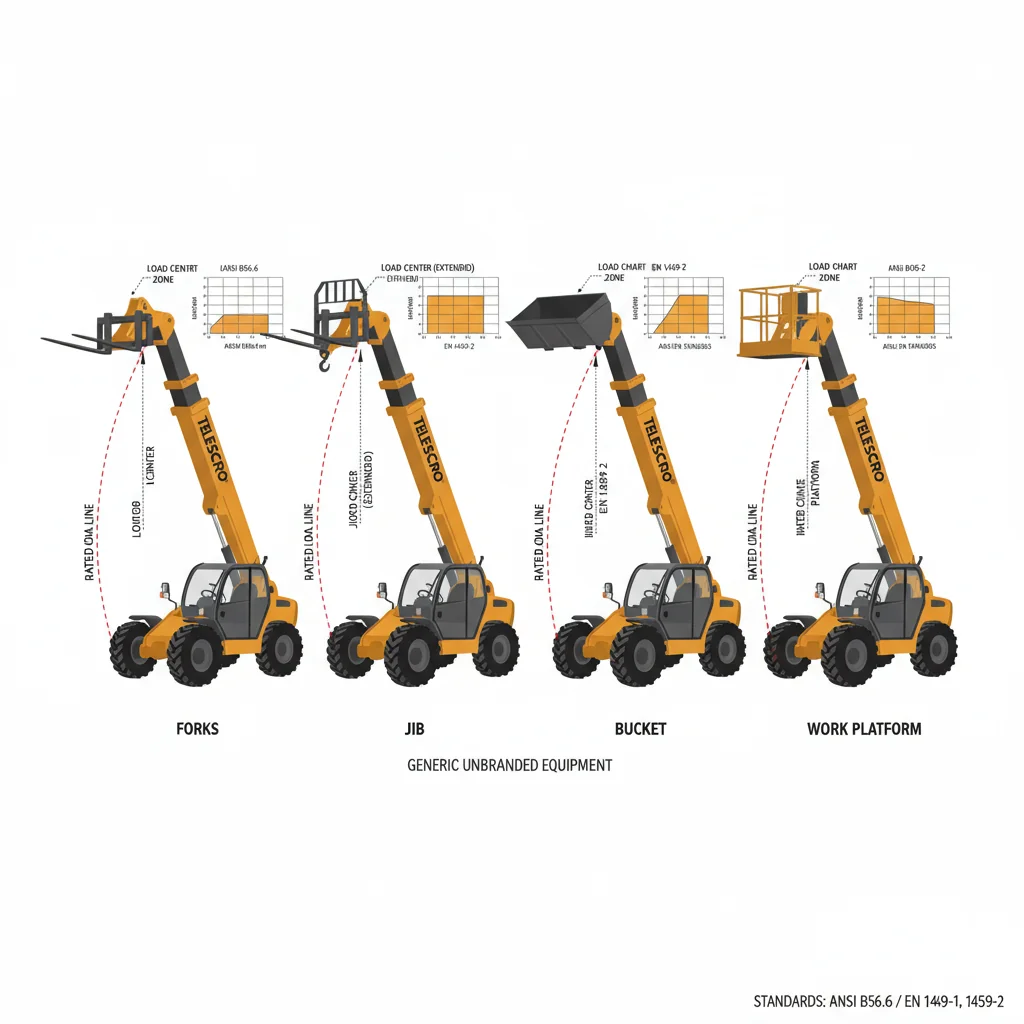
The biggest mistake I see is operators assuming the load chart for forks covers all attachments. That’s not the case—attachments like jibs, buckets, or work platforms change the machine’s geometry and shift the load center further out from the front tires, directly affecting stability and actual lifting capacity. I’ve seen this in Thailand, where a roofing contractor swapped a fork carriage for a 2-meter jib, expecting the same 3-ton rating at 8 meters reach. In reality, the chart for that jib only allowed about 1,200 kg at full extension—less than half the fork capacity.
Here’s what happens in real jobsites when you change attachments:
- Load Center Shifts7 – Buckets, jibs, or long platforms increase the horizontal distance from the front tire edge to the load center, forcing the boom to work harder and reducing safe lifting weight.
- Attachment Weight – Heavier tools eat into rated capacity. If the platform weighs 400 kg, you subtract that from the max shown on the chart.
- Zone Sequencing Changes – Some machines limit boom extension or movement earlier with certain attachments to keep stability margins.
- Region-Specific Charts – Attachments change both weight and load center, so OEMs provide attachment-specific load charts. Most charts are based on a stated standard load center (commonly around 24 in / 600 mm, depending on the OEM and region). If the actual load center is larger than the chart assumption, capacity must be reduced per OEM guidance.
From my experience training operators in Kazakhstan, ignoring these details leads to risky overloads—especially when regional standards (ANSI vs EN) aren’t matched to the machine’s documents. My advice: always check the load chart supplied for your exact attachment and make sure it’s approved for your region. Never assume a fork chart applies to a bucket, man basket, or jib.
The sequence in which a telehandler's boom is extended can impact the machine’s load capacity shown on the load chart, especially when specific attachments are used.True
Most load charts are based on specific boom extension and elevation sequences. Using attachments alters the geometry and center of gravity, making the order in which you extend or raise the boom crucial to maintaining stability and adhering to the correct load limits.
When attachments like jibs or buckets are installed, the telehandler’s original load chart for forks always remains applicable regardless of the boom extension sequence.False
Attachments change the telehandler’s load radius and weight distribution, which means the original load chart for forks is no longer valid. Ignoring this can lead to overloading and increased risk of tipping, as each attachment requires its own chart reflecting altered machine dynamics.
Key takeaway: Telehandler capacity changes with the attachment used. Load charts are attachment- and region-specific—never assume fork ratings apply to jibs, buckets, or platforms. Confirm that OEM documentation matches both the exact attachment and regulatory region before specifying, renting, or operating, as capacity and sequencing can change significantly.
Does Boom Extension Change Telehandler Capacity?
Boom extension sequence directly affects telehandler rated capacity8 and stability. Picking a heavy load with the boom fully extended can reduce usable capacity by 50–60%. Operators should lift at minimum reach, then raise and extend gradually, always referencing the manufacturer’s load chart for the current boom angle and reach.

Last year, I worked with a contractor in Kazakhstan who struggled with unexpected tipping issues on their 17-meter telehandler. They assumed the rated capacity of 4,000 kg applied everywhere on the chart. The problem? When they extended the boom out to nearly maximum reach—about 14 meters forward—the safe capacity dropped to just 1,600 kg. That’s a reduction of over 60%. Their site team didn’t realize that the boom extension sequence matters as much as the machine’s specs.
As a best practice, telehandler operators should pick loads with the boom as retracted as possible, using the machine’s most stable working zone. This minimizes load moment and keeps the combined center of gravity well inside the forward stability boundary defined by the stability triangle.
Once the load is clear and stable, the boom should be raised and extended gradually toward the target position. Operators should always reference the load chart for both boom angle and forward reach, not lifting height alone. The load chart defines rated capacity for each reach-and-angle combination, based on the reference point specified by the OEM (commonly the distance from the front tire to the load center).
Sudden extension or retraction with a suspended load shifts the center of gravity and creates dynamic forces beyond what’s calculated in the static chart. On rough ground—or if you’re even a few degrees off level—the risk rises fast. Some units have load moment indicators (LMIs), which will either warn or cut out movement when you’re near the edge. When that alarm comes on, stop immediately and retract until you’re back inside a safe zone.
My advice? Never assume capacity stays constant. Use the load chart for your exact configuration and extend the boom only when necessary. This habit can prevent accidents before they start.
A telehandler's lifting capacity generally decreases as the boom is extended further, due to increasing leverage and reduced stability.True
As the boom extends, the load moves farther from the machine's center of gravity, amplifying tipping forces and reducing safe lifting capacity regardless of the maximum rated load.
The boom extension sequence has no impact on the telehandler’s capacity as long as you don’t exceed the maximum rated load.False
Ignoring the extension sequence is unsafe; the telehandler’s capacity is directly affected by how far and at what angle the boom is extended, not just by the overall load weight.
Key takeaway: Telehandler stability and rated capacity depend not just on boom design, but on the operator’s extension sequence. Lifting loads at minimum reach and extending only as needed maintains safety and maximizes capacity. Always use the load chart and avoid sudden boom movements with suspended loads.
Does Boom Sequence Affect Capacity and Wear?
Boom extension sequence significantly impacts telehandler productivity, wear, and lifecycle costs. If the smallest-section cylinder extends most often, it cycles more frequently, accelerating wear on that section’s cylinder, pins, and wear pads. Efficient sequencing reduces cycle times and distributes wear, leading to both higher productivity and longer component life.

Last year, a client from Kazakhstan shared photos of a heavily worn boom section on a telehandler that had been in service for just two years. Investigation showed that, under their typical duty cycle, one boom section was extending on nearly every lift, while the other sections saw very little movement. This kind of uneven cycling can occur depending on boom design, sequencing logic, and how the machine is routinely operated.
When a single section carries most of the extension work, wear concentrates there. Over time, this accelerates issues such as hydraulic cylinder wear9, wear pad degradation, and pin or bushing looseness in that section. The result is earlier seal replacement, more frequent bushing work, and a higher risk of unplanned downtime.
The productivity impact is often underestimated. Illustrative example: if a job runs 300–400 lift cycles per day, even a few seconds of extra extension time per cycle can add up. A 4-second difference per cycle can translate into roughly an hour of lost time per week, or several dozen operating hours over a busy season. Those hours show up either as lost throughput or increased labor cost.
For buyers and fleet managers, this makes boom sequencing a legitimate lifecycle consideration—not just a performance detail. Ask the manufacturer how extension work is distributed across boom sections under typical operation. If inspections consistently show accelerated wear in one section, plan for closer monitoring, more frequent lubrication, and earlier component service in that area.
Uneven boom extension sequence can lead to accelerated wear on specific boom sections, causing higher maintenance needs and reduced structural integrity over time.True
When only one boom section extends regularly, it carries a disproportionate share of movement and load stress. This causes that section's pins, bushings, pads, and hydraulic cylinder to wear much faster than sections that remain largely stationary, leading to earlier failure and increased repair frequency.
The sequence in which telehandler boom sections extend has no effect on the machine's load capacity or component lifespan.False
Boom extension sequence directly affects both load distribution and wear of mechanical components. If one section extends most often, it experiences greater cycling and stress, leading to uneven wear and even reduced lifting capacity at certain reaches due to altered load dynamics.
Key takeaway: The way a telehandler’s boom sections extend can dramatically influence both operating efficiency and component longevity. Buyers should ask about boom sequencing, inspect high-usage sections more frequently, and recognize that optimized extension patterns can deliver greater value than small price differences between machines.
How Should Boom Sequence Be Field-Tested?
Boom extension sequence affects usable rated capacity throughout the telehandler’s load chart. Field-testing involves replicating the toughest scenario—matching load weight, reach from front tire edge, and maximum lift height. By performing side-by-side lifts and monitoring the LMI, buyers can directly compare capacity retention and sequencing smoothness in relevant job conditions.

To be honest, the spec that actually matters is how the boom behaves under your heaviest, most awkward lifts—not just maximum capacity printed on a brochure. I’ve watched crews in Malaysia test three "4-ton" telehandlers with 1,500 kg pallets, reaching into a seventh-floor window—about 9 meters out, lift height over 10 meters. All had similar invoices, but the load charts told a different story. One model kept its rated capacity nearly to full extension; the others started flashing the moment indicator halfway, cutting off extension when the load got close to the limit. That’s where real differences show up.
When you field-test boom sequencing, you want to replicate your most challenging site tasks. Set up the forks, a real test load, and mark your usual reach from the tire’s front edge. Start with the boom partly extended, then smoothly move through your normal working range—watching the load moment indicator (LMI) for early warnings or cut-outs. I’ve seen operators in Brazil get surprised when the LMI locks the boom just short of their target, even though the specs claimed “full capacity” almost everywhere.
It’s not all about raw numbers. How the boom sections extend—whether smoothly or in jerky stages—affects both your control and safety on-site. Some machines sequence all main sections evenly for balance, while others run one tube out first for faster reach but lose stability early. My advice: always compare side-by-side, using each OEM’s load chart and your toughest job scenario. That’s how you find practical mid-zone capacity and real operator confidence—not just headline features.
A telehandler's boom extension sequence can significantly affect its ability to maintain rated capacity at long outreaches, because certain designs redistribute weight and hydraulic forces more efficiently as the boom extends.True
Booms that sequence their extension from the base rather than the tip can keep the load closer to the machine's center of gravity for longer, helping the telehandler maintain stability and capacity further out.
As long as two telehandlers have the same rated maximum lift capacity, their performance at full boom extension will be nearly identical regardless of boom sequencing.False
Rated maximum lift only indicates the optimal conditions; different boom sequencing designs influence how much weight can be handled at longer reaches, and two machines with identical rated capacities may perform very differently at maximum outreach.
Key takeaway: Simulating real-world tasks is critical when selecting a telehandler. Field-testing each candidate’s boom extension sequence with representative loads and reach reveals genuine mid-zone capacity and practical operator experience—essential information not visible from headline tonnage or lift height specs. Always compare using actual OEM load charts and test conditions.
Conclusion
We’ve looked at how boom extension sequence can really change what a telehandler can handle on site, even if two machines have the same headline capacity. From my experience, buyers who check the full load chart details—not just max numbers—avoid costly surprises later. It’s easy to fall into the “3-meter blind spot” by trusting specs alone, but usable capacity at different extensions is what actually matters day to day. If you want help comparing load charts, or want a second opinion on which model matches your workflow, feel free to reach out. I’m always happy to share what’s worked for crews in the real world. Every jobsite throws something different at you; the right choice always fits your true working conditions.
References
-
Details the physics behind tipping moments, helping operators understand safe load limits and improve on-site safety. ↩
-
Understand why rated capacity on brochures may differ from real jobsite performance due to boom design and weight distribution. ↩
-
Comprehensive explanation of load charts, showing how they help operators understand safe lifting limits at various reaches and angles. ↩
-
Detailed analysis of how boom angle influences lifting capacity and machine stability, crucial for safe telehandler operation. ↩
-
Explains interpreting load charts to understand telehandler capacity variations based on boom angles and reach for safer, more efficient lifts. ↩
-
Details the impact of boom sequencing on load capacity and operational efficiency in challenging construction tasks. ↩
-
In-depth insight into how load center shifts reduce safe lifting weight and affect telehandler boom performance. ↩
-
Explore detailed insights on how boom extension impacts telehandler load limits and stability to prevent tipping hazards on site. ↩
-
Understand the factors accelerating cylinder wear, including frequent cycling of smaller boom sections, and how to extend component life. ↩