










How to Choose a Telehandler Big-Bag Lifting Attachment (Field-Tested Mistake Prevention)
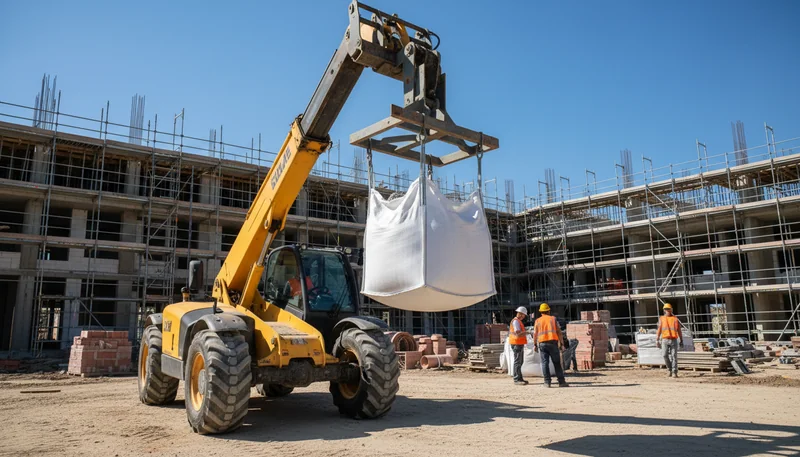
Last month, I watched a crew in Jiangsu struggle to lift fertilizer bags with a brand-new telehandler—until two bags ripped and the operator nearly lost control. The cause? A mismatch between the bags, the attachment, and the machine’s real capacity at full reach. It happens more often than most managers realize.
Correct selection of a telehandler big-bag lifting attachment requires aligning three key factors: the heaviest anticipated bag, the attachment’s certified Safe Working Load (SWL), and the telehandler’s capacity at the actual working radius. Capacity de-rates significantly as boom height and reach increase, making headline figures unreliable in most jobsite scenarios. Attachment mounting style—such as fork sleeves, pin-and-hook frames, or quick-coupler beams—affects both stability and operational efficiency.
How Should SWL and Bag Weight Align?
Safe telehandler big-bag lifting depends on aligning three key numbers: the heaviest expected bag, the attachment’s Safe Working Load (SWL), and the telehandler’s rated capacity at the working reach. Experts recommend selecting an attachment with an SWL at least 15% above the heaviest anticipated bag and consulting the load chart for each specific lifting position.
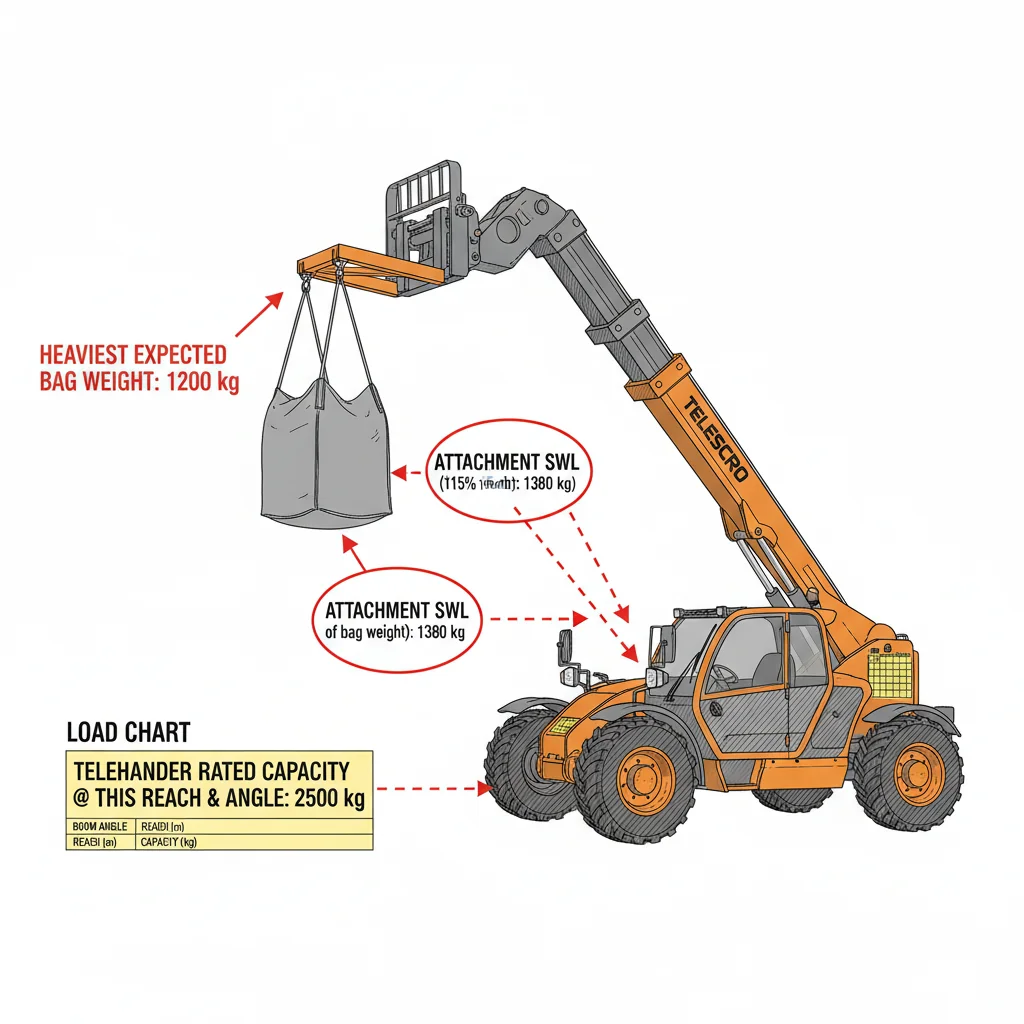
Most people don’t realize that lifting big bags with a telehandler is about more than just matching weight tags. Last year, I helped a team in Kazakhstan that thought a 1,200 kg bag would be fine with a 1,250 kg big-bag lifter. The problem? Their bulk orders sometimes included 1,350 kg fertilizer bags—well over the attachment’s Safe Working Load. A load like that risks a sudden failure or a tipped machine, especially on rough terrain. I always suggest building in at least a 15% safety buffer. So, if your heaviest bag is 1,350 kg, look for an attachment rated minimum 1,550 kg.
But here’s what matters most: never rely on your machine’s maximum capacity listed in the brochure. Telehandlers lose lifting power as soon as the boom extends. I’ve seen contractors in Dubai plan jobs using the “headline” rating—then discover at 8 meters reach, their 4-ton machine could only manage 1,400 kg safely. The load chart (which spells out safe weights at every boom angle and reach) is your best friend here. One bag might be fine at 4 meters, but risky or outright unsafe if you need to lift it further or higher.
Before you commit, check three things: the SWL plate on your attachment, your typical and peak bag weights, and your machine’s load chart at the working position. Operators in South Africa avoided a fine after consulting the load moment indicator before every lift. The right numbers protect your crew, your job schedule, and your machine. I suggest verifying these before every site change or new job order.
When selecting a big-bag lifting attachment, specifying a Safe Working Load at least 15% higher than the maximum bag weight ensures sufficient safety margin under dynamic conditions like rough terrain or sudden movementsTrue
A 15% safety buffer accounts for factors such as machine tipping risk, dynamic loading from terrain irregularities, and unanticipated load shifts, which static SWL-to-bag-weight matching does not consider. This reduces the likelihood of equipment failure or accidents.
Matching the big-bag lifter's SWL exactly to the heaviest bag weight guarantees safe operation as long as the telehandler's overall lifting capacity exceeds the bag weightFalse
Exact SWL matching ignores dynamic factors and load variability. The attachment’s rated SWL incorporates safety factors and should exceed the actual load to accommodate dynamic forces; relying solely on telehandler capacity without attachment margin risks equipment damage or tipping.
Key takeaway: Always match the big-bag attachment’s SWL to exceed the heaviest expected bag by at least 15%, and check the telehandler’s capacity at the desired reach. This approach prevents overloading, minimizes safety risks, and ensures stable, compliant telehandler operations during big-bag handling.
Which Telehandler Mounting Style Fits Best?
Choosing the correct telehandler big-bag lifting attachment depends on the mounting style: fork-mounted sleeves1, prong-style frames with pin-and-hook, or carriage/quick-coupler mounted beams. Carriage-mounted and OEM quick-coupler lifters provide superior stability and height for heavy, repetitive loads, while prong-style units with pin-and-hook excel in fast, multi-tool changeovers on demanding job sites.
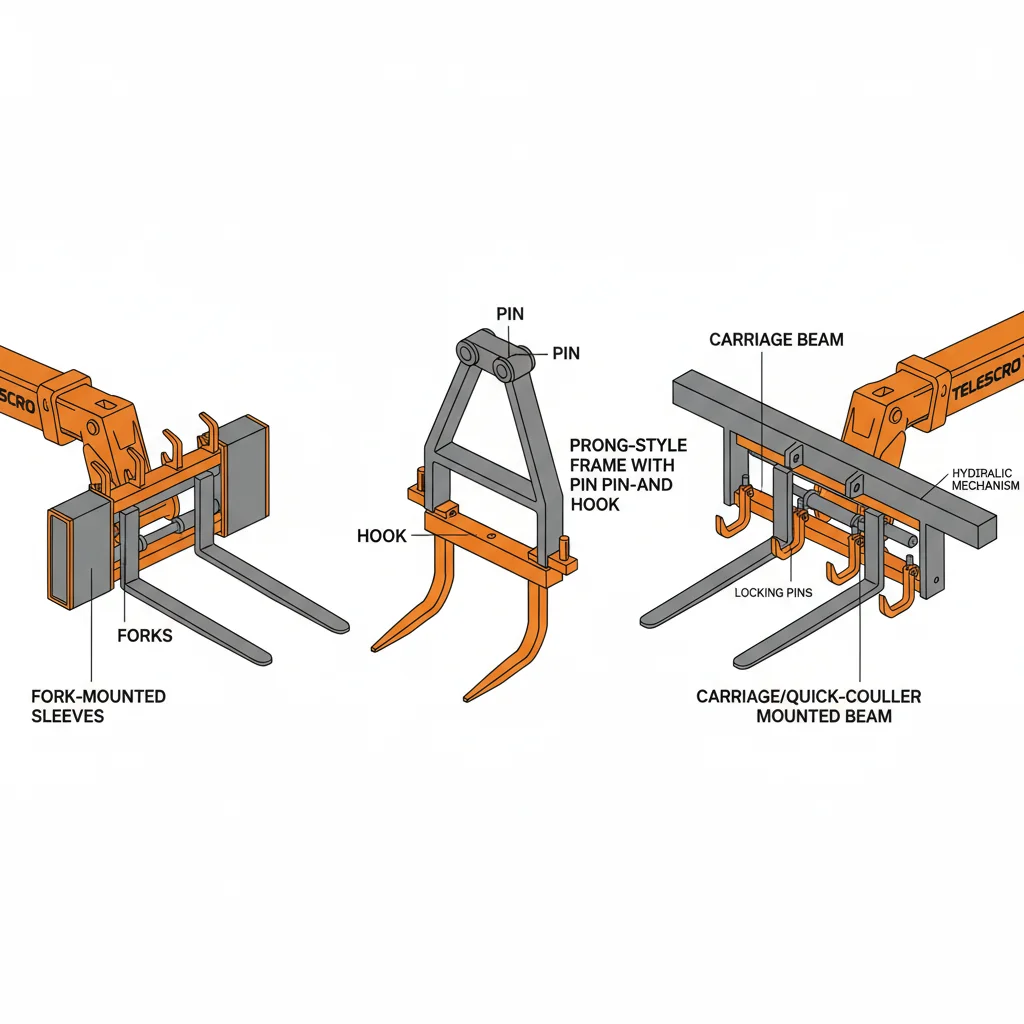
Let me share something important about telehandler mounting styles—this choice can really impact your day-to-day workflow. I’ve worked with a site manager in Dubai who switched from standard fork sleeves to a proper carriage-mounted big-bag beam2. Good decision. Their team moved from lifting only 1,000 kg bags at low heights to safely handling 1,500 kg sandbags up to 7.5 meters, all without struggling for stability or visibility. That’s a big productivity jump compared to using a loose fork sleeve (which can shift or flex under heavy cyclical loads).
Here’s a simple comparison table based on what I see most on jobsites:
| Mounting Style | Best For | Typical Capacity | Max Lift Height | Changeover Speed |
|---|---|---|---|---|
| Fork-Mounted Sleeves | Occasional, light use | 1,000–1,250 kg | 4–6 m | Fast (under 5 min) |
| Prong-Style Pin-and-Hook | Multi-tool quick swaps | 1,250–1,500 kg | 5–7 m | Very Fast (2 min) |
| Carriage/Quick-Coupler | Frequent, heavy lifting | 1,500–2,000 kg | 7–9 m | Medium (5–8 min) |
From my experience, prong-style pin-and-hook frames work well in Kazakhstan and Southeast Asia, where job sites often demand rapid switching between forks, bag lifters, and buckets. A project in Astana cut attachment downtime by over two hours per week after moving to a pin-and-hook system—those tool-free swaps add up fast.
My advice is straightforward: triple-check your carriage width (usually 1,200–1,550 mm), make sure the coupler matches your telehandler’s type, and never settle for a “forklift-only rated” lifter. Telehandler-rated beams are built for higher boom angles and rough ground, so safety and uptime won’t suffer.
Carriage-mounted big-bag beams improve lifting stability by distributing loads across the telehandler's entire carriage frame, enabling safe handling of bags up to 1,500 kg at heights exceeding 7 metersTrue
By mounting the big-bag beam directly to the carriage, the load is transferred more evenly, reducing torsional stress on the forks and frame. This allows operators to safely lift heavier loads to greater heights while maintaining machine stability and visibility.
Standard fork sleeve attachments inherently provide better operator visibility and stability than carriage-mounted big-bag beams when lifting heavy sandbagsFalse
Standard fork sleeves limit visibility because the load is carried directly on the forks, obstructing the operator’s line of sight. Additionally, sleeves concentrate load stress on the forks instead of distributing it, leading to reduced stability compared to carriage-mounted beams designed for big-bag lifting.
Key takeaway: Selecting the correct mounting style for big-bag lifting attachments3 prevents costly compatibility errors. Always verify the carriage width and coupler type, and ensure the lifter is telehandler-approved—not just forklift rated—to maximize safety, productivity, and uptime in varied telehandler operations.
How Does Site Layout Affect Attachment Choice?
Site layout directly shapes telehandler big-bag attachment selection requirements. Wider 4-hook crossbeams prevent bag collision during truck unloading or spreader loading, while compact or narrow-profile lifters suit tight barn access. On sloped or uneven ground, auto-levelling or pivoting beams improve bag stability. Carriage-mounted designs provide superior lift heights for high stacking or hopper loading operations.
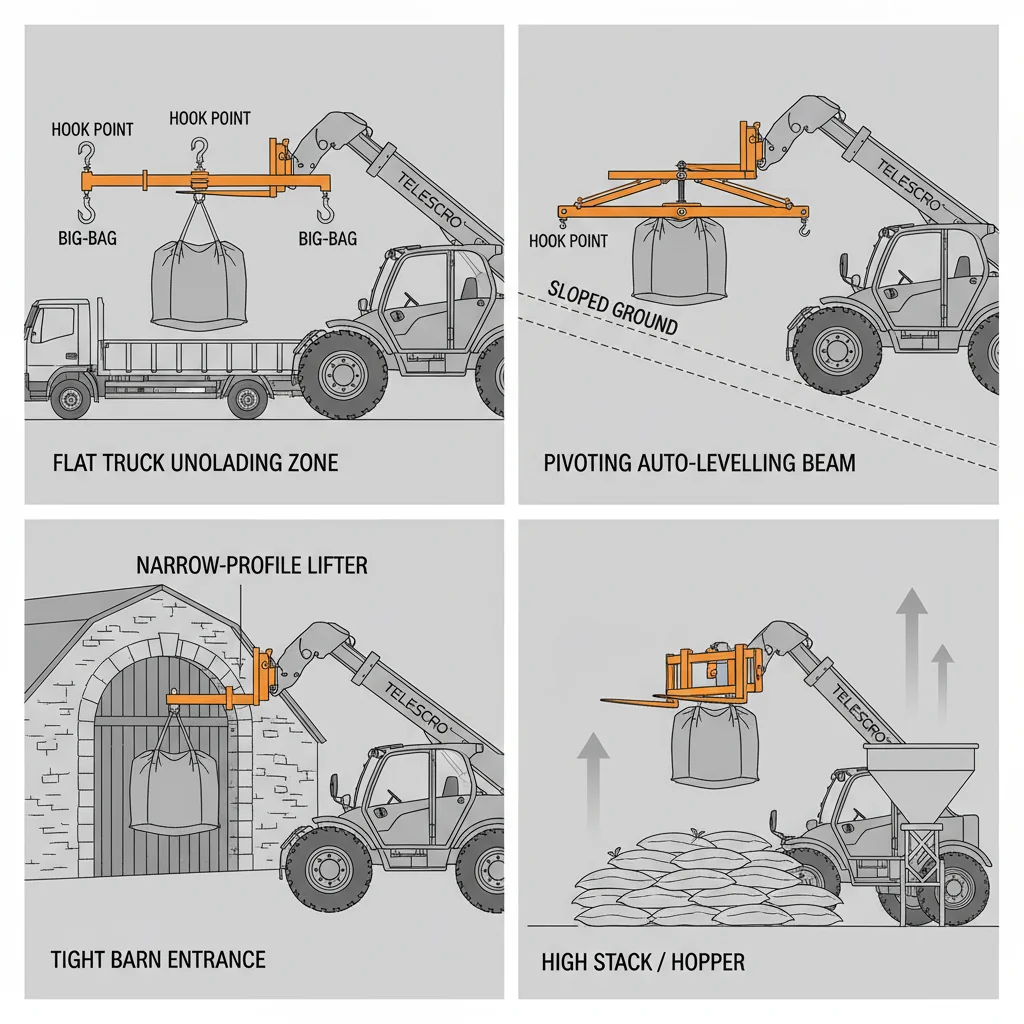
I’ve worked with customers who underestimated how much their site constraints would influence the choice of big-bag attachments. Take a customer in rural Denmark last autumn—they ordered standard fork sleeves for 1,000 kg fertilizer bags, thinking capacity was the only concern. Then came harvest season: barn doors only 2.4 meters wide, concrete beams just above the boom, and a tight turning circle because of feed bins. They called frustrated, bags swinging and getting caught, losing hours each week. The right attachment could have solved this from day one.
When you break down attachment selection, matching geometry to your site makes the work flow much smoother. Here’s what I always look at on a job walk:
- Wide crossbeam (4-hook) lifters – Best for open, flat sites where you’re unloading from trucks or loading spreaders. The wider spacing keeps big bags from banging into each other, reducing tearing and mess.
- Compact single-arm or narrow-profile lifters4 – Ideal for tight farmyards, warehouses, or inside barns where swing room is limited. These attachments can squeeze through smaller doorways and maneuver around support columns.
- Auto-levelling or pivoting beams – Critical if you’re operating on sloped, rough, or uneven ground. From my experience in Kazakhstan, farms with yard gradients over 10% see less spillage and safer operation thanks to these stabilizing features.
- Carriage-mounted designs – If you’re stacking two or three bags high or loading into tall hoppers, carriage mounting gives you extra lift height compared to fork-mounted sleeves.
When operating in sites with barn doors narrower than 2.5 meters and overhead obstructions within 3 meters, using rotating or swing-type big-bag attachments can prevent snagging and improve maneuverability.True
Standard fixed fork sleeves can cause big bags to swing uncontrollably in tight spaces with low overhead clearance; rotating attachments allow the operator to adjust the bag's orientation, reducing the risk of collision and improving cycle times in constrained environments.
The load capacity of a big-bag attachment is the sole factor to consider, as site layout has no significant impact on attachment performance or safety.False
Site constraints such as narrow doors, overhead obstacles, and tight turning radii significantly influence how safely and efficiently a big-bag attachment can be used; ignoring these can lead to damaged loads, equipment, and delays despite adequate load capacity.
Key takeaway: Effective lifting attachment selection considers not only capacity but also site-specific constraints like maneuvering space, load stability, and process flow. Matching attachment geometry and features to actual workflows and terrain reduces operational delays, bag damage, and safety risks, supporting seamless material handling on any telehandler jobsite.
Why Do Telehandler Big-Bag Loop Configurations Matter?
Loop and hook configurations in telehandler big-bag lifting attachments ensure proper load distribution and bag stability. Four-loop (cruciform or rectangular) beams reduce bag deformation and swinging, especially on uneven terrain. Match the attachment’s hook layout and spacing to the FIBC’s loop dimensions to prevent unsafe improvisation, bag failure, or accidental load drops.

The biggest mistake I see is crews using whatever attachment happens to be on-site, instead of matching the telehandler lifter to the bag’s actual loop spacing. Last year in Kazakhstan, a customer tried to move fertilizer in 1,000-kg big-bags using a 2-loop jib because that’s all they had available. They ended up lifting from just two of the four bag loops, risking bag tear and a load drop. Luckily, no one was hurt—but they did lose two bags and had to stop work for an hour to clean up the spill. The cost of lost material and downtime easily outweighed the price of the correct spreader beam. Here’s what matters most when handling big-bags: the spacing and number of hooks or claws on the attachment must line up with all bag loops.
Standard four-loop FIBCs often have loops spaced between 900 mm and 1,100 mm apart. If your spreader beam’s hooks don’t match, you end up with loops stretched at awkward angles, or worse—some loops not supported at all. This isn’t just a paperwork issue. When you drive over uneven ground, unsupported loops shift or slip entirely. That’s when bags swing out or even fall off. For jobsites handling a variety of bag sizes, I always suggest looking for lifters with adjustable hook positions or interchangeable adapters. I’ve seen this in Dubai, where one project handled bulk cement and smaller seed bags on the same day.
Using a lifting attachment that matches the big-bag's loop spacing ensures an even load distribution across all loops, which minimizes stress points and reduces the risk of bag rupture during lifting.True
Big-bags are designed with loop configurations (usually 4 loops) to evenly distribute weight. Using an attachment that only grips some loops shifts load unevenly, increasing the chance of tearing the fabric under high stresses. Matching the loop spacing maintains structural integrity and safe handling.
It is safe to use a 2-loop jib attachment for lifting standard 1,000-kg fertilizer big-bags since the weight is evenly supported by only two loops, which simplifies rigging.False
Standard 1,000-kg big-bags are designed to be lifted by all four loops to evenly distribute the load. Using only two loops concentrates the weight on fewer points, greatly increasing the risk of fabric failure and load drops, making this practice unsafe.
Key takeaway: Selecting the correct loop and hook configuration for telehandler big-bag attachments prevents unsafe handling and reduces risk of bag failure. Always verify attachment compatibility with bag specifications to ensure all loops are securely captured, maintaining safety and efficiency during transport—especially when conditions are rough or bags vary in loop spacing.
What Safety Standards Must Big-Bag Attachments Meet?
Big-bag lifting attachments for telehandlers must display a clearly marked, certified Safe Working Load (SWL), visible load plates, and carry documentation proving compliance with standards like EN 131555 (EU) or GB 6067 (China). Safety decals are essential and additional features—such as safety chains or electrical isolators—may be required on regulated sites.
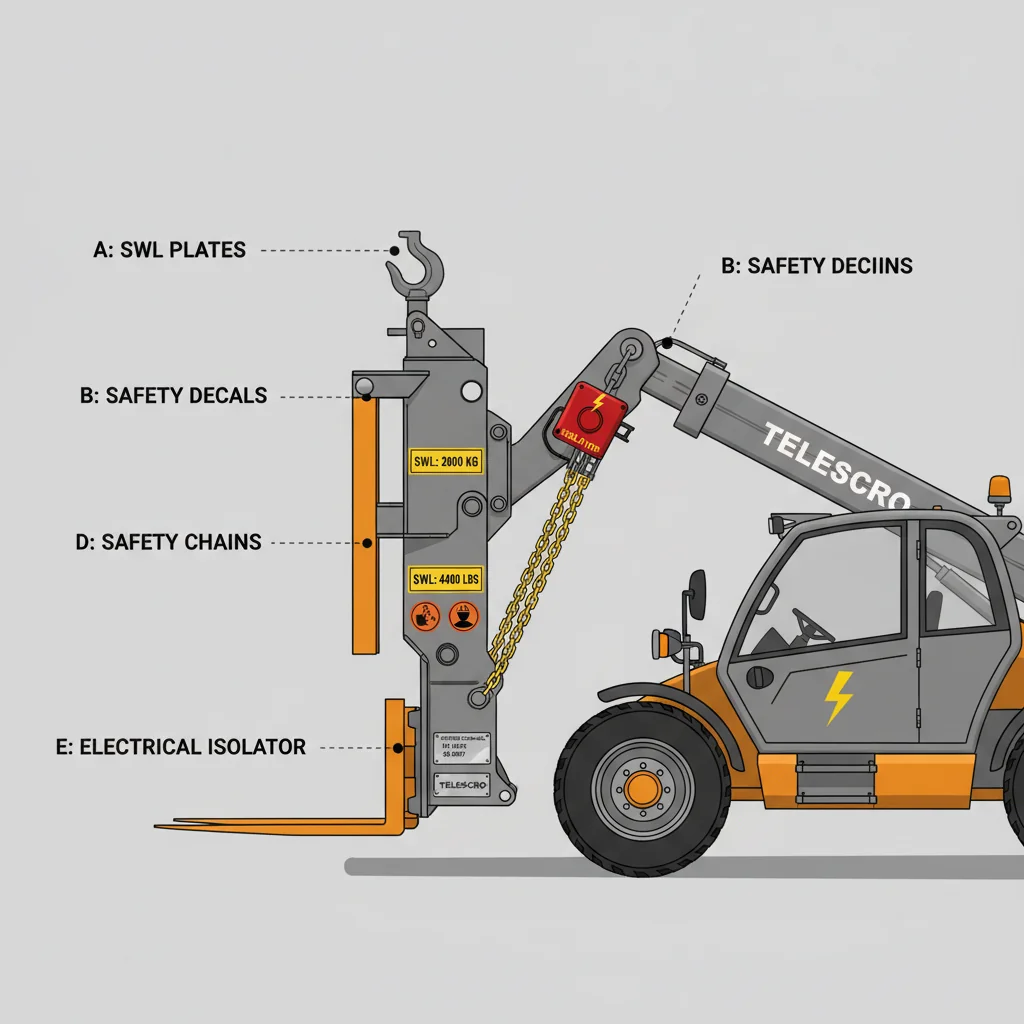
To be honest, the spec that actually matters is certified Safe Working Load (SWL) and real proof of compliance. I see too many sites—especially in fast-growing regions like the Middle East—where crews trust attachments with faded plates, or no markings at all. That’s a shortcut asking for trouble. On a Dubai high-rise project last year, I watched a team get stopped mid-lift because their big-bag hook lacked EN 13155 markings. Ten workers waited for hours while site inspectors argued about safety paperwork. Lost time and lost trust are not worth it.
Every big-bag lifting attachment should have, at minimum:
- Clearly marked SWL — Stamped or engraved, not handwritten, and visible from the operator’s cabin.
- Visible load plate — Shows rated load, model, and attachment ID for on-the-spot checks.
- Compliance documentation — Certification for EN 13155 (EU), GB 6067 (China), or the local lift standard.
- Required safety decals — Warning stickers and correct usage diagrams, especially for multi-language crews.
- Safety features for regulated sites — Some places, like Australia or Norway, require extra safety chains or electrical isolators included in your lifting setup.
In operation, always use all four bag loops vertically, never two at a time “just for speed.” Dragging bags sideways or shock-loading the hook is one mistake I’ve seen result in torn bags—and close calls. At least once a year, I hear a story about a bag swinging over someone’s head. The fix? Clear warning stickers and repeat safety training.
I suggest checking SWL marking and paperwork before accepting any new attachment on site. That step can prevent injuries, delays, and expensive inspection failures.
Big-bag lifting attachments must comply with EN 13155 standards, which specify mandatory markings including Safe Working Load (SWL) and manufacturing detailsTrue
EN 13155 is a European standard focused on safety requirements for non-fixed load lifting attachments, requiring clear marking of SWL, manufacturer identification, and traceability to ensure safe operation and regulatory compliance. Without these markings, the attachment cannot be reliably verified for its intended load capacity.
Big-bag attachments without EN 13155 markings can still be safely certified if they carry ISO 9001 quality management certificationFalse
ISO 9001 certifies quality management systems but does not set technical or safety standards for lifting attachments. Compliance with EN 13155 or equivalent lifting-specific standards is necessary to ensure safe working loads, structural integrity, and traceability; ISO 9001 alone cannot guarantee these critical safety aspects.
Key takeaway: Choosing big-bag attachments that are fully certified, clearly marked for SWL, and compliant with regional lifting standards is essential for site safety and legal compliance. Incorporating correct operating practices further prevents serious accidents and reduces the risk of injury, equipment damage, and regulatory penalties.
How to Inspect Telehandler Big-Bag Lifters?
A routine inspection of telehandler big-bag lifting attachments involves checking loop retainers, welds, and connection points for cracks, deformation, or excessive wear before each shift. Moving parts such as hydraulic hoses, cylinders, and pivot points require examination for leaks and proper function. Regular inspection and maintenance dramatically reduce risks of lift failures and operational downtime6.
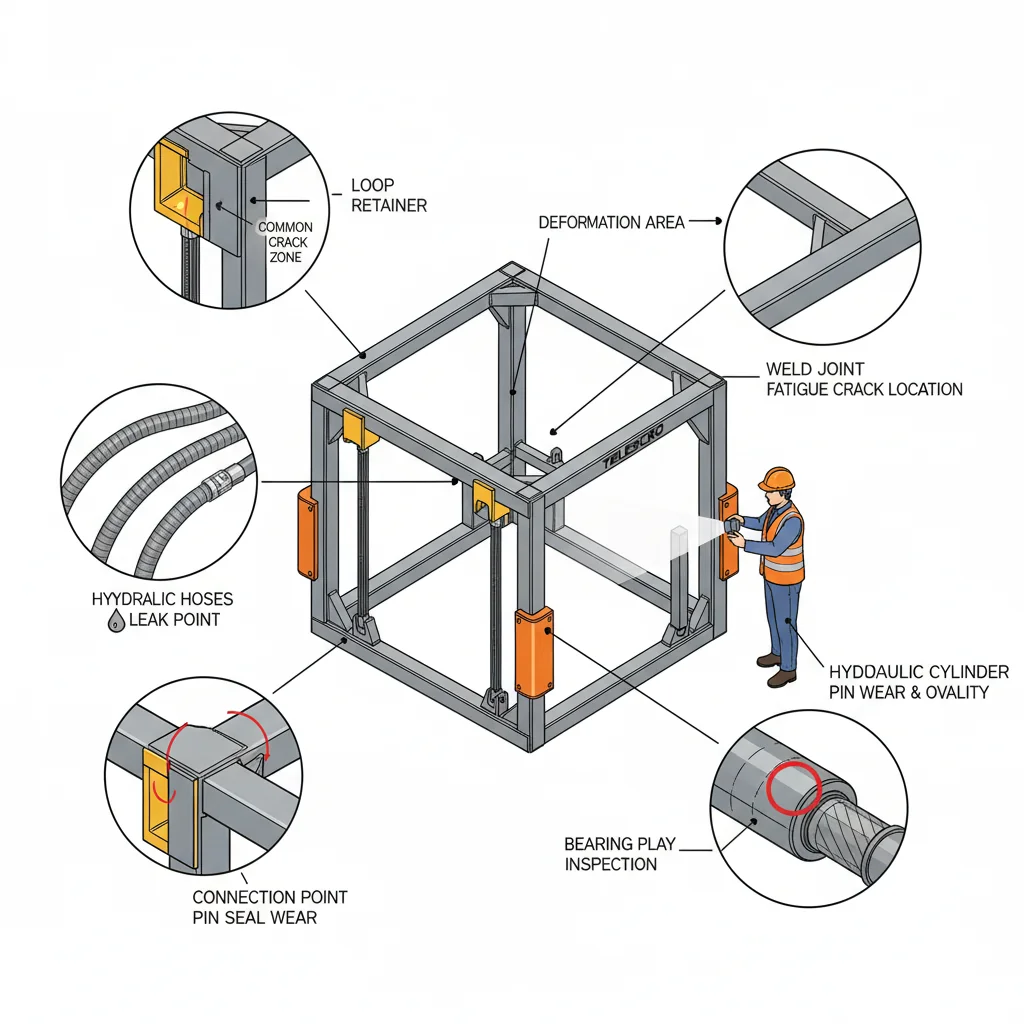
Here’s what matters most when inspecting telehandler big-bag lifters: you want to spot problems before they become safety incidents. Just last year in Dubai, a customer sent me photos of a cracked weld on their 3-ton attachment. The operator almost missed it during a routine check, and that crack could have failed under a full load. I always tell customers—start with a close look at the loop retainers or hooks. If you see any deformation, deep scoring, or even a small crack, take that lifter out of service right away. Hooks that even look slightly stretched can let a bag slip out when lifting one ton or more.
Next, check every weld and mounting plate for signs of rust or tiny hairline cracks. On a fertilizer project in Brazil, we saw corrosion set in just six weeks after heavy rain, especially around the base plates. I suggest rinsing and drying painted lifters after work in wet or corrosive sites. If you’re running attachments with hydraulics—spreaders or rotating hooks—inspect hoses for abrasions, pins for missing clips, and cylinders for any oil seepage. Hydraulic leaks look minor at first but can cause sudden drops during a lift.
Every 50 working hours, do a full inspection: check all welds, measure hook openings for signs of bending, and confirm the safe working load (SWL) marking is easy to read. Keep a simple logbook, just a paper sheet or digital note. One missed defect can shut down a whole shift. Consistent checks like this are the easiest way to avoid both accidents and costly downtime.
Inspecting the thickness of the big-bag lifter’s steel plate around the hook area is crucial, as a reduction of just 1 mm due to wear or corrosion can compromise the attachment’s rated load capacity.True
Steel plate thickness directly affects the structural integrity of the lifter. Even minimal thinning near load-bearing points, like hooks or loop retainers, can cause unexpected failure since design load ratings assume original material thickness. Regular micrometer checks help catch early wear.
Replacing big-bag lifter hook pins every 5 years is mandatory regardless of wear because metal fatigue always occurs within that timeframe.False
There is no fixed 5-year replacement interval for hook pins; instead, replacement depends on actual inspection findings such as wear, deformation, or corrosion. Fatigue life varies widely depending on usage and maintenance, so decisions should be condition-based rather than time-based.
Key takeaway: Consistent inspection and timely maintenance of big-bag lifters prevent accidents and unexpected downtime. Field-tested routines—checking hooks, welds, hydraulics, and periodic detailed assessments—are essential. Capturing these checks in a logbook ensures damaged components are not missed and improves operational safety for every shift.
How to Evaluate Telehandler Lifter ROI?
Total cost of telehandler big-bag lifters extends beyond initial price, as frequent bag damage, operational downtime, corrosion, and safety incidents significantly impact long-term ROI. Galvanized or stainless-steel lifters7 cost 10–25% more but offer improved durability in harsh fertilizer or saline conditions, reducing replacement frequency. Factoring workload, service life, spare part availability, and bag drop consequences is essential for accurate evaluation.

Last month, a grain terminal in Kazakhstan contacted me about chronic issues with their basic powder-coated lifters. They’d budgeted for three new units at around €600 each but were replacing them every 12 to 18 months due to corrosion and bent hooks—salty fertilizer dust ate through the paint faster than anyone expected. Every replacement also meant half a day’s lost loading, plus the risk of torn big bags spilling product over the yard. I always point out that saving €100 up front can quickly disappear after the first unplanned stoppage.
Quantifying ROI means looking beyond that initial invoice. For example, on projects moving 10 to 20 fertilizer bags daily, a good galvanized or stainless-steel lifter might cost €700–750—a 15% premium. But in harsh settings, these models often last at least three seasons, compared to a single season for entry-level ones. That extra year or two cuts your annual cost by half or more.
Operational downtime is another hidden cost. In Brazil, one customer told me a dropped bag forced three operators to stop work for hours. Cleanup, wasted product, and even minor frame repairs sometimes added up to €300 per incident. If your supplier can’t get replacement pins or bushings quickly, this “parts roulette” can drag on for days.
I suggest tallying your annual workload and downtime across a full season. Then, ask the supplier for real-world durability testimonials from similar sites. Choosing a lifter that matches your actual environment, even if it’s not the cheapest, usually pays off in reliability and peace of mind.
Choosing big-bag lifters with epoxy powder coating rather than standard powder coating can extend corrosion resistance life by up to 50% in salty fertilizer environmentsTrue
Epoxy powder coatings offer superior chemical resistance compared to regular polyester powder coatings, significantly slowing corrosion from fertilizer dust and moisture, which prolongs the lifespan of lifting attachments in harsh environments.
Replacing hooks on telehandler big-bag lifters every six months is recommended to comply with safety standards in agricultural loading operationsFalse
There are no specific safety standards mandating hook replacement every six months; instead, hook replacement schedules should be based on thorough inspections for wear, deformation, or damage rather than arbitrary time intervals.
Key takeaway: Evaluating telehandler big-bag lifting attachments requires analyzing not just purchase price, but also operational environment, maintenance factors, and potential costs from product loss or downtime. Investing in corrosion-resistant, higher-spec models aligned with daily usage often yields superior ROI by minimizing unexpected failures and repetitive replacement cycles.
When Are Custom Telehandler Bag Lifters Needed?
Specialized telehandler big-bag lifting attachments are needed when handling abrasive, extra-heavy, or non-standard bags. Purpose-designed claws, reinforced frames, or hydraulic spreaders8 prevent damage and improve safety for challenging loads, such as cement, minerals, or welded wire mesh. Customizable hooks and adapters reduce bag loop abrasion, lower damage rates by up to 30%, and support varying bag widths efficiently.
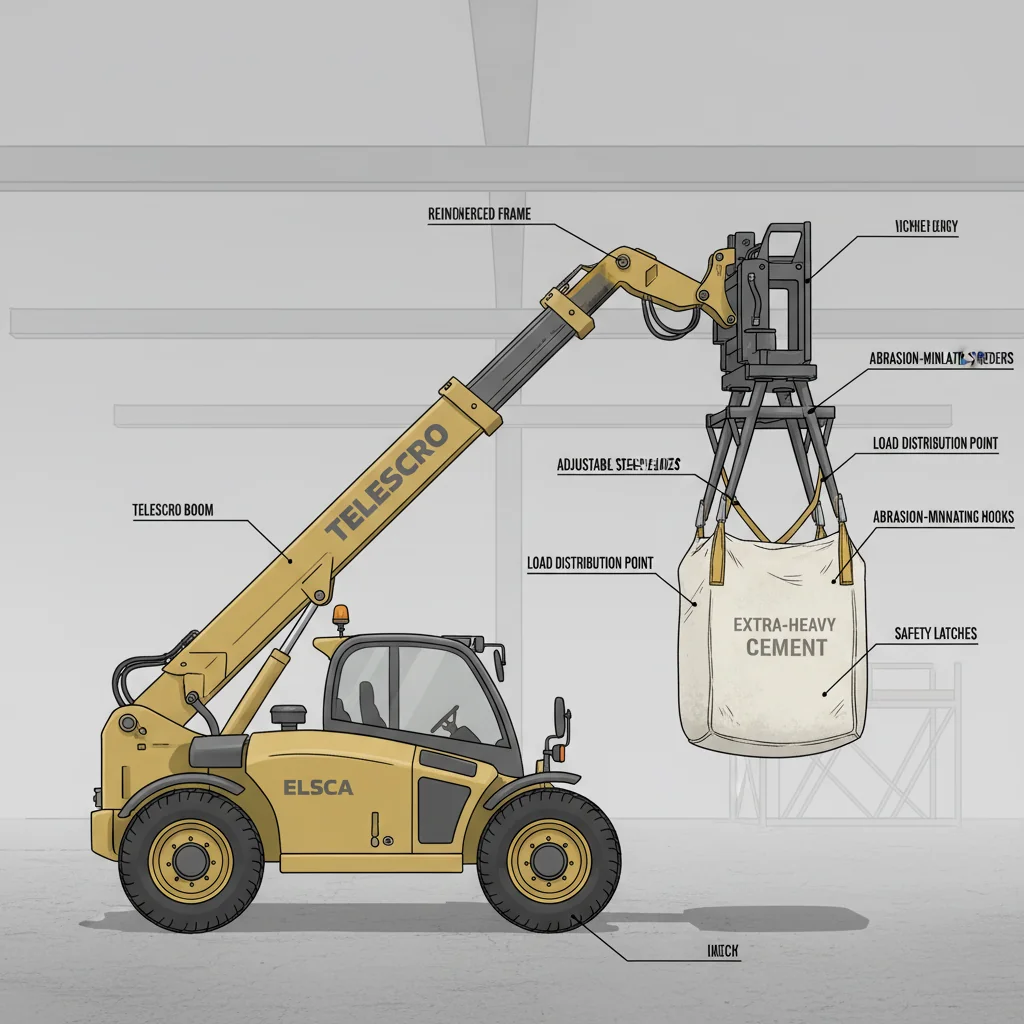
From my experience, standard big-bag lifters work fine—until your site starts moving materials like abrasive cement or dense mineral bags. That’s when trouble hits. One customer in Brazil tried using off-the-shelf attachments with recycled plastic-loop bags, but they lost over 25 bags per week to torn loops and ripped seams. The material itself wasn’t the only problem—the sharp edges of standard forks, combined with constant movement, shredded even heavy-duty loops over time. They switched to a reinforced lifter with round, rubber-coated hooks, and the bag damage rate dropped by nearly a third in the first two months.
Another scenario I saw in Kenya involved a site handling both fine gravel and large welded wire mesh. Their telehandler had to lift 1.5-ton bags and unwieldy mesh bundles. Using hydraulic spreaders let them handle both safely, without risky modifications or wasted time swapping attachments. It cost them about 15% more upfront for the semi-custom lifter, but it saved them more than two full days per month since they cut out most bag failures and re-handling.
If you mix bag types—say, fabric loops for fertilizer and stiffer paper-loop industrial bags—look for adjustable or bolt-on adapters. I’ve seen these adapters handle everything from 900 mm to 1300 mm wide bags without risky balancing tricks. It pays to send your supplier the actual bag drawings and describe your main materials. If you’re loading more than 300 bags per week, the extra investment for a tailored attachment usually pays off within a season. I suggest focusing on damage rates and lost time, not just the price tag.
Custom telehandler big-bag lifters often incorporate rounded or padded fork edges to prevent abrasion damage to plastic loops, significantly reducing bag loss rates by up to 80% on sites handling abrasive materials.True
Sharp-edged forks cause friction and tearing in plastic loop bags, especially with abrasive contents; customizing lifters with smoother contact surfaces distributes pressure more evenly, minimizing material wear and extending bag lifespan.
Standard telehandler forks are designed to automatically adjust their angle to prevent damage to big-bag loops during operation, eliminating the need for custom bag lifters in all scenarios.False
Typical telehandler forks have fixed angles and do not feature automatic adjustment mechanisms to protect bag loops; this limitation can lead to loop damage when handling abrasive or heavy materials, making custom lifters necessary in certain conditions.
Key takeaway: Evaluate actual material types, bag loop designs, and site handling risks when selecting big-bag attachments. For abrasive, heavy, or high-volume loads, a specialized or semi-custom lifter optimizes safety, minimizes waste, and pays for itself by reducing damage and downtime—especially when several bag types or non-standard packaging are in use.
Should Big-Bag Lifters Fit Forklifts Too?
Dual-machine compatible big-bag lifting attachments9—featuring integrated fork pockets—allow use with both telehandlers and forklifts. This increases attachment utilization across varied sites. However, verifying fork pocket dimensions10, rated load approvals, and operational stability is essential to ensure safe, compliant lifting. For mixed fleets, dual-use designs streamline operations, while single-telehandler users may find little added value.
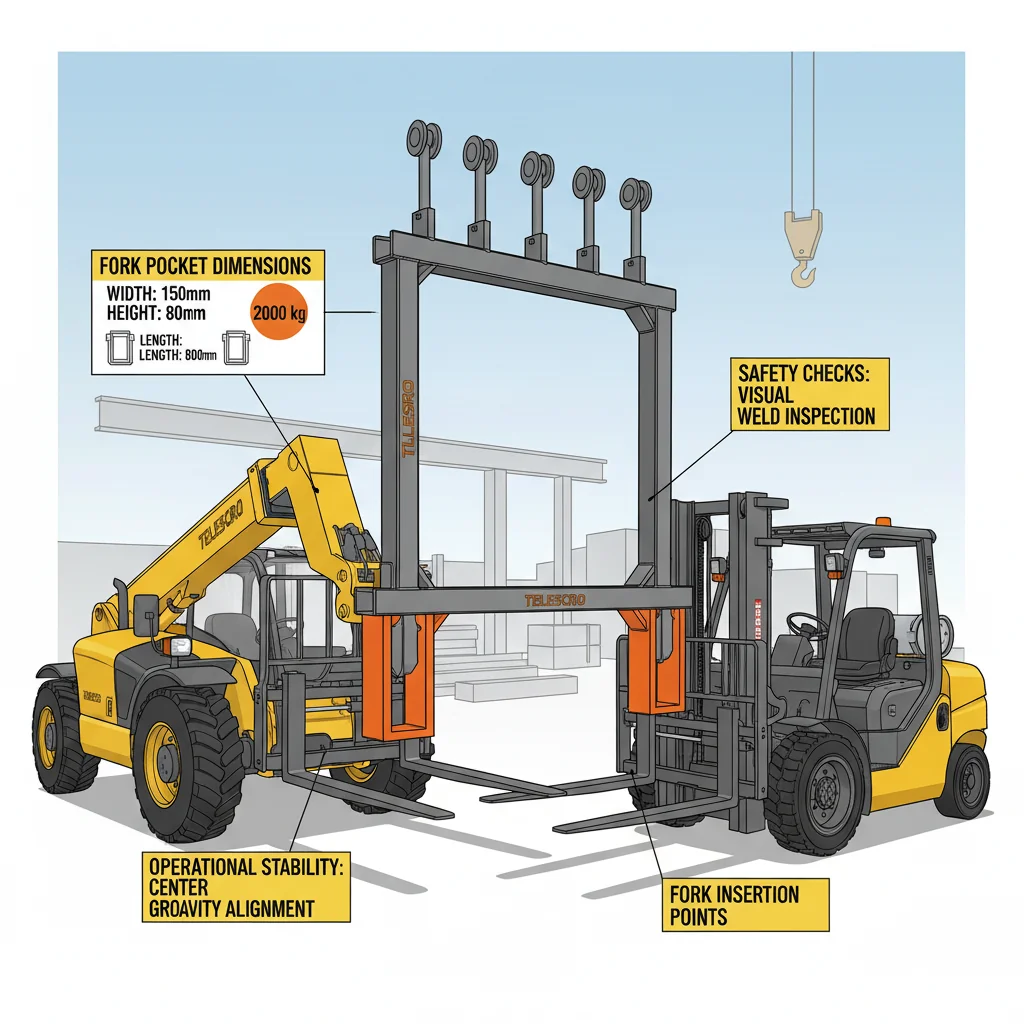
I’ve worked with customers who made this mistake—assuming every big-bag lifter with fork pockets is automatically safe to use on both telehandlers and forklifts. In Dubai last year, a logistics yard manager tried sliding a 2-ton big-bag beam onto his warehouse forklift’s 120 mm-wide forks. The fork pockets fit, but the lifter’s SWL rating didn’t cover forklift use at all. When lifting above 1.5 meters, the pallet truck wobbled badly, and they narrowly avoided a spill. The jobsite delay cost them at least two days.
It’s common to see dual-use attachments—those with integrated fork pockets—making sense on mixed fleets. I’ve seen this approach save costs for rental companies in Brazil. One manager told me a single dual-compatible lifter reduced his inventory needs by a third, allowing both the 3-ton telehandler and their 2.5-ton warehouse forklift to handle 1,000 kg fertilizer bags. Still, size isn’t everything. Always match pocket width, fork thickness, and spacing carefully. Check that the factory’s documentation lists forklift operation as approved, not just telehandler quick-coupler use.
Two other details matter. Visibility drops when the load sits lower on a forklift mast—especially indoors where boom reach doesn’t help. Stability is also different. Forklifts have less counterweight than telehandlers, so the same load can feel much heavier.
For mixed fleets, dual-use lifters can streamline logistics and reduce duplication. But if you run only telehandlers on your site, I suggest prioritizing durability and telehandler-rated performance. Don’t spend extra on features you’ll never use.
A big-bag lifter with fork pockets designed solely for telehandlers may have an SWL rating that does not account for the lateral instability of forklift forks, especially when lifting loads above 1.5 metersTrue
Telehandler forks and forklifts differ in dimension and load dynamics; telehandlers often have wider, heavier-duty forks and chassis designed for offset loads, whereas forklifts have narrower forks causing higher instability risks with attachments not rated for forklift use. This makes the SWL rating non-transferable and unsafe if used on forklifts.
If a big-bag lifter fits securely on forklift forks, it can safely handle the same load capacity as on a telehandler, since fork pocket dimensions determine load compatibility rather than machine typeFalse
Fork pocket dimensions alone don't account for differences in machine stability, chassis design, or lifting dynamics. A lifter rated for telehandlers may be unsafe on forklifts because forklifts’ narrower forks and different load centers can create instability or overload, regardless of physical fit.
Key takeaway: Dual-compatible big-bag lifters can reduce equipment costs and improve versatility for mixed telehandler and forklift fleets. Always confirm size compatibility, safety ratings, and manufacturer approvals for each machine type. For telehandler-only operations, focus spending on specialized, high-durability telehandler attachments instead.
Conclusion
We’ve looked at how to choose the right big-bag lifting attachment for your telehandler and why matching capacity to real jobsite loads is so important. From what I’ve seen, decisions based only on max specs often run into trouble—it’s what your machine can handle at working reach that matters most. If you want to avoid the "showroom hero, jobsite zero" trap, check the load chart at the exact boom position you’ll use and leave a safety margin. Need advice on attachment fit, load limits, or sorting through your options? I’m always happy to share what’s worked for crews in different countries. Feel free to reach out—every jobsite has unique challenges, and the right setup always comes down to real-world use.
References
-
Detailed insights on fork-mounted sleeves, including their capacity and best use cases for light telehandler lifting tasks. ↩
-
An expert look at how carriage-mounted beams enhance stability and lifting height, boosting safety and productivity on job sites. ↩
-
Explore how specific loop and hook configurations in lifting attachments prevent bag deformation and improve safety on uneven terrain. ↩
-
Details why narrow-profile lifters are ideal for restricted farmyards or barns, improving maneuverability and preventing bag swing issues. ↩
-
Detailed insights on EN 13155 safety standards ensure compliance with EU regulations, vital for legal and operational site safety. ↩
-
Details hidden costs of operational downtime due to lifter failures, emphasizing productivity loss and long-term financial impact. ↩
-
Explains durability advantages of galvanized vs stainless steel lifters in corrosive environments for longer service life and ROI. ↩
-
Learn how hydraulic spreaders enhance load stability and safety for heavy or awkward materials like welded wire mesh. ↩
-
Explore how dual-compatible lifters optimize asset utilization and operational efficiency across telehandlers and forklifts on diverse job sites. ↩
-
Understand the critical role of fork pocket size and rating in ensuring safe, compliant lifting and avoiding costly on-site accidents. ↩