










Can a Telehandler Lift People? Field-Tested Safety Checklist for Buyers
Last month, I was on a rural jobsite in Poland when a site supervisor rolled up, asking if his telehandler could "quickly lift a couple workers to fix some loose panels." He figured a pallet and some straps would do the trick. It’s a question—and a misconception—I still see far too often.
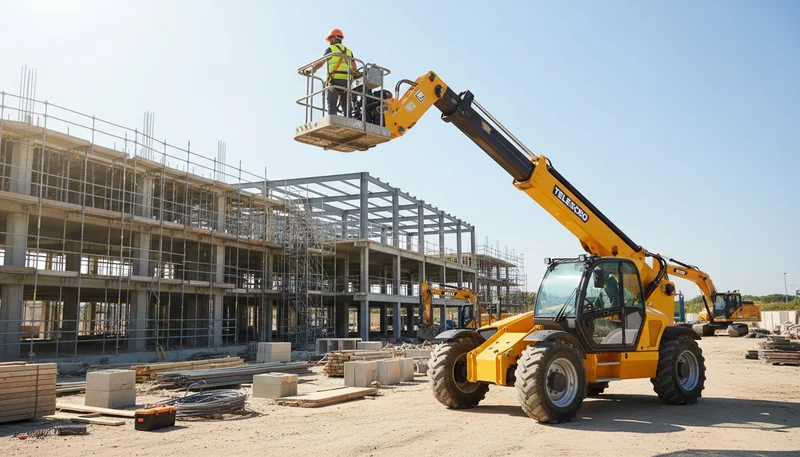
Yes. A telehandler can lift people only under strict conditions: the manufacturer must explicitly approve personnel lifting for that specific model and configuration, a certified and compatible personnel work platform must be used, and all applicable local safety rules must be followed. Telehandlers are designed primarily as material handlers, so lifting people is a controlled exception rather than standard practice, and is subject to tighter requirements than normal load handling.
When Can a Telehandler Lift People?
A telehandler may lift people only if the manufacturer approves personnel lifting for that model, a certified work platform1 designed for that telehandler is used, and all applicable local safety standards (e.g., OSHA/ANSI, EN 280, EN 1459, LOLER) are followed. If any of these conditions is not met, personnel lifting is unsafe and is commonly non-compliant with regulatory and site safety requirements.

Most people don’t realize that lifting people with a telehandler is actually the exception—not the rule. Unless the manufacturer has specifically approved personnel lifting for your exact model, you can’t just attach any work platform and call it safe. I’ve worked with project managers in Poland and South Africa who learned this the hard way. One team tried using a homemade basket on a 4-ton, 14-meter telehandler—no load chart, no written approval, just a generic platform. When a surprise safety audit happened, the job was stopped, and both the site and the equipment owner faced heavy penalties.
Here’s what matters most: you need all three pieces—manufacturer’s permission, a certified man basket built for your machine, and compliance with local law. For example, in the US, ANSI B56.6 and OSHA rules only allow people-lifting if the telehandler’s manual and load chart clearly support it. If you’re in the UK or EU, you’ll need to check EN 1459 for the machine and EN 1459-32 for the platform interface. Don’t confuse this with MEWPs—those follow EN 280 and are designed from the ground up for lifting people.
I always tell new buyers in the Middle East—if your dealer can’t provide a personnel lifting load chart or written factory approval, walk away from that feature. No shortcut or “universal” basket is worth the risk. If you skip any requirement, you’re exposing your team and business to major legal and safety problems. Always check every detail with the manual and the platform certification before sending people up.
A telehandler can only be used to lift people if both the manufacturer explicitly permits personnel lifting for that model and an approved, compatible work platform is used.True
Most telehandlers are not designed for personnel lifting, and doing so is only allowed when the manufacturer has authorized it and a matching work platform that meets safety standards is used. This is a critical safety and regulatory requirement.
Any telehandler rated for over 4 tons can be used to lift people safely if a work platform is installed.False
Capacity is not the determining factor for personnel lifting—manufacturer approval and specific safety equipment are required regardless of lifting capacity. Using an unauthorized telehandler for lifting people is a serious safety violation.
Key takeaway: Telehandlers can only lift people under strict conditions—manufacturer approval, a certified work platform, and full compliance with local safety standards. Using generic, homemade, or uncertified platforms, or missing manufacturer permissions, is both unsafe and likely illegal, exposing operators and owners to severe legal and safety risks.
What rules govern telehandlers lifting people?
When a work platform is used on a telehandler, most regulators treat it as a Mobile Elevating Work Platform (MEWP). In the US, OSHA and ANSI standards require certified platforms3, fall protection4, and specific load charts. In the UK/EU, LOLER, PUWER, EN 1459, and EN 280 mandate semiannual examinations and strict compliance with platform and capacity rules.
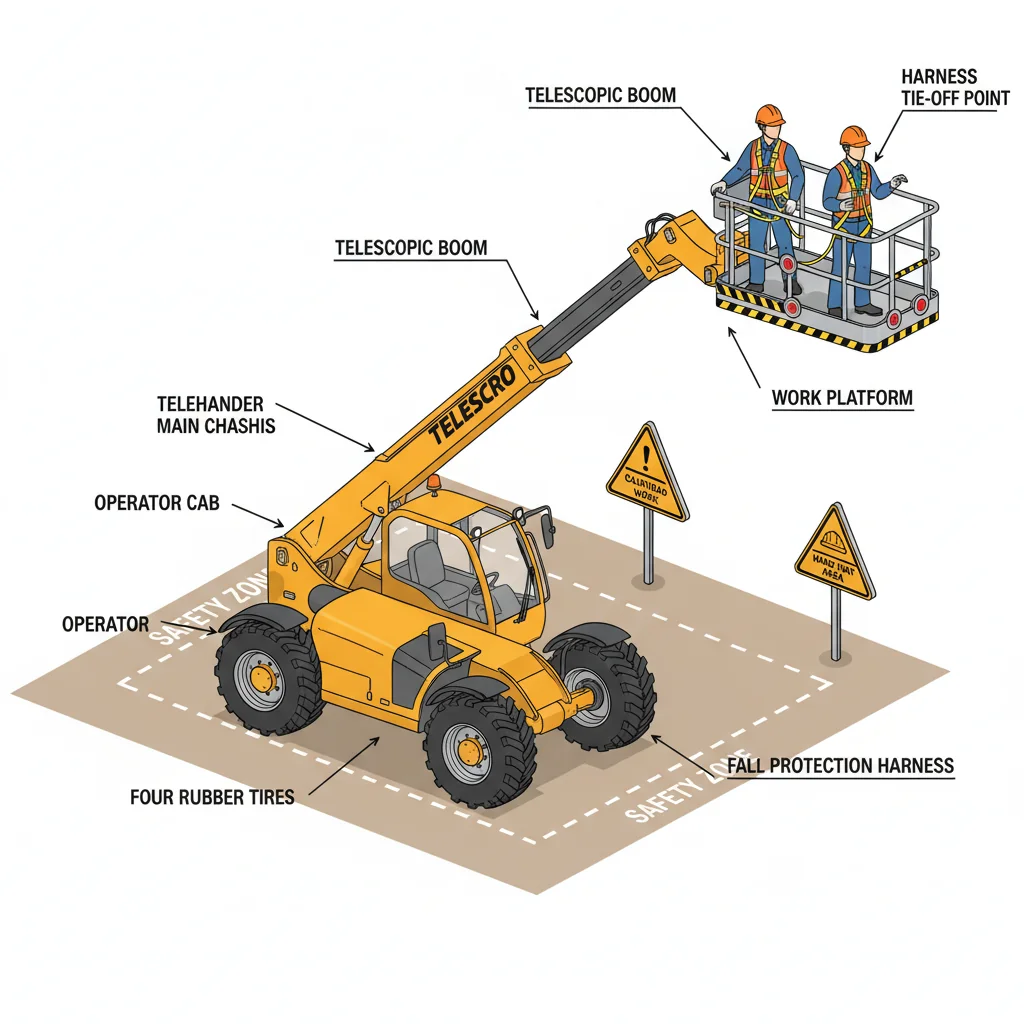
Let me share something important about using telehandlers to lift personnel—requirements change significantly once a personnel work platform is fitted. When people are lifted, the telehandler is no longer operating purely as a material handler, and additional controls apply, even though it is not designed or classified as a MEWP.
In the U.S., employers typically align personnel lifting with OSHA requirements and the ANSI/ITSDF B56.6 framework, which means using a certified personnel platform with guardrails and a secure gate, following the manufacturer’s instructions, and relying on the correct ratings for that configuration. The standard load chart used for pallets or materials does not apply to personnel lifting. Instead, operators must reference a dedicated personnel platform load chart—usually provided by the telehandler or platform manufacturer—showing the safe limits for lifting people at different reaches and boom positions. Skipping this step significantly increases the risk of overloading or instability, especially with the boom extended or tilted.
Last year in Dubai, I worked with a contractor who bought a 3.5-ton telehandler, expecting to use their existing homemade basket for electrical work. I had to step in—local safety standards flagged their gear immediately. They ended up renting an approved platform, which had its own inspection logs and could only carry two workers plus tools, not the four they originally planned. That’s a common surprise: using a self-made or unapproved basket is not just against regulations in most countries—it brings real liability if there’s an incident.
Routine inspections get stricter too. Lifting people usually means a mandatory inspection every six months, not just annually. I always suggest having your compliance paperwork up-to-date and keeping those load charts and inspection reports at the jobsite. It’s not just about avoiding fines—it’s about sending everyone home safe.
When fitted with a work platform to lift people, a telehandler must use a platform specifically designed and certified for personnel lifting, not just any material platform or homemade basket.True
OSHA regulations require that only purpose-built, certified work platforms with safety features like guardrails and locking gates be used for lifting personnel with a telehandler, not generic material handling attachments or improvised baskets.
As long as the telehandler's rated load capacity is not exceeded, any attached platform can be used to safely lift people without additional requirements.False
Even if the weight is within the telehandler's rated load, the use of uncertified platforms or non-compliant attachments for lifting people is strictly prohibited—regulations require purpose-built, certified personnel platforms with additional safety features beyond just weight considerations.
Key takeaway: Using a telehandler to lift personnel triggers additional regulations—including platform certification, personnel-specific load charts, and more frequent safety inspections. Always confirm applicable standards (OSHA, ANSI, EN 1459, EN 280, LOLER, PUWER) for your region, and maintain up-to-date compliance documentation to avoid liability and maximize operator safety.
What Equipment Makes Telehandler Man-Lifting Safe?
Safe and compliant man-lifting with a telehandler requires, at a minimum, a manufacturer-approved machine5 and a certified personnel work platform designed for that specific model. Typical requirements include a dedicated personnel platform load chart, smooth and proportional boom controls, suspension or ride-control disablement where fitted, frame-levelling or stabilizers6 where required by the load chart, functional emergency ground controls7, and a positively locked personnel platform. In regions requiring CE conformity, the platform should be properly certified and supported by documentation confirming compatibility with the telehandler (e.g., EN 1459-3 interface requirements), with compliant guardrails, toe boards, and clearly marked capacity limits.

The biggest mistake I see is assuming any telehandler with forks can lift people if you just add a work platform. That’s risky—not only for safety, but also for legal compliance. Safe, compliant man-lifting always starts with a telehandler that is explicitly approved by the manufacturer for personnel work.
You can see this approval in the load chart: it must include dedicated personnel platform ratings, not just material-handling capacities. I’ve seen situations in Dubai where a team tried to use a “universal” basket with a standard 3.5-ton telehandler. The site safety manager stopped the job immediately—there was no platform-specific load chart, no written approval, and no emergency ground controls. The project lost a full day before a certified machine-and-platform combination was brought in.
From an equipment perspective, several features become critical once people are on board. The machine needs smooth, proportional boom controls to avoid sudden or jerky movement. If the telehandler is equipped with boom suspension or ride control, it should be disabled during personnel lifting—bouncing isn’t just uncomfortable, it’s dangerous.
Not every telehandler has stabilizers, but when they are fitted, they must be deployed exactly as required by the load chart, particularly at high reach or on uneven ground. Partial stabilizer use (short-jacking) is only permitted within the manufacturer’s stated limits for reduced extension—guesswork is not acceptable. Ground conditions also matter: the machine must be set up on firm, level, and sink-resistant support.
Finally, platform selection is non-negotiable. Only certified, positively locking personnel platforms that are approved for the specific telehandler model should be used. “Universal” or improvised baskets do not meet the technical or compliance requirements for lifting people.
A telehandler is only approved for man-lifting if its load chart specifically includes personnel platform ratings, not just material handling capacities.True
Manufacturer approval for man-lifting is indicated by a dedicated section on the load chart showing safe platform capacities; using a machine without this documentation is both unsafe and often illegal.
Any telehandler equipped with a certified man basket automatically meets legal and safety requirements for lifting people.False
Attaching a certified man basket to a telehandler does not ensure compliance or safety; the machine itself must be specifically designed and approved by the manufacturer for personnel lifting, as shown on the load chart.
Key takeaway: Only telehandlers and work platforms specifically approved by the manufacturer—complete with the proper load chart, safety features, and certification—may be used for lifting people. Never improvise or substitute attachments; always request written confirmation of compatibility and follow all operating instructions for legal, safe personnel lifting.
Why Are Pallets Unsafe for Lifting People?
Pallets and homemade cages are not certified personnel platforms8 and lack secure attachment, load rating, guardrails, and fall protection. Using them on telehandler forks exposes workers to severe risks, including falls or tip-overs. Regulatory authorities consider this a clear breach of safety law, with potential for insurance denial and prosecution after an incident.
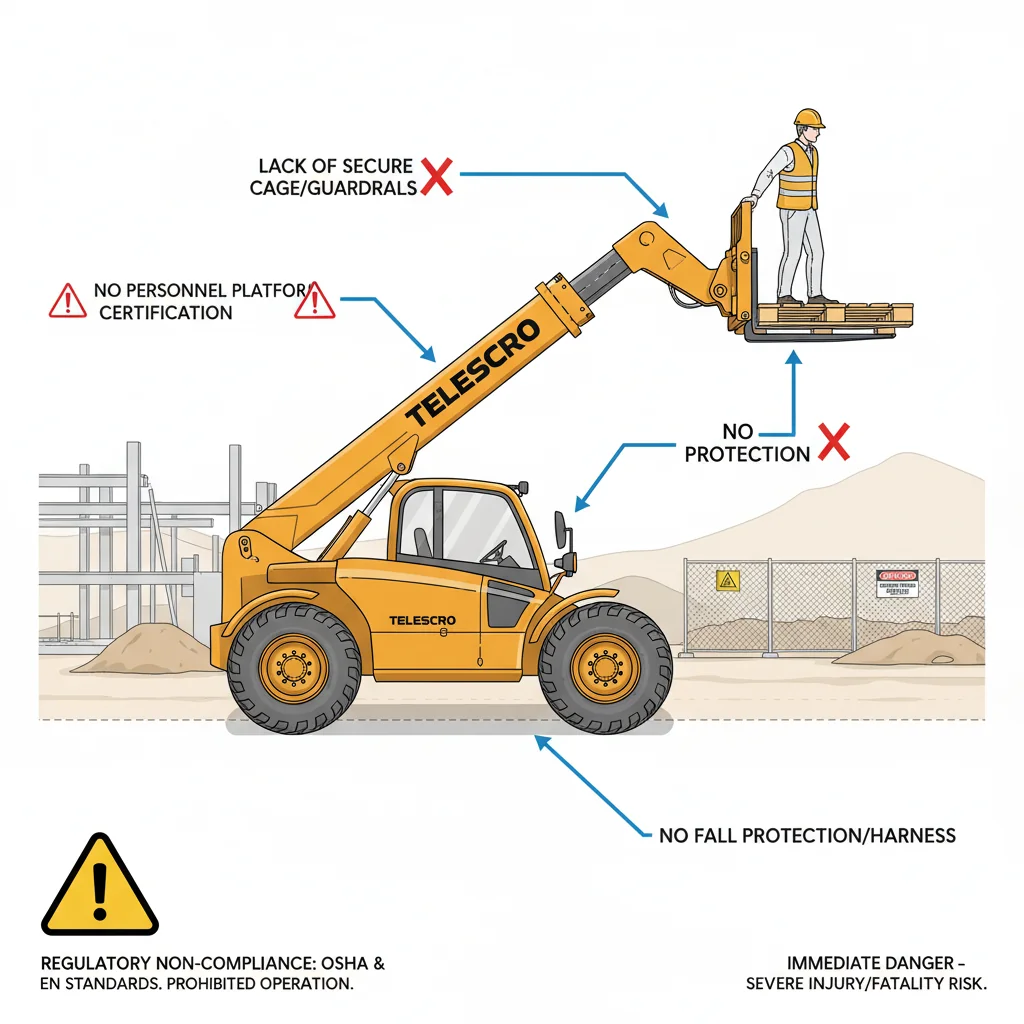
A lot of people ask me, “Why not just stand on a pallet if the lift is only a few meters up?” Here’s the hard truth: pallets were never designed to hold people. They aren’t engineered for human weight distribution, sudden moves, or shifting loads. I’ve seen cases in Vietnam and Brazil where a bump in the ground, or even a light wind with the boom up, sent a pallet sliding straight off the forks. Without any positive locking attachment, it only takes a slight tilt or an unexpected brake for disaster—especially if you’re five meters up in the air.
Standing on a pallet or a welded cage means there’s no rated load chart for people, no guardrails, and zero fall protection. I talked to a site foreman in Dubai last year who thought strapping a pallet to the forks would “do the job for that day.” The platform wobbled at just 3 meters, and the worker nearly fell. He later told me his insurance company rejected the claim, since it was a clear breach of both manufacturer documentation and local law. Telehandler manuals are blunt about this: only use certified, purpose-built personnel platforms, with documentation showing the manufacturer has approved that exact model and setup.
Here’s what matters most—regulators everywhere, from Australia to Europe, actively inspect for makeshift platforms. If a problem happens and you used anything but a certified work platform, you could face prosecution or massive civil liability. That’s why I always suggest: don’t improvise. Rent a certified platform or a MEWP if you need to lift people. Lives and business licenses both depend on it.
Pallets can unexpectedly shift or fall from telehandler forks because they lack any mechanical lock or restraint to prevent movement during lifting operations.True
Unlike purpose-built man baskets, pallets are simply placed on forks and rely on friction alone, making them prone to slipping off, especially if the machine tips, stops suddenly, or moves over uneven ground.
As long as the pallet is rated for higher weight than the person, it is safe to lift workers a few meters using a telehandler.False
Pallets are engineered for distributing static loads of boxed goods, not the dynamic and uneven forces caused by a person moving or shifting. Also, the absence of safety railings and mechanical attachment makes them fundamentally unsafe for personnel, regardless of weight rating.
Key takeaway: Only use purpose-built, certified and manufacturer-approved work platforms on telehandlers when lifting people. Improvised solutions such as pallets or homemade cages are illegal and unsafe, risking severe accidents and liability. Always follow national safety standards and consult the specific telehandler and platform documentation before any personnel lifting task.
What Training Is Required for Telehandler Personnel Lifting?
Operators must receive specialized training for personnel lifting with telehandlers, beyond standard forklift or telehandler certification. This includes reading the dedicated personnel load chart9, correct use of stabilizers, ground assessment, wind and reach limits, emergency lowering, and clear communication protocols. Platform occupants also require job-specific instruction for safe entry, harness use, and rescue planning.

I’ve worked with customers in Kazakhstan who assumed their forklift training covered them for personnel lift jobs. That mistake nearly led to a major accident. Lifting people with a telehandler brings in a whole different set of risks and rules. Standard forklift or telehandler material-handling certification just isn’t enough once people step into the platform. Operators must get machine-specific training—focused on personnel lifting with the actual platform attachment, reading the correct load chart for “personnel use,” and understanding how stabilizer or frame-level adjustment changes safe working limits.
Take platform stabilizers10, for example. Not every telehandler has them, and partial extension changes both your rated capacity11 and stability. Only the manufacturer’s load chart (usually a separate one just for personnel platforms) will tell you what’s safe at each reach and boom angle. There’s no shortcut here—ignore “rules of thumb” like “half the rated capacity is fine” and you risk both safety and compliance. I saw this first-hand on a high-rise site in Dubai: their team forgot to use the wind speed limits listed in the platform’s manual. The machine nearly tipped when a gust hit with the boom extended over 12 meters.
Platform occupants need their own job-specific training, too. That means learning safe entry and exit routines, using harnesses where required, and understanding the rescue plan if the platform or machine loses power. Many regulations demand a trained ground worker on standby because most telehandler baskets have no full drive controls in the platform. My honest advice? Build a simple lift plan naming all trained staff and emergency procedures. Proper training costs far less than downtime, fines, or injury claims.
Telehandler operators must receive specific training on using personnel work platforms, in addition to standard telehandler certification, before legally lifting people.True
Standard telehandler certification focuses on material handling and does not address the added hazards, rules, and safe operating procedures required when people are lifted. Proper training on personnel lift attachments and procedures is required by safety standards.
If an operator is certified to use a telehandler for material handling, they are automatically qualified to lift people with any attached work platform.False
Material handling certification does not cover the unique hazards or safety procedures of personnel lifting. Operators need additional, machine- and attachment-specific training to safely and legally perform personnel lifts.
Key takeaway: Standard telehandler or forklift training is not sufficient when lifting people. Both operators and platform occupants need targeted instruction, including assessing ground conditions, using manufacturer load charts, understanding wind/reach limits, and emergency procedures. Proper training is essential to meet safety standards, avoid fines, and prevent injuries.
What Safety Rules Apply for Lifting People?
When lifting people with a telehandler, safety rules are strict: never travel or slew with the boom raised and personnel aboard unless the manufacturer allows it. Operate only on firm, level ground, reference the personnel load chart, use stabilizers or frame-levelling if fitted, follow wind limits per the operator’s manual, and ensure ground rescue capability is present.
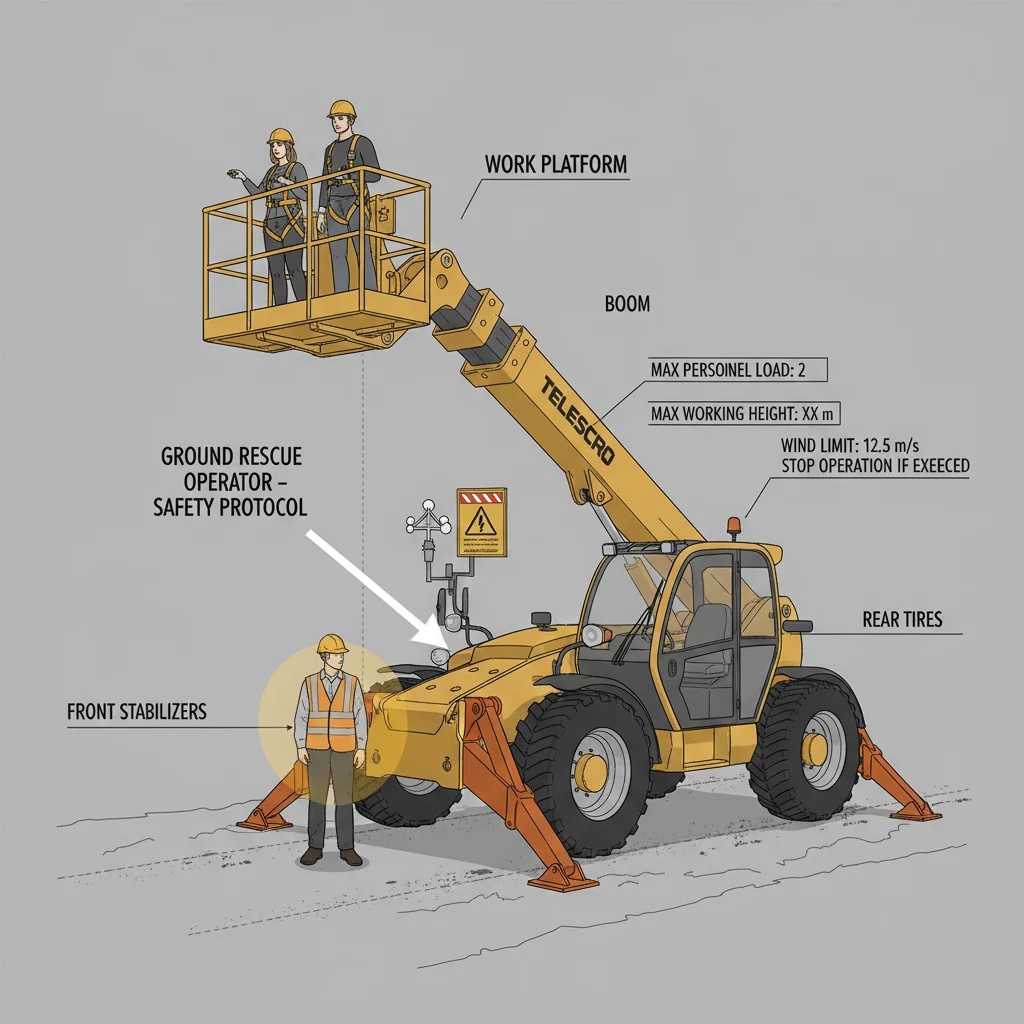
Here’s what matters most when lifting people with a telehandler: you have to follow the manufacturer’s instructions letter for letter—there’s no room for “close enough.” That means only using a personnel platform that’s approved specifically for your telehandler model, along with the right attachment interface. I always see folks in the Middle East trying to adapt standard material forks or homemade baskets for quick access, but that’s not only dangerous—it’s illegal under most country standards like EN 1459-3. The jobsite might look flat, but even a small slope or soft patch can turn safe into risky, especially with personnel in the air.
A customer in Dubai learned this the hard way. Their team set up a 4-ton fixed-boom telehandler on packed ground, lifting two workers for sign installation—about 10 meters up. Midway, the ground shifted slightly under one rear tire. With no stabilizers fitted on that model and the platform at near-full extension, the machine started to lean. Luckily, their site supervisor had enforced the rule: never travel or slew with people on board, and always keep a ground spotter trained for emergency lowering. They managed to bring the platform down safely, but it could have gone wrong fast.
I recommend these habits every time: check the personnel load chart—capacity and reach drop fast with people instead of materials. No shortcuts—never “eyeball” stability or wind speed. Use stabilizers or frame-levelling features if your telehandler has them, but remember, many compact or mid-range machines don’t. Keep communication clear. Always warn basket occupants before any permitted movement, and make sure rescue plans are practical, not just paperwork.
A telehandler can only be used to lift people if it is equipped with a manufacturer-approved personnel work platform that integrates securely with the machine’s attachment system.True
This is true because telehandlers are not designed by default for lifting people; only platforms specifically approved and matched for the machine ensure safety and compliance with regulations.
It is acceptable to use standard pallet forks and a homemade cage to lift people, as long as the operator is experienced and the platform appears stable.False
This is false because using non-approved attachments or homemade platforms is not only unsafe, but also illegal according to most safety regulations, regardless of the operator's experience.
Key takeaway: Lifting people with a telehandler requires adherence to machine-specific load charts, rigorous ground stability, manufacturer-approved personnel platforms, and strict prohibition of boom movement with personnel unless specifically allowed. Only operate under controlled conditions, with trained supervision and documented safety procedures as required by regional and OEM standards.
What Inspections Are Needed for Lifting People?
A telehandler used for man lifting requires enhanced inspection and documentation compared with material-only use. In some jurisdictions—such as the UK—lifting people typically triggers a thorough examination12 by a competent person at intervals of up to 6 months, with the personnel platform included. Elsewhere, inspection frequency and scope depend on local regulations, employer policies, and the competent person’s assessment. Daily pre-use checks should focus on welds, locking pins, platform integrity, attachment retention, and safety systems. Any defects must be rectified before personnel lifting is permitted.
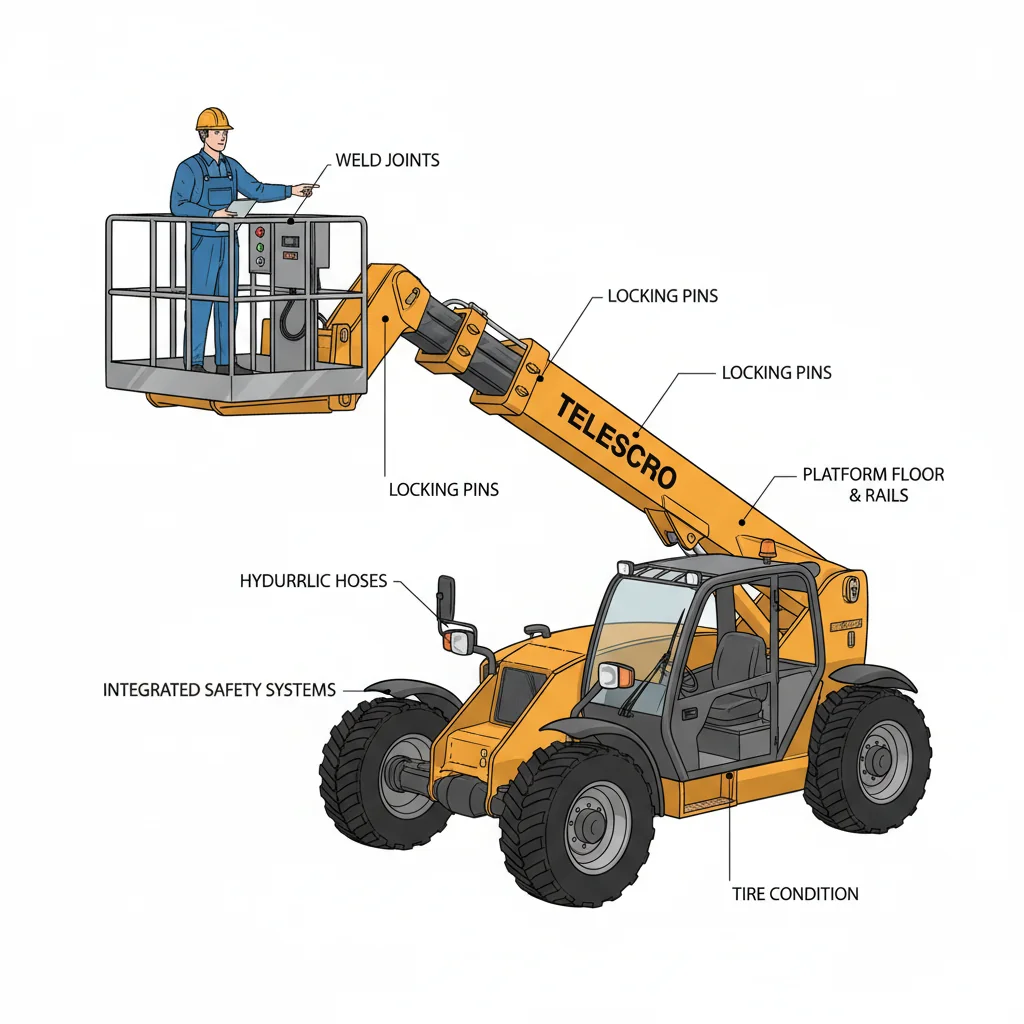
To be honest, the specification that often matters most is how frequently the machine and platform are inspected—not just their age or outward condition. Once a telehandler is used for lifting people, additional legal, contractual, and safety obligations usually apply, and many contractors underestimate this shift when moving from material handling to personnel access.
In some jurisdictions and project environments—particularly those managed under UK-style LOLER regimes—lifting people commonly triggers a full “thorough examination” by a competent person at intervals of up to six months, covering both the telehandler and the personnel platform. In other regions, inspection intervals and scope depend on local regulations, site rules, and the competent person’s inspection scheme.
From a practical standpoint, many insurers and major project owners expect inspection frequencies aligned with personnel-lifting risk rather than goods-only use. On several projects I supported in Dubai, relying on annual inspections alone raised compliance concerns and nearly delayed site approvals. While a six-month interval may feel demanding, insufficient inspection can leave operators exposed to non-compliance, contractual disputes, or insurance complications.
Daily pre-use checks13 become absolutely critical. I always advise operators to look for cracked welds on platforms, bent or missing locking pins, and any play in quick couplers. On one job in Vietnam, a missing pin almost led to a platform slipping free—luckily, their checklist caught it. You need to verify guardrails and ensure safety gates close securely. Never ignore warning lights from the load moment indicator (LMI)—even minor LMI faults can signal deeper hydraulic or electrical issues. Leaking hydraulic hoses, loose connections, or platform damage must be fixed before anyone steps in the basket.
The reality is, skipping these steps can void your insurance and has led to serious accidents. Document every check in a logbook. I suggest scheduling monthly spot audits so you don’t fall behind. Cutting corners on inspections with people at height is never worth the risk.
A telehandler used to lift people requires a full thorough examination at least every six months, regardless of machine age or recent use.True
This aligns with safety regulations in many jurisdictions, which specify a six-month interval for formal inspections when lifting personnel, reflecting the increased risk and legal obligations compared to lifting materials.
If a telehandler is only a few years old and appears in good condition, it does not need a thorough examination before being used to lift people.False
The legal requirement for thorough examination is based on use and application, not just the machine’s age or visual condition. Lifting people triggers stricter inspection frequencies, regardless of these factors.
Key takeaway: Lifting people with a telehandler requires stricter inspections than goods-only use. Mandatory six-month thorough examinations (per LOLER or equivalent) and daily pre-use checks of all safety-critical components are essential to comply with regulations, satisfy insurers, and prevent incidents. Skipping checks may void cover and risk serious accidents.
When Is a Telehandler Platform Suitable?
A telehandler work platform14 is best for occasional man-lift tasks when a telehandler is already on site and access is needed at variable heights over short durations. It excels on rough terrain or uneven ground and for jobs such as cladding, window installation, or inspection up to 17 m.
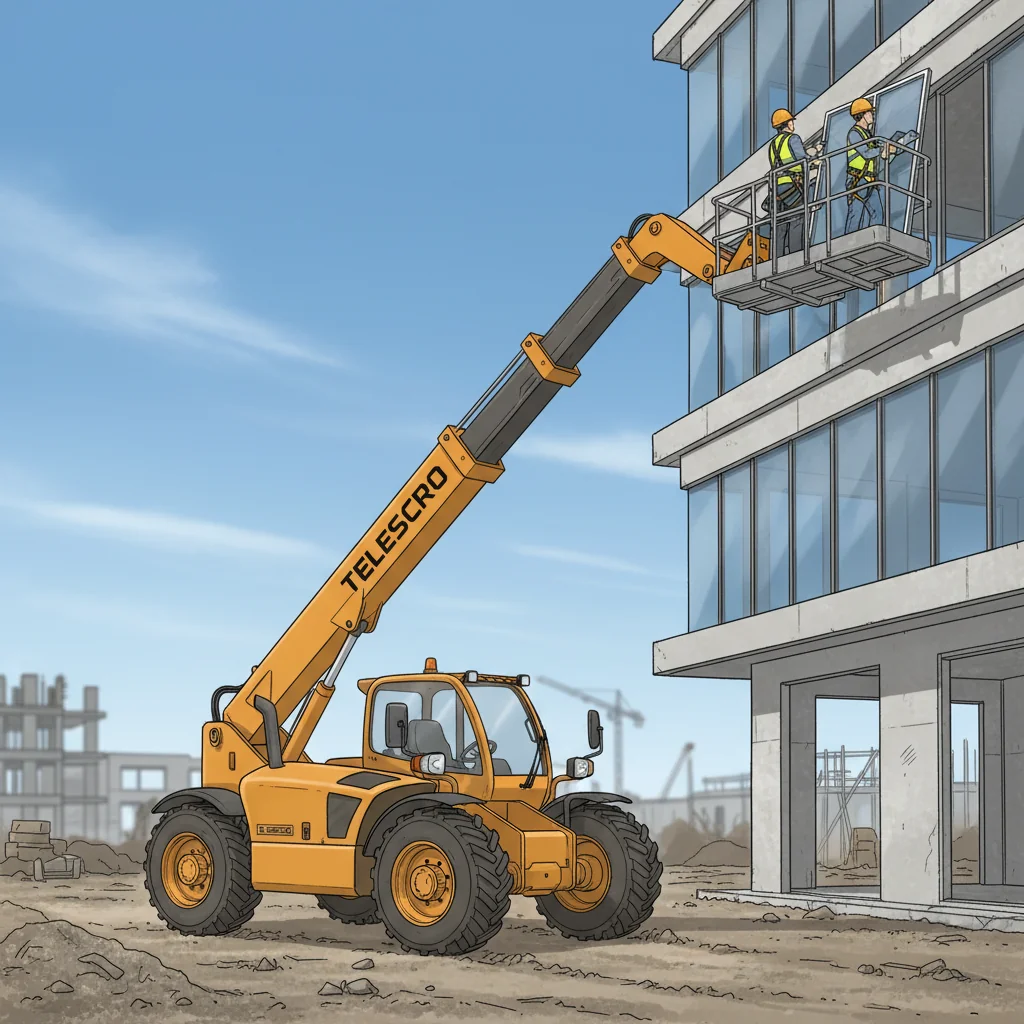
Last month, a contractor in Dubai called me about a glass installation project. They already had a 14-meter telehandler onsite for material handling, but suddenly needed safe elevated access for two days of facade cladding work at variable heights—sometimes 6 meters, sometimes over 13. In that situation, renting a separate boom lift for such short durations didn’t make sense. Fitting a certified work platform to their telehandler solved their problem. They could lift two workers and tools up to each level as needed, even moving along rough, unfinished ground where a scissor lift would have struggled for traction or simply got stuck.
I’ve seen this approach work best where jobs don’t justify a full man-lift for weeks, or where access points shift constantly. Common examples from my experience include gutter repair in Kazakhstan, roof edge maintenance on UK farm buildings, or quick inspection work at different heights in South Africa. A good telehandler platform can handle variable terrain and heights, especially between 9 and 17 meters, but keep in mind rated capacity drops with extension. Always check your load chart—the safe basket load can fall to just 250–350 kg at maximum reach.
For day-after-day facade install or if you need long lateral outreach over machinery, a dedicated boom lift usually delivers better productivity. Plus, local regulations matter. In China, for instance, travelling with people in the basket is banned—operators need to be aware of these rules everywhere. Before choosing, ask: how often will I lift people, how complex is my access, and do my site rules support platform use? I always suggest running these checks before finalizing a decision.
Fitting a certified work platform onto a telehandler is suitable for temporary elevated access when the application does not require outreach beyond the telehandler's maximum horizontal reach.True
Certified work platforms are designed to be used within the safe working envelope of the telehandler, making them appropriate when workers need vertical access that stays within the telehandler's rated reach and stability limits.
A telehandler can always lift people safely as long as they are standing on pallet forks or an improvised cage.False
Lifting people using pallet forks or makeshift platforms is unsafe and violates safety regulations; only manufacturer-approved, certified work platforms with proper attachments should be used for lifting personnel.
Key takeaway: Telehandler platforms offer flexible, short-term access for people where site conditions or task variety limit boom and scissor lift practicality. Always weigh task frequency, access complexity, and local regulations before selecting a telehandler for personnel lifting applications.
Is Buying a Telehandler Work Platform Cost-Effective?
Investing in a certified telehandler work platform15 can be cost-effective for companies frequently lifting personnel, especially when they already own a compliant telehandler. High-quality platforms range from USD 2,000–8,000, while daily boom lift rentals cost USD 150–400. However, suitability, insurance, inspections, and specific job requirements must be considered before purchase.

Here’s what matters most when you’re deciding between buying a telehandler work platform and just renting a boom lift. If you already have a telehandler rated and approved for personnel lifting, adding a certified work platform can save a lot in the long run. For example, these platforms typically cost between USD 2,000 and 8,000, depending on size and features like side entry, rotation, or self-levelling. On one project in Kenya, I worked with a roofing contractor who did aerial installation work about 35 times a year. Renting a boom lift there started at USD 200 per day—sometimes higher during the rainy season when demand spiked. He invested in a 3-meter platform for his own 3.5-ton telehandler, and the purchase paid itself off in just over a season.
But this payoff only happens if your telehandler really is compliant for lifting people. Many older models don’t have the right stability features, moment indicators, or approved hydraulic circuits. There’s also more responsibility. The inspector in South Africa recently reminded me—local law required quarterly inspections, specific operator training, and updating insurance documentation for man-lifting work. If any of these are skipped, you risk jobsite shutdowns or voided coverage.
Still, for complex tasks—like work at 18 meters with lots of lateral outreach—I usually suggest renting a dedicated MEWP (Mobile Elevating Work Platform). Boom lifts have tighter turning, better platform controls, and smoother lift cycles for high-reach or confined access. Before you buy, review your yearly usage, check your machine’s load chart with the platform installed, and confirm insurance compliance. For frequent, lower-height lifts, owning makes sense. For occasional or special jobs, renting is safer and often cheaper.
A certified work platform attached to a telehandler can legally be used for lifting personnel only if both the platform and the telehandler are specifically approved for personnel lifting by the manufacturer.True
This is true because safety regulations require both the telehandler and the platform to be rated and approved by their manufacturers for personnel use, which is different from material-only models. Using an uncertified platform or machine for lifting people is prohibited by industry standards.
Any telehandler can safely lift personnel if you use a commercially available man basket, regardless of the machine’s original rating.False
This is false because not all telehandlers are rated or equipped for personnel lifting, even if a commercial platform is attached. Manufacturer approval and compliance with relevant safety standards are crucial for legal and safe operation when lifting people.
Key takeaway: Purchasing a telehandler personnel work platform makes financial sense for frequent users with compliant machines. Evaluate total costs, compliance, training, and insurance before deciding. For infrequent or complex high-reach jobs, renting a specialized boom or MEWP may remain safer and more economical.
How to Align Dealer, Insurer, and Safety?
Before lifting personnel with a telehandler, obtain written verification16 from the dealer or manufacturer that the machine and platform attachment are approved for man-lifting under the correct standard. Forward this documentation to the insurer for coverage confirmation, then mandate a tailored safety procedure or checklist from a competent safety officer or HSE consultant.

From what I’ve seen, the biggest headaches come from misalignment between the dealer, insurer, and safety officer—especially when teams rush to use a telehandler for man-lifting without proper approvals. A few months ago, a project manager in Malaysia called me after their insurer refused a claim involving a 4-ton rotating telehandler paired with a new work platform. The problem? No one had secured written verification from the dealer that this exact combination was approved for personnel lifting under the right standards. They had the CE mark, but not the paperwork linking their machine and attachment for man-lifting as per EN 1459-3. That missing document stalled their site for almost a week.
What I’ve learned after supporting jobsites from Kenya to Norway is that proper alignment starts with the dealer or manufacturer. Always request a letter or certificate, for your specific telehandler model and work platform, confirming it’s approved for personnel lifting—and check which standard applies. If it’s CE or EN 1459-3, make sure the load chart includes personnel capacities, not just material. This isn’t box-ticking. Insurers want that proof before they’ll confirm coverage. Sometimes they even add requirements for quarterly checks or operator re-training if man-lifting is involved.
Don’t stop there. The final piece is bringing in a competent safety officer or HSE consultant to develop a site-specific procedure. That covers planning, set-up, operation, emergency rescue, and clear daily checklists. In my experience, this triple check—dealer, insurer, safety—prevents arguments and shows you’ve done your due diligence. I suggest saving all three approvals in a single site file. That way, if an incident happens, you’re covered—legally and professionally.
A dealer’s written verification is usually required to confirm that a specific telehandler and work platform combination is approved for lifting personnel.True
Manufacturers and dealers must evaluate whether a particular telehandler model, when paired with a specific work platform, meets safety and regulatory standards for personnel lifting. Written confirmation from the dealer ensures this approval, reducing liability and ensuring insurer compliance.
If a telehandler is equipped with any work platform, it is automatically approved for man-lifting regardless of the platform brand.False
Not all work platforms are compatible or approved for use with every telehandler. Approval depends on both the telehandler’s design and the exact work platform model; automatic approval is never granted solely based on the presence of a work platform.
Key takeaway: Before authorizing personnel lifting, secure written OEM dealer approval for the exact telehandler and platform, insurer confirmation of operation coverage, and a robust, site-specific procedure from safety personnel. This triple documentation approach ensures legal compliance, reduces liability, and demonstrates professional duty of care.
Conclusion
We’ve looked at when it’s safe—and legal—for a telehandler to lift people, plus the safety standards you absolutely can’t skip. From what I’ve seen on real jobsites, buyers who dig beyond the brochure specs are less likely to run into “showroom hero, jobsite zero” situations. Always double-check that your manufacturer allows personnel lifting, and use a certified work platform that matches both the machine and your local regulations.
Have questions about how to match a telehandler to your site or need help with attachment choices? I’m happy to share what’s worked for real crews across 20 countries—just reach out. Every project brings its own challenges, so make the choice that actually fits your workflow.
References
-
Explains the importance of certified work platforms in ensuring safe personnel lifting with telehandlers, complying with safety standards. ↩
-
Detailed insights into EN 1459-3 standard requirements for telehandlers used in personnel lifting, crucial for compliance and safety assurance. ↩
-
Provide an in-depth analysis of the necessity of certified work platforms and their associated safety standards, ensuring personnel lifting operations comply with international regulations such as OSHA and ANSI. ↩
-
Details fall protection methods essential for preventing injuries during aerial lifts, backed by safety regulations and best practices. ↩
-
Explains the critical role of manufacturer approval in ensuring telehandler safety and legal compliance for lifting personnel. ↩
-
Technical insights into stabilizers’ role in enhancing machine stability and preventing tipping during personnel lifts in construction scenarios. ↩
-
Details the necessity of emergency ground controls in telehandlers to prevent accidents and respond quickly in critical situations. ↩
-
Explains the safety and legal importance of using certified platforms, reducing fall and tip-over risks with expert insights. ↩
-
Learn how the personnel load chart ensures safe lifting capacities and prevents accidents during telehandler personnel lifts. ↩
-
Discover how platform stabilizers influence rated capacity and stability, essential for safe and compliant personnel lifting operations. ↩
-
Details load limits at maximum reach and explains how rated capacity impacts safe operation of telehandler man-lifts. ↩
-
Explores legal and safety requirements for bi-annual thorough examinations ensuring compliance and operational safety of personnel lifts. ↩
-
Covers critical daily inspections on welds, locking pins, and safety systems to prevent accidents and maintain equipment integrity. ↩
-
Explains the best uses, terrain advantages, and safety considerations for telehandler platforms in variable height, short duration tasks. ↩
-
Detailed insights on certified telehandler work platforms, focusing on safety standards and cost-effectiveness for personnel lifting jobs. ↩
-
Explains the critical role of written verification from dealers to ensure safe, compliant personnel lifting and avoid insurance claim issues. ↩