










What does “boom angle” mean on a telehandler? Field Guide for Safe Operation
Not long ago, I watched a crew in Vietnam arguing about a “45-degree boom,” and every single person had a different idea of what that actually meant. They were puzzled because their pallet load almost tipped the telehandler, despite the load chart1 saying it should be safe.
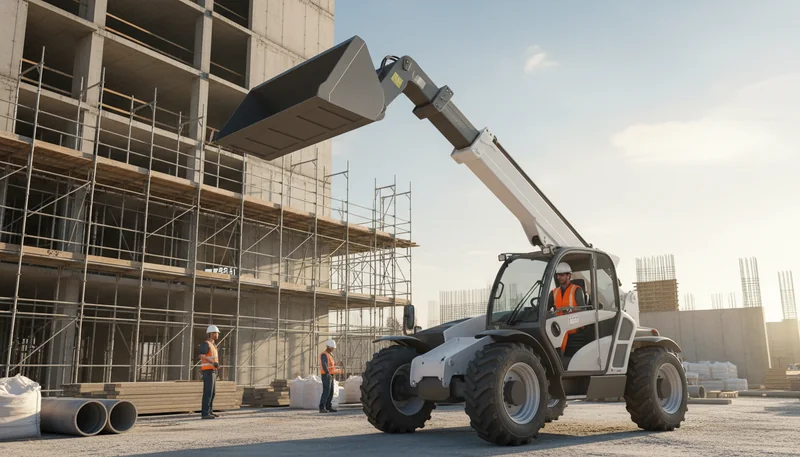
Boom angle on a telehandler is the angle between the boom’s centerline and a true, level horizontal reference. On most OEM load charts and boom angle indicators, this angle is referenced “from horizontal” (not “off vertical”), so operators can match boom position to the correct capacity zone. Together with boom extension, boom angle defines the machine’s working envelope—affecting achievable forward reach2 and lift height for a given configuration.
What is boom angle on a telehandler?
Boom angle on a telehandler is the angle, measured in degrees, between the boom’s centerline and a level horizontal reference. This “angle from horizontal” convention is commonly used on OEM load charts and boom angle indicators so operators can match boom position to the correct capacity zone.

Most operators only realize how critical the definition of boom angle is after seeing a load chart misinterpreted on site. I encountered this on a project in Dubai where a crew referred to “60 degrees off vertical,” while the load chart defined boom angle strictly from horizontal—a major difference in actual boom position. On most rough-terrain telehandlers, a 0° boom angle means the boom is level with the ground, with maximum elevation typically reaching about 65–70°. Certain applications, such as loading below grade, may also require limited negative boom angles, often down to approximately −4°, depending on the model.
The key point is this: telehandler load charts, boom angle indicators, and electronic safety systems all reference boom angle from a true horizontal plane. The angle is defined by the boom’s orientation relative to level ground, not the cab, the chassis, or a vertical reference. Mixing these definitions can lead operators to believe a lift is within rated limits when it is not, significantly increasing the risk of overload or instability. While some crews may get away with this error, relying on the wrong angle reference is a common factor in near-misses and tip-over incidents.
To stay compliant and safe, lock in this habit early: read boom angle as “degrees from horizontal.” If you see an indicator that reads 48°, that’s 48° above level—not off vertical. I suggest always verifying with the machine’s physical angle gauge and matching it to the load chart. Consistency with these terms is non-negotiable—confusion here leads to real jobsite risks.
On most telehandlers, the boom angle is measured from the horizontal, not the vertical, so 0° means the boom is level with the ground.True
Boom angle is conventionally referenced from the horizontal axis in telehandler load charts, which is essential to interpreting lifting capacities correctly. Using the vertical as a reference would reverse the angle measurements and lead to miscalculations.
A telehandler’s boom angle directly determines the length of the load it can safely handle, regardless of the boom’s extension.False
While boom angle is critical for stability and lifting capacity, the maximum safe load length also depends on the boom’s extension (reach) and other factors like attachment type—not just angle alone.
Key takeaway: Boom angle is always measured from the horizontal, not vertical or the telehandler’s frame. Misunderstanding this definition can lead to serious load chart errors and unsafe lifting. Ensuring all operators use the correct terminology is critical for safe, compliant telehandler operation.
How does boom angle affect reach and height?
Boom angle on a telehandler directly controls reach and lift height for a given boom length. Low boom angles maximize forward reach but limit vertical height, mid angles balance both, and high angles deliver maximum lift height with reduced reach. Task planning should align with these angle bands.

Let me share an important point about telehandler boom angles that comes up on almost every large jobsite. Boom angle is one of the primary factors that determines where a load can actually be placed, regardless of what the headline specifications say about maximum reach or lift height.
On a warehouse project in Kazakhstan last year, I worked with a crew handling insulation panels using a 4-ton telehandler with a nominal 17-meter boom. When operating at shallow boom angles—around 10° to 20°—the machine could achieve significant forward reach, approaching the limits shown on the load chart. However, vertical lift was minimal, often insufficient to clear scaffolding or perimeter walls. This low-angle setup worked well for loading trucks from street level, but not for placing materials onto elevated structures.
When the same boom was raised into a mid-angle range—approximately 35° to 45°—the operating envelope changed noticeably. Forward reach decreased, but usable lift height increased substantially, allowing materials to be placed onto second-floor decks or platforms. This mid-angle range is where many common construction tasks, such as placing bricks or blocks onto elevated slabs, are typically performed.
At steep boom angles, often up to about 65°–70° depending on the model, the telehandler delivers its maximum lift height. In this configuration, forward reach is limited—often just a few meters—but vertical access is maximized. This is well suited for tasks such as dumping into tall hoppers positioned close to the machine or unloading into confined pits where height matters more than outreach.
The key takeaway is that boom angle always involves a trade-off between reach and height. Operators should plan lifts based on the actual working angle required by the task, rather than relying solely on advertised maximum reach or lift height figures.
A lower boom angle on a telehandler typically results in increased horizontal reach but reduces the achievable lifting height.True
A lower boom angle positions the boom closer to horizontal, extending the distance it can reach outwards, but this also means the vertical lift is limited compared to higher boom angles.
Increasing the boom angle will always increase both the vertical height and the horizontal reach of a telehandler simultaneously.False
Raising the boom angle increases vertical height but can actually decrease horizontal reach, since the tip of the boom moves upward and closer to the machine’s base rather than outward.
Key takeaway: Boom angle selection defines whether a telehandler achieves more forward reach or lift height with the same boom length. Operators should consult the load chart for each angle band and ensure chosen equipment’s working envelope aligns with expected operational needs, not just headline specifications.
How Does Boom Angle Impact Load Capacity?
Boom angle directly affects a telehandler’s safe load capacity. As the boom angle decreases (more horizontal), the load moves further from the front axle, sharply reducing rated capacity due to increased tipping risk. Higher boom angles (more vertical) improve forward stability but allow increased loads only at shorter reaches. Always consult the load chart for exact capacities.
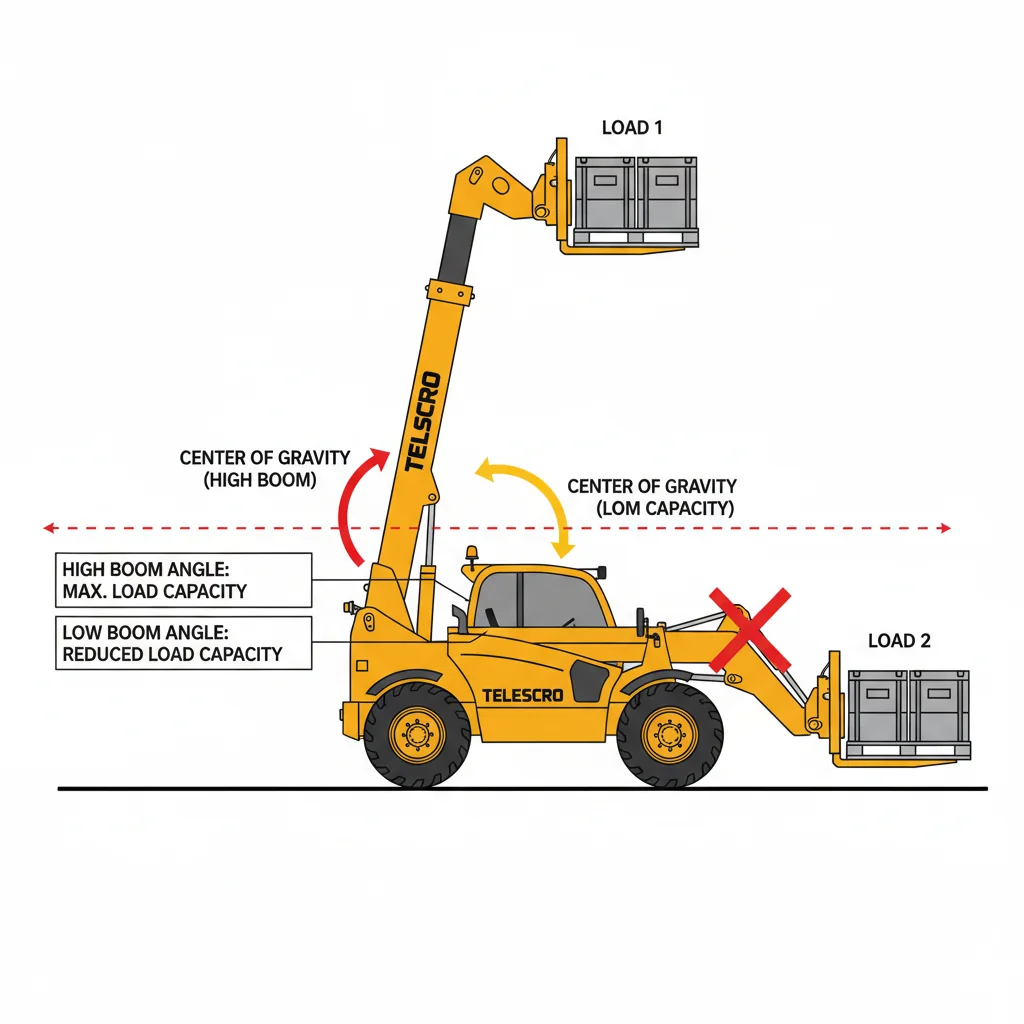
When discussing telehandler load capacity, boom angle is not just a technical detail—it is one of the primary factors controlling stability and tip-over risk. Many buyers focus on the headline “rated capacity,” but the actual safe limit varies significantly with boom angle and reach.
At lower boom angles (closer to horizontal), the load moves farther forward from the front axle, increasing leverage and shifting the center of gravity toward the tipping axis at the front wheels. As a result, capacity can fall sharply as outreach increases. A lift that is safe at minimum reach can drop to well under half of the rated figure once the boom is extended.
I saw this clearly on an industrial project in Peru, where a contractor was installing lightweight steel roofing sheets. The crew was using a 4-ton telehandler with a nominal 17-meter boom and assumed it could comfortably handle around 2,000 kg at a working reach of about 9 meters. However, with the boom set at roughly 35° from horizontal, the load chart showed allowable capacity closer to 1,100–1,200 kg, depending on attachment and setup. The foreman had relied on the “4-ton class” designation instead of the chart, and the machine came close to a forward instability event during positioning.
The lesson is consistent across regions: the specification that truly matters is the model- and attachment-specific load chart, used on level ground and at the actual boom angle and reach required for the task. Brochure maximum capacity figures are reference points—not working limits. Always verify the real numbers for your operating position before lifting.
A telehandler’s maximum safe load decreases significantly as the boom is lowered towards a more horizontal angle, because the center of gravity shifts forward, increasing the risk of tipping.True
This is true because when the boom is lowered, the load moves farther from the telehandler’s front axle (the tipping axis), making it more difficult to keep the machine stable. The further out the load, the lower the available capacity before reaching a tipping point.
Boom angle on a telehandler only affects how high you can lift the load, but has no impact on the machine’s load capacity or stability.False
This is false because boom angle directly impacts the leverage exerted by the load, affecting both stability and maximum safe capacity. A lower boom angle increases the distance between the load and the tipping axis, increasing the likelihood of tipping and reducing safe lifting capacity.
Key takeaway: Boom angle, reach, and load position together determine a telehandler’s safe capacity—there is no universal number. Always rely on model-specific load charts rather than marketing claims, as small changes in boom angle can significantly alter stability and allowable load. Misjudgment can lead to tipping hazards.
How is boom angle used in load charts?
Telehandler load charts integrate boom angle into their capacity data, typically displayed as angle scales or bands alongside reach and extension. Operators must reference the specified boom angle for each job to ensure the quoted rated capacity applies. A flatter angle than charted always results in reduced capacity, increasing risk.

The biggest mistake I see is operators relying on “it looks about right” when judging boom angle. That approach is risky—boom angle is not a visual estimate but a fundamental input used in telehandler load charts.
Every rated capacity shown on a load chart is tied to a specific combination of boom angle, boom extension, and load center. For example, when working at roughly 12 meters of lift height with about 7 meters of forward reach, the applicable capacity zone on many load charts falls within a defined boom-angle band—often in the mid-30° range. If the boom is set flatter than that band, even by a few degrees, the effective capacity can drop by several hundred kilograms.
This is why small angle differences matter so much at long reach. A setup that appears only slightly flatter can move the load further forward of the front axle, increasing leverage and quickly reducing the safe working load. Without checking the actual boom angle against the load chart, operators can unknowingly exceed rated limits—even though everything “looks” acceptable from the cab.
I’ve seen projects in Kazakhstan stalled for half a day because an operator skipped this check and overloaded the machine at an incorrect angle.
Here’s how I teach crews to cross-check boom angle with the load chart:
- Define your job: What’s your required lift height, reach, and load weight?
- Find that zone: Check the load chart grid for the working point or angle band covering those details.
- Match extension and angle: Set your boom extension to the correct zone—often marked by color or letters on the boom itself.
- Verify in the cab: Use your boom angle indicator3 to align with the charted angle or stay safely within the allowed band.
If your actual boom angle is flatter than the chart allows, capacity drops fast. Even a 2–3 degree mismatch matters at long reach.
On a telehandler, the rated load capacity shown on the load chart can decrease substantially if the boom angle is lower than specified, even if extension and reach stay the same.True
Boom angle directly affects leverage and tipping forces on a telehandler. A lower boom angle increases horizontal reach, which increases the risk of overload and instability. Load charts are calculated for specific boom angles to reflect these changing forces and ensure safe operation.
Boom angle markings are purely for reference and do not influence the actual safe working load defined by the load chart.False
Boom angle is a critical factor used in calculating the safe working load for each position. Load charts list capacity values based on specific angles, and ignoring them can lead to overloading or unsafe operations. The markings are not just references; they are essential to interpreting the load chart correctly.
Key takeaway: Telehandler operators must always cross-check the boom angle indicated in the load chart against the actual boom angle during operation. Failing to match these conditions may significantly reduce rated capacity, posing safety risks. Accurate use of boom angle ensures safe lifting within tested limits.
What Is a Telehandler Boom Angle Indicator?
A telehandler boom angle indicator displays the boom’s angle in real time, using a pendulum-style gauge or electronic display readable from the operator’s position. Its primary function is to help match the actual boom angle to the load chart, reducing guessing errors and improving safe lifting operations.

To be honest, I’ve seen too many operators try to “eyeball” the boom angle instead of relying on a proper indicator. This is a shortcut with real consequences—especially when you’re working on a site with tight margins between rated capacity and tip-over. The boom angle indicator is your reference point. It shows the exact angle between the boom and the chassis, which you then compare to the load chart. Without this, you’re basically guessing where the safe limits are.
Last year in Dubai, I consulted on a high-rise project using several 4-ton telehandlers with 17-meter reach. The customer complained about inconsistent lifting results. When I visited, two of the machines had damaged pendulum-style boom angle indicators4—the gauges were either sticky or nearly impossible to read in direct sunlight. Operators couldn’t easily match boom angles to the load chart, so half the time they were either trying lighter loads than necessary or pushing the limits without realizing. One near miss involved a load of steel mesh at 14 meters—they barely avoided a tip because the angle was off by just a few degrees.
Here’s what matters most: safety standards require the boom angle indicator to be readable from the normal operating position. For mechanical gauges, look for smooth needle movement. For electronic versions, check both screen brightness and sensor responsiveness. I always suggest confirming this before you sign for a rental or purchase. If you can’t clearly see the boom angle—especially in full daylight—you’re leaving a key safety margin to chance. That’s not a risk I’d ever recommend taking.
A boom angle indicator on a telehandler allows the operator to accurately interpret the load chart by showing the precise angle of the boom relative to the chassis.True
Load charts for telehandlers are typically based on both boom extension and boom angle. The indicator provides essential real-time information, enabling the operator to safely determine if a lift can be made at a given position.
The boom angle indicator also tracks the telehandler’s total weight to prevent exceeding rated capacity.False
A boom angle indicator measures only the geometric angle of the boom, not the weight of the telehandler or its load. Weight monitoring requires additional sensors such as load moment indicators or integrated weighing systems, not just a basic boom angle gauge.
Key takeaway: Always confirm a clearly visible, smoothly operating boom angle indicator is present before operating a telehandler. Relying on visual estimates instead of accurate instruments greatly increases the risk of load chart misuse and tipping incidents, compromising both safety and operational efficiency.
How do telehandler boom angle sensors work?
Modern telehandlers use electronic boom angle sensors as part of a load moment indicator system5 to continuously assess machine stability. These sensors detect boom position and, with extension and load data, provide precise warnings if stability limits are approached, often activating alarms or automatic function cut-outs to prevent unsafe operations and tip-overs.
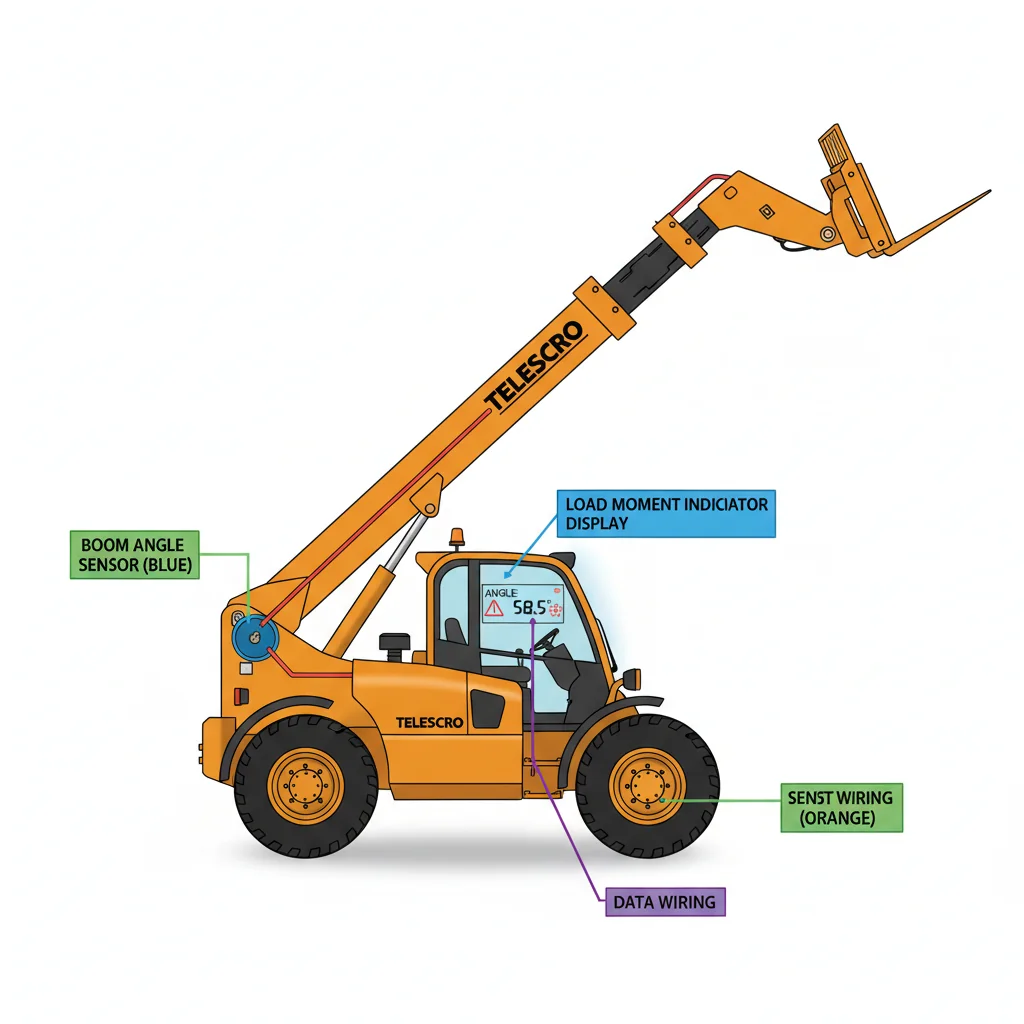
Last month, a contractor in Dubai asked why his brand-new 4-ton telehandler kept cutting out when the boom was low and fully extended. The answer was the boom angle sensor kicking in to keep the machine stable. The sensor continuously monitors the actual boom angle—how steep or flat it is—and feeds that data to the load moment indicator system. When you stretch the boom out close to horizontal, even small shifts can push a machine past its safe working limit.
From my experience, these sensors are only as useful as their accuracy. I saw a job in Kazakhstan go sideways when a cheap sensor misread the boom angle by just a few degrees. At 15 meters extension, that “small” error meant they tried to lift 1,100 kg when the safe load was only around 900 kg. The result? The machine alarm triggered halfway, locking the hydraulics and stopping work. It could have been much worse—a tip-over here damages not just the machine, but also risks injury and serious downtime.
Here’s the thing: high-quality sensors paired with clear, in-cab alerts make life safer and more predictable. Good systems will flash lights, sound buzzers, and even stop movement before you cross the line. I always tell customers to check if their telehandler shows real-time angle and load data, not just “red light” warnings. If you depend on this machine daily, the extra cost of better sensors is nothing compared to the disruption caused by a stability accident.
A telehandler's boom angle sensor sends continuous, real-time feedback to the load moment indicator, which uses this data to prevent unsafe lifting when the boom is nearly horizontal.True
The boom angle sensor measures the tilt of the boom and provides this information to safety systems. Near-horizontal booms are less stable, so the system can limit operations based on real-time angle readings to avoid tipping or overloading.
Boom angle sensors on telehandlers only activate when the boom is fully raised, and have no effect on stability at low angles.False
Boom angle sensors monitor the boom’s position at all angles, not just when fully elevated. Their primary safety function is to protect stability, especially when the boom is low and extended, as this is when telehandlers are actually most prone to instability.
Key takeaway: Telehandler boom angle sensors are critical safety components, directly tied to load management systems. Minor errors in angle detection at long reach can lead to costly accidents. High-quality sensors and clear in-cab alerts help prevent tip-overs, protect operators, and reduce expensive equipment downtime.
Which boom angle range impacts telehandler use?
Boom angle range in telehandlers typically spans from about −4° (below horizontal) to +65–70°, and directly determines usable reach, dump height, and stability. Best practice is to evaluate each model’s load chart at the actual angles and reaches required for specific site tasks, not just max height or reach.

From my experience, buyers often focus on maximum lift height but miss how much the boom angle actually shapes daily work. I’ve worked with a team in Kazakhstan who picked a popular 4-ton telehandler with an 18-meter reach, expecting it could place blocks onto a third-floor slab from the street. On site, most of their lifts happened with the boom at shallow angles—15 to 30 degrees, not fully vertical. At those angles, the machine’s rated capacity dropped below 1,100 kg. That was a problem, since their blocks routinely reached 1,300 kg per pallet. The key point? The boom’s usable angle range—not just max height—directly limits which jobs a telehandler can handle safely. Being able to lower the boom a few degrees below horizontal (−4°) makes truck loading, ground dumping, and mixer feeding much easier. At the other end, 65–70° comes into play when you need the highest dump or a tight footprint. But the toughest moves—like placing loads at long reach over obstacles—happen in the mid-angle zone.
Here’s a comparison based on tasks:
| Boom Angle Zone | Key Tasks | Typical Capacity Drop | Impact on Ops |
|---|---|---|---|
| −4° to 0° (below level) | Truck loading, pushing into mixers | Minor (10–15%) | Better ground-level access |
| 10°–35° (shallow/mid) | Reaching over slabs, floor-to-floor lifts | Substantial (30–60%) | Most demanding for stability |
| 60°–70° (steep) | Max height dumps, vertical lifts | Lowest capacity | Required for tall building work |
A telehandler’s rated lifting capacity is typically much lower at shallow boom angles than at steep angles, even if the load is well within the maximum weight limits for higher angles.True
At shallow boom angles, the boom extends further horizontally, increasing leverage and reducing stability, so manufacturers assign lower load ratings to these positions to prevent tipping or overloading.
The boom angle only affects the maximum height a telehandler can reach, not its lifting capacity at different positions.False
Boom angle directly influences both reach and lifting capacity, as a shallower angle puts more strain on the machine and reduces the safe load it can lift. It's not limited to affecting height alone; it plays a critical role in load limits throughout the boom's range.
Key takeaway: Boom angle range affects which tasks a telehandler can safely and efficiently perform. Always compare models by reviewing the load chart at the real angles and reaches required for planned work, as maximum lift height alone does not guarantee better performance or stability.
How to inspect telehandler boom angle indicators?
Boom angle indicators on telehandlers must be inspected with the boom fully lowered (read near 0°) and fully raised (near rated maximum, e.g., 68–70°) per the operator’s manual. Electronic sensors require periodic calibration. Examine sensor brackets, linkages, and wiring for looseness, corrosion, or damage to prevent inaccurate readings and operational risk.

Let me share something important about inspecting telehandler boom angle indicators—this is one detail that gets missed on too many jobsites. If you want reliable lifting and safe operation, always start with a functional check at both extremes of movement. That means fully lower the boom until it’s level, confirm the indicator shows close to 0°, and then raise it all the way—most models hit about 68–70° at maximum—and look for the reading to match what’s listed in the operator’s manual. I’ve seen sites in Kazakhstan where techs skipped this step, and the result was operators working with load charts that simply didn’t match the real-world position of the boom. That’s a risk no one wants on a busy job. For electronic sensors, go a step further. I recommend you ask your service provider to cross-check the display against an independent inclinometer placed directly on the boom. This can spot hidden calibration errors—especially on machines that run long days in dust or rain. Last summer, a customer in Kenya noticed random warning beeps on a 14-meter model. We found the sensor wiring had corroded after a wet season. That minor issue caused false readings, shutting down lifts even though the machine was stable. Always inspect sensor brackets, linkages, and every bit of wiring for looseness or corrosion. A worn linkage or a few loose bolts can translate into several degrees of error—and that’s enough to trigger the load moment indicator or, worse, allow an unsafe lift by mistake.
Boom angle indicators on a telehandler should be checked at both fully lowered and fully raised positions to ensure accuracy across the full range of movement.True
Indicators can sometimes stick or drift out of calibration at one extreme, so verifying readings at both ends (level and maximum elevation) ensures the device provides accurate information throughout its operational range.
Boom angle indicators are designed to automatically recalibrate themselves every time the telehandler is powered on, eliminating the need for manual checks.False
Most telehandler boom angle indicators require periodic manual calibration checks, as they do not recalibrate automatically when the machine is started. Operators must verify accuracy using physical position checks as part of routine inspections.
Key takeaway: Regularly inspect telehandler boom angle indicators for accuracy at full lower and raised positions, and ensure electronic systems are calibrated. Damaged or misaligned indicators can compromise lift safety and productivity. Always follow manufacturer guidelines for inspection intervals and maintenance procedures.
How does boom angle affect telehandler safety?
Boom angle, measured from horizontal, directly impacts telehandler rated capacity6. As the boom angle decreases (flattens) and extension increases, capacity shrinks, raising the risk of instability. Operators develop intuition for safe boom angles through supervised exercises with test loads and by using repeatable angle settings for recurring tasks.

Let me share something important about boom angle that I see misunderstood on jobsites, especially with new operators. The boom angle—measured from perfectly level ground—directly controls how much weight your telehandler can safely lift and how stable the machine feels. As you lower the boom closer to horizontal and push it out, rated capacity drops sharply. This happens faster than most people expect. On a 4-ton, 14-meter telehandler, you might safely pick 2,500 kg at a 45° angle with the boom half-extended. But if you flatten that boom to 20° and extend it to 11 meters, the real safe load might fall to only 800 kg. I’ve seen contractors in Malaysia caught off guard by this, nearly tipping their machine trying to lift a pallet that wasn’t risky at a steeper angle. From my experience, there’s no substitute for hands-on, supervised training with test loads. One of my favorite drills is placing a 1,000 kg pallet on level concrete, then having the operator hold a steady boom angle—let’s say 30°—and slowly extend to the maximum on the chart. Once that limit is felt, repeat at 40° and 20°. Operators learn, by feel, just how quickly things get unstable as the boom gets flatter and farther out. Repeating this with guidance builds true intuition for capacity and risk, much better than any classroom lecture. On busy sites, I always recommend picking a “repeatable” boom angle and extension zone whenever possible.
A telehandler’s rated lift capacity decreases significantly as the boom angle lowers and extends outward, even if the load remains the same weight.True
This is true because a lower boom angle increases the horizontal distance from the load to the machine’s fulcrum, creating a longer lever arm and amplifying tipping risk. Manufacturers design capacity charts to reflect this sharp reduction in safe lifting limits at lower boom angles.
As long as a telehandler’s outriggers are deployed, the boom angle has little impact on lifting capacity.False
This is false because outriggers may improve stability slightly on some models, but the boom angle remains the primary factor limiting capacity. Lowering the boom increases tipping risk regardless of outrigger use, because the lever arm effect intensifies as the load moves farther from the telehandler’s center of gravity.
Key takeaway: Understanding and consistently checking boom angle is critical for telehandler safety, as capacity decreases sharply with lower angles and greater reach. Operators should use supervised training with real loads and adopt repeatable boom angle settings to reinforce correct, safe habits on every job.
Conclusion
We’ve looked at what “boom angle” really means on a telehandler and why measuring it from the horizontal is so important for safe operation. From my experience, skipping the basics or using the wrong terminology around boom angles can lead to what I call the “3-meter blind spot”—it seems minor, but that small misunderstanding can cause major issues with load charts or site safety. If you’re still unsure about reading a load chart or which numbers matter for your jobsite, I’m happy to help. Reach out any time—I’ve supported crews in 20 countries and know how confusing these details can get. Every site is different, so choose what keeps your team safe and your project moving.
References
-
Detailed explanation of load chart interpretation using boom angle ensures operators avoid overloads and maintain stability on site. ↩
-
Explains the trade-offs between forward reach and lift height based on boom angles, essential for effective load placement strategies. ↩
-
Explore how boom angle indicators provide real-time angle data to prevent tip-overs and enhance safe lifting on construction sites. ↩
-
Learn detailed inspection steps and calibration tips to ensure accurate boom positioning and safe telehandler operation. ↩
-
Detailed insights on load moment indicator systems that use sensor data to warn operators and avoid overloads and machine instability. ↩
-
Explore detailed insights on how changing boom angles impact load limits and operational safety for telehandlers, backed by industry examples. ↩