










How Attachment Weight Impacts Telehandler Lifting Capacity: Expert Field Guide
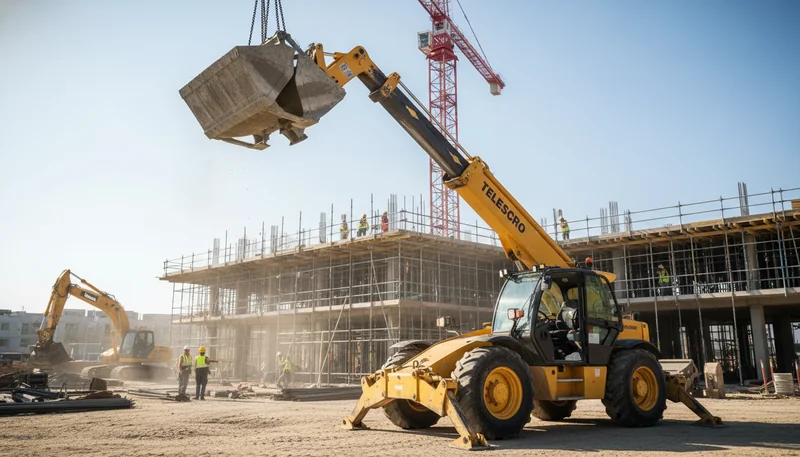
A site manager in Brazil once asked me why his brand-new telehandler seemed underpowered whenever they fitted the heavier jib for steelwork. He’d checked the rating on the data plate, but the real answer was hanging in plain sight—right at the boom tip.
Attachment weight reduces a telehandler’s usable capacity because load ratings are defined for a specific machine configuration and load center shown on the load chart. Many published charts assume a standard fork carriage and OEM-stated test conditions (such as firm, level ground and the specified tire setup). Heavier or longer tools—such as work platforms or jibs—add mass and change load geometry, which moves the combined center of gravity forward and increases overturning moment. As forward reach increases, this effect becomes more critical, so allowable capacity at the working point can drop substantially unless the correct attachment-specific chart is used.
How does attachment weight affect lifting capacity?
Attachment weight reduces a telehandler’s usable rated capacity1 because the load chart2 defines rated capacity for a specific boom position (reach/height) and a stated configuration, including the attachment and its load center. Heavier or longer non-standard tools—such as work platforms or jibs—use up part of the allowable capacity and can shift the load center forward, so the remaining payload at the same boom position is typically lower than with standard forks.
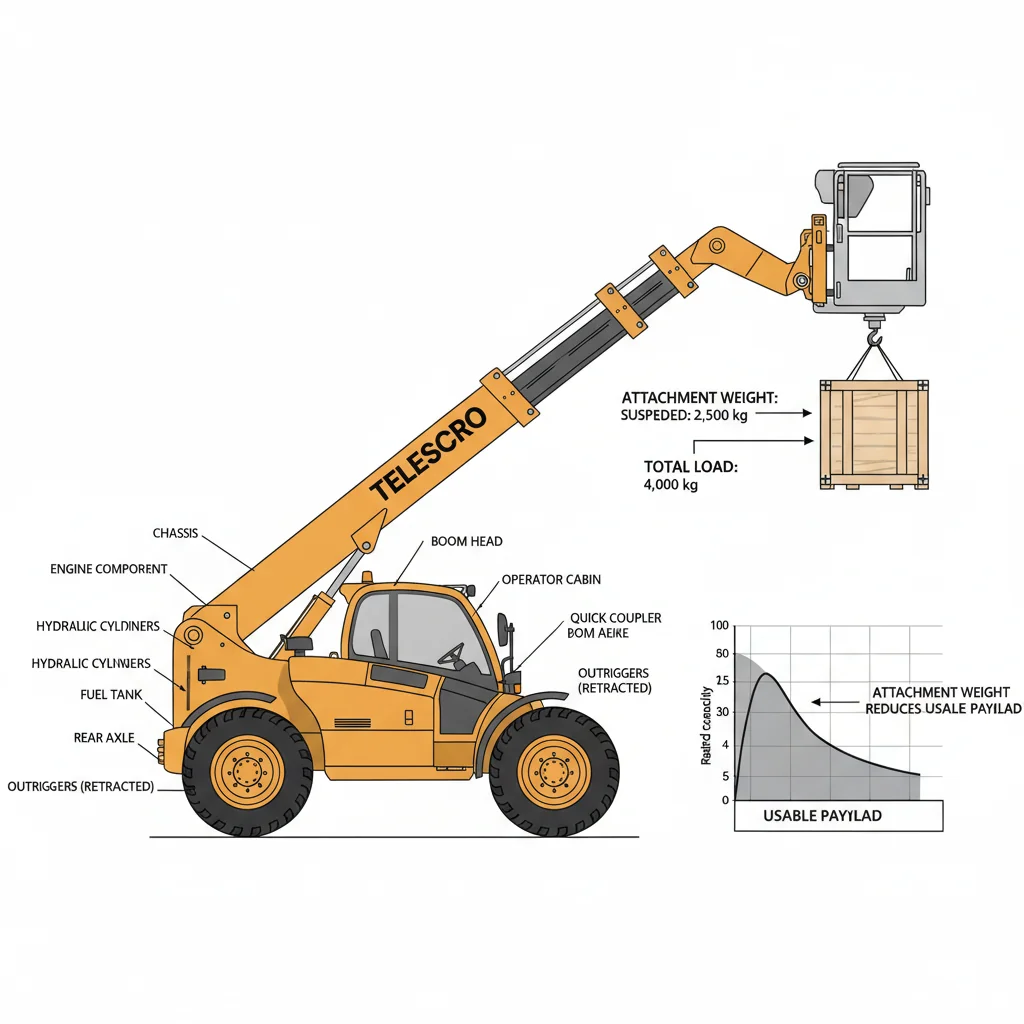
Many buyers overlook that a telehandler’s rated capacity already includes the attachment installed for the rated configuration. For example, on a 4,000 kg-class telehandler operating at a given boom position with standard forks, the forks themselves may weigh around 400 kg. At that same position, a 3,600 kg pallet would effectively consume the full rated load for that configuration. If the forks are replaced with a heavier attachment—such as a work platform or jib weighing 700 kg—the additional attachment mass reduces the remaining allowable payload at that same boom position, even before accounting for rigging, chains, or slings.
I’ve worked with a factory team in Kazakhstan where this became a real problem. Their maintenance crew kept using a 500 kg man basket, forgetting that the basket’s weight counted against the load chart. They ended up overloading the boom more than once—fortunately, we caught it before anything tipped.
When you reference the load chart, use the OEM’s stated definition of the rated load for that configuration—typically the load at the attachment’s specified load center, with the attachment mass and any lifting accessories accounted for as applicable. This includes:
- The self-weight of the attachment (forks, jibs, buckets, or platforms)
- Any lifting accessories or rigging (chains, slings, hooks)
- The payload itself (boxes, pallets, people)
- Any extra tools or materials placed on the platform
Here’s what matters most: Always check the actual weight of each attachment—not just its type. Too many operators guess, or assume “all jibs weigh about the same.” That’s risky thinking. I suggest confirming the combined mass at every boom position and referencing your specific load chart before every lift.
The weight of a telehandler attachment is subtracted from the machine’s maximum rated lift capacity, reducing the amount of payload you can safely pick up.True
Industry standards require that the total load—including attachment weight—does not exceed the telehandler’s rated capacity, ensuring safe operation and preventing overload.
Any attachment mounted to a telehandler does not affect its rated lift capacity, as the machine is always designed to compensate for attachment weight automatically.False
Telehandlers do not adjust their rated capacity for different attachments automatically; operators must manually account for the attachment’s weight to avoid overloading and compromising safety.
Key takeaway: Telehandler rated capacity always includes attachment weight. Failing to account for heavier non-standard attachments leads to overloading and safety incidents. Always confirm total weight—attachment + rigging + payload—matches or stays within the load chart at the specific boom position and reach.
Why Does Attachment Weight Matter at Full Reach?
Attachment weight impacts telehandler lifting capacity most at extended reach because stability, not just boom strength, limits performance. Heavier or longer attachments push the load center3 farther from the front axle, sharply reducing rated capacity as shown on the load chart, especially at greater reach or height.

Let me share something important about attachment weight at full reach—this is where many jobs go wrong, even with experienced operators. The main limiter at extended reach isn’t the strength of the boom—it’s the machine’s stability about the front-end support line defined by the tire contact points (as represented in the load chart). Every extra kilogram on the attachment, or any increase in its length, shifts the load center farther from the front tires. Stability drops fast. I’ve seen a customer in Dubai use a long jib to lift HVAC units up to the 11th floor. The telehandler had a 4-ton rating, but at 12 meters with that jib, the safe capacity shrank to barely 1,200 kg—dangerous if you’re not watching the load chart closely.
Here’s what actually happens at greater reach:
- Heavier attachments (like concrete buckets or rotating carriages) directly eat into your allowable payload at full extension.
- Long or extended attachments move the load center further out, reducing stability—the machine may tip at a fraction of its base capacity.
- Side-shift carriages or similar tools add lateral movement, making dynamic tipping more likely at height.
- Large buckets not only weigh more but also increase the distance to the load center, often reducing rated capacity significantly at the same reach and height due to added mass and a more forward load center.
I always recommend: before planning a lift, check the load chart zone for your real working position—with your actual attachment. Never trust only the “headline” capacity. On paper, most 4-ton, 14-meter units look strong. In reality, at 10–12 meters and with bigger tools, you can be limited to less than half that. Double-check the numbers—jobsite safety depends on it.
At full reach, even a small increase in attachment weight can substantially reduce a telehandler’s lifting capacity due to the greater moment arm generated about the front axle tipping axis.True
At maximum boom extension, the distance from the center of gravity of the load to the tipping axis is at its longest. This means any added weight, even minor, amplifies the overturning force much more than if the boom is retracted, quickly reducing stability and allowable capacity.
As long as the telehandler is within its maximum rated lifting capacity, the attachment weight has no effect on stability at full reach.False
The rated lifting capacity at full reach already factors in the combined weight of the load and any attachment. Exceeding the recommended attachment weight or ignoring it can move the center of mass further forward, reducing stability and possibly causing tip-over, even if the lifted object alone is within nominal capacity limits.
Key takeaway: Always reference the load chart for specific reach and attachment combinations, as rated capacity drops sharply with increased forward reach and heavier or longer attachments. Do not rely on headline tonnage—actual capacity at working reach may be much lower due to stability limitations.
Why use attachment-specific telehandler load charts?
Each telehandler attachment alters weight and geometry, requiring a dedicated, manufacturer-approved load chart. Using a generic fork chart for all attachments is incorrect and dangerous. Always request and verify the exact load chart for each machine-attachment combination at actual working height and reach before operation.

The biggest mistake I see is crews using a standard fork load chart for every attachment. To be honest, that’s a shortcut that can put lives and equipment at risk. Each attachment—whether it’s a bucket, jib, man basket, or side-shift carriage—changes the telehandler’s weight distribution and operating geometry. I’ve worked with teams in Dubai who added a 300 kg jib, only to find out their maximum safe lift at 8 meters dropped by 25%. They didn’t have the correct chart, so they were guessing. That’s a dangerous place to be.
Here’s why attachment-specific load charts are non-negotiable:
- Every attachment alters weight and moment—a bucket or jib can shift the load center and add significant mass at the boom tip.
- Manufacturers test and publish separate load charts for forks, buckets, carriages, and so on, reflecting actual safe capacities at each height and reach.
- Using the fork chart for other attachments is incorrect and risky. For example, a side-shift carriage—even adding just 200 kg—can reduce capacity by 10–30% in the working zone.
- Jobsite real world matters, not showroom claims. Always request the actual load chart for your specific machine-attachment combo, and check capacity at your real working height and reach—like 10 meters out, 6 meters up.
If the dealer or rental company can’t provide a manufacturer-approved load chart for your chosen attachment, don’t improvise. Treat that attachment as not approved for lifting until you have written OEM confirmation or a qualified engineer’s sign-off. I always tell buyers—load chart accuracy is the difference between safe operation and a costly mistake.
Telehandler lifting capacity can decrease significantly when using heavier attachments, even if the load remains the same, because the attachment’s weight and geometry alter the machine’s center of gravity and load moment.True
Attachment-specific load charts account for the added weight and extended reach effects of non-standard attachments, which substantially change the safe operating limits of the telehandler compared to standard forks.
As long as the rated load is not exceeded, using any attachment with a telehandler does not impact the maximum lifting height or capacity.False
Each attachment has unique weight and dimensions that change the load chart; failure to use the correct chart can result in overloading or instability even if the rated load for standard forks is not surpassed.
Key takeaway: Attachment-specific load charts are essential for telehandler safety and accuracy, as each configuration directly impacts rated capacity. Never substitute charts between attachments. If no approved load chart is available for a given attachment, consider it unapproved for lifting until written confirmation is obtained from the OEM or a qualified engineer.
How do man baskets affect lifting limits?
Man baskets (work platforms) are among the heavier telehandler attachments and are subject to stricter safety requirements under standards such as EN 1459 and ANSI/ITSDF B56.6. Depending on design and size, a typical man basket can weigh several hundred kilograms empty. Platform load charts apply additional restrictions for personnel lifting, which significantly reduces allowable total load (platform, occupants, and tools), especially at extended reach, compared with standard fork configurations.

Here’s what matters most when you’re planning to use a man basket on a telehandler: the entire “safe load” calculation changes. Man baskets are a different world compared to standard forks or buckets. The empty basket alone can weigh 500 to 800 kg—and that’s before you add a worker, PPE, maybe a small tool trolley. Suddenly, the real payload you can lift drops far below the headline numbers. I’ve seen this catch out teams in Romania and Dubai, especially those used to material handling, not personnel work.
For example, a telehandler rated for 3,000 kg at 10 meters with forks might be limited to just 1,200 kg total when a man basket is attached at full extension—even if you pick a larger basket. That total includes the basket itself, every person on board, and their gear. Now imagine three workers with tools—your margin is almost gone. The reason is strict safety margins4 and engineering controls that apply any time a person is lifted. Load charts for man baskets have extra reduction factors baked in, so operators don’t just risk tipping—they’re also complying with local safety law.
From my experience, never guess “close enough” or just use the fork load chart for basket work. Always check the dedicated man basket chart for your exact model, because the usable load can fall below 1,000 kg at mid-to-long reach even on a 4-ton telehandler. If you need several workers or heavy tools up high, you may have to choose a higher capacity machine. I always tell customers in Kazakhstan and Kenya—platform jobs are where spec sheets get real.
Attaching a man basket to a telehandler often shifts the center of gravity forward, reducing the maximum allowable lift capacity at any given boom extension compared to forks or buckets.True
A man basket’s weight acts further out from the carriage, increasing the overturning moment and directly lowering the safe lifting limit, even before factoring in additional personnel or tools.
Man baskets have no significant effect on a telehandler’s rated lifting capacity because the weight is typically less than that of a loaded bucket.False
Unlike typical material buckets, man baskets add both weight and require strict adherence to load charts specifically for personnel lifting. Their placement and safety regulations substantially reduce the maximum allowable load, regardless of their absolute weight.
Key takeaway: Man baskets drastically lower a telehandler’s lift limit due to high attachment weight and strict personnel safety margins. Operators must use the dedicated platform load chart for the specific telehandler model, never rely on materials charts, and always calculate total platform load including all occupants and tools.
How Does Attachment Weight Derate Capacity?
Attachment weight reduces telehandler lifting capacity by adding dead weight and moving the load center forward. Heavier attachments—such as large rock buckets—can significantly reduce allowable payload at a given reach compared with standard forks, particularly at mid to long extension. Additional features like side-shift or tilting carriages commonly introduce further capacity reductions, as reflected in OEM attachment-specific load charts, depending on machine model and boom position.

Last month, a contractor in Saudi Arabia sent me site photos after struggling with unexpected derating. Their standard 3.5-ton telehandler, which could handle around 2,000 kg at 7 meters with forks, dropped to about 1,350 kg once they switched to a rock bucket that alone weighed close to 1,000 kg. They only realized the issue after the machine tripped its load moment indicator5 during a heavy lift—forcing them to rent a larger unit on short notice. This kind of problem happens more often than you’d expect.
Why does attachment weight matter so much? Buckets and advanced carriages affect usable payload through several mechanisms.
- Dead weight: Every attachment adds its own mass before any material is lifted. Depending on size and design, buckets and platforms can weigh several hundred kilograms empty, directly consuming part of the available lifting capacity.
- Forward-shifted load center: Buckets and extended carriages move the load’s center of gravity farther from the front axle, where reach is defined on the load chart, reducing stability at reach.
- Side-shift or tilt mechanisms: Hydraulic side-shift or tilt functions add extra mass and complexity, further reducing allowable capacity as reflected in OEM attachment-specific load charts.
- Loose or shifting materials: Materials such as rock, demolition debris, or soil can shift during travel or tilt, effectively moving the load center outward and reducing stability.
In practice, oversized or heavy attachments may appear productive, but they often reduce safe lifting limits and working efficiency at reach, particularly under real jobsite conditions.
Heavy attachments like buckets or jibs reduce a telehandler's rated lifting capacity because the attachment weight is treated as part of the load by the machine's load management system.True
Load moment indicators consider the combined weight of the attachment and payload, meaning heavier attachments eat into the available lifting margin before the machine reaches its safe working limit.
A telehandler's maximum lift capacity remains the same regardless of which attachment is used, as long as the attachment is made by the original manufacturer.False
Attachment weight directly affects safe lifting limits regardless of manufacturer origin, since the load management system only recognizes total mass at the boom tip and not the source of that weight.
Key takeaway: Heavy buckets and advanced carriages significantly reduce a telehandler’s usable lifting capacity due to added dead weight and a forward-shifted load center. When using demanding attachments or handling dense materials, always check the load chart and consider upsizing to a higher capacity telehandler for safety and productivity.
What attachment weight is safe for telehandlers?
Attachment weight must be considered as part of the total load defined in the telehandler’s rated capacity. Heavier forks, carriages, or buckets consume available lifting capacity and can significantly reduce usable payload, particularly at extended reach. Because the impact varies by machine model, boom position, and attachment geometry, operators must always verify capacity using the relevant OEM load chart6 for the specific attachment and configuration.

What really matters is not the headline capacity on the datasheet, but how the attachment weight and boom position interact at your actual working reach. I regularly see crews fit large buckets or heavy carriages based on the assumption that “the machine is rated for 3 tons.” In practice, once a 600 kg attachment is installed, a significant portion of the available capacity is already consumed—before reach, height, or load shape are even considered.
On one project in Kazakhstan, a fork-mounted brick clamp increased attachment weight to more than 750 kg. As the boom was extended beyond mid-range, the allowable load dropped sharply. The result was simple: the machine could no longer place a full pallet of bricks at the required height, despite appearing correctly sized on paper. The issue was not machine quality, but misunderstanding how attachment weight and reach compound each other on the load chart.
Field guidance I use on jobsites:
- Always treat attachment self-weight as part of the total lifted load, together with rigging, couplers, and accessories.
- Expect usable payload to decrease rapidly as attachment weight increases, especially beyond mid-boom extension.
- Never rely on headline capacity alone; always check the OEM load chart for the specific attachment at the actual working height and reach.
- For frequent lifting of dense materials, prefabricated elements, or steel, selecting a machine with additional rated capacity margin at the required working position often prevents productivity loss and operational risk.
An attachment’s weight directly subtracts from a telehandler’s rated lifting capacity at any given reach, meaning heavier attachments can significantly limit what you can safely pick up.True
Manufacturers rate telehandler capacities assuming no oversized or extra-heavy attachment is installed. When you mount a heavy attachment, it takes up part of the machine’s lifting allowance, reducing the actual load you can lift at specific reaches or boom angles. This principle is especially important at full or extended reach, where capacity limitations are already tight.
As long as the load you are lifting does not exceed the telehandler’s rated capacity, the weight of the attachment itself does not need to be factored into your lifting calculations.False
This is incorrect because the machine’s rated capacity includes both the load and any attachments mounted to the boom. Failing to account for a heavy attachment can lead to overloading the telehandler, increasing the risk of instability, tipping, or equipment failure.
Key takeaway: Attachment weight has a direct and often underestimated impact on telehandler lifting capacity, particularly as reach increases. There is no universal “safe percentage.” The only reliable reference is the OEM load chart for the exact machine, attachment, and boom position. Machines selected with adequate capacity margin at the real working point deliver safer operation and better long-term productivity.
Why are unapproved telehandler attachments risky?
Unapproved or homemade attachments can invalidate the telehandler’s load chart and certification, as they introduce unknown weight and change load geometry, often reducing rated capacity. Industry standards require tested and approved attachment configurations. Incidents involving non-OEM or untested tools expose owners to significant safety, legal, and insurance consequences.

From what I see on real jobsites, many crews assume that if an attachment fits the quick coupler, it’s good to go. That’s risky thinking. In Dubai last year, a customer used a homemade jib for roof truss work. The attachment only weighed about 220 kg, but the original load chart didn’t account for that extra weight or for the changed load center. As a result, their 2.5-ton telehandler—rated for around 1,200 kg at full extension—was suddenly limited to under 900 kg. The crew had no idea until the stability alarm sounded mid-lift. That job nearly ended in a tip-over.
Here’s what makes unapproved attachments so dangerous on site:
- Unknown weight: Homemade buckets or jibs may look light, but even 200–300 kg extra can slash your safe capacity by hundreds of kilos—especially with the boom extended.
- Changed load geometry: Non-OEM attachments often move the load farther from the pivot point, shifting the load center forward beyond what the machine was tested for.
- Invalid load chart: Using untested tools means your official load chart no longer matches the reality—so rated capacity is just a guess, not a fact.
- Non-compliance with standards: Safety codes like EN 1459 and ANSI/ITSDF B56.6 require tested, approved attachments with updated charts.
- Serious liability: If there’s an accident or inspection, the first thing checked is whether you used a listed, approved tool. Insurance claims can be denied if not.
I always recommend insisting on OEM-approved attachments or getting certified load data for anything custom. Treat “universal fits” with real caution. A little paperwork can prevent a lot of risk.
Adding an unapproved attachment to a telehandler can reduce its rated lifting capacity even if the attachment itself is lighter than the load being lifted.True
The attachment's weight and how it shifts the load center both affect the overall balance and safe lifting limit, which can drop below the telehandler's listed rating even if the attachment seems minor.
If an attachment securely fits the telehandler’s quick coupler, it can always be used without recalculating lifting capacity.False
Fit to the coupler does not guarantee safety; using any unapproved or custom attachment changes weight distribution and the load moment, requiring recalculation and possibly reducing safe capacity.
Key takeaway: Only use attachments approved by the telehandler OEM, or obtain validated load data and an updated chart. Unapproved or homemade tools can dramatically reduce safe capacity, breach industry standards, and increase liability after incidents or inspections—regardless of physical compatibility with the quick coupler.
How to estimate derated payload on-site?
When a configuration-specific load chart is not available, a conservative field estimate can be made by starting with the telehandler’s rated capacity at the required reach and height using the standard attachment, then subtracting the additional attachment weight and any rigging. Because real jobsites rarely meet ideal test conditions, further operational margin should be applied based on ground conditions, load stability, and operator control. This approach is intended only as a temporary risk-reduction measure and must not replace OEM-approved load charts or written engineering confirmation.
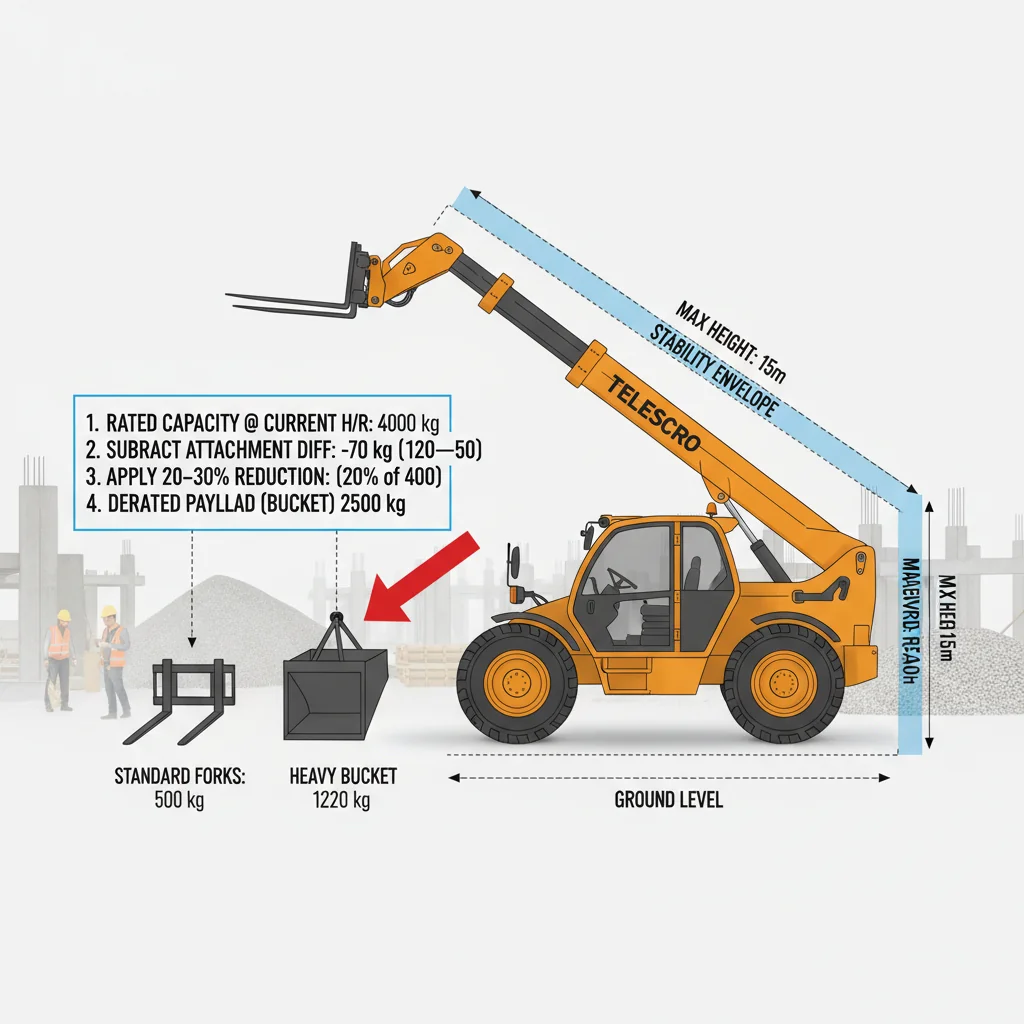
Let me share something important about estimating safe payloads when you don’t have a configuration-specific load chart on hand. This comes up a lot on jobsites—operators swap attachments, but nobody has a chart for the new setup. Here’s a field method I use, and I’ve seen it work for crews in places like Saudi Arabia and Peru. First, always start with the telehandler’s rated capacity at your actual reach and height, using the standard attachment listed in the OEM chart. For example: at 7 meters reach, the chart might say 2,500 kg with standard forks. If you’re switching to a heavier tool, like from forks (400 kg) to a bulk bucket (650 kg), subtract the weight difference directly—so, 2,500 kg minus 250 kg equals 2,250 kg. But that’s not your safe payload yet. Real jobsites aren’t perfect: ground will rarely be totally level, loads might not be centered, and operators are human. That’s why I always recommend applying a 20–30% working safety reduction to your calculated number. For the example above, you’re looking at a payload limit closer to 1,600–1,800 kg. It’s better to run light than risk an overloaded telehandler tipping forward. I’ve worked with a contractor in Kenya who insisted on using near-theoretical capacity and paid for it with a damaged boom cylinder after a sudden stop. To avoid this, write the safe working limit into your shift instructions.
When using a heavier-than-standard attachment, you must subtract the difference in attachment weight from the telehandler's rated capacity at your working reach and height, because the additional attachment mass reduces the safe payload you can lift.True
Telehandler load charts are based on a standard attachment; heavier attachments consume part of the total lifting limit, so operators must account for this difference to avoid overload and maintain safety margins.
Attachment weight only affects payload capacity at maximum reach, but not at shorter boom extensions or lower heights.False
Attachment weight impacts the overall load moment at all reaches and heights, not just at maximum extension; any increase in attachment mass reduces lifting capacity at every position described in the load chart.
Key takeaway: When lacking a configuration-specific load chart, telehandler operators can conservatively estimate safe payload by deducting the new attachment’s extra weight and applying a 20–30% safety reduction to the reference capacity. This on-site method helps prevent overloads, but always prioritize manufacturer data.
How do terrain and dynamics affect capacity?
Load charts assume firm, level ground and static conditions. In real operations, uneven terrain, slopes, boom movement, braking, and heavy attachments introduce dynamic loads7 that are not reflected in static rated capacities. These dynamic effects can momentarily increase overturning forces beyond chart assumptions. For this reason, experienced operators apply additional operating margin on rough or sloped ground, avoid working near chart limits, and keep the boom as low as practicable while traveling.
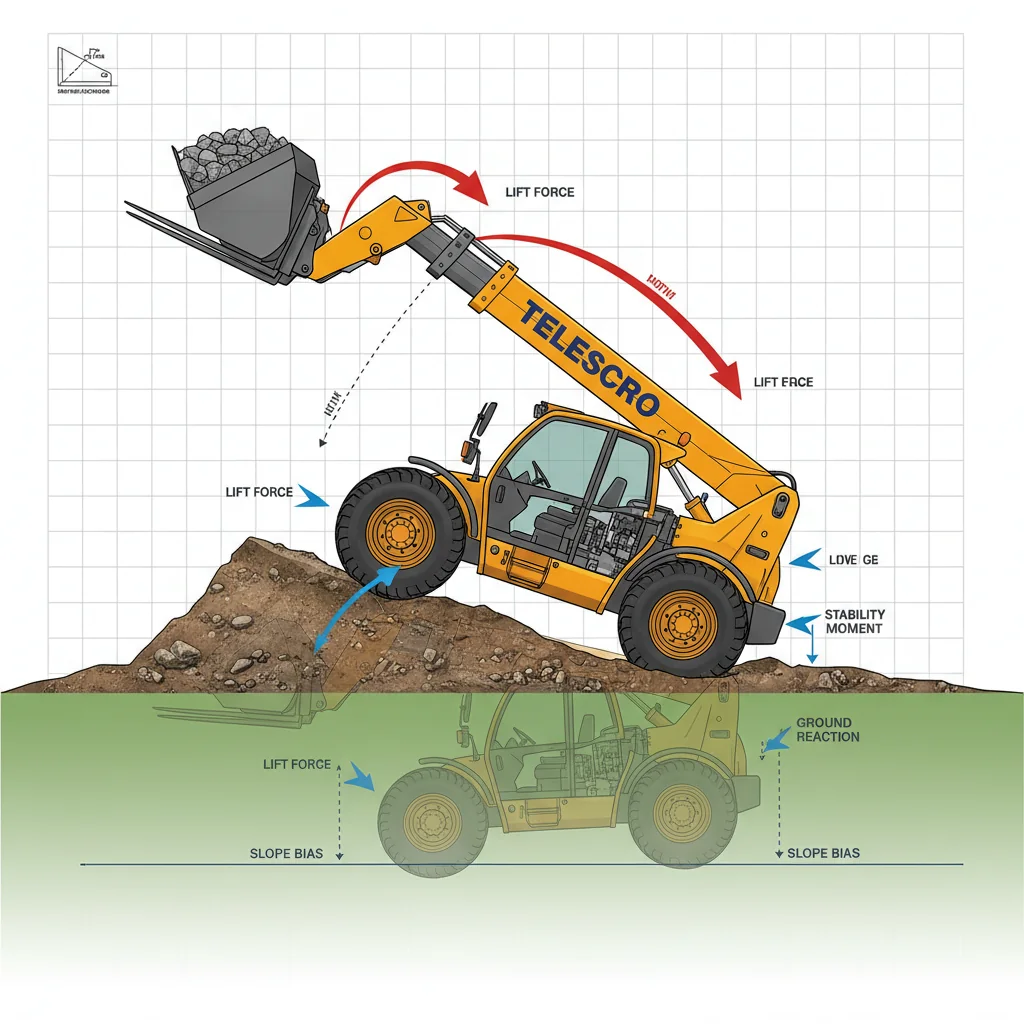
The biggest mistake I see is teams relying on load chart numbers without thinking about ground conditions or dynamic movement. Those charts are built for perfect situations: machine totally level, boom steady, and a standard attachment. But real jobsites in places like Brazil or South Africa are rarely that flat. As soon as your telehandler is on a rough patch, or you’re driving with the boom raised, things change fast. I’ve watched an operator in the UAE hit a shallow rut with a 3.5-ton machine, forks carrying about 2,000 kg. Just that minor jolt made the boom bounce—he was running “within capacity,” but for a second the load shifted dangerously forward. That’s dynamic load in action.
Here’s what matters most when you add heavier attachments—think of buckets or long jibs. The further weight moves out on the boom, the faster your stability margin disappears. If you’re working with loose material, even a shifting bucket can pull your load center outward. I’ve seen real jobsites where a 4-ton machine, rated for 1,500 kg at near full reach on level ground, barely handled 900–1,000 kg safely once the ground got uneven and a material bucket was attached.
To be honest, I always tell customers to work at 50–70% of the chart rating on soft or sloped ground, especially with heavy or uneven loads. Lower the boom and slow down when traveling—don’t get tempted by the “max” line on the chart. Operator skill makes the difference, so make sure everyone knows how dynamic forces work, not just the static numbers. That’s how you stay safe and productive.
The weight of the attachment itself directly reduces the maximum load a telehandler can safely lift, as the load chart ratings assume a standard attachment, not heavier specialty tools.True
Load charts typically account for a specific standard attachment. Heavier attachments eat into the machine’s rated capacity, so operators must subtract the attachment’s weight from the charted numbers for true safe lifting capacity.
Attachment weight has minimal influence on telehandler lifting capacity, since the machine’s hydraulics compensate for any extra mass automatically.False
Hydraulic systems cannot compensate for the added weight of an attachment; this extra weight reduces the allowable payload and must be factored into lifting calculations to avoid exceeding capacity and risking tip-over.
Key takeaway: Rated capacity applies only on firm, level ground in static conditions. Real-world variables—such as slopes, rough terrain, and heavy attachments—require conservative working margins, slower operation, and adherence to load chart prerequisites. Operator training and awareness of dynamic risk are essential for safe telehandler use.
How does attachment weight affect capacity?
Attachment weight directly reduces a telehandler’s rated capacity because both the attachment and any shifted load center must be accounted for on the load chart. Heavier, larger attachments often cause capacity derating8, requiring operators to work at shorter reach or lower heights, which increases fuel use, tire wear, and operational costs.

Let me share something important about attachment weight—this is a detail that often gets missed when crews are choosing equipment for a tricky site. On a real job in Turkey, we worked with a team running an 18-meter telehandler rated for 4,000 kg. They decided to use an oversized bucket for fast gravel loading. But by the time you’d factored in the 500 kg bucket, plus the shifted load center, their usable capacity at 12 meters dropped to just above 1,200 kg. The operator had to work at much shorter reach and shuffle the machine constantly. They burned more fuel, the tires wore out sooner, and the cycle time actually got slower.
Here’s how heavier or larger attachments affect working capacity in real terms:
- Attachment self-weight counts as part of the total load—so a 600 kg work platform instantly cuts into your lifting margin.
- Load center shifts9 forward—the longer or bulkier the attachment, the greater the derating on the load chart.
- Cycle speed decreases—you’re forced to reposition more often instead of working at maximum outreach or height.
- Fuel and tire costs go up—running near tipping limits means more tire scrub, increased hydraulic strain, and more downtime.
From my experience, over-specifying attachments looks smart on paper, but in reality it creates “showroom hero, jobsite zero” situations. If I’m quoting for a client in the UAE or Kazakhstan, I always check the cycles per hour at the safe working reach, not just the maximum bucket size. Compare the real-life hourly output and total operating costs—sometimes a lighter, properly sized attachment delivers more throughput with less wear and fewer headaches.
Attachment weight reduces the maximum lifting capacity of a telehandler because it must be subtracted from the rated load, and it can also affect the center of gravity, further reducing safe lift limits at reach.True
When choosing attachments like buckets or work platforms, their weight is part of the total load on the telehandler. This means the capacity chart must be recalculated to account for both the attachment and the material lifted. Additionally, heavier attachments can shift the load center further from the machine, making it less stable at full extension.
Telehandlers automatically compensate for attachment weight with built-in sensors, so using a heavier attachment does not impact the rated lifting capacity at any boom position.False
While some advanced telehandlers may have load management systems, standard practice requires operators to manually include the attachment’s weight in their capacity calculations. No telehandler can ‘ignore’ the real-world effects of added attachment mass on capacity and stability, especially at reach.
Key takeaway: Attachment weight reduces usable capacity by adding to total load and shifting the center of gravity. Over-specifying attachments can decrease productivity and raise operating costs by forcing shorter cycles, more repositioning, and greater fuel and tire consumption. Always compare real working cycles and lifetime costs before selection.
How does attachment weight stress telehandlers?
Heavy attachments increase front-end stress on telehandler booms, quick couplers, tilt cylinders, and carriage welds. Frequent operation near rated limits accelerates wear of pins and bushings, causes premature seal failures, and can lead to long-term boom fatigue10, cracked frames, and alignment issues, especially under dynamic, shifting loads.

I’ve worked with jobsite teams in places like Qatar and South Africa who ran into real trouble by underestimating how much stress a heavy attachment creates. When you fit a large bucket or hay grapple, you’re adding anywhere from 250 to 700 kg up front—not just the load, but the attachment itself. That extra weight pulls harder on the boom head, flexes the quick coupler, and asks more from the tilt cylinders every time you move. If you keep working near the limits shown in the load chart, expect to see premature wear on pins, bushings, and even early seal leaks in those front cylinders.
Over a few seasons, I’ve seen recurring cracked welds at the carriage and increasing side-to-side play at the boom head—especially on machines always running heavy tools like block clamps or log grapples. One customer in Kazakhstan ignored early warning signs. By year three, their main boom weld failed right before harvest—unplanned downtime that cost them nearly a week.
There are several ways excessive attachment weight can silently push a telehandler towards mechanical failure:
- Accelerates pin and bushing wear11, leading to sloppy boom movement
- Causes more frequent seal failures in tilt and auxiliary cylinders
- Increases forces on carriage welds, raising the risk of micro-cracks
- Promotes long-term boom fatigue and possible frame distortion—especially with shifting, dynamic loads
I always recommend choosing the lightest attachment that still fits your job. If you’re running heavier tools daily, grease pivot points more often and check high-stress welds for hairline cracks every month. A little extra maintenance now will save you a major repair bill down the road.
The weight of an attachment is treated as part of the overall load by the telehandler’s load management system, reducing the maximum safe payload by the attachment’s mass.True
Telehandlers must account for both the attachment and the load it carries. Most load charts assume the attachment is installed, and you must subtract its weight from the rated capacity; ignoring this can risk overloading the machine.
Attachments positioned farther from the boom head do not affect the telehandler’s lifting capacity, as only the main load weight matters.False
The distance from the boom's pivot point affects the load moment. Heavy attachments mounted farther from the boom head increase leverage and decrease safe lifting capacity, making their positioning critically important for stability and safety.
Key takeaway: Excessive attachment weight accelerates wear on high-stress components, increasing the risk of mechanical failures and unplanned downtime. Selecting lighter, suitable attachments and tightening maintenance—especially on pins, bushings, welds, and locking systems—helps extend the telehandler’s service life and reduce overall ownership costs.
How Should Telehandler Attachments Be Specified?
Specifying telehandler attachments requires full disclosure of the machine’s brand, model, year, quick-coupler12 type (preferably with photos), current load chart, and intended loads. Suppliers must state the attachment’s self-weight, working load, and OEM approval status, and supply a combined load chart to confirm safe lifting capacity with the chosen configuration.
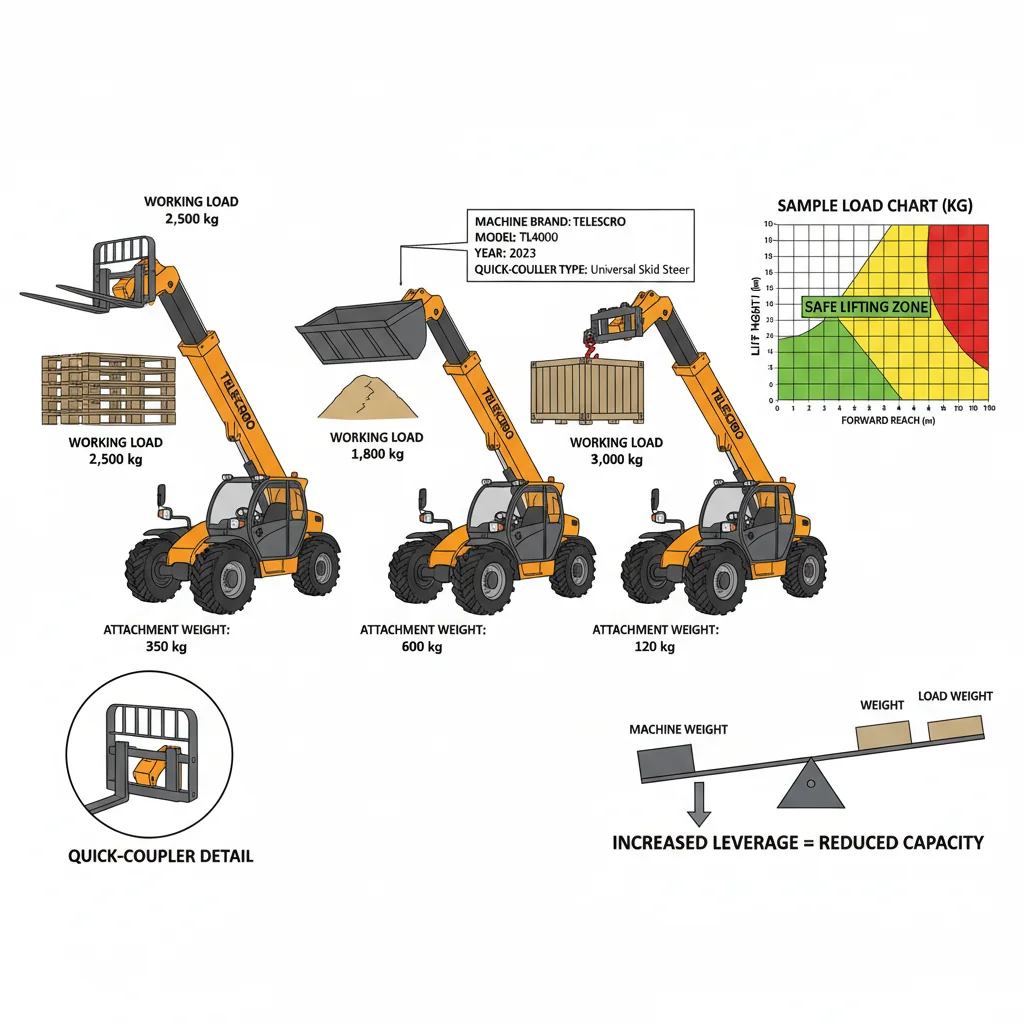
I’ve worked with customers who made this mistake—assuming any attachment labeled “telehandler” will fit their machine. The reality is, even when the quick-coupler matches, a platform or bucket that fits mechanically might quietly slash your usable capacity. I’ve seen a team in Kazakhstan order a 4-ton telehandler and add a third-party platform, only to discover the machine was limited to lifting about 600 kg at 10 meters—half what they expected from the standard load chart.
To avoid surprises like this, here’s what you must prepare for the supplier:
- Brand, precise model, and year of your telehandler.
- Quick-coupler type and pin dimensions—photos help avoid mistakes.
- Machine’s current load chart (official version in your language or English).
- Your actual working needs—what type of loads, weights, materials, typical reach and height.
Once you provide these details, make sure the supplier clearly answers:
- Attachment self-weight (this eats into your machine’s capacity).
- Attachment maximum working load and intended application.
- OEM or professional engineering approval for your chosen combination.
- Combined load chart or configuration sheet—don’t just accept “it will fit.”
I always suggest requesting the combined load chart, especially with platforms, jibs, or heavy buckets. That tells you the real rated capacity at specific boom angles—not the showroom number. It’s frustrating to realize on the jobsite that your “4-ton” machine now legally handles less than 1 ton with the attachment you just bought. Double-checking these details upfront is what keeps your operations efficient and safe.
An attachment with a higher dead weight can substantially reduce a telehandler's maximum lifting capacity at full reach, even if it fits the coupler perfectly.True
Telehandlers calculate maximum lift based on total weight at the coupler, including any attachment; heavier attachments eat into the load the machine can safely lift at distance, reducing usable capacity.
As long as an attachment fits the telehandler's quick-coupler, it will not affect the lifting capacity stated on the machine’s original load chart.False
Load charts are based on standard factory attachments; heavier or third-party attachments increase the total weight at the boom tip, often lowering maximum rated capacity, especially at greater reach.
Key takeaway: Always provide suppliers with precise telehandler details and request comprehensive attachment data, including self-weight and OEM or engineering approval. Insist on a combined load chart, especially for platforms or heavy-duty attachments, to prevent hidden capacity derating that could limit operational effectiveness on-site.
When should a telehandler be upsized?
A telehandler should be upsized when heavy attachments—such as 900–1,100 kg rock buckets or large grapples—regularly bring working loads within 10–15% of the rated limit13 at the required reach. Operating near maximum chart capacity reduces stability and efficiency; moving to a higher machine class provides a practical safety buffer.
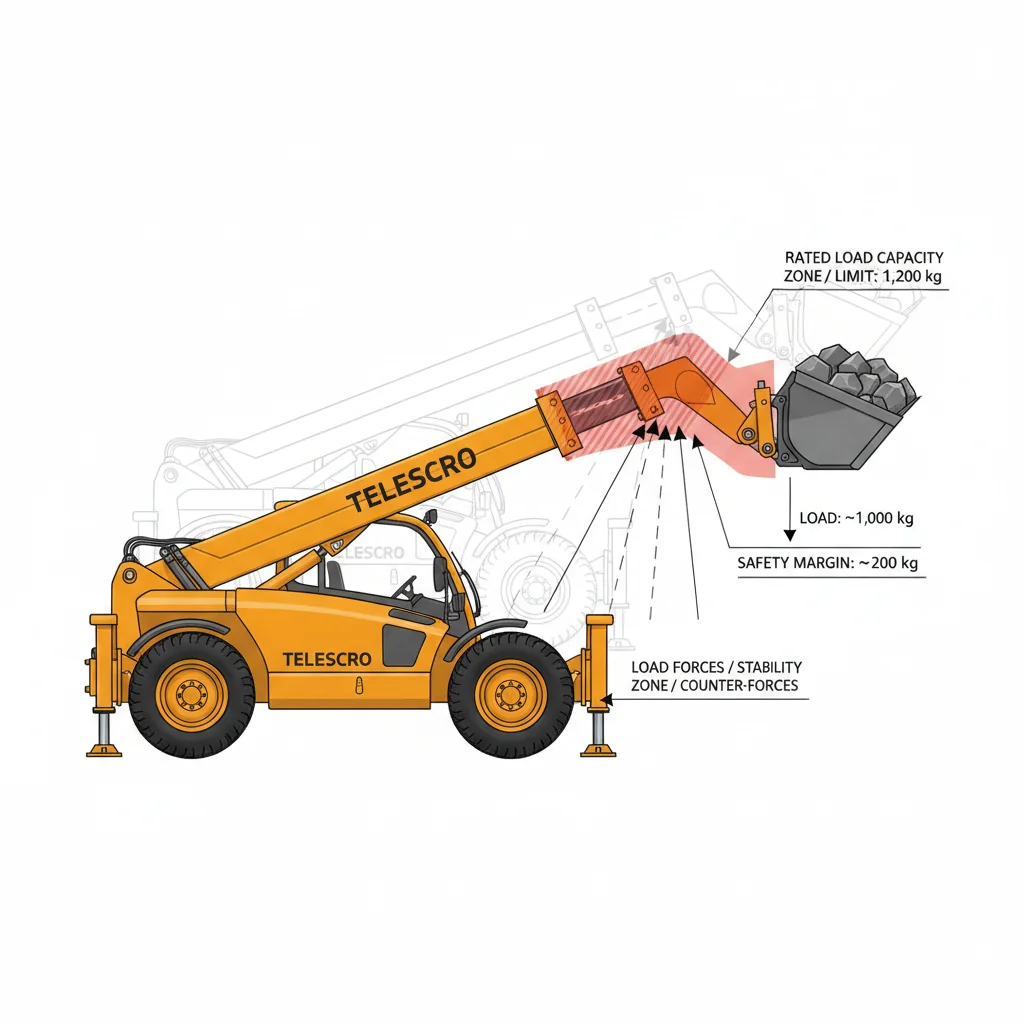
I often get calls from project managers who discover too late that their chosen telehandler can’t safely handle daily loads once heavy attachments are factored in. For example, a team in Dubai used a 4-ton telehandler with an 18-meter reach and fitted it with a 1,000 kg rock bucket. On paper, that machine looked strong enough. Once the attachment weight was subtracted, and they checked the load chart at 12 meters reach, real-world safe capacity dropped well below their typical site requirements. Their operators spent every shift working dangerously close to the rated limit—stressful for the crew, and tough on the machine.
This kind of situation isn’t rare. If your telehandler frequently lifts loads within 10–15% of its rated capacity—especially with large attachments or at long reach—you’re already pushing the limits of forward stability. The load chart measures reach from the front tire edge to the load center, and once you add heavy tools or awkwardly shaped items, the “headline” capacity loses much of its value. Stability margin shrinks, wear and tear increase, and any unexpected surge (like a muddy patch or uneven ground) can tip things from safe to risky in seconds.
I always recommend upsizing if your usual jobs keep you near the limit, especially with demanding attachments like pipe grapples or man-baskets carrying two workers. Moving up even one class—say, to a 5.5-ton model or higher—gives a real safety buffer and longer equipment life. It also means less downtime from wear-related maintenance and more confidence when site conditions are unpredictable. Always match your load chart review to actual attachments and working positions before you commit.
Telehandler lifting capacity must be recalculated after adding a heavy attachment because the attachment's weight directly reduces the machine's available capacity at any reach.True
The load chart for a telehandler assumes only the carriage is mounted; extras like rock buckets or jibs add weight to the boom, meaning the maximum safe load is reduced by the attachment's mass, particularly at extended reaches.
As long as a telehandler’s base lifting capacity exceeds the heaviest object on site, attachment weight does not need to be considered when deciding if upsizing is required.False
This is incorrect because attachment weight and its effect on reach must always be subtracted from the gross lifting capacity. Ignoring attachment weight can easily lead to dangerous overloads and necessitate upsizing to maintain safe operation.
Key takeaway: If frequent lifts with heavy attachments push a telehandler close to its rated capacity at the needed working radius, upsizing to the next machine class delivers greater long-term safety, reduces maintenance stress, and increases operational flexibility, especially under changing site conditions.
Conclusion
We’ve looked at how attachment weight directly affects your telehandler’s safe lifting capacity, with real-world jobsite impacts if you overlook it. From my experience, the contractors who avoid trouble always confirm the combined weight—attachment, rigging, and payload—against the load chart at the exact boom position. Too often, I see teams fall into what I call the “3-meter blind spot”—they focus on max lift specs and forget the details that actually keep the site safe. If you have questions about attachments, load charts, or practical machine choices, feel free to reach out. I’m happy to help you sort through the details based on what actually works in the field. Every site is different—choose what fits your real workflow.
References
-
Details the reduction in rated capacity due to attachment weight and length, essential for safe telehandler operation at height. ↩
-
Comprehensive explanation of telehandler load charts including factors like attachments and rigging to prevent overload incidents. ↩
-
Explains how load center location impacts telehandler tipping risk and rated capacity at extended reach for safer lifting. ↩
-
Learn why engineering codes require reduced load limits and additional safety margins when telehandlers lift man baskets with personnel onboard. ↩
-
Provide an in-depth introduction to the operating principles of the load moment indicator and its critical role in preventing overloading and equipment damage—intended for equipment operators. ↩
-
Explain how to properly use OEM load charts to ensure safe load limits across different machine configurations and attachments, helping prevent overload-related incidents. ↩
-
Explore detailed expert insights on how dynamic loads impact machine stability and safety in rough ground conditions. ↩
-
Detailed analysis of how attachment weight causes capacity derating, reducing reach and increasing operational costs for telehandlers. ↩
-
Explains the impact of load center shifts on lifting capacity with expert insights on load chart adjustments and safety implications. ↩
-
Detailed insights into the factors leading to boom fatigue, including heavy attachment stress and best practices to avoid costly failures. ↩
-
Explore how accelerated pin and bushing wear impacts boom movement and longevity, with expert tips on inspection and maintenance. ↩
-
Detailed insights into different quick-coupler types and how they impact attachment fit and telehandler safety. ↩
-
Explains the importance of the rated limit in telehandler safety and how operating close to it impacts stability and efficiency. ↩