











How to Arrange Sea Shipment for a Chinese Telehandler (Field Guide to Avoid Costly Delays)
Last month, I worked with a contractor in Argentina who missed a critical project deadline just because his telehandler ended up stranded at a Chinese port—wrong container type, a paperwork snag, and suddenly, the whole shipment was delayed for weeks. Mistakes like these are more common than most people realize.
Arranging sea shipment for Chinese telehandlers requires careful coordination between equipment dimensions, shipping methods, and port capabilities. The primary modes include containerized (standard, flat rack, or open-top), Ro-Ro, and rarely, LCL shipping. Mode selection is driven by overall machine size in transport position and receiving port limitations. FCL shipments typically offer lower risk of delays and damage compared to LCL, especially for heavy equipment.
Which Sea Freight Mode Suits a Telehandler?
Selecting the ideal sea freight mode for a Chinese telehandler depends on shipping dimensions and port handling. Containerized shipping1—FCL, flat rack, or open-top—is preferred for units fitting standard 40ft containers, providing cost savings and protection. Ro-Ro shipping2 suits fully assembled, drivable machines but is limited by route and port. Accurate transport dimensions from the manufacturer are essential.

Most people don’t realize that your telehandler’s shipping mode can make or break your timeline—and budget—before the unit even leaves China. I’ve seen a customer in Kenya nearly miss a project start because his 13-meter high-reach telehandler was just a bit too tall for a standard 40ft container. They had to rebook last-minute onto a flat rack. That cost them an extra $1,200 and two weeks of delay at Mombasa port. Getting your shipping dimensions right the first time is essential.
Here’s a direct comparison to make things clear:
| Shipping Mode | Best For | Protection | Route/Port Limits | Typical Cost |
|---|---|---|---|---|
| Standard Container | Compact/disassembled units <2.4m H | Excellent (fully sealed) | Very few | Lowest |
| Flat Rack | Wide/tall units up to ~3.5m H | Moderate (open sides) | Some ports restricting size | Medium |
| Open-Top Container | Units slightly too tall for standard | Good (weather cover) | Limited to equipped ports | Medium-high |
| Ro-Ro | Fully assembled, drivable machines | Good (inside Ro-Ro ship) | Only at Ro-Ro capable ports | Medium-high |
| LCL (Shared Container) | Small units/parts only | Excellent | Slow, risk of damage/loss | Low per unit |
To be honest, most buyers assume Ro-Ro is always faster. In reality, it only works if both export and import ports handle Ro-Ro cargo. Last November, I coordinated a 4-ton telehandler for a customer in Dubai.
Shipping telehandlers taller than 4.3 meters often requires flat rack containers instead of 40ft standard containers due to international container height limitsTrue
Standard 40ft containers typically have an internal height of about 2.39 meters, with ‘high cube’ containers offering up to around 2.7 meters. Telehandlers exceeding these dimensions—especially in height—cannot fit inside, necessitating flat rack containers that allow for outsized cargo.
Standard 40ft containers can accommodate telehandlers up to 15 meters in height if the boom is retractedFalse
Even with the boom retracted, the maximum internal height of standard containers is no more than 2.7 meters (high cube). Telehandlers taller than this cannot fit inside, regardless of boom position, making flat rack or open-top containers necessary.
Key takeaway: Matching the telehandler’s exact shipping dimensions to the right sea freight mode prevents costly last-minute changes and surcharges. Collaborate early with the manufacturer and freight forwarder to ensure the telehandler fits within preferred containerized options or meets Ro-Ro requirements for efficient, delay-free international shipment.
When Is FCL Better Than LCL Shipping?
For telehandlers, Full Container Load (FCL) shipping is almost always more efficient and cost-effective than Less than Container Load (LCL). Due to telehandlers’ size and weight—often exceeding 15 m³—FCL reduces risk, minimizes handling, and avoids costly terminal delays, making it the preferred option for heavy equipment shipments.

Let me share something important about choosing between FCL and LCL for telehandler shipments. In my experience, the size and value of these machines make FCL more reliable for nearly every situation. For example, last year I arranged shipping for a customer in Kenya who ordered a standard 4-ton telehandler—just the bare unit filled almost 18 cubic meters. That’s close to maxing out a 20-foot container on its own. FCL allowed us to load the machine directly at the factory, shrink-wrap everything tight, and avoid terminal storage where extra handling often leads to scratches or even damage to hydraulic lines and boom sensors.
When you use LCL, things get messy. I’ve seen a project in Dubai delayed by over a week because the telehandler’s parts sat in a crowded LCL warehouse, waiting for customs clearance alongside dozens of unrelated goods. Small savings on the base rate don’t help if your jobsite is stuck, waiting on critical equipment. LCL billing may look attractive at $120–200 per cubic meter, but terminal fees and every extra lift add up fast. For a full machine, that means unpredictable charges and more risk of scuffs, broken mirrors, or a dent in the cab—none of which manufacturers’ warranties cover.
I always suggest using LCL only if you’re shipping separated attachments, like forks or buckets, and the main machine is sent FCL. Most customers get better value and fewer headaches this way. For a high-value unit, reliable and predictable shipping is worth every cent.
Choosing FCL shipping for telehandlers allows for loading the machine directly at the factory and shrink-wrapping the entire unit to prevent corrosion during long sea journeysTrue
FCL shipments enable the telehandler to be loaded in a dedicated container at the factory, allowing for comprehensive protective measures like shrink-wrapping which minimizes exposure to saltwater and humidity, reducing corrosion risks during transit.
LCL shipping is generally more cost-effective for telehandlers over 12 cubic meters because it allows combining multiple shipments, spreading out the container costFalse
Despite seeming cost-effective, LCL shipping for large telehandlers typically incurs higher handling fees and risks damage due to multiple cargo handling, and containers are often rented by volume or weight, making FCL more economical and safer for machines close to container capacity.
Key takeaway: FCL shipping is typically recommended for telehandlers due to size, value, and risk mitigation. LCL is only viable for separate, small accessories or parts. FCL reduces handling steps, potential damage, and delays, leading to more predictable costs and transit times for high-value cargo.
What Documents Ensure Telehandler Sea Shipment Compliance?
Essential documents for telehandler sea shipments from China include a commercial invoice3, packing list with precise dimensions and weight, bill of lading, and Chinese export customs declaration. Import destinations require specific compliance, such as CE certificates4 and technical files for the EU or EPA/OSHA papers for the US. Accurate information prevents costly customs delays and ensures regulatory approval.

The biggest mistake I see is contractors underestimating how strict paperwork checks can be at some ports. Last year, a team in Dubai ordered a 3.5-ton telehandler with a 14-meter reach from China. Everything was smooth until customs flagged the shipment for missing the original CE certificate. That little delay kept their machine in the port warehouse for over a week, with storage charges adding up fast. I always remind customers—a scanned certificate isn’t enough for some EU or Middle Eastern ports; they expect original documents with matching serial numbers and up-to-date technical files.
Here’s what matters most when prepping for sea shipment: your commercial invoice must have the exact model, serial number, declared value, and HS code. Customs won’t accept rough estimates. The packing list? Every dimension and net/gross weight must match how the telehandler sits—sometimes a fully-assembled unit, sometimes cab removed for height limits. In my experience, a small packing detail off by 10 centimeters has delayed customs clearance in Brazil. The bill of lading needs your delivery address and consignee details to match all other documents.
One thing that surprises newcomers—different destinations mean different compliance tests. For the US, you’ll be asked for EPA engine compliance, possibly Tier 4/Stage V emission certificates, and sometimes OSHA safety documentation. The EU always wants CE marking, declaration of conformity, and the technical file listing hydraulic circuit protection and emergency stop systems. My tip? Share your destination’s latest import rules with your freight forwarder and let your manufacturer confirm paperwork before vessel departure. I suggest building in at least three working days buffer for customs checks—faster ports still find reasons to dig into machinery shipments.
For telehandler sea shipments to the EU or Middle Eastern ports, only an original hard copy of the CE certificate is accepted for customs clearance, while scanned or photocopied certificates are routinely rejectedTrue
Many customs authorities strictly require original CE certificates as proof of compliance, because scanned or photocopied documents can be easily forged, leading to delays like storage fees and shipment holds. This is especially common in high-regulation regions such as the EU and Middle East.
A stamped digital copy of a CE certificate is legally considered equivalent to the original document for telehandler sea shipments and usually accepted by all customs authoritiesFalse
Despite advances in digital documentation, most customs authorities still mandate an original physical CE certificate for equipment clearance. Stamped digital copies are often not legally recognized, and relying on them can cause shipment delays and fines.
Key takeaway: Accurate, complete documentation—including commercial invoice, packing list, bill of lading, and compliance certificates for the destination market—is critical to avoid sea freight holdups. Confirm all regulatory approvals with the telehandler manufacturer well before departure and allocate sufficient time for customs clearance.
What Is the Telehandler Sea Shipping Timeline?
The typical telehandler shipping timeline5 from China to the destination yard is 6–10 weeks total. This includes 1–2 weeks for documentation and export customs, 3–6 weeks of sea transit, and 1–2 weeks for unloading and final inland transport. Seasonal port congestion and missed vessel cut-offs often add 1–3 weeks.

Last year, a customer from Dubai asked me why their newly ordered 4-ton telehandler with 17-meter reach still hadn’t arrived after two months. Their project was stuck waiting, frustrated by the uncertainty. To be honest, the complexity behind sea shipping timelines often surprises even experienced buyers. The average door-to-yard timeline from China is about 6 to 10 weeks, but there are several moving parts. Let’s break it down.
First, you’ll spend 1–2 weeks on documentation, export customs, and getting the machine to a major Chinese port—usually Shanghai, Ningbo, or Tianjin. I’ve seen cases in Brazil and South Africa where slow paperwork or last-minute certificate queries delayed shipments by almost a week. Once loaded, the sea transit itself takes 3–6 weeks. For example, shipping to the US West Coast is generally about 20 days on water. Shipping to Europe or the US East Coast? Count on around 30–35 days, depending on the shipping line and seasonal congestion.
After arrival, you’re not done. Plan another 1–2 weeks for unloading, local customs, port handling, and moving the telehandler to your jobsite. I’ve watched contractors in Kenya and Kazakhstan lose precious days when inland transport met traffic jams or missed local clearances. Weather, port strikes, and holidays like Chinese New Year or Golden Week can add another 1–3 weeks if your timing is unlucky.
I always suggest budgeting for the worst-case scenario—at least 9–10 weeks total—and building in 1–2 extra weeks of leeway. That flexibility saves major headaches when your project is on a tight schedule.
Sea shipping a telehandler from China typically involves a mandatory 1-2 week period for export customs clearance and documentation, which significantly impacts the overall timelineTrue
Export customs procedures and paperwork can be complex and time-consuming, often requiring up to two weeks for completion, thus forming a critical part of the 6 to 10 week sea shipping timeline from China.
Telehandler sea shipments from China rarely require more than 3 days for unloading and port handling upon arrival at the destination portFalse
Unloading and port handling can often take several days to over a week due to port congestion, crane availability, inspection protocols, and paperwork, meaning 3 days is typically an underestimate for most international ports.
Key takeaway: Telehandler sea shipments from China usually take 6–10 weeks, accounting for paperwork, vessel schedule, transit, and inland delivery. Factoring in peak season and potential delays, project managers should build in at least 1–2 weeks of flexibility to avoid costly disruptions.
How Do Port Choices Affect Telehandler Shipping?
Port selection for telehandler sea shipment directly impacts both logistics costs and transit time. Major Chinese coastal ports6 like Shanghai, Ningbo, Shenzhen, or Guangzhou offer 20–30% lower shipping rates and expedited sailings compared to inland points. Destination port efficiency also matters: high-volume ports see frequent service but risk seasonal congestion, affecting overall delivery schedules and costs.

Here’s what matters most when shipping telehandlers: the ports you choose on both ends can make or break your project’s timeline and budget. I’ve worked with customers from Kazakhstan to Brazil, and the difference adds up quickly. Say you’re sourcing a 4-ton telehandler with a 13-meter boom. If your Chinese supplier ships from a deep inland city, you’re looking at several days of trucking just to reach the coast, and that alone can push your logistics costs up by 20–30%. That’s before you factor in potential delays if a truck gets stuck or local permits take longer than expected.
A contractor in Kenya learned this the hard way. They went with a slightly cheaper machine based in inland China. But by the time they paid for 1,000 kilometers of overland transport (plus oversized load permits), their “bargain” had cost them at least $2,500 extra—more than if they’d purchased ex-works near Ningbo or Shanghai. Shipping from major coastal ports not only saves money, but you also benefit from more frequent sailings. For example, I often see weekly services from Shanghai to Los Angeles or Hamburg, which keeps your project on schedule.
Don’t forget about the destination port, either. High-traffic hubs like Rotterdam or Antwerp move containers quickly most of the year, but congestion during peak import season can add two or three extra days—even a week—to unloading. I suggest always confirming with your supplier exactly which ports are involved, not just ex-factory pricing. Sometimes, paying for a unit closer to a main port is the smarter long-term move.
Choosing a deepwater port close to the telehandler supplier in China can reduce pre-shipment inland trucking costs by up to 30%, significantly lowering overall logistics expenses.True
Deepwater ports near manufacturing hubs allow telehandlers to be loaded directly onto ocean vessels with minimal inland transport, avoiding costly and time-consuming multi-day trucking that increases expenses by 20-30%.
Using a shallow-water port for shipping Chinese telehandlers is generally more cost-effective because it allows for smaller vessel operations, reducing port fees.False
Shallow-water ports cannot accommodate large ocean vessels typically used for heavy equipment like telehandlers, leading to transshipment delays and higher overall costs compared to deepwater ports designed for direct containerized shipments.
Key takeaway: Choosing major coastal ports at both the origin and destination can reduce telehandler shipping costs by 20–30% and shorten transit times. Inland shipping adds substantial trucking expenses. Always clarify port details with suppliers, as a lower ex-factory price may not offset higher logistics costs from less optimal shipping routes.
How Are Telehandlers Secured for Sea Shipment?
Telehandlers require professional loading and secure lashing7 for safe sea shipment. Machines are chocked, blocked, and fastened using chains or ratchet straps rated above operating weight, with wooden blocks and welded stops preventing movement. Export-grade packaging8, rust inhibitors, and clear markings further reduce damage risk. Detailed photographic evidence of the lashing process is often mandatory for shipping and insurance compliance.

I’ve worked with customers who made shipment mistakes that cost them thousands in delays and damage claims. One case from Brazil stands out—a 4-ton telehandler with a 13-meter boom was loaded using basic straps and old chocks. Halfway across the Atlantic, rough weather shifted the machine, breaking a hydraulic cylinder mount and damaging a wheel. Getting replacement parts added three weeks to their project. That’s the real risk if you skip proper securing.
When preparing a telehandler for sea shipment, you can’t cut corners. Machines like these have a high center of gravity—just blocking the wheels isn’t enough. I always recommend using chains or heavy-duty ratchet straps rated at least 20% above the telehandler’s operating weight. For example, an industry-standard 4,000 kg unit should have tie-downs good for at least 5,000 kg each, and you want at least four solid points anchored to the container floor or flat rack. Welded stops and hardwood blocks help absorb shocks from rough seas.
Export-grade protection makes a massive difference too. In northern Europe, I’ve seen crews apply rust inhibitors to every exposed cylinder and rod—especially vital if your telehandler will sit at the port for more than a week. Open cab? Cover it with shrink-wrap or a durable tarp. Protect all control boxes and electronics with weatherproof covers. Mark major tie-down points, center of gravity, and “No Fork Here” spots clearly—the stevedores will thank you. I suggest making photographic proof of each step standard—it’s now required for insurance by most ports. This simple habit helps protect your investment and keeps disputes to a minimum.
Shipping telehandlers with booms extended beyond 10 meters requires specialized engineered supports to prevent stress damage during sea transportTrue
Extending booms beyond certain lengths increases leverage on mounting points during ship movement. Specialized cradles and supports distribute loads to prevent structural damage, which basic straps and chocks cannot adequately address.
Using standard wooden blocks under telehandler wheels alone is sufficient to secure the machine for sea shipment without additional tie-downsFalse
Wooden blocks alone cannot prevent shifting caused by ship motions; proper securing requires multiple tie-down straps or chains anchored to the vessel to restrict movement and protect hydraulic components and tires.
Key takeaway: Proper packaging, lashing with rated hardware, and photographic evidence are essential when arranging sea shipment for telehandlers. Investing in export-grade protection and mandating detailed load documentation dramatically reduces transit damage, speeds port handling, and is increasingly required by ports and insurers for machinery shipped from China.
Why is pre-shipment inspection vital for telehandlers?
Pre-shipment inspection for telehandlers ensures mechanical integrity and legal protection before export. Essential checks include fluid leaks, hardware security, damage assessment, and operational safety verification. Using independent inspection firms provides photographic evidence and reports, critical for insurance claims and dispute resolution. Early detection in China saves significant costs versus post-arrival corrections.

Last month, a project manager in Kazakhstan sent me photos of a 4-ton telehandler arriving with a cracked hydraulic cylinder and two bent fork tines. The insurance claim dragged for weeks because there was no clear evidence of the machine’s condition before shipping. That’s why I always make pre-shipment inspections a priority for export orders—especially for units with a reach over 16 meters or multiple attachments. It’s not just about ticking boxes. You’re protecting your business.
Think about what’s at stake. I’ve seen buyers in Kenya discover missing safety guards or chipped boom welds only after the telehandler landed at port—fixing those issues locally nearly tripled their repair costs. In China, labor and spare parts are much cheaper, so catching defects before export can save thousands of dollars, not to mention major project delays.
A solid pre-shipment inspection should cover more than just the basics. I suggest checking for hydraulic leaks9, signs of impact around the counterweight, security of battery connections, full function of the moment indicator, and that all safety systems—like backup alarms and cut-off switches—work as designed. For jobsites requiring multiple attachments, confirm each tool (forks, buckets, lifting jibs) is properly secured and matches your load chart.
Independent third-party firms can provide photographic evidence and a detailed condition report. This paperwork becomes crucial for insurance or in case of a dispute with the supplier. My advice: always include pre-shipment inspection as part of your contract, especially on purchases over $50,000 or when buying for a whole fleet. Early diligence always pays off in the field.
Pre-shipment inspections often include pressure testing of hydraulic cylinders, which can reveal micro-cracks not visible to the naked eye, preventing costly damage disputes during shipmentTrue
Pressure testing applies controlled hydraulic pressure to cylinders to detect leaks or weaknesses, ensuring that any internal damage is identified before shipping, which safeguards against hidden defects causing failures in the field.
For sea shipments of telehandlers from China, it is standard practice to dismantle the engine and fuel system to comply with maritime safety regulationsFalse
While some components are secured or drained to prevent leaks, completely dismantling the engine and fuel system is not a maritime requirement and would be impractical; telehandlers are generally shipped intact with appropriate precautions instead.
Key takeaway: Conducting a structured pre-shipment inspection for telehandlers minimizes the risk of transit damage disputes, supports insurance claims, and enables correction of quality issues before export. Integrating independent inspections into the purchase contract is crucial for large or high-value telehandler orders.
How to Calculate Telehandler Sea Freight Costs?
Total telehandler sea freight cost10 includes not only the ocean rate—ranging from USD 1,500–5,500 per unit for China–EU/US routes—but also origin trucking, export handling, lashing, documentation, port charges, insurance (0.2–0.5% cargo value), customs clearance, and inland delivery. Incoterms like CIF and DDP11 heavily impact both costs and operational control.

To be honest, the freight cost question comes up every single week—usually after someone gets a shock from extra charges at their destination. The ocean rate for one standard telehandler (let’s say a 4,000 kg unit with 13-meter reach) from China to Hamburg or Los Angeles normally sits between USD 1,800 and 4,500, depending on whether you use a flat rack or stuff it into a regular 40-foot container. Easy, right? The real issue starts when you factor in everything else.
Take last season: a customer in South Africa ordered two units. Ocean freight showed up clear on their quote. But they forgot about local trucking from our Chinese factory to Shanghai port—around USD 150 per unit for a 400 km trip—plus export paperwork, about USD 60. Lashing and securing? Count another USD 75, minimum. Insurance was 0.3% of invoice value, which covered major risks during the four-week sea journey. Once units landed in Durban, port handling and customs eaten up roughly another USD 480. Final delivery to their site, 60 km inland, added $330. When you add it all, “extra” costs easily made up 20% over the original sea rate.
Incoterms play a big role. I’ve seen first-time buyers struggle with CIF—Cost, Insurance, Freight—because duties, taxes, and inland delivery are their own headache after arrival. In most cases, DDP (Delivered Duty Paid) looks pricier upfront, but covers almost every step to your site, so budgeting is cleaner. I strongly suggest getting detailed, line-by-line quotes with all fees broken out. That way, no one’s surprised halfway through the project.
Using a flat rack for shipping a 4,000 kg telehandler with a 13-meter reach reduces sea freight costs by up to 40% compared to using a standard 40-foot containerTrue
Flat racks allow telehandlers to be shipped without disassembly and avoid wasted container space, which can significantly reduce freight volume charges and result in cost savings of up to 40% depending on the telehandler dimensions and shipping route.
Sea freight costs for telehandlers are always fixed and do not vary with the shipping route or seasonal demandFalse
Sea freight costs fluctuate based on factors like shipping route, seasonal demand, port congestion, and fuel prices. Therefore, telehandler sea freight costs are variable and can differ significantly depending on timing and destination.
Key takeaway: Estimating total landed cost for Chinese telehandler shipment requires factoring in more than the base ocean rate. Include ancillary charges, insurance, and local delivery, adjusting for Incoterms. Breaking down each component and comparing clearly itemized quotes helps avoid surprise costs and streamline international deliveries.
What Role Do Freight Forwarders and Tracking Play?
Experienced freight forwarders specializing in heavy equipment shipping12 handle factory pickup, export paperwork, vessel booking, insurance, customs clearance, and inland transport for Chinese telehandlers. Utilizing reliable carriers and modern tracking systems, they provide real-time location updates and proactive alerts, enabling precise planning for port handling, cranes, and operator scheduling, and significantly reducing risks of costly shipment delays.
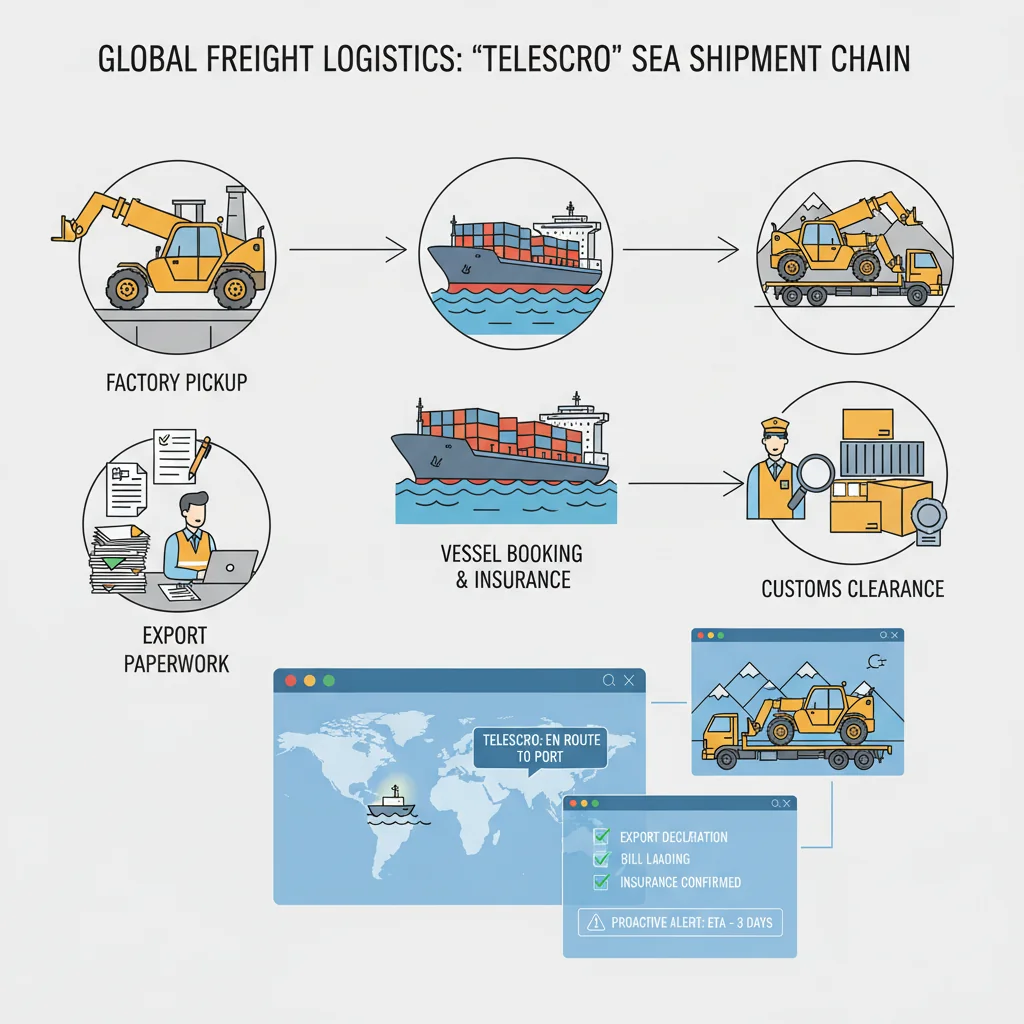
Plenty of buyers focus only on price quotes and forget that moving a fully-assembled 12-ton telehandler from China to, say, Kenya, is a different challenge than shipping pallets of smaller equipment. Freight forwarders specializing in heavy machinery are your problem-solvers here. They don’t just book space on a vessel—they coordinate the factory pickup, arrange export paperwork, select reliable carriers, handle insurance, and monitor customs steps at both ends. I’ve seen what happens when general-purpose agents are used: one customer in Brazil had their 17-meter unit stuck on the dock for almost two extra weeks because nobody pre-booked the port crane that could handle a 14-ton lift. That delay forced them to reschedule operators and slow the foundation work.
What sets good forwarders apart is the real-time tracking13 and communication they provide. These days, many offer an online dashboard. You can see if your telehandler’s at the Chinese terminal, loaded on the vessel, or waiting at a transshipment port in Singapore. I always suggest asking, “How quickly do you notify us of schedule changes?” For larger site teams—like a customer in Saudi Arabia handling five telehandlers for a high-rise—knowing expected arrival dates a week in advance made it possible to book local cranes and plan crew training. That sort of coordination can save at least two working days.
The practical takeaway? Don’t just base your forwarder choice on cost. Ask about their heavy equipment experience and the specific tracking tools they use. This reduces your risk of delays or costly mistakes, and ensures your jobsite flows the way you expect.
Freight forwarders specializing in heavy machinery often use modular loading techniques to disassemble telehandlers partially, reducing shipping volume and costs without compromising on-site assembly integrityTrue
By partially disassembling large telehandlers, freight forwarders can optimize container space or deck area on vessels, reducing freight charges while ensuring the telehandler can be reliably reassembled onsite with original factory precision. This approach is especially useful for 12-ton machines in international shipments.
Standard container shipping is always the most cost-effective and simplest method for transporting fully-assembled 12-ton telehandlers from China to KenyaFalse
Fully-assembled 12-ton telehandlers usually exceed standard container size limits, making breakbulk or Ro-Ro shipment necessary. Using standard containers for such large equipment is often impractical or more expensive due to size constraints and the special handling required.
Key takeaway: Relying on a specialized freight forwarder with proven experience in handling telehandler shipments and offering robust tracking tools is critical for minimizing import risks, avoiding shipment delays, and ensuring smooth coordination of port logistics and delivery schedules.
What Multimodal Transport Options Suit Telehandlers?
Sea plus road14 is the standard multimodal option for Chinese telehandler shipments, with offloading at a seaport followed by road transport using low-bed trailers or heavy trucks. In Europe and parts of Central Asia, China–Europe rail combined with road15 offers a faster, cost-effective alternative for certain routes and telehandler sizes.

Many buyers ask me how to balance cost and timing when moving telehandlers inland, especially for destinations far from major ports. In Kazakhstan, for example, a customer recently debated between sea plus road or trying the China–Europe rail route for a pair of 3-ton, 13-meter machines. Both options work, but the right choice depends on your priorities—transit time, handling risk, or total landed cost.
Let’s look at the key differences:
| Multimodal Option | Typical Use Cases | Transit Time | Cost (to inland) | Limits/Challenges |
|---|---|---|---|---|
| Sea + Road | Most global shipments | 30–45 days | Lowest to most ports | Heaviest/oversized units need special trailers |
| Rail + Road | Europe, Central Asia, Russia | 12–18 days | Slightly higher | Not suitable for all sizes; limited rail hubs |
| Full Truck (rare) | Short distances in China/SEA | 3–12 days | Highest | Only cost-effective for urgent, smaller telehandlers |
From my experience, for most standard models under 12 tons and below 2.6 meters wide, rail plus road can save at least two weeks versus all-sea for inland Europe. If you’re shipping a 4-ton, 17-meter high-reach model to Germany, but your site is 600 km from Hamburg port, China–Europe rail into Poland plus local trucking often hits a “sweet spot”—faster, usually with simpler customs. But oversized machines usually need to stick with sea plus road, since rail limits width and height. Also, every extra transfer—unloading, reloading—adds handling risk and fees.
When shipping telehandlers from China via sea, using 40-foot high cube containers allows accommodating machines up to 13 meters in length without disassemblyTrue
40-foot high cube containers provide extra height and length, enabling transport of longer telehandlers intact, reducing handling risks and saving on costly disassembly and reassembly time.
Sea shipment from China to inland Kazakhstan is always faster than China–Europe rail transport for telehandlersFalse
Rail transport typically offers faster transit times between China and inland locations like Kazakhstan, as sea shipments must first reach major ports and then rely on slower road transport for inland delivery.
Key takeaway: Choosing the right multimodal option—sea plus road or rail plus road—can optimize telehandler delivery from China. Carefully compare costs, transit time, and transfer points for each route, and always specify full delivery details in quote requests to avoid unnecessary risks and fees.
Conclusion
Arranging sea shipment for a Chinese telehandler really comes down to getting those shipping dimensions right and working with your partners early. That way, you avoid those costly last-minute changes that catch too many buyers off guard. From my experience, the real trouble starts when the actual machine ends up a bit wider or taller than planned—the kind of “3-meter blind spot” that leads to repacking fees or missed Ro-Ro bookings. If you’re sorting out your shipment, I’m happy to help look over your container fit or talk through Ro-Ro requirements. Feel free to reach out with any questions—sometimes a second look saves weeks on the dock. Every project is a little different, so pick what truly fits your workflow.
References
-
Detailed explanation of containerized shipping modes for telehandlers, focusing on cost savings and protection benefits. ↩
-
Insightful overview of Ro-Ro shipping’s suitability for drivable telehandlers, including route and port limitations. ↩
-
Detailed explanation of commercial invoice requirements helps avoid customs delays by ensuring accurate model, serial number, and HS code info. ↩
-
Covers the critical role of original CE certificates and technical files in compliance, preventing costly customs holds in EU and Middle Eastern ports. ↩
-
Provides an expert breakdown of the full 6-10 week telehandler shipping process, covering documentation, sea transit, and unloading delays. ↩
-
Explore how Shanghai, Ningbo, Shenzhen ports reduce shipping costs by 20–30% and speed up telehandler delivery for global projects. ↩
-
Provide a detailed explanation of safe lashing techniques to ensure that telehandlers and other heavy equipment remain securely in place during long-distance ocean transport, minimizing the risk of damage and shipment delays—useful for logistics professionals. ↩
-
Offer an in-depth introduction to export-grade packaging materials and techniques designed to protect heavy equipment from salt corrosion and mechanical impact during sea transport—valuable for export logistics specialists and equipment transportation managers. ↩
-
Provides technical tips on identifying hydraulic leaks early to avoid expensive repairs and maintain operational safety in telehandlers. ↩
-
Learn detailed cost factors including ocean rate, trucking, insurance, and port fees for accurate telehandler shipment budgeting. ↩
-
Discover how Incoterms impact cost allocation and operational control in telehandler sea freight, key for managing import/export expenses. ↩
-
Comprehensive insights into how specialized freight forwarders manage complex logistics for heavy machinery, reducing costly delays and risks. ↩
-
Explains how modern tracking systems provide live updates and proactive alerts that optimize port handling and operator scheduling. ↩
-
Explore detailed advantages of sea plus road shipping for telehandlers, including cost efficiency and typical transit times to inland destinations. ↩
-
Learn how the China–Europe rail plus road route offers faster transit and cost-effective alternatives for telehandler shipments in Europe and Central Asia. ↩