










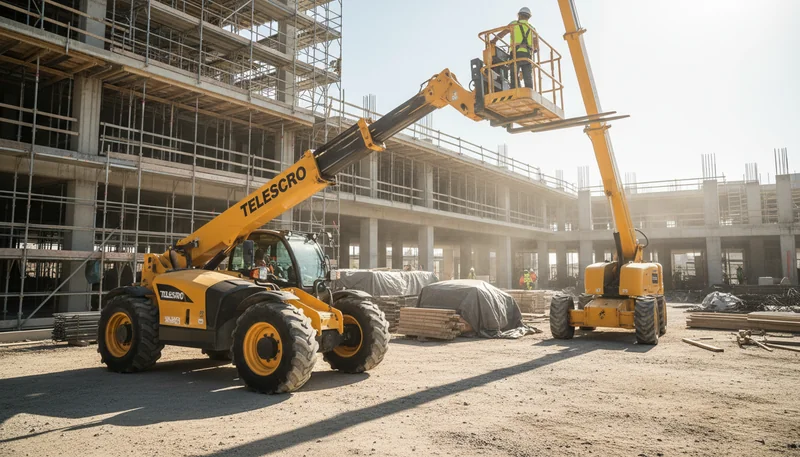
الرافعة التلسكوبية مقابل الرافعة ذات الذراع: الاختلافات الرئيسية التي يغفلها المشترون في الميدان
The biggest mistake I see buyers make is assuming a telehandler and a boom lift can do each other’s job. Just last month, a site manager in Australia asked me why his new boom lift struggled to move pallets of block—he thought “all long-armed machines” were basically interchangeable.
في هذه المقالة، سأعرض الاختلافات التي تم اختبارها ميدانياً بين الرافعات التلسكوبية والرافعات ذات الذراع المتحرك، وهي الاختلافات التي نادراً ما يسلط عليها المصنعون الضوء.
You’ll learn which machine is truly made for materials, which one keeps people safe at height, and why specs like reach and مخططات الأحمال1 matter more than most buyers expect.
What Sets Telehandlers Apart from Boom Lifts?
Telehandlers are designed for lifting and placing heavy materials using forks or buckets, with capacities between 5,000–24,000 lb. Boom lifts, in contrast, raise workers and tools safely to height, supporting only 440–1,000 lb. Choosing the wrong machine can impact productivity and job safety.
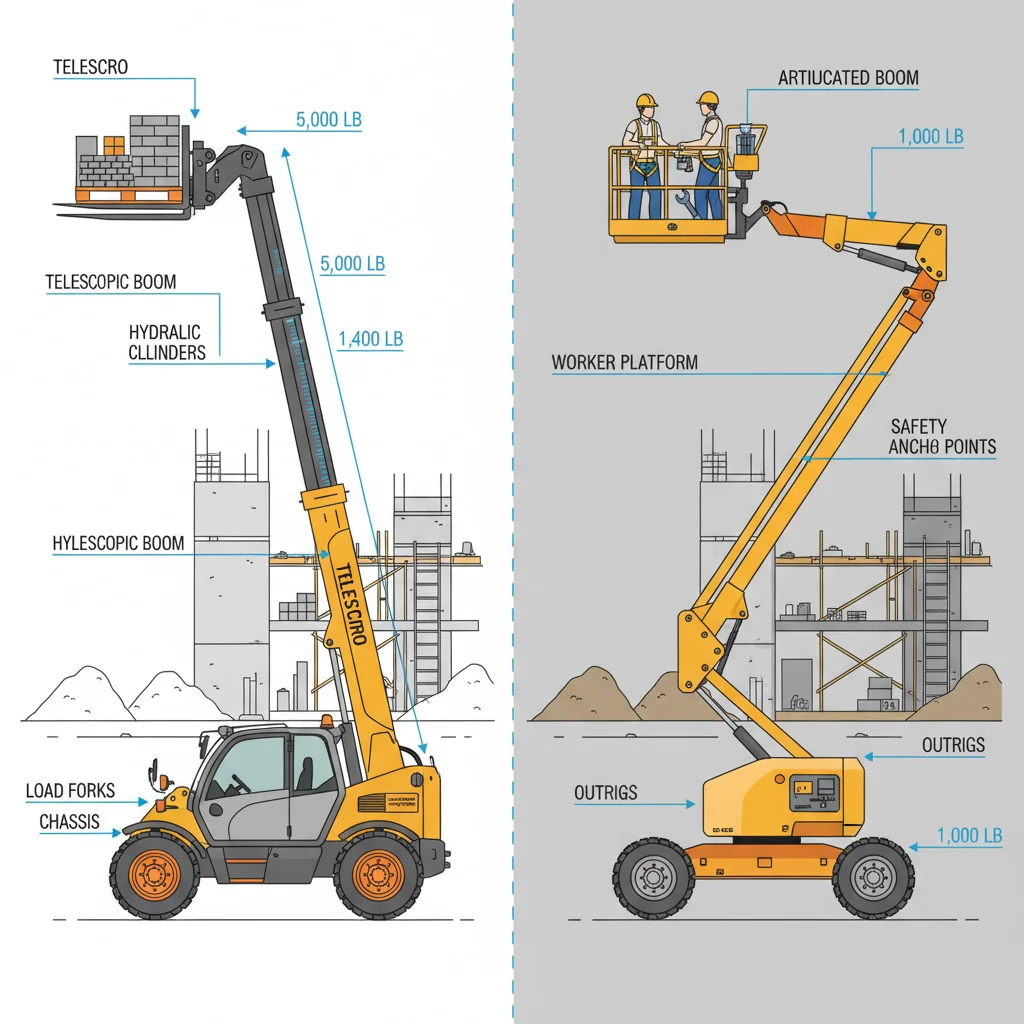
Let me share something important about choosing between a telehandler and a boom lift. Most people look at the max height and think they’re the same, but the core function is completely different. I’ve seen contractors in Kazakhstan run into trouble because they tried to use a boom lift for moving pallets of bricks—big mistake. Boom lifts are built with safety rails and platform controls for lifting people and their tools, not tons of materials. Typical capacities for boom lifts range from 200 to 450 kg—enough for one or two workers, plus light gear.
Last month, a site in Dubai called me about lifting roofing sheets to the fourth floor, roughly 14 meters up. Their boom lift could reach the height, but the platform load couldn’t legally carry more than a small bundle at once. It ate up hours, and forced extra lifts—totally inefficient. In this scenario, a telehandler with forks and a 3.5-ton capacity would have finished the job in less than half the time. The secret is in the mechanics: telehandlers rely on a robust hydraulic cylinder system2 and adjustable boom to handle loads up to 12 tons, depending on the attachment and reach.
بالنسبة لـ مناولة المواد3—think bricks, aggregates, heavy equipment—telehandlers excel. For jobs where your team needs stable, safe access at height, like electrical maintenance or façade glazing, a boom lift is your best bet. I always suggest checking the مخطط الحمولة4, especially at working reach, before making any decision. It’s not about specs on paper—it’s about using the right machine for your real-world job.
Telehandlers use stabilizers and larger tires to safely handle loads up to 5,000 kg at extended reach, a capacity far exceeding typical boom lift load limitsصحيح
Telehandlers are designed for heavy lifting and material handling with features like stabilizers and robust tires that enable them to move heavy loads safely at a distance, unlike boom lifts that prioritize personnel lifting and usually have load limits around 200-300 kg.
"Boomخطأ
"Boom
النقطة الأساسية: Always align equipment with your task. Telehandlers excel in moving and placing heavy materials across job sites, while boom lifts provide stable, compliant access for workers at height. Misapplication risks downtime, poor results, or safety violations—know your core need before renting or purchasing.
How Do Telehandler and Boom Lift Reach Differ?
Telehandlers typically reach 20–56 ft vertically with significant forward reach for lifting loads, while boom lifts, especially telescopic models, offer maximum vertical height—often 80–185 ft—with moderate outreach, mainly for positioning people. Each excels in different working height and outreach scenarios on site.

Most people don’t realize that reach isn’t just another number on the spec sheet—it’s a completely different job in practice depending on the machine. Take a common site in Dubai where I recently supported a contractor: they used a standard 4-ton telehandler with a 17-meter maximum reach to lift blocks to the sixth floor. The key? They needed about 8 meters of forward outreach6 from the wheels, not just height, to get over scaffolding and place loads safely. Telehandlers shine in these scenarios because their booms extend out horizontally, letting you lift material several meters away from the chassis—something a boom lift just isn’t built for.
On the other hand, boom lifts—especially telescopic types—are all about maximum elevation. When a team in Brazil needed to install glass panels 35 meters above ground, a high-reach boom lift was the only tool for the job. These machines put people where ladders or scaffolding can’t; their vertical height often goes beyond 50 meters, with working baskets designed for safe access. Articulating booms add flexibility for “up-and-over” access at places like shopping malls or stadiums. But their rated capacity is much lower—usually only 230 kg or so, just enough for two workers plus gear.
Here’s what matters most when matching equipment: ignore the headline max height for a moment. I always recommend checking the load chart or working envelope. A telehandler may reach 17 meters, but the rated capacity at 13 meters forward might drop to just 1,000 kg. Pick the machine that fits your real working scenario, not just the one that tops the spec sheet.
Telehandlers typically provide greater forward outreach compared to boom lifts of the same maximum height, making them more effective for placing loads over obstacles like scaffoldingصحيح
Telehandlers are designed with telescoping booms that extend primarily forward, often reaching 8-10 meters of horizontal outreach, whereas boom lifts prioritize vertical reach with less forward extension, which limits their ability to navigate around obstacles on site.
Boom lifts generally offer higher load capacities at maximum reach than telehandlers of similar size due to their specialized counterweight systemsخطأ
Although boom lifts have counterweights to stabilize the machine, their load capacity at maximum reach is usually lower than telehandlers because boom lifts focus on vertical elevation with limited horizontal outreach, while telehandlers are engineered to safely carry heavier loads further forward.
النقطة الأساسية: Telehandlers are ideal for placing heavy loads at moderate heights with forward reach, whereas boom lifts excel at providing access to very high locations, especially for people. Always consult working envelope charts to match equipment capabilities with your on-site height and outreach demands.
How Do Telehandler and Boom Lift Capacities Compare?
Telehandlers offer variable load capacity, handling 2.5–6 t near the base with decreasing capacity as the boom extends; they rely on load charts and stabilizers for safe operation. Boom lifts provide constant, low platform capacity (200–450 kg), prioritizing personnel safety over heavy material handling.
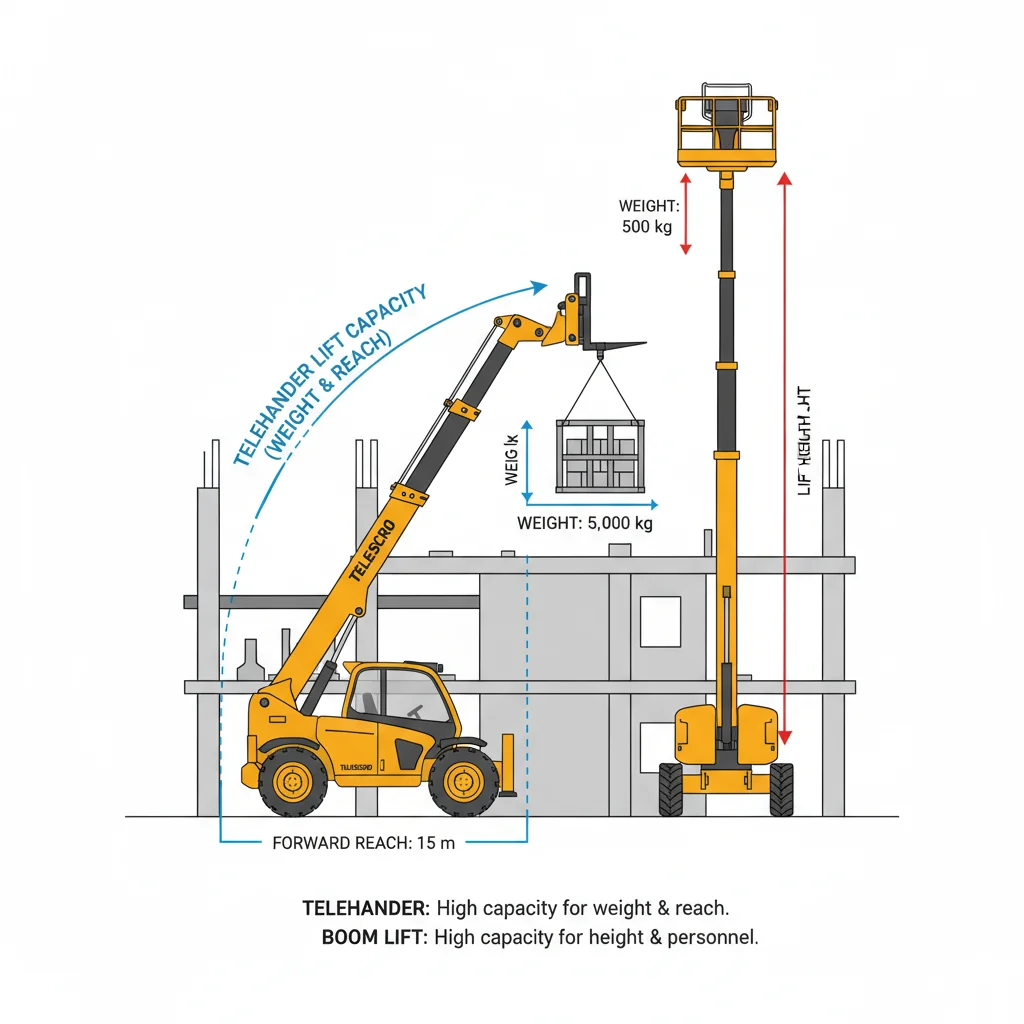
Here’s what matters most when you’re comparing telehandler and boom lift capacities: the purpose each machine is designed for is completely different. If you look at the tables and manuals, it’s easy to think they overlap, but from my experience onsite, that’s a shortcut to trouble—especially with safety.
Let’s break down the real jobsite differences. I recently worked with a steel contractor in Dubai. They needed to lift 1.8-ton bundles of rebar to the fourth floor—about 12 meters up. A boom lift could reach the height but was limited to a 250 kg platform load. That’s it—just enough for one worker and hand tools. The contractor switched to a telehandler, specifically a 4-ton model. Close to the machine, that telehandler handled full rebar bundles with ease. But as they boomed out, the load chart showed only 900 kg capacity at 12 meters. They had to split the bundles in half—not ideal, but safe and compliant.
Here’s a clear comparison to show how these machines stack up:
| نوع الماكينة | السعة النموذجية | Capacity at Max Reach | Designed To Lift | ميزات الثبات |
|---|---|---|---|---|
| أداة مناولة عن بُعد | 2.5–6 t near chassis | 700–1,200 kg (max reach) | Materials, bulk loads | Load chart, outriggers, frame |
| رافعة ذراع الرافعة | 200–450 kg (platform) | Same at all working heights | People, small tools | EN280/ANSI standards, sensors |
I always remind customers: check the load chart (for telehandlers) or platform rating (for boom lifts) before every lift. For people, choose a boom lift. For heavy materials, go telehandler—and know your safe limits.
Telehandlers generally have higher maximum lift capacities at lower elevations compared to boom lifts, which prioritize extended reach over load weightصحيح
Telehandlers are engineered to carry heavier loads closer to the ground using robust chassis and stabilization, whereas boom lifts are designed primarily to reach greater heights with lighter loads, making their capacities at height significantly lower. This design difference is crucial for selecting the right machine for heavy lifting tasks at elevation.
Boom lifts typically have higher overall lift capacities than telehandlers when operating at their maximum outreachخطأ
Boom lifts sacrifice maximum load capacity for extended reach and maneuverability; thus, their lift capacities at maximum outreach are usually much lower than telehandlers, which maintain stronger load ratings but with less horizontal reach. Assuming boom lifts can handle heavier loads at full extension can lead to unsafe operating conditions.
النقطة الأساسية: Telehandlers are built for heavy, variable loads—operators must consult load charts for safe use. Boom lifts are designed for people, not materials, and have strict platform limits. Select the right machine based on the job’s primary need to stay safe and compliant.
How Do Telehandler Attachments Compare to Boom Lifts?
Telehandlers excel in versatility, offering quick-coupler systems7 for a range of attachments like forks, buckets, and jibs, making them multi-taskers on job sites. Boom lifts, in contrast, are limited to platform accessories, focusing on safe and efficient work at height rather than material handling.
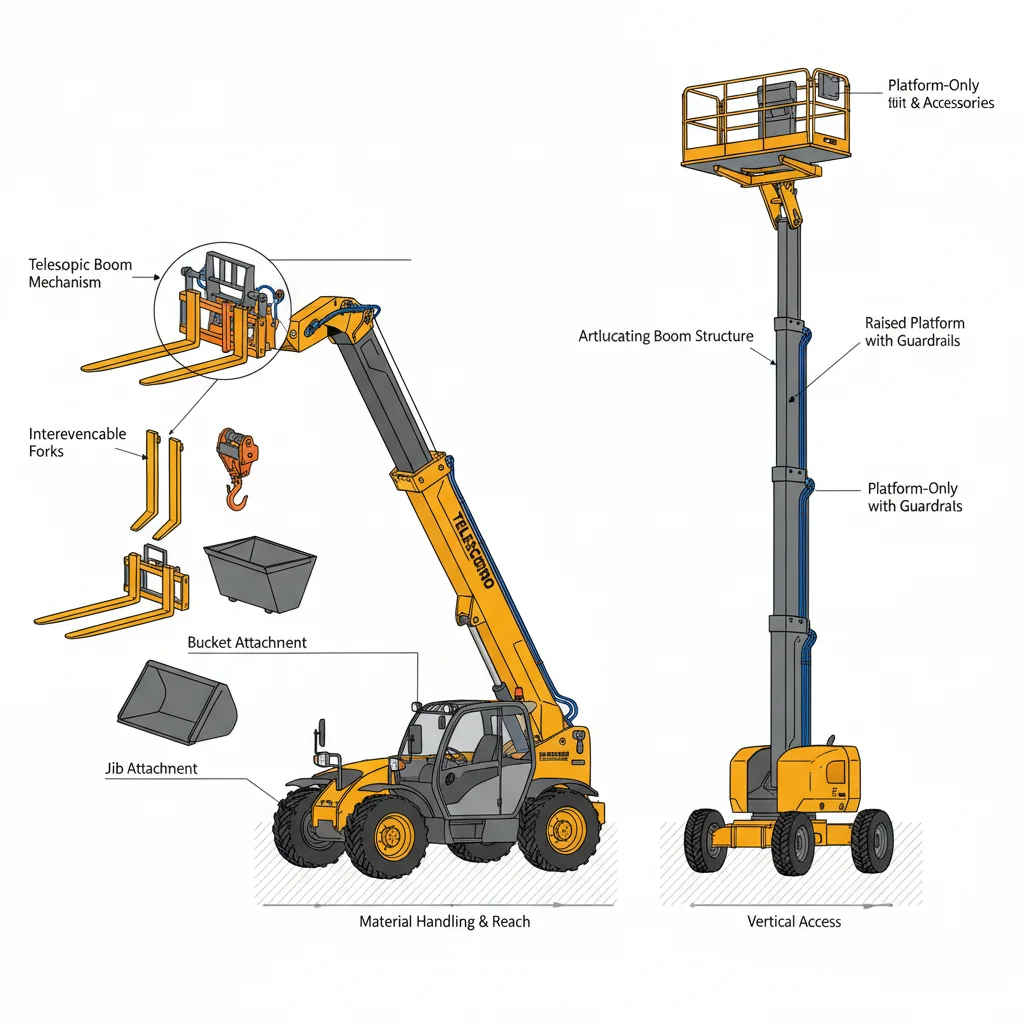
Last month, a contractor in Dubai asked if they could manage both material handling and light access jobs with one machine. That’s when the difference between telehandlers and boom lifts really stood out. On a typical site, a telehandler with quick-coupler lets you swap between pallet forks, a 1.2-cubic meter bucket, and even a 2-ton jib hook in under 20 minutes. I’ve seen a 4-ton, 17-meter telehandler unload steel mesh, shift gravel, and lift a team in a certified man basket—all before lunch.
Boom lifts, on the other hand, are focused on safe elevation. You get options like wider baskets, pipe racks, or glazier kits—but these don’t turn the machine into a material handler. Last year in Kazakhstan, a refinery site tried using a boom lift for pallet work and quickly realized its design is strictly for access. The max load platform on a typical 18-meter articulated boom is around 230 kg—enough for two workers with tools, but forget moving heavier gear.
Here’s a simple side-by-side table:
| الميزة | أداة مناولة عن بُعد | رافعة ذراع الرافعة |
|---|---|---|
| Attachment Variety | High (forks, buckets, jibs, hooks) | Low (platforms, tool trays) |
| مناولة المواد | Yes (2–5 tons typical) | No (230–340 kg platform max) |
| Personnel Lifting | Occasional (cert. basket) | Core function |
| Swap Time | <20 min (quick coupler) | غير متاح |
| Access Range | Multi-directional, mid-high reach | Vertical/lateral, high reach |
If you want maximum productivity and asset utilization, I suggest adding certified attachments and verifying your telehandler’s load chart for each task. For pure height work, stick with a boom lift—it’s the specialist.
A telehandler with a quick-coupler can switch between attachments like pallet forks, buckets, and jib hooks in under 20 minutes, enabling it to perform both material handling and light personnel lifting tasks efficiently on a single job siteصحيح
The quick-coupler system allows operators to rapidly interchange attachments without specialized tools, significantly reducing downtime and making telehandlers versatile enough to handle varied workloads including certified man basket lifts.
Boom lifts generally have interchangeable attachments like buckets, forks, and jib hooks, allowing them to perform heavy material handling tasks similarly to telehandlersخطأ
Boom lifts are primarily designed for aerial access and do not typically support heavy material handling attachments or high-capacity quick-couplers. Their structure and hydraulics are optimized for personnel lifting rather than carrying heavy loads.
النقطة الأساسية: Telehandlers stand out for their attachment versatility, enabling multiple material handling and light access tasks. Boom lifts, with their specialized platform options, provide efficient, safe elevation for repetitive height work. Weighing these differences is crucial for fleet managers and buyers aiming for maximum ROI and site productivity.
Which machine handles rough terrain best?
Telehandlers outperform boom lifts on rough, uneven ground thanks to large tires, high الارتفاع عن الأرض8, و الدفع الرباعي9. Boom lifts—especially slab models—are better for smooth surfaces, while rough-terrain booms offer moderate off-road ability but require careful slope and platform safety management.
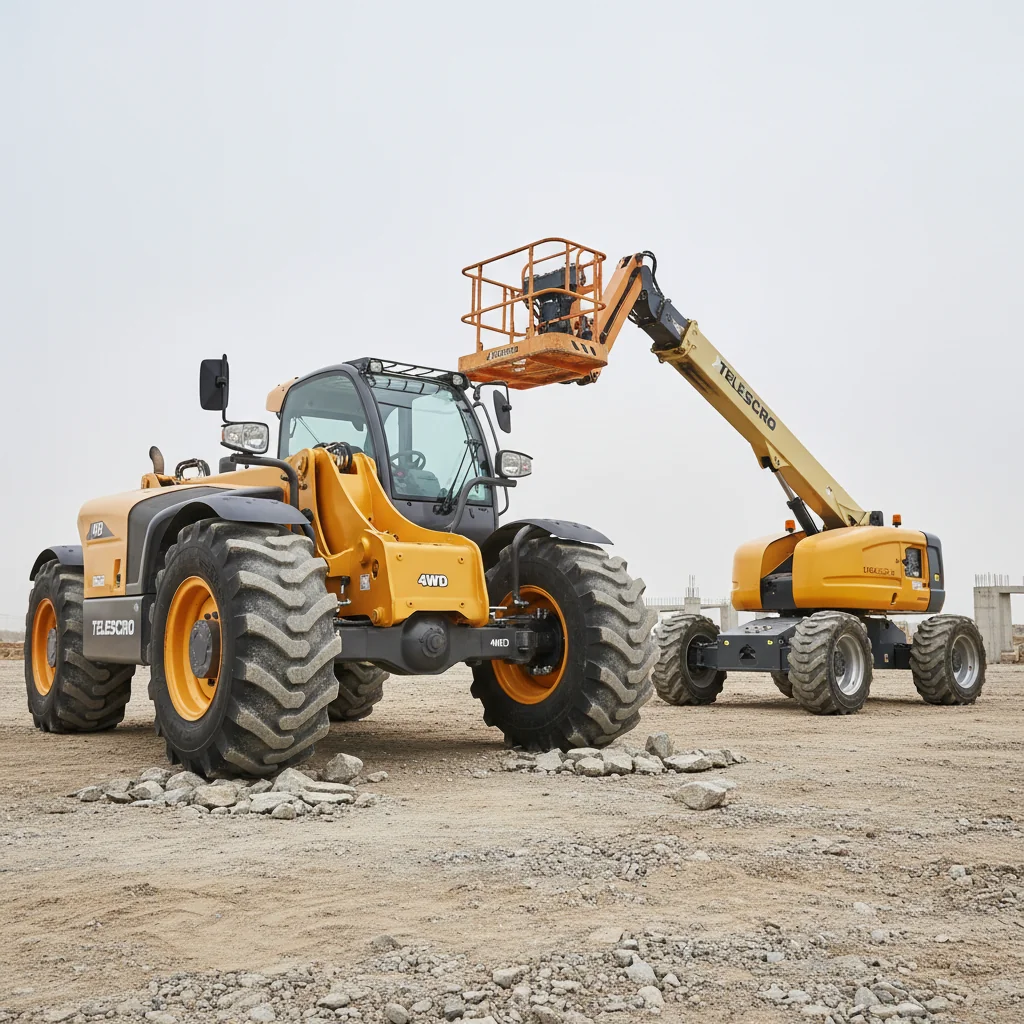
The biggest mistake I see is companies underestimating just how rough their ground will get when the weather turns. Last rainy season, a contractor in Kazakhstan struggled because their boom lifts, even the so-called rough-terrain models, were stuck for hours in deep mud. A 4-ton telehandler with big, aggressive tires tackled the same slope and ruts—no problem. That kind of ground clearance (around 410 mm) and true four-wheel steering make a huge difference. You can cross a jobsite with loads of bricks or rebar without needing temporary roadways or slab.
Here’s a quick comparison at a glance:
| نوع الماكينة | Best Terrain | السعة النموذجية | ماكس ريتش | نصف قطر الدوران | Extra Features |
|---|---|---|---|---|---|
| أداة مناولة عن بُعد | Muddy, uneven | 2,500–5,500 kg | 7–18 m | <4.5 m | 4WD, crab steer, high clearance |
| RT Boom Lift | Firm, semi-rough | 200–450 kg | 12–28 m | 4.5–5.5 m | Outriggers, slope sensors |
| Slab Boom Lift | Smooth, level | 200–350 kg | 8–20 m | <3.5 m | Non-marking tires, compact frame |
From my experience, if you need to move both people and materials over truly rough ground, telehandlers give you the best mobility and flexibility. On a housing site in Brazil, I saw a team save at least two days because their telehandler navigated saturated clay after heavy rain, while scissor and boom lifts stayed parked.
Telehandlers with around 410 mm ground clearance and true four-wheel steering outperform boom lifts in maintaining traction and stability on muddy and uneven slopesصحيح
Higher ground clearance prevents bottoming out in deep mud, and four-wheel steering improves maneuverability and load stability on rough terrain, characteristics often limited or less effective in boom lifts.
Boom lifts generally have greater ground clearance than telehandlers, allowing them to handle rough terrain more effectivelyخطأ
Boom lifts typically have lower ground clearance (usually under 300 mm) compared to telehandlers and rely more on outriggers for stability rather than off-road maneuverability, making them less capable on rough terrain despite their intended 'rough-terrain' designation.
النقطة الأساسية: For sites with muddy, rutted, or unfinished surfaces, telehandlers provide unmatched mobility and load capacity. Boom lifts are best for prepared slabs or moderately rough areas when you need safe elevation for people. Always match equipment capabilities to site conditions for maximum productivity and safety.
What Safety Training Do Telehandlers Require?
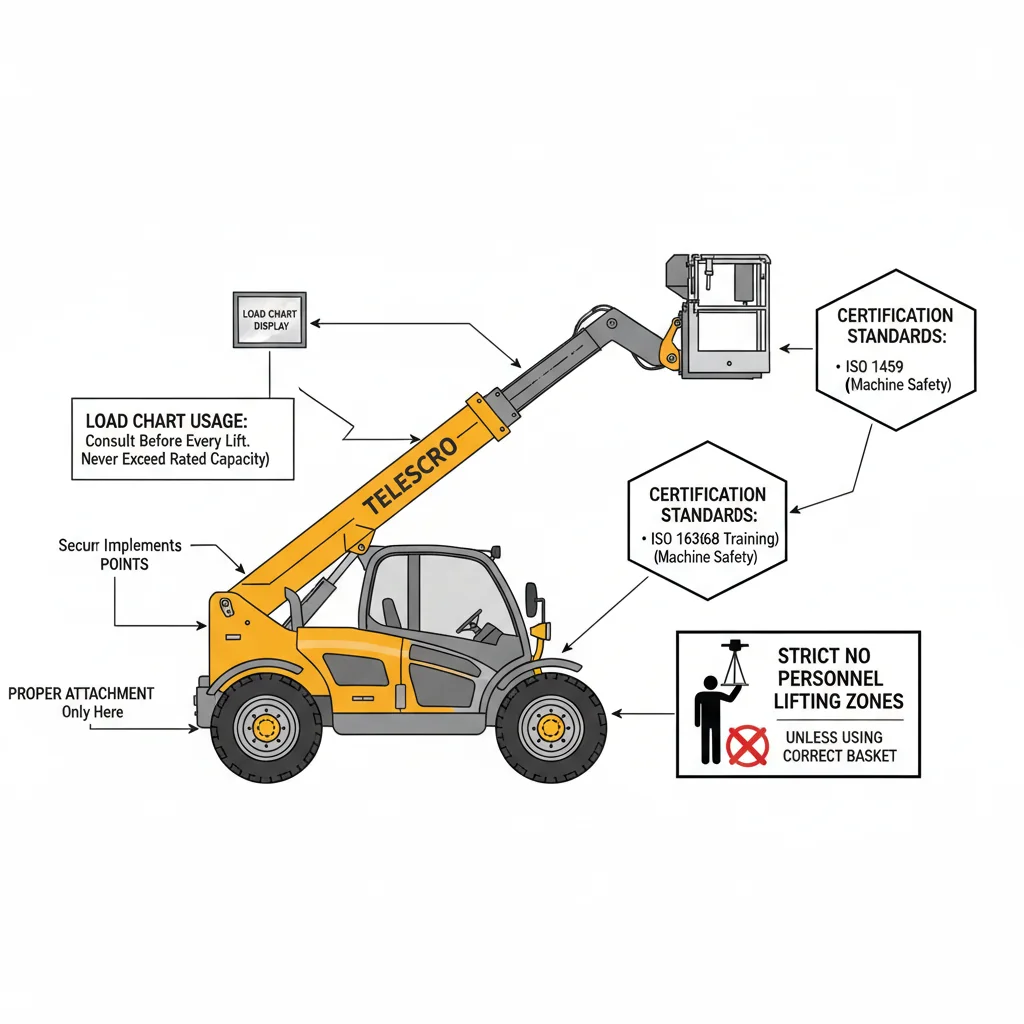
تتطلب الرافعات التلسكوبية operator certification10 under standards like ISO 16368, ISO 1459, and local lifting regulations. Training must cover load charts, proper attachments, and strict prohibition against lifting personnel unless manufacturer-approved baskets are used, following all personnel lifting protocols and emergency procedures as mandated by local regulations.
I’ve worked with customers who made the mistake of thinking a forklift license covers telehandler operation—that’s a risky shortcut. Telehandlers require dedicated training because their stability, lifting limits, and boom controls are completely different from forklifts or boom lifts. For example, a contractor in Kazakhstan once hired drivers with only basic forklift permits to use a 4-ton, 14-meter telehandler for steel erection. Within days, a load nearly tipped the machine after the operator misread the load chart. No one was hurt, but it stalled the project for a week and forced expensive retraining.
Proper telehandler certification usually follows standards like ISO 16368 and ISO 1459, plus whatever local rules your site authority sets. The certified training must address several things: how to read and follow the load chart (which shows safe working capacity at different boom lengths and angles), how to select and securely lock the right attachment, and mandatory pre-use inspections. I always emphasize to my clients that the hydraulic system—especially the moment indicator or tilt sensor—can mean the difference between safe lifting and a dangerous accident.
When lifting people, things get stricter. Using forks or an unapproved basket for personnel, as I’ve sadly seen on jobsites in Brazil and Kenya, is strongly prohibited. Only a basket specifically approved by the manufacturer—and clearly labeled as such—should ever be fitted, with safety latches and proper harness points. Operators must also know local escape and emergency-lowering procedures.
To be honest, investing in real training for every operator on each machine type saves time, avoids fines, and, most importantly, keeps your people safe. I suggest budgeting for certification and periodic refreshers—don’t rely on “experience only.”
Telehandler operators must be trained to understand load charts specific to their machine's boom extension and angle, as lifting capacity can decrease by up to 50% at full reach.صحيح
Unlike forklifts, telehandlers have variable lifting capacities depending on boom extension and angle, requiring operators to read and apply detailed load charts to prevent tipping or structural overload. This complexity makes dedicated training essential.
A forklift license automatically qualifies an operator to use any telehandler regardless of boom length or lifting capacity.خطأ
Forklift licenses cover equipment with fixed forks and limited reach; telehandlers feature extendable booms and different stability characteristics, so specific telehandler training and certification are required for safe operation.
النقطة الأساسية: Telehandlers and boom lifts have distinct safety standards and training requirements. Using either machine outside its designed purpose—like lifting people with telehandler forks—raises accident risk and violates regulations. Always ensure operators are formally trained on each equipment type, and follow manufacturer plus local rules for safe use.
How Do Telehandler and Boom Lift Costs Compare?
Telehandlers cost $60,000–$150,000+ but offer multipurpose use and strong resale value. Boom lifts are more affordable at $25,000–$90,000, but serve narrower tasks. Analyzing utilization, resale, and project needs is crucial before deciding to buy or rent for best ROI.
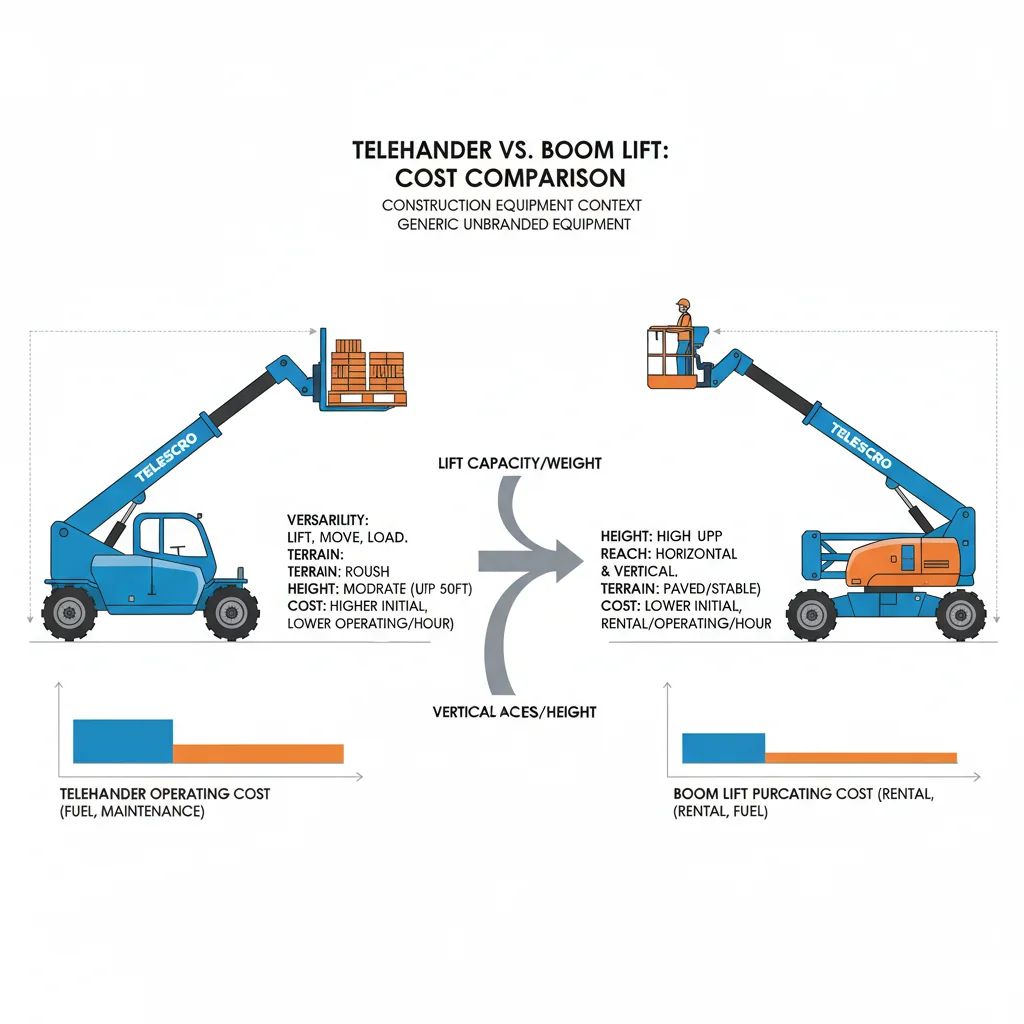
Most people focus on sticker price, but that’s only the starting point. I’ve seen contractors in Kazakhstan get surprised by how quickly the real investment adds up, especially once you factor in attachments and routine maintenance. Telehandlers usually cost more up front—often $60,000 to $150,000+ for a standard 3- to 4-ton, 9- to 13-meter model. But their ability to handle pallet forks, buckets, winches, or even man baskets means you can swap attachments and keep the machine busy year-round—moving blocks one week, unloading steel the next.
Boom lifts, on the other hand, are more specialized. Pricing ranges around $25,000 to $90,000 depending on platform height—typically 12 to 28 meters. I helped a fit-out company in Brazil last year that mostly did ceiling and lighting installs. For them, renting a 20-meter articulated boom lift made sense. Utilization was low, and electronics-heavy models don’t always offer the best resale—especially after a few years in humid conditions.
Here’s a direct comparison to break it down:
| المعدات | Price Range | Key Uses | الاستخدام | قيمة إعادة البيع |
|---|---|---|---|---|
| أداة مناولة عن بُعد | $60,000–$150,000+ | Loading, lifting, moving | High (multi-role) | Strong—if maintained |
| رافعة ذراع الرافعة | $25,000–$90,000 | Access at height only | Lower (specialty tasks) | Average to fair |
When deciding whether to buy or rent, always check expected use hours, project diversity, attachment costs, and resale trends. I usually advise customers with steady year-round workloads to invest in a well-spec’d telehandler. If your jobs are short-term or highly specialized, renting a boom lift usually protects your cash flow and keeps the fleet lean.
Telehandlers typically have higher upfront costs than boom lifts but offer greater versatility by supporting multiple attachments like pallet forks, buckets, and man baskets that extend their operational use over different phases of constructionصحيح
Because telehandlers can be fitted with diverse attachments, they serve multiple functions beyond lifting personnel, justifying their higher initial price through increased utility and reduced need for separate machines.
Boom lifts generally cost more upfront than telehandlers due to their complex telescoping booms and advanced safety featuresخطأ
While boom lifts have specialized functions and safety equipment, telehandlers typically have higher base prices because they combine lifting capacity with multifunctional attachments and heavier chassis, making boom lifts usually less expensive initially.
النقطة الأساسية: Factor in not just purchase price, but also equipment versatility, projected use hours, attachment costs, and resale value. Telehandlers typically justify higher upfront costs via broader utilization and strong resale; boom lifts are best rented for specialized, occasional needs, optimizing both cash flow and operational flexibility.
When Should Telehandlers and Boom Lifts Combine?
On medium-to-large job sites, using telehandlers for material staging11 و boom lifts for safe access12 at height optimizes workflow. Deploying both machines in sequence prevents misuse, reduces downtime, and boosts productivity—minimizing safety risks, delays, and costs compared to stretching one machine beyond its design.
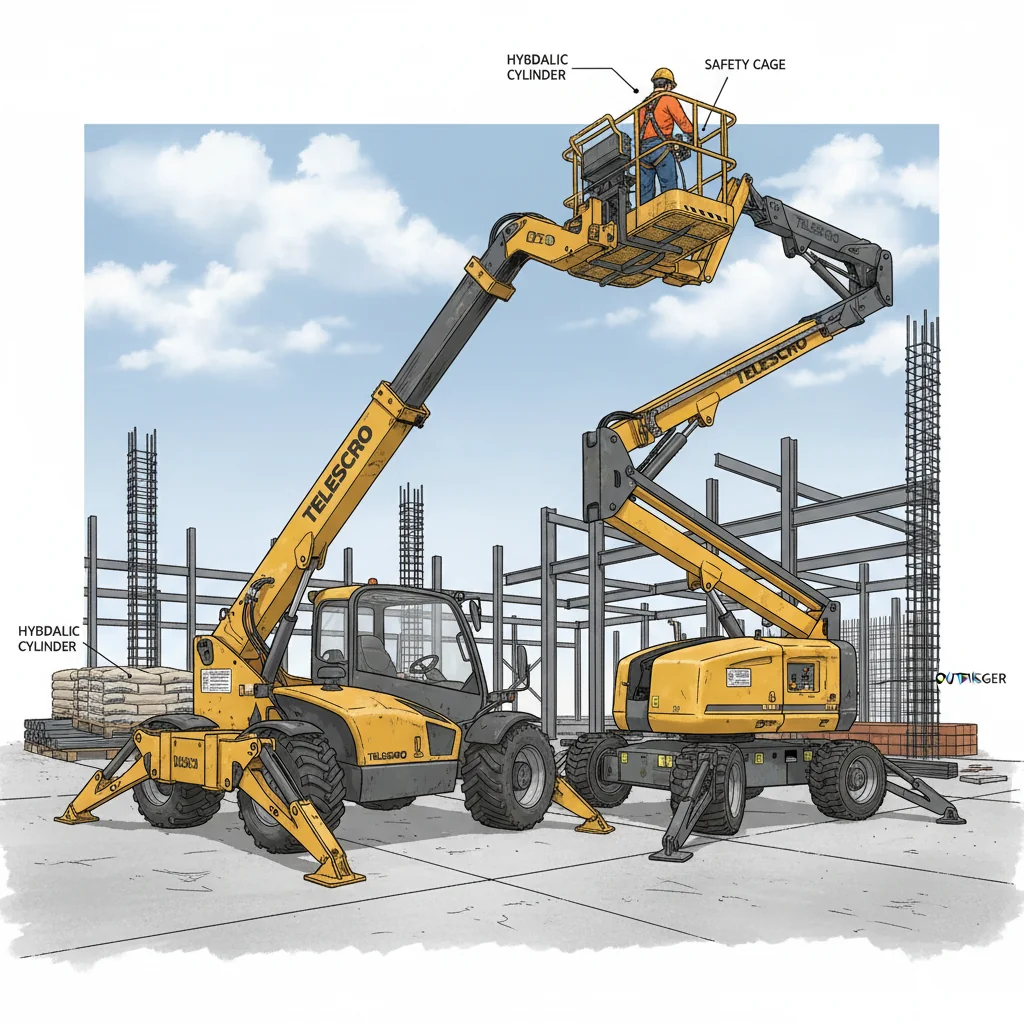
To be honest, I’ve seen too many sites try to stretch one machine into doing everything—and that’s usually where trouble starts. In Brazil last year, a project manager told me they needed to get HVAC units onto a fifth-floor roof and assumed their 4-ton telehandler with 17-meter reach could just “do it all.” They ended up using a work platform attachment on the telehandler for worker access, but the stability just wasn’t there. At full extension, the telehandler barely managed 800 kg, and the moment indicator kept warning of overload. The site lost at least a day after the telehandler’s hydraulic pump overheated from constant repositioning.
Let me share something important about sequencing equipment. Telehandlers are best for getting heavy loads—including palletized bricks, drywall, or ductwork—exactly where crews need them. On a big site in Kenya, the team used a compact telehandler with a turning radius under 4.5 meters to drop steel beams to each upper floor before anyone touched a boom lift. Only after materials were staged did the boom lift crew come in—working efficiently and safely from baskets up to 20 meters. That job finished two weeks ahead of deadline, mainly because there was no wasted time moving equipment back and forth.
When you break down site productivity, it rarely pays to shortcut with one machine. I always suggest checking the load chart at your real working height, then planning to pre-position all heavy materials before sending crews up in a boom lift. For complex projects, letting each machine do its job is what really saves time and money.
Telehandlers equipped with work platform attachments typically have a maximum safe load capacity of around 800 kg at full boom extension, making them less stable for personnel lifting compared to purpose-built boom liftsصحيح
Telehandlers are primarily designed for material handling, and when fitted with work platforms, their stability at full extension diminishes significantly, often limiting load capacity to around 800 kg or less, whereas boom lifts are engineered specifically for personnel safety and stability at height.
Boom lifts generally have higher load capacity at maximum reach than telehandlers because they use counterweight systems that telehandlers do not employخطأ
While boom lifts are designed for personnel access and safety, their load capacities at maximum reach are usually lower than telehandlers, which have heavy-duty counterweights for material handling; boom lifts prioritize safe platform capacity over heavy lifting.
النقطة الأساسية: For complex projects, pre-positioning materials with a telehandler before crews operate boom lifts maximizes efficiency and safety. Relying on both machines as intended protects workers, streamlines scheduling, and frequently proves more cost-effective than trying to force a single solution into dual roles.
Which Telehandler Type Suits Your Application?
Standard fixed-boom telehandlers excel at general lifting for construction or agriculture. Compact models fit tight sites or urban work, while آلات المناولة عن بُعد الدوارة13 (Roto) enable 360° load placement—ideal for crowded projects or crane replacement. Match capacity, reach, and maneuverability with your site’s demands.
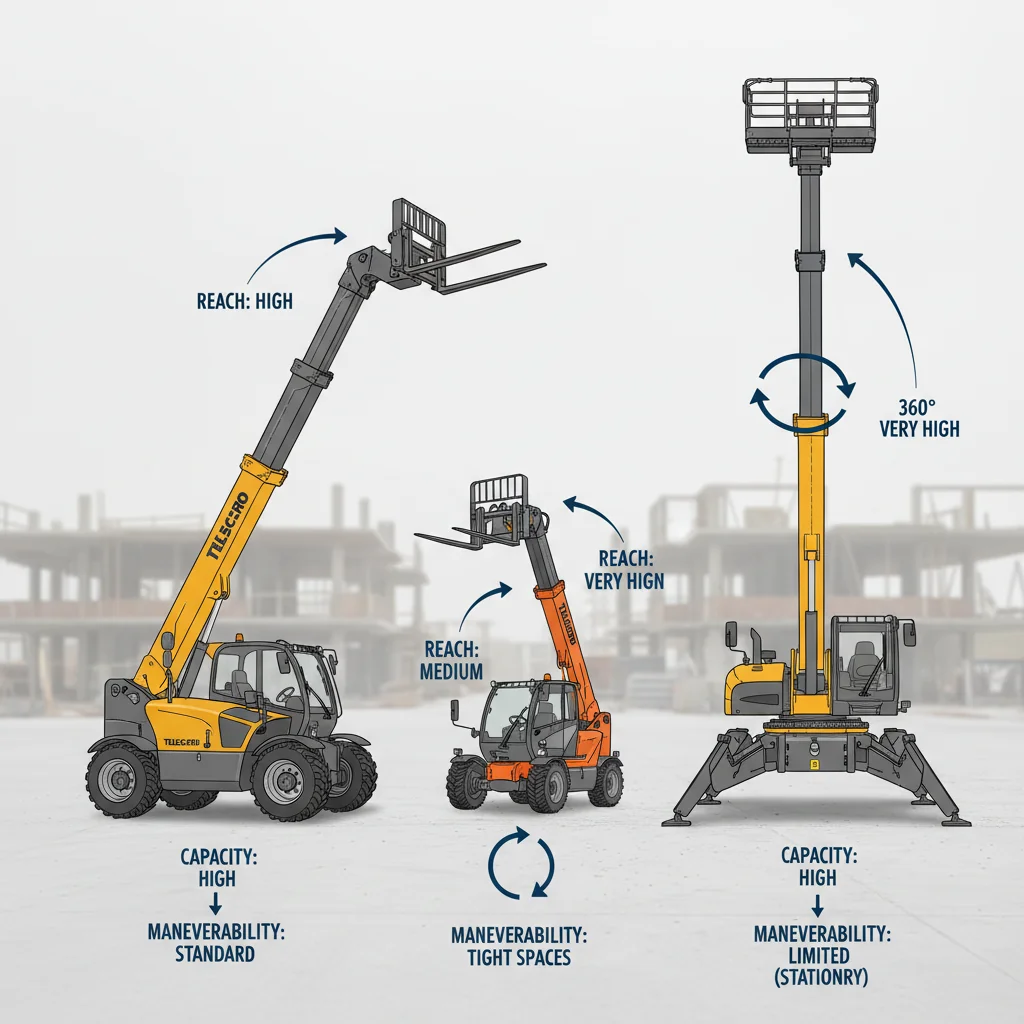
From my experience, buyers often underestimate how much the choice of telehandler type shapes a project’s efficiency. In Kazakhstan last year, a crew tried to use a standard 4,000 kg fixed-boom model in tight urban streets. Their main challenge? The turning radius was over 4.5 meters. Moving materials in those narrow alleyways cost them hours every week. They later switched to a compact 2,500 kg telehandler, reach around 9 meters, with a turning radius under 4 meters—suddenly, productivity jumped and traffic headaches faded.
Let’s break down the main types so you can match them to real-world demands:
| النوع | الأفضل لـ | الطاقة الاستيعابية | الوصول | نصف قطر الدوران |
|---|---|---|---|---|
| Standard Fixed-Boom | Open sites, general tasks | 3,000–5,000 kg | 10–18 m | 4–5.5 m |
| مدمجة | Urban, confined areas | 2,000–2,800 kg | 6-10 m | 3–4 m |
| Rotating (Roto) | Crowded jobs, crane duties | 3,000–5,500 kg | 14–32 m | ~5 m (with outriggers) |
I’ve seen rotating telehandlers make a big difference where space is limited or vertical lifting is complex. For example, in a Singapore jobsite, a Roto model (3,800 kg, 21 meters reach) handled glass panels on three building faces—all from a single setup. The 360° turret allowed precise placement without moving the chassis, and outriggers kept stability high. That flexibility isn’t just convenient; it also means less risk from awkward maneuvers.
When specifying your machine, balance rated capacity, practical lift height, and actual operating space. I suggest checking the load chart for each type—especially at extension—before you commit. For small city projects, compact telehandlers14 often pay for themselves just in saved time and easier logistics.
Compact telehandlers with a reach around 9 meters often have turning radii under 4 meters, making them significantly more maneuverable in confined urban spaces compared to standard fixed-boom models with turning radii over 4.5 metersصحيح
Smaller telehandlers are designed with tighter chassis and sometimes 4-wheel steering, reducing their turning radius substantially. This allows operators to work efficiently in narrow or restricted sites where larger models' wider turning circles cause delays.
Boom lifts are generally able to lift heavier loads than telehandlers due to their superior boom stability and hydraulic capacityخطأ
Telehandlers are typically engineered for heavier load capacities and greater versatility in load handling. Boom lifts prioritize extended vertical reach and access rather than heavy lifting capacity, so they often have lower maximum load limits compared to telehandlers.
النقطة الأساسية: Selecting the right telehandler configuration—standard, compact, or rotating—directly impacts site efficiency, safety, and productivity. Carefully balance required lifting capacity, reach, and available site space to ensure you get the most value and capability for your specific project or field application.
How Do Maintenance Needs Differ by Machine?
Telehandlers and boom lifts share hydraulic upkeep needs, but telehandlers require extra attention to boom sections and cylinders, while boom lifts must have their platform leveling and emergency descent systems tested regularly. Environmental limits—especially wind—restrict boom lifts more than telehandlers during outdoor operations.
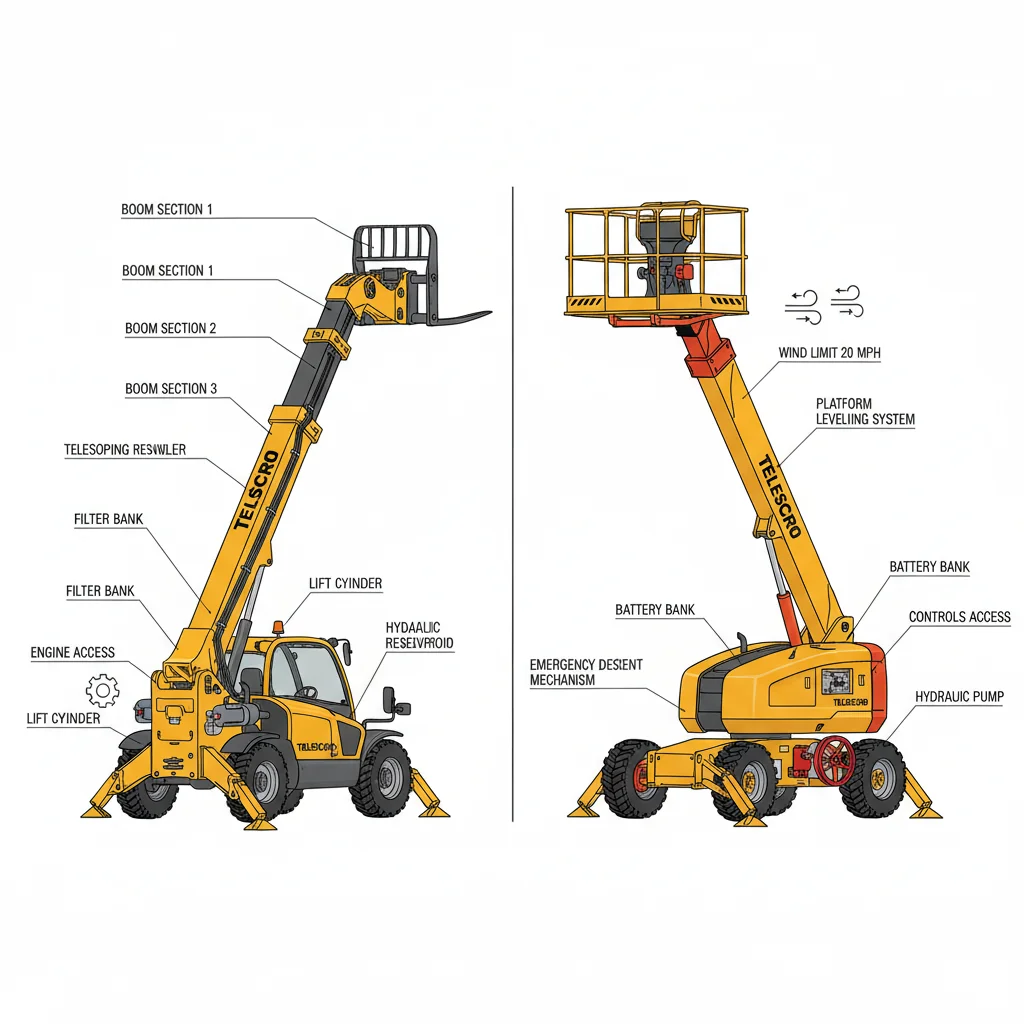
A lot of customers ask me, “Aren’t telehandlers and boom lifts almost the same to maintain?” They look similar at first, but in real jobsite conditions, the differences stack up fast. For example, last year in Kazakhstan, a contractor ran both a 3.5-ton telehandler (13-meter reach) and a 14-meter articulating boom lift on a precast yard. On paper, both rely on hydraulics—so yes, both need routine checks for hydraulic leaks, hose wear, and keeping filters clean. But I always remind teams that telehandlers, carrying heavy material loads along extended booms, are brutal on their telescoping sections and cylinders15. Dust jams up boom slides. Thick mud sticks on the undercarriage. We found deep grooves on sliding pads after just eight months of daily use. Grease these sections more often than the manual suggests, especially if you’re working in cement or brick dust.
On the boom lift, what really matters is the platform leveling system16—if it fails, the basket could tilt dangerously or refuse to auto-correct at height. In Singapore, a client had a platform interlock malfunction at 10 meters; they caught it early during a weekly check, which probably prevented a serious accident. Emergency descent functions need monthly tests too—no exceptions. Operators’ lives depend on these.
One crucial limitation? Wind. Most boom lifts are rated for max 12 m/s (about 43 km/h). On a harsh winter day in Poland, I saw all lifts grounded, but telehandlers continued moving pallets safely. Still, both machines hate heavy rain, ice, or extreme heat, so I suggest always scheduling maintenance in sheltered spots and keeping track of every downtime minute in harsh regions.
Telehandlers typically require more frequent inspection of their boom telescoping mechanisms compared to articulating boom lifts due to the higher mechanical stress from carrying heavier payloads at extended reach.صحيح
Telescopic booms on telehandlers endure substantial loads as they extend to lift heavy materials, necessitating regular checks for wear and lubrication, whereas articulating boom lifts distribute stress across multiple pivot points, reducing the frequency of telescoping mechanism maintenance.
Boom lifts generally require more engine oil changes per hour of operation than telehandlers because their hydraulic systems operate at higher pressures.خطأ
Engine oil change intervals are primarily determined by engine type and operating conditions, not hydraulic pressure. Boom lifts and telehandlers often use similar engines, so their oil change frequency is comparable and not directly linked to hydraulic system pressure.
النقطة الأساسية: Prioritize machine-specific maintenance—telehandlers need rigorous boom inspections, boom lifts require frequent safety system checks. Both are weather-sensitive, but boom lifts are particularly limited by wind exposure. Adhering to manufacturer schedules and choosing properly protected models boosts uptime and safety in tough field conditions.
الخاتمة
We’ve looked at how telehandlers and boom lifts suit different jobsite needs and why matching their strengths to your tasks matters. From my hands-on experience, it’s easy to get distracted by working height or price, but those don’t tell the whole story. The “3-meter blind spot” I see is buyers overlooking real performance at extended reach or how fast they can get spare parts when it counts. Before making your choice, check the load chart for your typical use and ask about local support. If you want help evaluating your options for your application, feel free to reach out—I’m happy to share what’s worked for real crews. Every site is different—choose what actually works for your workflow.
المراجع
-
Understand the critical role of load charts for telehandlers, ensuring safe lifting operations and avoiding overloading risks on construction sites. ↩
-
Explore detailed mechanics of hydraulic cylinder systems in telehandlers, essential for lifting heavy loads safely and efficiently. ↩
-
Explore the benefits and use cases of telehandlers for material handling compared to boom lifts, with real-world examples. ↩
-
Breaks down how to interpret load charts to maintain stability and safety, avoiding accidents and project delays. ↩
-
Explore detailed comparisons of load capacity in telehandlers, including safety considerations and load chart usage for optimal jobsite operations. ↩
-
Detailed insights on forward outreach explain how telehandlers safely lift loads beyond their chassis, crucial for complex construction tasks. ↩
-
Detailed insights on how quick-coupler systems enable fast attachment swaps, boosting telehandler efficiency on diverse job sites. ↩
-
Learn how high ground clearance enables telehandlers to navigate muddy, uneven sites without getting stuck or damaging loads. ↩
-
Explore how four-wheel drive enhances traction and stability in telehandlers for challenging off-road construction sites. ↩
-
Explains essential certification standards and why dedicated telehandler training prevents costly mistakes and ensures site safety. ↩
-
Explore how telehandlers optimize heavy load placement, improving workflow efficiency and safety on large construction projects. ↩
-
Understand the safety benefits and operational advantages of using boom lifts for worker access on medium-to-large construction sites. ↩
-
Discover expert insights on the benefits of rotating telehandlers, including 360° load placement and crane replacement advantages. ↩
-
Explore how compact telehandlers optimize maneuverability and efficiency in tight or urban work environments with limited space. ↩
-
Detailed insights on wear and tear issues in telehandler booms and how proper upkeep prevents costly failures in harsh jobsite conditions. ↩
-
Technical overview of platform leveling system functions and maintenance to avoid dangerous tilt and ensure safety during high-elevation use. ↩